Delaware C-Corp vs LLC Tax Treatment for NYC Seed Founders
Institutional investors need C-Corps; LLCs create tax and legal obstacles.

For NYC seed founders, Delaware C-Corp vs. LLC tax treatment comes down first to raising money, then to saving on tax. If institutional capital is part of the plan, a Delaware C-Corp is the practical starting point. An LLC can suit a profitable, owner-run business, but choosing one for a venture-backed startup can leave the founder repairing the foundation just as investors arrive.
Why the C-Corp vs. LLC question is really a fundraising question
Founders often choose an entity to save on tax, while investors ask whether they can invest in it at all. Those are different questions. The familiar warning about corporate “double taxation” assumes a profitable company that pays dividends to shareholders. A pre-revenue seed startup burning cash first has to find some revenue worth taxing.
For a C-Corp losing money, the loss stays inside the entity and can be carried forward. Without taxable profits and dividends, there is no double-tax problem. Yet the warning can steer founders toward an LLC before they have considered what a fund needs to buy. Institutional investors need preferred stock, and standardized preferred-stock financing belongs inside a C-Corp, so founders need to weigh both the tax return and how they plan to raise money.
Why institutional investors cannot hold LLC interests, regardless of preference
The constraint starts behind the venture fund, with its limited partners. Most VC funds get their money from tax-exempt institutions, such as pension funds, university endowments, and foundations. Those institutions can owe tax on Unrelated Business Taxable Income, or UBTI, even though they are tax-exempt. Excessive UBTI can also jeopardize that status. A promising startup does not make those obligations disappear.
An LLC passes income and losses through to its members, so operating income reaching a tax-exempt LP can create UBTI. That exposes the institution to a tax liability it was not meant to incur through its venture investment. A C-Corp acts as a tax blocker. Its operating income stays inside the corporation instead of passing through to investors, and their gains at exit are capital gains.
The paperwork creates a separate obstacle, even without UBTI. LLCs issue a Schedule K-1 to each member at year-end, and a fund with LPs across dozens of states faces multi-state filing obligations for itself and potentially its investors. That administrative burden can be enough to stop a deal. It is not something a founder can resolve by asking the partner to be flexible. The partner has investors, too, and none signed up for a surprise subscription to tax paperwork.
What preferred stock actually requires and why LLCs cannot provide it
Even if LP tax obligations disappeared, the standard deal would still need the right instruments. Preferred stock gives investors the first claim on money from an exit through liquidation preferences, before common shareholders get anything. Anti-dilution provisions protect investors in a down round by adjusting their ownership. These protections make the investment underwritable. An LLC has membership interests rather than corporate stock, and an operating agreement is not a credible substitute for the preferred-stock terms assumed by a standard venture financing.
The NVCA Model Legal Documents spell out that assumption for deals across the industry. The suite is based on Delaware corporate law, including the Voting Agreement, Investors’ Rights Agreement, and ROFR/Co-Sale Agreement. Its term sheet is for a Series A preferred-stock financing. This is the shared language of institutional deals. Choosing a different entity means departing from the legal framework investors expect before negotiations over valuation or rights even begin.
How QSBS raises the stakes of getting the structure right at day one
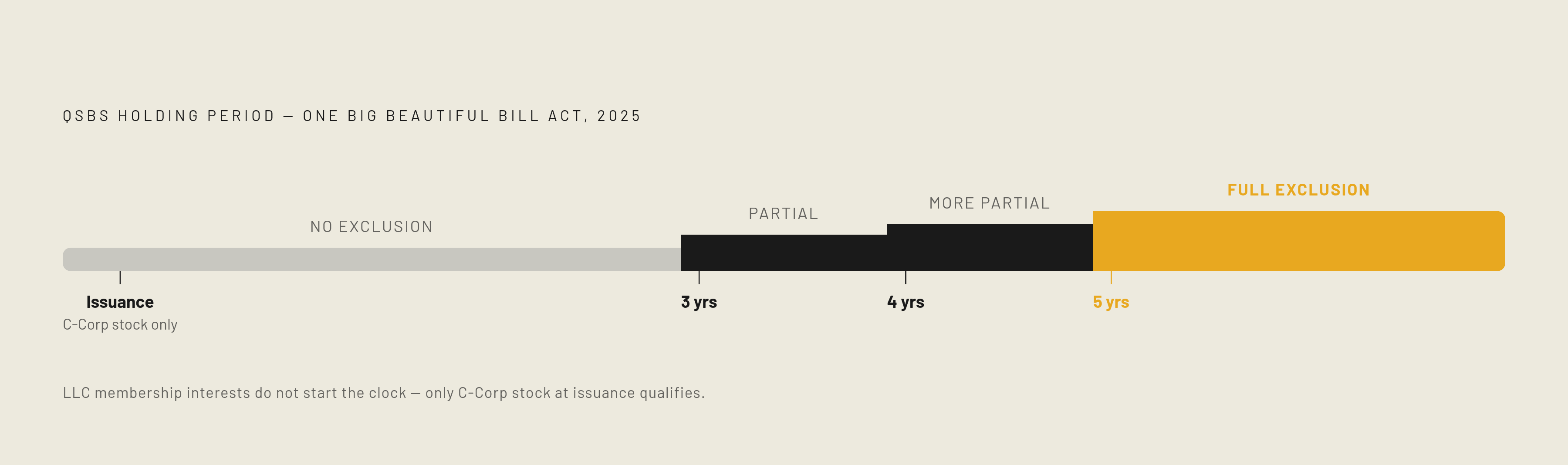
Qualified Small Business Stock, or QSBS, can give founders and early investors in qualifying C-Corps a federal tax exclusion on a large share of their exit gains. LLC interests do not start that stockholding clock.
The One Big Beautiful Bill Act, signed July 4, 2025, materially expanded the benefit for stock acquired after that date. The Act raised the per-taxpayer, per-issuer exclusion cap and the gross-assets threshold for eligible companies, with inflation indexing beginning in 2027. A larger exclusion can shelter more qualifying gains, while a higher asset threshold expands the room for companies to qualify. The drafting-error caveat around the inflation adjustment means that detail should not be treated as settled without qualification.
The Act also introduced earlier, partial access to the exclusion. Qualifying stock held for at least three years receives a partial exclusion, stock held for at least four years receives a higher partial exclusion, and stock held for at least five years receives the full exclusion available under the rules. Timing still governs the benefit. The holding period runs from stock issuance. Every month spent in an LLC before converting is a month that does not count toward that stockholding period.
Why converting from LLC to C-Corp mid-raise is so painful and what the narrow escape looks like
A founder has built something valuable inside an LLC, and the investor needs a C-Corp before proceeding. What looked like a future administrative task becomes a present condition of the raise. Meanwhile, the founder still has due diligence, investor conversations, and a business to run. The legal cleanup has chosen an impressively bad time to become urgent.
Conversion can also expose a founder to tax without producing cash to pay it. Where the conversion is taxable, the gain can reflect the fair market value of the C-Corp stock received minus the founder’s basis in the LLC. A small basis and a business that has grown in value can mean a large paper gain. No cash need change hands. That is the unpleasant distinction between becoming wealthier on a valuation spreadsheet and having money available for a personal tax bill.
A tax-free route is possible but narrowly available. It depends on meeting the required ownership-control conditions at conversion. Once outside investors have joined the LLC, maintaining the necessary supermajority can become difficult, making the early window important.
Even a conversion that avoids an immediate tax bill consumes time. Legal work, amended cap tables, and state filings compete with the raise for attention. Those tasks are not improved by an investor waiting on the other end. Founders need to resolve entity structure before outside capital arrives, rather than treat conversion as a box to tick after interest appears.
When an LLC is genuinely the right choice and what makes the boundary clear
An LLC is often the sensible choice for a capital-light business that earns revenue and has no intention of raising institutional venture capital. Pass-through losses can offset personal income in year one, and owners can use a flexible operating agreement to set their own terms. An LLC also avoids corporate board and annual-meeting formalities. For a profitable business distributing income to a small group of owners, avoiding the corporate tax layer directly serves the business model.
That works for many professional services firms, lifestyle businesses, and real estate vehicles. Their owners may intend to hold the business and distribute profits. That plan is just as sound as venture funding. It simply calls for a different structure. Applying that tax logic to a company with different plans for funding and ownership is a mistake.
Hiring adds another distinction for seed founders. LLCs cannot grant Incentive Stock Options, or ISOs, one of the main ways to pay early engineers with equity. They use profit interests instead, with complex tax treatment and less familiarity for prospective employees. In New York’s competitive hiring market, that can make the offer less attractive.
The practical test is whether institutional capital is a meaningful possibility in the next several years. If so, the small upfront cost difference favors starting as a C-Corp and preserving that option, rather than accepting a potentially expensive conversion later. Foreign founders with no US-sourced revenue at a very early stage may face a different initial calculation. But once they plan to seek institutional funding, they too need a C-Corp. The boundary is the intended financing path.
What formation in Delaware actually costs and the equity moves that matter at day one
For founders on the institutional-funding path, the practical next step is to form the Delaware C-Corp and handle founder equity at the start. The basic setup is accessible. Stripe Atlas charges $500 for a complete Delaware C-Corp formation, including a certificate of incorporation, EIN, founder equity, and 83(b) filing. Stripe’s legal document templates were created in collaboration with Cooley LLP, which is not affiliated with Atlas. Traditional startup attorneys tend to cost more, but choosing an entity at the start need not take a lot of legal work.
The ongoing Delaware tax calculation deserves attention at formation, too. Delaware has a low minimum annual franchise tax under the Authorized Shares Method, while the way shares are set up affects how much tax is due under the Assumed Par Value Method. Founders should use a very low par value per share and authorize shares at the seed-stage standard. Those choices help minimize tax under the latter method. A modest filing fee is not the whole cost picture, but neither is the recurring obligation a reason to postpone the right structure.
Founder stock creates a more urgent deadline. Founders receiving restricted stock subject to vesting should file an 83(b) election with the IRS within the strict window after receiving their shares. The election allows tax treatment based on the stock’s value at grant. Missing the deadline can mean ordinary income tax on a much higher value later. This task belongs on the day-one list, ahead of the folder labeled “after the raise.
A company incorporated in Delaware still needs to register in New York. A company whose founders live and operate in New York will need to register as a foreign corporation doing business there, with separate filing and ongoing requirements. The two states serve different roles in this setup. Delaware is the incorporation state of record, while New York remains the place where the business operates. Getting both pieces in place is part of formation.
How the NYC seed environment makes entity structure a community and momentum question, not just a legal one
In New York’s seed market, warm introductions can determine access to active funds, and the timing of those introductions is not always under a founder’s control. A peer the founder trusts may offer one before the legal cleanup is done. The founder then faces an awkward choice. Disclosing an unresolved structure problem can put the introduction at risk, while rushing a conversion creates the tax and legal pressure described earlier. Readiness has a relationship cost as well as a filing cost.
Small, trusted rooms make honest post-mortems possible, including the parts of a raise that went wrong. A weekly dinner with six founders who have navigated a seed round offers room for that conversation without the performance of a broad networking channel. An invite-only, in-person founder community built around candid conversation can make those lessons available before an investor is waiting. The useful introduction is not always to a fund. Sometimes it is to the founder who explains which mistake to avoid before the fund calls.