Term Sheet Clauses NYC Founders Misread at Seed Stage
Most NYC founders skip the clauses that quietly decide how much equity they actually own.

New York's seed market moves fast, prices high, and runs almost entirely on SAFEs. More than ninety percent of pre-seed financings in 2026 closed on a SAFE instead of priced stock, an instrument founders tend to treat as simple paperwork even though it carries stacking provisions that interact in ways most first-timers never bother to model. That speed is what causes founders to read only the valuation on the cover page and skip the terms that decide what actually happens to the money once it lands, since a term sheet has two halves. Founders in a hurry read the first half and skip the second, and the clauses that quietly decide how much of the company they still own by the next financing (option pool sizing, MFN provisions buried inside earlier instruments, pro rata rights with no expiration date) get a fraction of the scrutiny that the valuation number gets. Every section that follows is about one of those clauses, and every one of them costs more than a slightly lower valuation would have.
The option pool shuffle: how the pre-money number on the cover page overstates what you are getting
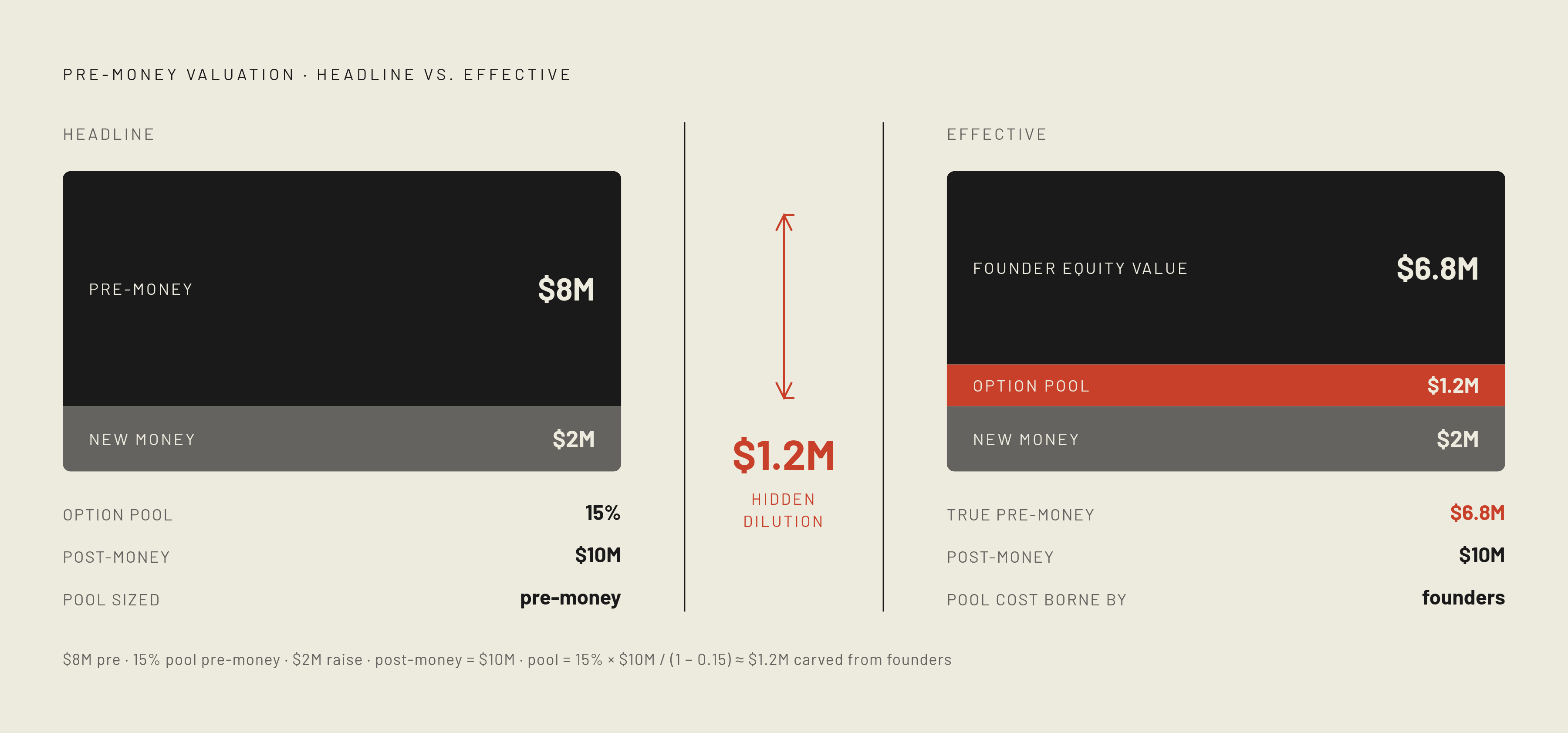
Buried inside the capitalization section of most term sheets is a single paragraph that moves more equity than any other line in the document, and founders skim past it fastest. A term sheet stating a pre-money valuation "subject to a fully diluted option pool of fifteen percent" is not actually offering that pre-money number.
Run the math on a typical deal. An eight-million-dollar pre-money valuation with a two-million-dollar raise and a fifteen percent option pool works out to a true pre-money value closer to six million eight hundred thousand dollars. That gap of one million two hundred thousand dollars appears nowhere on the cover page. Investors almost always want that pool sized into the pre-money rather than the post-money, so the dilution lands on founders, not on the new money coming in. The standard phrasing describes this as establishing an option pool representing a percentage of post-money capitalization, language that sounds neutral but functions as the exact mechanism that lowers the effective pre-money without ever calling itself that.
The fix starts with one question: is the pool pre-money or post-money, and how big does it actually need to be? Changing either answer can shift founder ownership by several percentage points even when the headline valuation stays untouched. Investors will say the pool needs to exist to hire for the next stage of growth, and that is a fair point on its own. Size that pool against a real hiring plan instead of a round number, and insist it comes out of the post-money.
MFN clauses in stacked SAFEs: how earlier instruments reprice themselves without a new negotiation
A most favored nation clause looks harmless sitting alone in a single SAFE. Stack several SAFEs closed months apart: that same clause lets every earlier MFN holder reprice their stake downward once the founder sends written notice and the investor elects the new terms within the window. The clause fires when a new instrument closes, with no new negotiation required.
Picture a company that signs an uncapped SAFE in January and then a ten-million-dollar capped SAFE in April. The January investor now holds that same ten-million-dollar cap the moment the April paper closes. A third investor who comes in later at an eight-million-dollar cap pulls every earlier holder down again, including the one from January who never saw that number coming. The effect compounds across every instrument already on file, so a founder who has closed three SAFEs over twelve months can end up handing the very first investor a valuation cap nobody negotiated and nobody saw coming at signing.
NYC's fundraising rhythm makes this worse than it would be elsewhere. Raising a first SAFE to reach a milestone, then reopening at a different cap for the next tranche, is the exact pattern that lets MFN clauses stack before anyone has modeled what the stack actually does. The fix is sequencing: before signing any new SAFE, map every existing instrument that carries an MFN clause and run the new cap through each one. The repricing happens automatically once the new instrument closes, so the only point where a founder has any leverage is before that signature, not after.
Pro rata rights granted without limits: how seed-stage generosity forecloses a Series A
Pro rata rights get handed out at seed more casually than almost any other term in the document, and they do the most damage at Series A. A pro rata right granted without a floor or an expiration date follows an investor into every round the company raises after that, for as long as the company keeps raising. Grant it to six different SAFE holders and a founder can find well over a million dollars of a five-million-dollar Series A already spoken for before a new lead even shows up.
One founder closed his seed round in November and signed pro rata letters with all six of his SAFE holders, a routine-feeling decision at the time. By May, his Series A process was underway, and the lead investor wanted a meaningful ownership stake in exchange for a five-million-dollar check, which is a standard ask for anyone leading a round. His six pro rata holders, combined, wanted a significant chunk of that same round just to hold onto their existing seed positions. There wasn't room for both claims. The round ended up smaller than his target and priced lower than the lead had originally proposed, because the cap table had already promised away the space a new lead needed.
The right itself isn't the mistake. Investors will point out, correctly, that pro rata is a standard and reasonable ask, and granting it to two or three investors whose checks and relationships justify that claim is a defensible call. Handing it out to every angel and every SAFE holder regardless of check size is the structural error. The fix is a floor: negotiate a minimum check size required to carry a pro rata right, so a two-thousand-dollar angel check can't claim allocation in a round that needs a lead to own a real stake to justify the diligence and reserves behind it.
Super pro rata rights: when a seed investor's follow-on claim crowds out your Series B lead
Super pro rata is a sharper version of the same problem. Standard pro rata lets an investor maintain their existing ownership percentage as new rounds come in. Super pro rata lets them grow it, and founders tend to sign it without much resistance because the number attached to it feels small at the time and a Series B feels like a hypothetical two or three years out.
It stops being hypothetical fast. By the time a multi-million-dollar Series B shows up, that growth right has turned into a real allocation claim, and it can sit directly in conflict with what a new institutional lead needs to do the deal. Series B leads typically need a meaningful ownership stake to justify the diligence time, the board seat, and the capital reserves a round like that requires. If a seed investor's super pro rata right eats into that allocation, the lead either can't hit their target ownership or has to expand the round to get there, which dilutes everyone else on the cap table to make room.
The clearest move here is refusal. A seed investor asking to grow their stake at Series B is asking for a right that comes directly at the expense of the lead a founder will need two years later, and that trade almost never pencils out at the moment of signing. Super pro rata belongs in the same category as tranched investments, multiple liquidation preferences, and ratchet provisions: non-standard terms that a well-structured seed deal simply doesn't include.
Participating preferred and liquidation multiples above 1×: the exit economics clause most founders skip
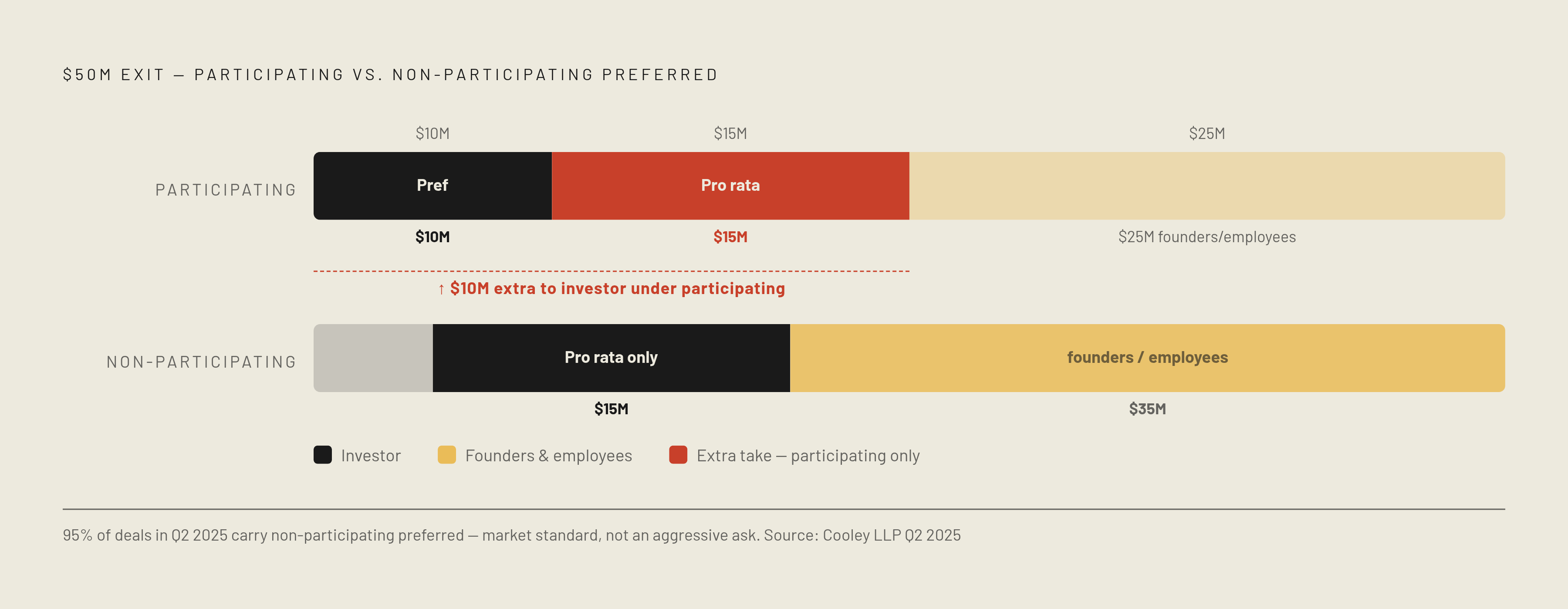
Participating preferred lets an investor collect twice from the same exit, once through their liquidation preference and again alongside common stockholders on what's left. That structure is fundamentally different from the 1× non-participating standard most founders assume applies to every deal by default.
Run the numbers on a fifty-million-dollar exit with a ten-million-dollar participating preference. The investor takes the ten million off the top first, then takes their ownership percentage of the remaining forty million on top of that. That's millions more than the same investor would collect under a non-participating structure, and every dollar of it comes directly out of what founders and employees take home. Liquidation multiples above 1× cause a related but separate problem: a higher multiple means the investor gets a multiple of their original check back before anyone else sees a dollar, so on a modest exit the founders and the team can walk away with nothing while the investor multiplies their return.
A Cooley LLP report on Q2 2025 venture financings found that 98% of deals carried a 1x liquidation preference, and 95% carried nonparticipating preferred stock. A founder asking for 1x non-participating terms isn't making an aggressive ask; they're asking for what the overwhelming majority of the market already does, which gives them leverage. Start there. If an investor insists on participation anyway, ask for a cap that bounds the double-dip. And treat any multiple above 1x as a signal about how that investor is going to behave in every negotiation that follows, not just as one line item to trade away.
Broad protective provisions and board control: the governance terms that compound at every future round
Economics are only half the picture. Protective provisions, the list of company actions that require investor sign-off, aren't unusual on their own. The trouble starts when that list is broad enough to cover day-to-day operating decisions and gets paired with a board the founders don't control from the earliest stage, because that combination hands away the ability to actually run the company.
A standard protective-provisions list covers things like a sale of the company, a change in board composition, new debt above an agreed threshold, and charter amendments that would harm a preferred stockholder. Any language that extends investor consent rights into ordinary operating decisions needs a line-by-line read. A mistake that shows up constantly in the protective-provisions list is a board seat granted at seed with no sunset or reversion clause attached to it. The fix is straightforward: tie that board seat to the round it was granted in, with automatic reversion language written into the seed documents before anyone signs.
These governance terms don't sit in isolation from the economic ones covered above. Protective provisions combined with option-pool carve-outs can shift exit proceeds by millions and shift ownership by several percentage points, because governance and economics interact. Reading them one at a time understates what each one actually costs. The fix at seed is to keep the protective-provisions list limited to major corporate actions, keep the board under founder control (commonly two founders and one investor), and attach sunset language to any board seat an investor is granted.
Generalist legal counsel as the structural condition that lets these clauses land
These clauses appear across different funds, different sectors, and different deal sizes, a pattern that isn't about careless founders. It comes down to who is reading the document on the founder's behalf before it gets signed.
A generalist startup lawyer handles incorporation, equity grants, and customer contracts competently, and that's genuinely useful work. A specialist VC-side firm reads roughly forty term sheets a week. CUT
A few thousand dollars spent on specialist legal counsel at the term sheet stage can save seven figures at exit, which makes this one of the worst places to try to cut costs in the entire fundraising process. Founders don't need to out-negotiate a fund's partners directly. They need to know which clauses to flag, and they need someone in their corner who has seen the same playbook dozens of times and strips the aggressive terms before the founder ever sits down at the table. In a market that runs on warm introductions, the most reliable way to find that kind of lawyer is through a founder who has already closed a priced round with a specialist firm, rather than through a generic referral or a cold search.
What pushing back looks like, clause by clause
Understanding what a clause costs is different from knowing how to counter it, and a founder who can explain the mechanics but doesn't have a specific ask in hand still walks into the negotiation at a disadvantage. On the option pool, the question to ask before touching any other number is whether the pool sits pre-money or post-money, and the size of that pool should get negotiated against a real hiring plan rather than accepted as a round figure, since valuation and pool size are never actually separate conversations. On MFN clauses, the job is to map every existing SAFE that carries one before signing anything new and run the incoming cap through each of them, because the repricing fires automatically the moment the new instrument closes and that is the only point where there's any room to manage it. On pro rata, the right move is granting it deliberately to a small number of high-value investors rather than handing it to every SAFE holder by default, and attaching a minimum check-size floor so small angels can't claim allocation at Series A, since a pro rata right with no expiration date follows an investor into every round the company raises afterward. On super pro rata, the clean answer is refusing it outright at seed, the same way a well-structured deal excludes tranched investments, multiple liquidation preferences, and ratchet provisions as a matter of course. On participating preferred and liquidation multiples, the opening position is 1x non-participating; if an investor pushes for participation anyway, the counter is a cap that bounds the double-dip, anything above 1x is a signal about that investor's posture rather than just one term among many, and cumulative dividends and redemption rights are refused at seed. On protective provisions and board control, the ask is a tight list limited to major corporate actions, a board structure founders actually control at seed, and sunset or reversion language on any board seat granted at this stage, since a board seat with no reversion clause is a structural mistake that only gets fixed by negotiating that language before signing. None of this needs to happen under pressure, either: a term sheet is usually not legally binding except for its exclusivity, no-shop, and expense provisions, so receiving one is the start of a negotiation, not the end of it, and the founders who treat it as final are the ones who spend years trying to undo what they signed.