Legal Entity Choice for NYC Startups Before Raising
Pick your entity before pitching investors, because the wrong choice forecloses funding.

The entity a founder files on day one decides, quietly and in advance, which funding doors stay open and which ones shut before a single pitch gets made. Most founders treat entity choice like picking a bank or a business insurance plan: a box to check, a fee to pay, a thing you get through so you can start building. That framing is backwards. The entity you pick determines who is legally allowed to invest in your company, what kind of stock you can offer them, what tax benefits you and your future investors can claim, and how expensive it gets to undo a bad call later. Institutional investors and venture capital firms show a strong, consistent preference for Delaware or New York C Corporations, and that preference isn't about taste or habit. It comes from the mechanics: standardized share classes, preferred stock structures, and option pools that only certain entities can offer. Get the entity wrong, and the fix doesn't happen quietly in a lawyer's office somewhere down the line, it happens in the middle of a term sheet negotiation, on the investor's timeline, at the investor's expense estimate, and usually at the worst possible moment to be spending money on legal cleanup.
What Each Entity Offers
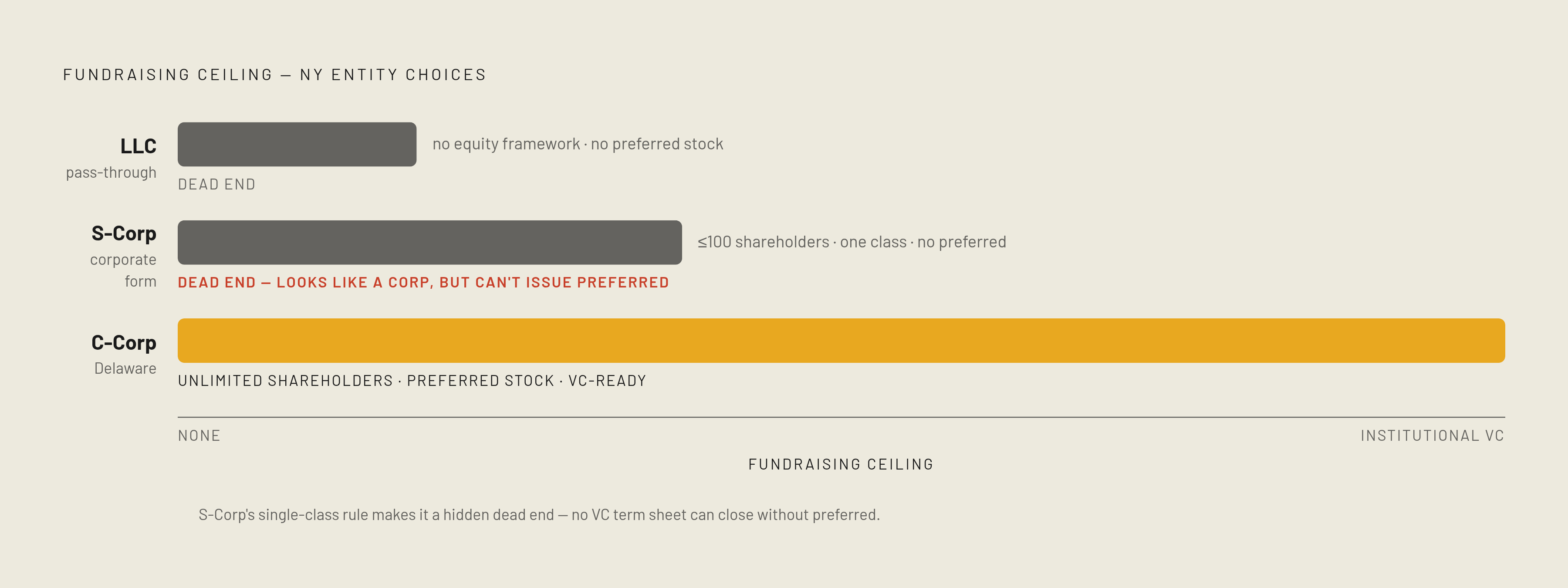
New York founders realistically choose between three structures: the LLC, the C-Corp, and the S-Corp. These aren't three flavors of the same thing at different price points. Each one has a hard ceiling, and that ceiling decides whether institutional money is even on the table.
The LLC gives founders pass-through taxation, liability protection, and a lot of operational flexibility with few formalities attached. For a bootstrapped business or one generating revenue with no plan to raise institutional capital, that's genuinely a good home. The trouble starts when an LLC tries to act like a venture-backed startup. Most VCs won't invest in an LLC, because the structure can't issue preferred stock, which is a corporate instrument that doesn't exist in LLC law. An LLC can get close with something called preferred membership interests, which approximate similar economic rights, but that's not the instrument venture funds are built to use. Equity incentives run into the same wall: option pools, founder vesting schedules, and structured dilution all depend on corporate equity frameworks that LLCs don't reliably support.
The C-Corp is built for exactly this. It allows unlimited shareholders, multiple classes of stock including preferred, and it exists perpetually regardless of who comes and goes. Yes, C-Corps face double taxation: corporate income gets taxed once at the entity level and again when dividends go out. But for an early-stage company plowing every dollar back into growth instead of paying dividends, that's a theoretical cost. What matters is that the C-Corp supports the standardized capital structure, multiple stock classes and all, that institutional venture capital requires as a condition of writing a check.
The S-Corp sits in a strange spot: it's a corporation on paper, but its restrictions make it close to useless for a venture-track company. No more than 100 shareholders. Every one of them has to be a U.S. citizen or resident. Only one class of stock, period. Each of those rules is a direct constraint on fundraising. An S-Corp can't take money from foreign investors, can't take money from venture funds with international limited partners, and can't issue the preferred stock that any real term sheet is going to ask for. For a company planning to raise institutional capital, the S-Corp is a dead end that happens to look like a corporation.
Delaware as the Default State of Incorporation for NYC Companies
If the C-Corp is the right vehicle, the next question is which state. For venture-track companies, the answer is almost always Delaware, even when the company is based entirely in New York and has no plans to leave. That's not tradition for tradition's sake. Investors and venture firms prefer Delaware C Corporations because the legal framework there is standardized, the case law is deep, and the governance mechanics behave the same way deal after deal, year after year.
That predictability has a specific payoff. When a dispute comes up over board authority, stockholder rights, or a merger, Delaware's Court of Chancery has almost certainly already ruled on a nearly identical situation. That means less legal guesswork for everyone sitting at the table, founders and investors alike. It also means the paperwork investors already know how to read. Term sheets, SAFEs, standard preferred stock terms, all of it gets written assuming a Delaware C-Corp sits on the other side of the table. Incorporate somewhere else, and that paperwork has to be custom-drafted or bent into a shape it wasn't built for.
Accelerators have baked this expectation in further. Several major accelerator programs effectively require Delaware C-Corp status before they'll close an investment. A company that incorporated elsewhere has to convert as a condition of getting the money. Major accelerator programs will still accept and evaluate applications from companies that haven't yet converted. Delaware just tends to be where things land by the time money actually moves.
None of this means a New York C-Corp is off the table. For founders not chasing institutional capital, it's a reasonable, simpler choice. But for a company built to raise, Delaware is the practical default, and the one real cost of picking it while operating out of New York is having to register as a foreign corporation here too. That's an added filing, but it's routine, and any startup attorney in the city handles it without blinking.
New York's specific compliance requirements that catch founders off guard
Operating a business physically in New York brings its own set of compliance obligations, separate from anything Delaware asks of you, and founders who learned startup formation from other states' playbooks routinely miss them.
The one that trips people up most is the LLC publication requirement. New York requires LLC founders to publish notice of formation in two county-designated newspapers, one daily and one weekly, for six straight weeks. After that, a Certificate of Publication, along with affidavits of publication from both papers, has to be filed with the New York Department of State. Skip this step, and the state can suspend the LLC's ability to do business. This isn't a deadline you can quietly let slide. Costs vary a lot by county, and in Manhattan specifically, this single publication step can cost more than every other formation fee put together. This requirement only applies to LLCs, not corporations, which is one more reason the C-Corp path sidesteps a New York-specific headache.
For companies that incorporate in Delaware but operate in New York, there's a parallel step: filing an Application for Authority with the New York Department of State and paying the applicable fee to register as a foreign corporation. That's the price of the Delaware default, covering an extra filing, an extra fee, and ongoing compliance obligations in two states. Manageable, but not free.
New York also requires LLCs to adopt a written Operating Agreement within 90 days of formation. Corporations face a parallel requirement, adopting bylaws at their first organizational meeting, though that process tends to have more established templates to work from. And the fees don't stop once the paperwork is filed. Corporations owe New York State franchise taxes, calculated as whichever is highest among a business income rate, a capital base rate, or a fixed dollar minimum tied to New York receipts. LLCs owe an annual filing fee based on income brackets instead. Either way, the compliance bill doesn't end at formation. It's the ongoing cost of operating formally in this state.
The tax benefits that disappear if you delay or choose the wrong entity
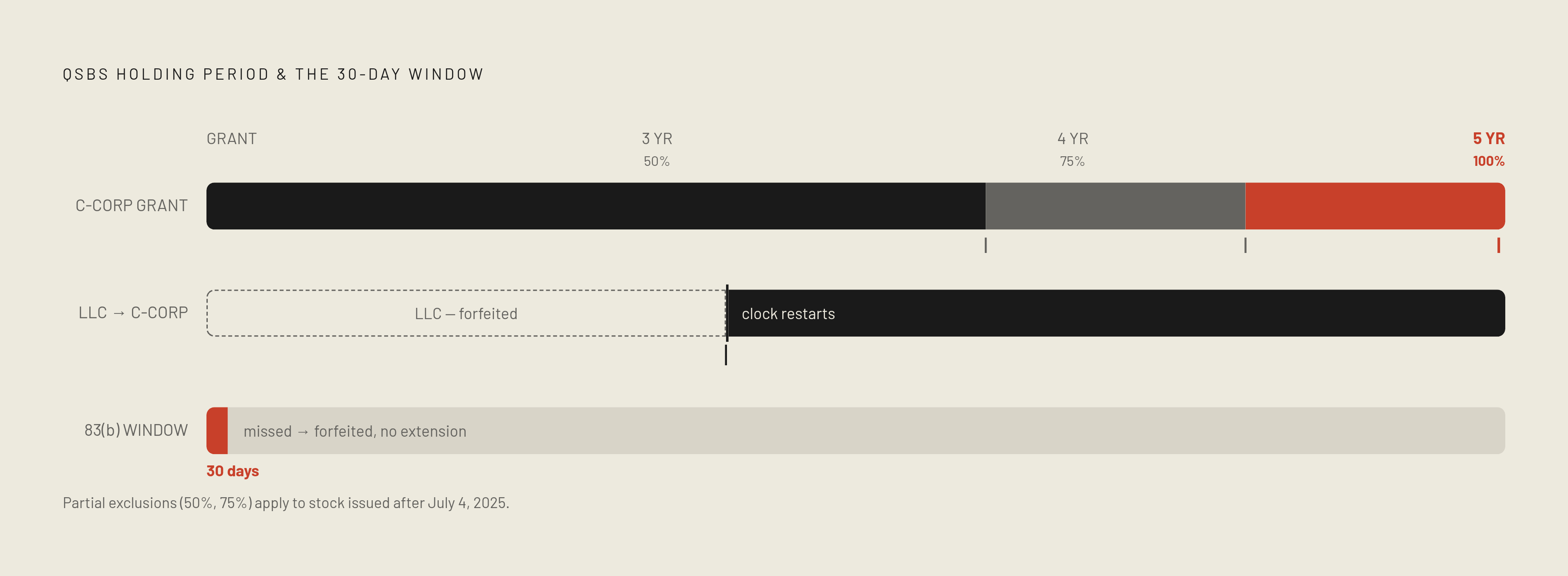
The single most expensive reason to get the Delaware C-Corp decision right at formation is a federal tax benefit, and its clock starts ticking the day shares get issued, whether you're paying attention to it or not.
That benefit is Qualified Small Business Stock treatment under the tax code, and it lets founders, employees, and investors in qualifying C-Corps exclude a substantial chunk of capital gains when they eventually sell their stock. Only C-corporation stock qualifies. LLC membership interests don't count, full stop. The holding period begins the day after shares are issued, five years for the full exclusion, with partial exclusions available at three and four years for stock issued after July 4, 2025. A founder who starts as an LLC and converts to a C-Corp later doesn't get to count the years spent building the company as an LLC. The clock starts over at conversion.
That means every month spent operating as an LLC before converting is a month subtracted from the QSBS holding period, and there's no way to get that time back once it's gone. Delay has a real cost here, measured in years founders can't recover.
The 83(b) election makes the stakes even sharper. Filing an 83(b) election within 30 days of a stock grant locks in the QSBS holding period starting from the grant date, and it locks in ordinary income tax at the company's current valuation, which for an early-stage company is usually close to zero. Skip that filing, and later vesting events get taxed as ordinary income at whatever the company's valuation has grown to by then, which could be a far bigger tax bill for the exact same shares. The 30-day window for this election is absolute. There's no late filing, no extension, and no way to recover the benefit after the fact. The IRS has released a dedicated form to standardize how this election gets filed, it's now the only permitted format for electronic submission and an optional standardized option for filing by mail, with the IRS treating online submission as the preferred method.
The decisions that must happen at formation, not after the term sheet arrives
Picking the right entity gets a founder through the front door. It doesn't finish the job. Investors look past the entity type to the equity structure behind it, the vesting schedules attached to founder shares, and whether the company's intellectual property actually belongs to the company. Problems in any of those areas are far more expensive to fix once a deal is already in motion than they would have been to set up correctly at the start.
Founder vesting is where this problem first appears. Issue founder shares at incorporation with no vesting schedule attached, and a co-founder who leaves after six months keeps their entire stake forever, regardless of how little they ended up contributing. Institutional investors treat that as a dealbreaker. The standard structure is four years of vesting with a one-year cliff: no shares vest until the founder completes a full year of service, and the remaining shares vest monthly over the following three years. Setting this up correctly at formation costs almost nothing. Unwinding an unvested co-founder's equity after the fact is expensive, slow, and tends to damage the relationship permanently.
IP assignment matters just as much. Every founder and early employee who contributes to the product needs to formally assign that work to the company at formation, not later, and not with a handshake. IP that technically still lives outside the company, in a founder's personal name, tangled up in a prior employer's work-for-hire agreement, or sitting in a freelancer's portfolio, creates exactly the kind of due diligence problem that can delay or kill a round.
Equity incentive structure rounds out the list. Option pools, strike prices, and vesting terms all assume a corporate equity framework that only entities like the C-Corp reliably provide. A stock option plan set up early gives a company a real tool for hiring and retaining talent without burning cash it doesn't have, and that tool depends on the corporate infrastructure supporting it already being in place. Investors reviewing a cap table are looking for proof that the founders understood what they were building before anyone else told them to.
When the LLC is the right answer
None of this means every company in New York should be a Delaware C-Corp by default. The C-Corp path is right for founders planning to raise institutional capital. For founders building a genuinely profitable, owner-operated business with no venture raise on the horizon, the LLC is often the better fit, and reaching for a C-Corp out of habit rather than intention just adds cost without adding anything useful.
Founders pick an LLC over a C-Corp specifically because they don't need venture funding and want to avoid double taxation along with the heavier corporate compliance load. For a revenue-first business, that reasoning holds up fine. A C-Corp costs more every year in compliance than an LLC does, and that extra cost earns its keep when fundraising is actually the plan. When it isn't, it's just money spent for no return.
The real risk is founders who drift into the LLC path while telling themselves the raise is coming eventually, operating as an LLC "for now" and discovering months or years later that converting costs real time, real legal fees, and QSBS holding-period years that can't be recovered, right at the moment the company can least afford any of it.
The test is simple. If you can honestly say you're building for profitability and long-term ownership rather than an exit and institutional backing, the LLC earns its place. If you're building to raise, the C-Corp decision needs to happen before the first line of code gets written, not after the first investor meeting goes well.
Getting This Right as a New York Founder
New York's startup scene runs on relationships more than it runs on cold outreach. Funding conversations happen through warm introductions, accelerator alumni networks, and peer referrals that move across the Flatiron and Union Square corridor, where operators who've already been through a raise vouch for the next founder coming up behind them. In that kind of environment, a founder's reputation arrives at a meeting before their pitch deck does.
Clean legal formation functions as a signal, so when a warm introduction turns into a first meeting, the investor's next move is almost always a quick diligence pass. An LLC where a C-Corp should be, a missing 83(b) election, founder shares with no vesting attached: these are the kinds of findings that create friction before a relationship even has a chance to start. Founders who've been through a round before know the legal structure of a company is invisible when it's done right and impossible to miss when it isn't, and fixing it under deal pressure is the worst possible time to be doing that work.
Getting counsel involved early, before incorporation documents are finalized, to walk through the business plan, the expected capital structure, and likely exit scenarios, costs little compared to what a restructuring costs later. The founders who get this right are the ones who treated the entity decision as the company's first real strategic choice, made it on purpose, and then went back to building.