NYC Startup Accelerators and Incubators Worth Applying To
Which NYC accelerators actually deliver exits and network access worth your equity.

Startup programs are everywhere in New York now. Over 145 of them, by most counts, which means the real work isn't finding a program anymore — it's figuring out which one won't waste four months of your life.
That matters more here than in most cities, because the stakes are bigger. Startup Genome ranked New York the #2 startup ecosystem in the world in 2025. NYC firms raised $31.1 billion in VC that year, up $6.2 billion from 2024. In one recent 12-month stretch, 543 Manhattan companies raised a seed or Series A round, beating San Francisco's 486 over the same window. Pick an accelerator here and you're choosing an entry point into one of the deepest capital pools anywhere, and a bad pick costs you more than it would somewhere smaller.
Three things make this city different, and they're worth naming before anything else. Sector depth in AI, fintech, and healthtech is real, backed by investors who've actually underwritten deals in the space rather than just talking about them on conference panels. Capital shows up at every stage, so a demo day here means something instead of being a slideshow nobody follows up on. And most of the good programs want you physically in the building, which turns the in-person network into a condition of acceptance rather than a nice bonus.
Treat what follows as a map, not a ranking. The job is matching your stage and your sector to a program that actually pushes you forward, rather than chasing whichever name gets the best reaction at a dinner party.
Accelerators vs. incubators: what the distinction actually means for how you spend the next year
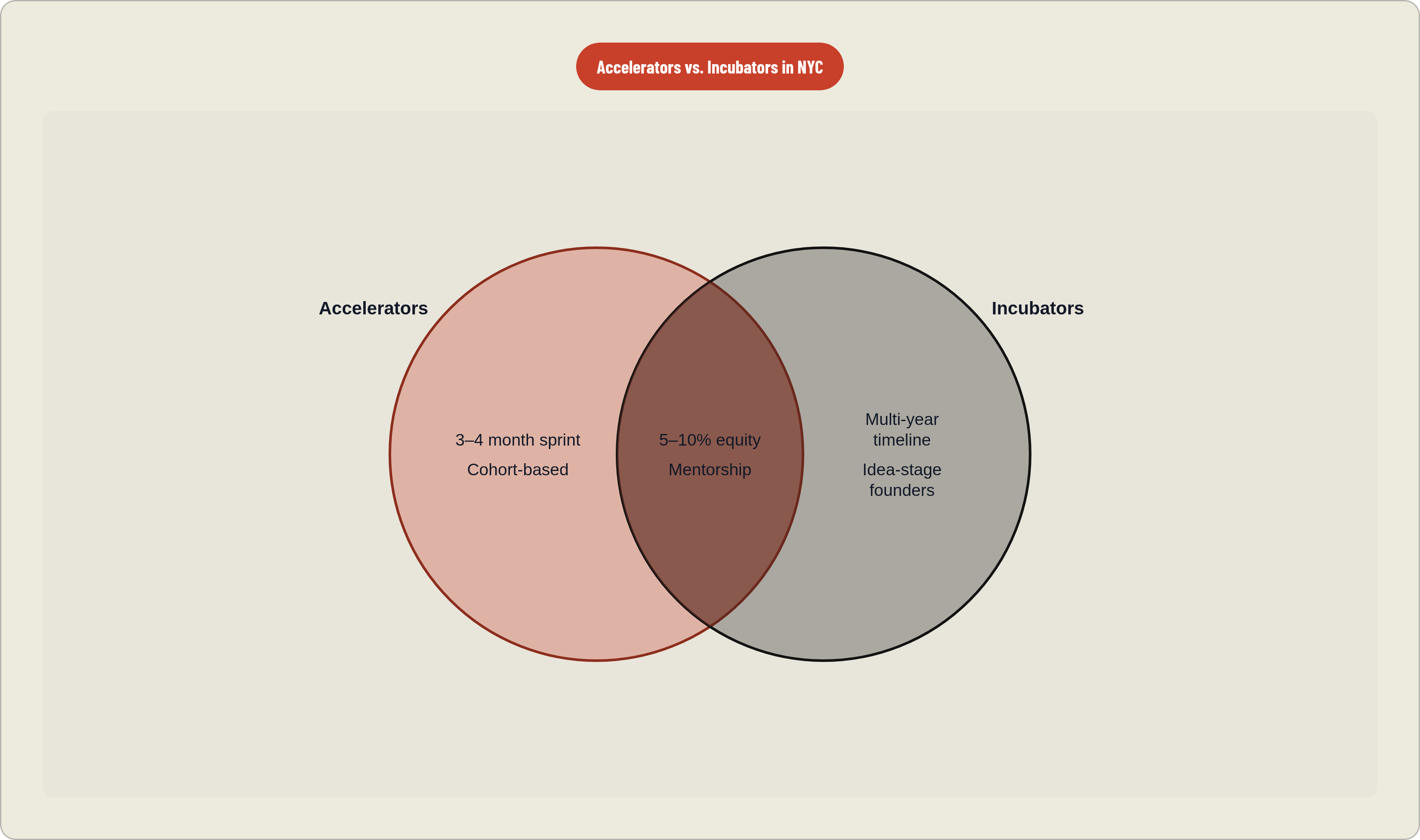
Accelerators run hot and short. Three to four months, cohort-based, built for companies with something already worth speeding up: a product, some users, a hypothesis you've tested at least once. Incubators stretch longer, sometimes years, and they exist for founders still shaping the idea, the team, or even the basic question of who's supposed to buy this thing.
Both typically take 5 to 10 percent equity. Corporate incubators land in the same range, though you should read the actual term sheet, not the glossy one-pager sitting next to the granola bars at the info session. The real difference sits in the clock. Accelerator equity comes with an end date; incubator equity often doesn't, and "no end date" sounds relaxing until you realize it also means no forcing function pushing you to finish anything.
So the question worth asking yourself is blunt: are you ready to sprint, or do you need time to think? Accelerator pressure is rocket fuel if you're execution-ready, and a trap if you're still figuring out whether anyone wants what you're building. Incubator patience cuts the other way. It's a gift at idea stage and a distraction if you should already be out talking to customers instead of polishing a deck nobody's asked for yet.
NYC blurs this on purpose, too. Studio models, thematic camps, and hybrid funds run on their own calendars and refuse to sort cleanly into "accelerator" or "incubator." Worry less about the label and more about what the program actually does with your time and your cap table.
ERA: the NYC-native accelerator for founders ready to build here specifically
ERA, founded in 2011, requires NYC residency for the program, full stop. That's a filter, and a useful one.
Structure is simple: two four-month cohorts a year, January and June, with a six-figure investment per company via a post-money SAFE. You get hands-on mentorship and a co-working setup that puts you next to other founders instead of alone in your apartment, arguing with a whiteboard about your own pricing model.
The numbers back it up. Over 375 startups have gone through ERA, and the portfolio has raised more than $2 billion combined, with a market valuation topping $10 billion as of June 2025. Rockerbox sold to DoubleVerify for $85 million in 2025. TripleLift hit a $1.4 billion valuation after a Vista Equity Partners stake in 2021, and six ERA companies made the Inc. 5000 fastest-growing list for 2025. None of that happens on vibes alone.
ERA is also upfront about who it's not for: mature companies chasing a big check, or founders who want a passive investor to wire money and vanish. That kind of honesty is rare, and worth taking at face value. The residency requirement functions as the actual point, not as red tape. ERA's bet is that founder relationships form faster across a real table than across a Zoom grid, and they're probably right about that.
Techstars NYC: the global network with a local cohort worth examining closely
Techstars NYC runs three months, mentorship-heavy, with a $220,000 investment: $200,000 through an uncapped MFN SAFE, plus $20,000 for convertible common equity. Techstars takes a small percentage of common stock plus the future value of that SAFE, and in exchange you get access to over $2 million in partner perks and, on paper, lifetime access to the Techstars network of mentors, investors, and alumni.
What are they screening for, exactly? Founders who understand customer pain down to the granular level, move fast, and are chasing a market big enough to eventually clear a billion dollars a year in revenue. That's their stated bar. The Fall 2025 NYC cohort spanned AI infrastructure, biotech, fintech, proptech, government tech, and supply-chain compliance, a wide net compared to the specialist shops elsewhere on this list.
The global numbers give the network claim some actual weight: over 3,200 companies funded worldwide, 19 unicorns including SendGrid, ClassPass, and Chainalysis. One founder in the NYC program applied five times before getting in. After the program, she raised a $1.5 million seed round from Harlem Capital, a firm she met during mentor madness, with zero prior VC relationships going in. That's the network working the way it's supposed to.
Here's the tradeoff, no hedging: the Techstars name is both the draw and the catch. Cohort quality and mentor engagement swing year to year, and acceptance rates run as low as 1 to 2 percent. Apply early, and apply specifically to NYC instead of treating it like a lottery ticket tossed into a general pool.
Forum Ventures: the specialist case for B2B SaaS founders
Forum Ventures, founded in 2012, has made close to 500 investments, mostly in software, making it one of the most active early-stage B2B SaaS investors in the city. It runs as a fund and a community at once, with no demo day bolted on the end.
Building enterprise or SMB software? This is the room where mentors speak the language instead of nodding politely through your churn-rate explanation. NYC pulls in roughly 30% of all U.S. fintech investment and sits on a deep bench of enterprise customers, and Forum is built to work exactly that seam.
The specialization is the whole pitch, and also the limit. If your SaaS product has a real consumer angle, or a hardware component riding along, this isn't your room. Go find the one built for that instead.
Betaworks Camp: for product-obsessed founders building at the edge of a specific technology
Betaworks Camp, running since 2007, puts founders in residence at Betaworks for 13 weeks, actually there in the building most days. Investment runs from the low six figures up to the high six figures depending on the camp and how much conviction they've got in your company, meaningfully bigger and more flexible than ERA's flat check.
Each camp centers on one technology theme. Past editions covered AI, synthetic media, audio, vision, voice. The 2026 camp has an AI focus with rolling applications instead of one hard deadline, which tells you something about how Betaworks operates: they're betting on where a wave is headed and recruiting the founders they think will define it. Apply to the camp that actually matches what you're building, and don't bend your pitch sideways to fit a theme it doesn't belong in.
This works best for early-stage, product-obsessed founders, especially ones building where technology meets media, entertainment, or infrastructure. If creative immersion beats structured business coaching for you, this is the right speed. One honest catch: the in-residence requirement is real, and if your team is scattered across three time zones already, showing up for 13 straight weeks is harder in practice than it reads on the website.
AlleyCorp: the studio model for founders still forming the company, not running it
Kevin Ryan founded AlleyCorp in 2007. The portfolio includes MongoDB, Business Insider, and Gilt, reflecting years of track record rather than a first-year effort. It runs as both an internal studio and an early-stage venture fund, and the Studio side is internal-only, with no application form to fill out.
By AlleyCorp's own description, the Studio suits technical talent still circling an idea, researchers testing a thesis, or side-project founders poking at something before quitting the day job. Already have a company and need capital plus mentorship? That's the fund's job, not the Studio's. Still a technical founder orbiting an idea with no co-founder yet? The Studio dynamic is worth understanding even without a door to formally knock on.
NYC's density produces a very specific kind of founder: between jobs, between ideas, between co-founders, standing in a hallway trying to figure out which room to walk into next. AlleyCorp's model fits that exact in-between moment, and it's focused on technology and healthcare, which happen to be the city's two deepest VC verticals anyway.
Sector-specific and university-affiliated programs that fill real gaps in the landscape
Healthtech in NYC stopped being a niche a while ago. In 2024, 113 healthtech companies here raised $4 billion combined, a 60% jump from 2023. Programs targeting digital health, biotech, and life sciences are stepping into a market that's already well-capitalized, and founders here should weigh hospital and health-system partnerships as heavily as check size.
Climate and sustainability programs are growing too, though the pipeline is younger and less proven than health or fintech. NYC's policy environment and its concentration of institutional buyers still make it a reasonable place to build here, though patience is required.
University programs get less attention than they deserve. Columbia, NYU, and Cornell Tech all run programs that reach past their own student body, and some take outside applicants, opening up research, IP, and faculty connections no commercial accelerator can match. That matters most for deep tech and biotech founders who need lab access alongside a check.
Corporate incubators round things out. Several big financial institutions and media companies run NYC programs, with equity terms typically landing between 3 and 10 percent. Read those partnerships closely; they often want strategic access as much as return, which needs to be priced in honestly rather than discovered later. Across all of it, one rule holds up: a smaller sector-focused program with real domain expertise beats a big-name generalist almost every time.
How acceptance rates and application timing actually affect your odds
Start with the number, because it tells most of the story on its own: acceptance rates at NYC's top programs run as low as 1 to 2 percent, selective-university territory.
A tight application to the right program beats a scattershot blast to fifteen. Programs with rolling applications, Betaworks among them, reward founders who apply before cohort momentum builds and the bar quietly climbs. Fixed-cycle programs like ERA and Techstars reward founders who start prepping months out, not the week the deadline hits.
Selection committees are reading for three things: real evidence you understand your customer, not just a polished product; a clear reason why this team, in this city, right now; and some proof the team ships and someone actually pays for it. The Techstars founder who got in on her fifth try makes the point better than any advice could: persistence and refinement beat one shinier pitch.
Watch for the failure modes that trip people up over and over. Applying to an accelerator before you're ready, or an incubator once you're already past that stage. Forcing your idea into a sector program's focus because the idea feels strong enough to override the mismatch (it usually isn't). Treating the whole application like a pitch-deck exercise instead of the start of an actual relationship, and skipping the warm introduction — in a city this dense, six degrees of separation is closer to two, and program managers notice who bothered to ask around first.
What programs can't give you, and where peer community fills the gap
Accelerators end. Your cohort becomes alumni, not people you text on a random Tuesday, and the intensity of those three or four months rarely survives the drop back into normal life on its own.
Most programs quietly can't give you an honest, ongoing conversation with founders at your exact stage, in your exact city, wrestling with the same decisions in real time. Trust built slowly over dinners and bad weeks, rather than trust manufactured during a demo-day rehearsal. Introductions from someone who actually knows both people, rather than a warm-sounding email pulled off a shared Slack channel.
The founders who get the most out of this city's ecosystem treat their peer relationships with the same seriousness they bring to picking a program in the first place. Density makes that possible here in a way most places can't match. Programs open doors and write checks, but the people standing on the other side of those doors are the ones who actually stick around, which is the gap NYC Founders Club, a private, invite-only community for active NYC founders built around small weekly chef's-table dinners, was designed to fill once the cohort ends.