NYC Startup Neighborhoods Compared for Founders
Where you locate your startup shapes your network, hiring.
New York has a way of making every decision feel geographic. Which subway line you live near shapes who you grab coffee with. Which blocks you walk shapes who you run into. And where you plant your startup shapes more than most founders expect until it's already too late to change.
Most founders treat the office as a logistics problem. Find something affordable, close to a train, big enough for the team. That framing is understandable. It also misses something real. In New York, neighborhoods don't blur into each other the way they do in cities built around cars. Each one carries its own density of capital, talent, and industry. Those differences are consequential enough that founders who picked the wrong neighborhood often talk about it the way they talk about a bad early hire. Quietly. Reluctantly. More influential than it looked at the time.
New York is the second-largest startup ecosystem in the world by most measures. The capital is real. The talent base is real. Company formation in Manhattan has outpaced San Francisco in recent years. And the ecosystem is broad, not just deep in finance. AI, fintech, healthtech, climate tech. These communities exist here, and they're not stacked on top of each other in the same few blocks. They spread across the city in ways that matter day to day.
What that spread means practically:
- Clustering near your sector peers is genuinely achievable here, not aspirational
- Investor foot traffic is real and unevenly distributed across neighborhoods
- The competition for good hires is citywide, so proximity to where your target candidates already live and work actually moves the needle
Founders who treat New York as one undifferentiated market are leaving a real strategic variable on the table. The city is too large and too varied for averaging to work in your favor.
Flatiron and NoMad: The Densest Startup Corridor and What That Density Actually Buys
The stretch from the mid-teens to the low thirties along Fifth Avenue and Broadway is the closest New York has to a purpose-built startup corridor. VCs, accelerators, Series A through C companies, enterprise clients. Often within a few blocks of each other. Sometimes in the same elevator bank.
Here's what nobody puts in a lease agreement: density buys you unplanned collisions. Running into an investor at a coffee shop. Bumping into a future hire at the lunch spot downstairs. Sitting next to someone at a dinner you both wandered into because it was three blocks from your respective offices. That stuff is genuinely hard to engineer, and Flatiron makes it happen more than anywhere else in the city. Small daily encounters accumulate into relationships, deals, and hires you couldn't have scheduled your way into. Think of it as compound interest for your network — invisible until suddenly it isn't.
Madison Square Park shows up in offer letters. Not as a nice amenity to mention in a pitch deck but as a genuine recruiting tool candidates actually respond to. Recent leases by major AI and SaaS companies have reinforced the corridor's consolidation around high-growth tech. The neighborhood isn't diluting. It's doubling down.
The cost of all that density is straightforward. Flatiron commands some of the highest rents in Midtown South, and even older or less-finished buildings get bid up because of the address. There's no version of this where you get the cluster for free.
This is the right call for funded startups at seed through Series B who want investor proximity as a daily operating condition, and for companies where the recruiting signal of a Flatiron address genuinely helps close candidates. It's harder to justify for very early pre-revenue teams where the premium doesn't survive a spreadsheet, or for founders who want their office culture to feel distinct from the surrounding startup environment rather than part of it.
Union Square: Transit Density as a Hidden Competitive Advantage
Union Square sits at the intersection of more subway lines than almost any other point in the city. The practical effect: people from every borough can get there without a transfer. This matters for founders more than it sounds like it should.
When your office is that accessible, you're not accidentally filtering your hiring pool by geography. A strong candidate from the Bronx and a strong candidate from Park Slope can both reach you in roughly the same amount of time, and neither one has to think too hard about it. Client meetings happen more spontaneously. Investor check-ins don't require the coordination overhead that comes with being somewhere harder to reach. Even co-founder coffee becomes less of a logistical event.
Office availability in Union Square has run below Manhattan's overall vacancy rate. The market is tighter here because demand is real and sustained. Worker density in the area also recovered faster than most Manhattan business districts, which means the street-level energy is genuinely back. Lunch spots, coffee shops, after-work gatherings that actually happen instead of getting canceled because the neighborhood feels dead after six.
Union Square also functions as a buffer. It sits adjacent to Flatiron's startup density without fully paying the Flatiron premium. Close enough to the Village and the Lower East Side to draw talent from those communities. You get a lot of the upside without the full price tag, and that's a trade a lot of founders should be making but aren't because Union Square doesn't have the same mythological status in startup conversations. To put it plainly: Union Square is the subway system of neighborhoods — unglamorous, underappreciated, and essential once you actually understand how the city works.
The fit is clearest for founders whose team is geographically spread across the five boroughs, companies that hold frequent in-person events or client visits, and teams that want Flatiron adjacency without the Flatiron rent. It's underrated, and probably not for much longer.
Chelsea and SoHo: What a Neighborhood's Cultural Identity Does to Your Company's Brand and Talent
Some founders want their building and their block to say something about what they're building. Chelsea and SoHo are for those founders.
Chelsea's art-gallery and creative-industry atmosphere draws a specific kind of person. Designers. Product thinkers. Builders who care about aesthetics and how things feel. The neighborhood self-selects for a certain sensibility in candidates. If that sensibility is central to what you're building, the surrounding environment does part of the recruiting work for you. You don't have to explain to a candidate why craft matters. They already get it. They walked past three galleries to get to the interview.
SoHo's loft stock signals something different from a glass tower in Midtown. High ceilings, cast iron, natural light. Some founders will tell you the quality of the space shapes the quality of the work done inside it, and they're not wrong. It shows up in how the company feels to everyone who walks through the door, including candidates deciding whether to join.
Both neighborhoods carry a premium. They're among the most sought-after addresses in downtown Manhattan, and the rents reflect that without apology.
The real difference from Flatiron is where the gravity points. Less concentrated investor foot traffic, VCs are less likely to be a few floors up. More concentrated access to creative and consumer talent. Designers, brand builders, and creative technologists skew here by choice. SoHo in particular has drawn fintech and AI companies whose products need to feel consumer-grade. The neighborhood's retail and fashion energy is adjacent to what those companies are building, and that adjacency is useful in ways that don't show up cleanly in a market analysis but that you feel immediately once you're there.
Consumer, media, fashion-tech, and design-driven startups find the neighborhood reinforces what the product stands for. For founders whose primary hiring constraint is attracting a specific kind of creative or product talent, the fit is real. For founders who need daily investor proximity, these neighborhoods ask you to work a little harder for it.
DUMBO and Williamsburg: When Brooklyn Is the Right Answer and When It Isn't
The default instinct to dismiss Brooklyn as a cost-saving fallback misreads what DUMBO and Williamsburg actually offer. These aren't consolation prizes. They're specific ecosystems with specific advantages, and for some companies, they're the right answer on the merits, not just the budget.
DUMBO
DUMBO has built real critical mass in design-led technology, creative AI, and hardware. Newlab and the Brooklyn Navy Yard anchor a hardware and urban tech ecosystem that has no real Manhattan equivalent. If you're building in those spaces, Manhattan is the wrong call. That's not a bold take. It's just where the relevant companies, facilities, and talent actually are.
City incentive programs can meaningfully offset rent costs for companies relocating from Manhattan, which is worth modeling before dismissing Brooklyn on cost grounds. The physical environment also does real work. Converted industrial buildings, waterfront, bridges. It photographs well, but more importantly it signals something about values and approach that a glass tower in Midtown does not, and certain candidates respond to that signal specifically.
Williamsburg
Williamsburg offers lower rents than DUMBO and dramatically lower rents than Flatiron. The startup density along Kent Avenue and nearby corridors is genuine. The talent pool skews toward younger, culturally-driven builders who chose to live and work in Williamsburg by conviction rather than convenience. If that person is your ideal hire, being there makes you easier to find and easier to choose.
Events and founder gatherings in Williamsburg feel less formal than Manhattan equivalents. That texture is a feature for founders who want their community to feel like a neighborhood rather than a networking circuit.
The Real Trade-Off With Brooklyn
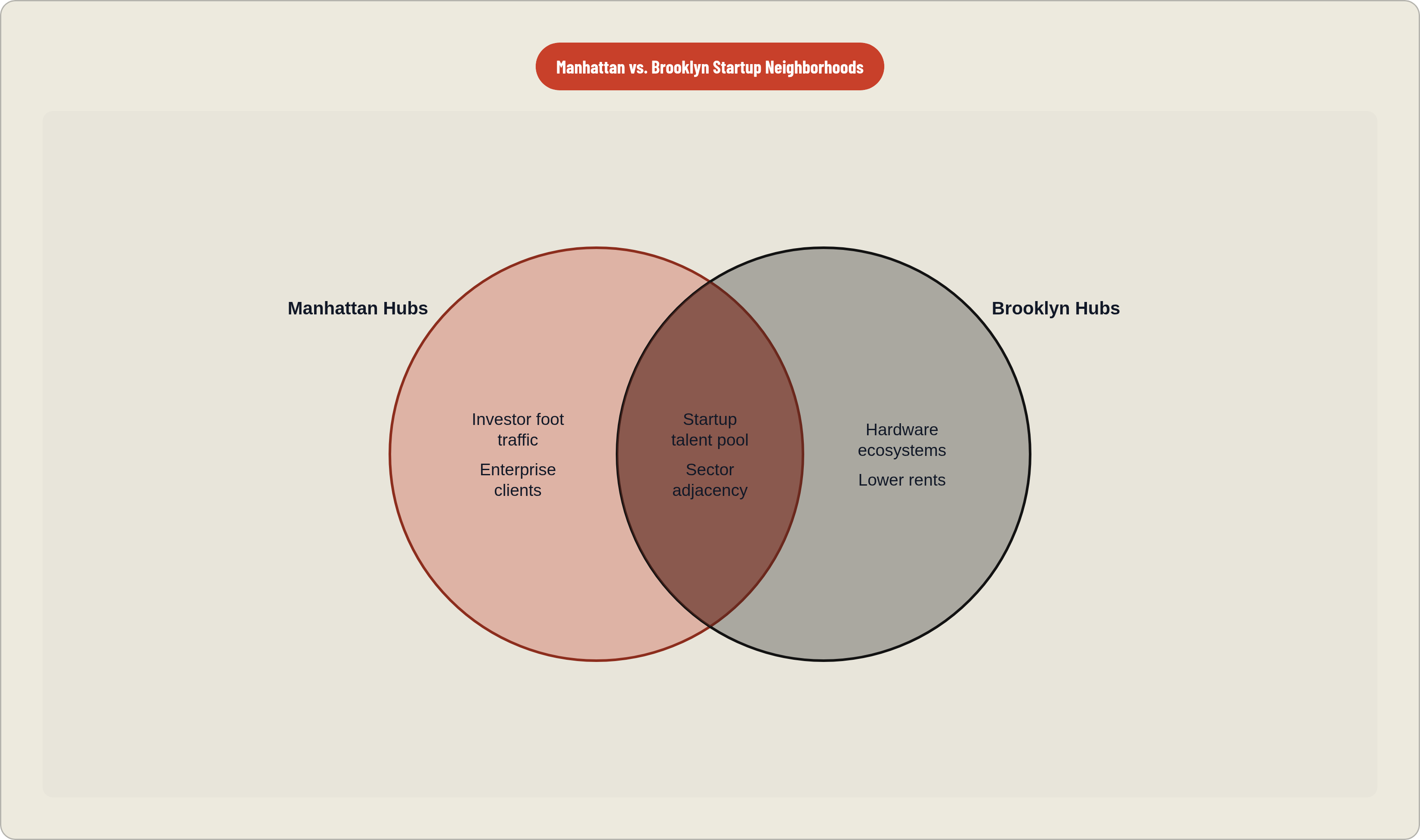
There are legitimate reasons Brooklyn isn't the right answer for every company. Investor foot traffic is lower, a meaningful difference from Flatiron or Union Square. The commute calculus reverses: instead of drawing candidates from Brooklyn to Manhattan, you're asking some Manhattan-based hires to commit to the bridge. Some will. Some won't, and they'll be polite about it until they get a competing offer somewhere more convenient. The Brooklyn address also signals something specific about culture and values. For the right company, that signal is an asset. For others, it's friction that slows hiring without a corresponding upside.
Brooklyn makes the most sense for hardware, climate tech, creative technology, and design-led companies where the ecosystem density is genuinely there. For founders whose team already lives in Brooklyn and whose office should reflect that reality rather than fight it. And for very early teams who need to preserve runway and can't yet justify Midtown South rents for a company that's still figuring out what it is.
Other Nodes Worth Knowing: Long Island City, the Financial District, and Roosevelt Island
These three don't always make the shortlist. Each has a specific logic, even if the answer is usually "not for you."
Long Island City
LIC's argument is simple. Close to Midtown via multiple subway lines, rents substantially below the Manhattan average. The startup ecosystem is still building critical mass, so it works best for companies where cost efficiency is a real constraint and where team members are already Queens-based. Investor foot traffic is lower than any Manhattan option, and if regular investor proximity matters to your operating rhythm right now, that gap is worth taking seriously rather than handwaving.
Financial District
FiDi makes clear sense for fintech companies whose work is directly adjacent to the institutions clustered there. Proximity to Wall Street is an actual operational advantage in those cases, not a symbolic one. The neighborhood's recovery has accelerated, but the ambient energy still skews finance rather than startup culture. That's a feature for some companies and friction for others, and founders are usually pretty good at knowing which camp they're in. Rents can be competitive relative to Midtown South, and the sublease market has historically offered real discounts. For the right company, that combination is worth pursuing seriously.
Roosevelt Island
Cornell Tech makes Roosevelt Island relevant for deep tech, hard science, and university-adjacent startups. The research relationships and talent pipeline are real. The trade-off is physical isolation. Roosevelt Island is not on the way to anything, which limits the incidental collisions that happen in denser neighborhoods. If the research relationship is genuinely core to how your company operates, the isolation is a reasonable price. If it isn't, you're paying that price for very little in return.
All three share a common trait: each has a specific logic that works for a specific kind of company. None functions as a general-purpose substitute for the Manhattan startup corridors.
How the Office Market Itself Shapes the Decision Founders Actually Face
Manhattan vacancy has declined meaningfully from its pandemic-era peak. The sublease inventory that made 2021 and 2022 feel like a buyer's market has dropped substantially. There are still deals to be found, but the window is narrower and getting narrower, and founders who are waiting for conditions to get more favorable are going to be disappointed.
The pricing spread across neighborhoods is wide enough to be a real variable in your planning. Older stock in less sought-after areas can run well below the citywide average. Premier Flatiron and SoHo addresses can run multiples of that. The gap between sublease and direct rent in Midtown South remains meaningful and is worth pursuing for teams with near-term flexibility needs.
Tenant improvement allowances have also declined even as construction costs remain elevated. What landlords are willing to build out for you has shrunk. If your team needs a specific configuration, you will be paying for buildout that two years ago would have been covered. Get the real numbers before you sign anything.
The three most costly early-stage office mistakes in this market:
- Over-committing on square footage relative to near-term headcount. Growth projections are optimistic by nature. Leases are not.
- Underestimating buildout costs in an environment where TI allowances no longer cover them.
- Skipping flexibility clauses. Expansion rights, early exit options, and renewal terms matter a lot when the company's trajectory shifts. It will shift.
The right question is what lease terms let you operate confidently for the next eighteen months while keeping your options open beyond that. Affordability in the moment is only part of the picture.
What Neighborhood Fit Looks Like When Sector, Stage, and Team Geography Line Up
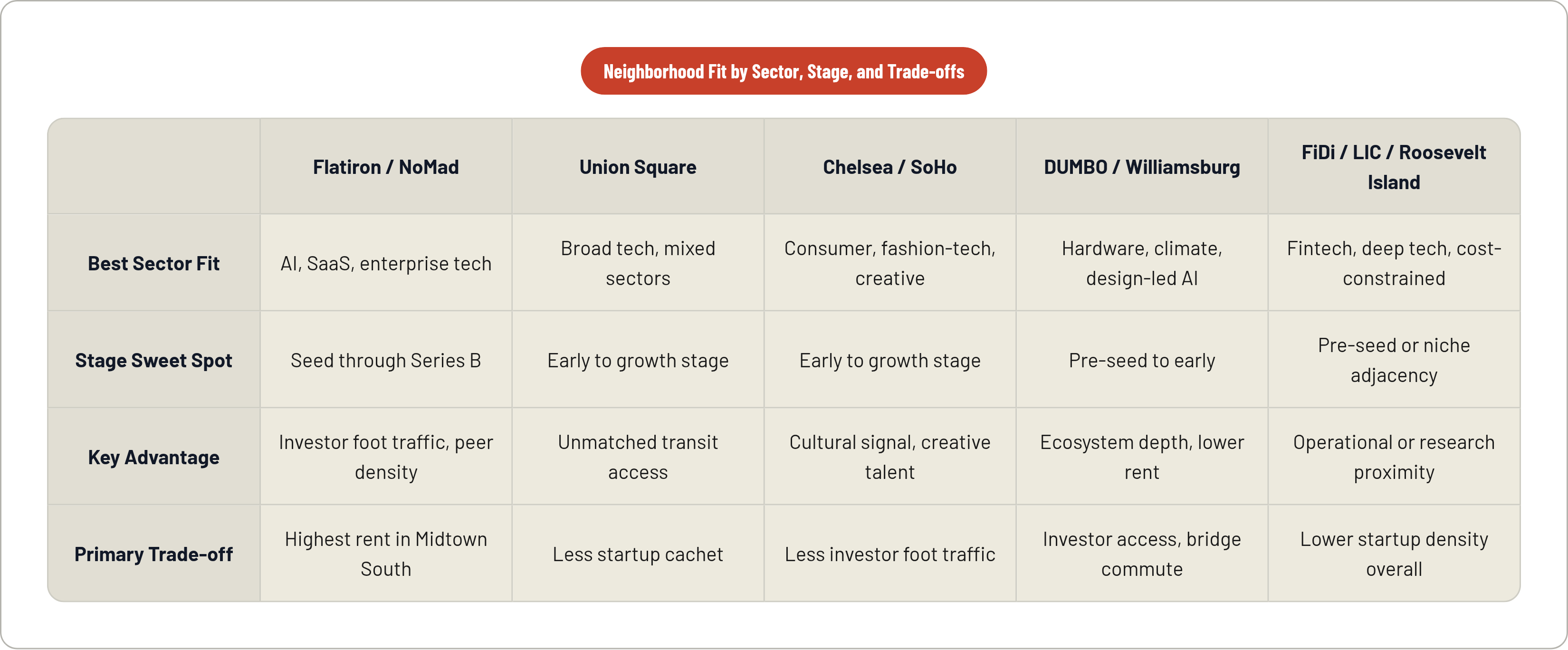
Three variables do most of the work.
Sector adjacency. Which neighborhood already concentrates the companies, investors, and talent in your space. This is the one most founders underweight, and it's the one that pays dividends the longest. It's also the hardest to fix later without actually moving.
Stage. The investor density of Flatiron matters more at Series A than at pre-seed. Cost flexibility matters more at pre-seed than anywhere else. Where you are in the journey changes what the neighborhood needs to do for you, and those needs shift faster than most founders expect.
Team geography. Where your existing and target hires actually live, and what commute they'll tolerate by conviction versus what quietly becomes attrition six months in. Founders consistently overestimate how much people will stretch on commute for a company they like. Candidates do it to get the job. Then reality sets in.
A rough map of how this plays out:
- Funded AI, SaaS, enterprise tech. Flatiron or Union Square for peer density and investor access.
- Consumer, creative, fashion-tech, brand-driven products. Chelsea or SoHo for the cultural signal and the talent type it attracts.
- Fintech with direct Wall Street relationships. Financial District for operational proximity.
- Hardware, climate, creative AI, design-led ML. DUMBO and the Brooklyn Navy Yard ecosystem.
- Culture-first, community-driven, Brooklyn-native teams. Williamsburg for talent fit and founder community texture.
- Deep tech with university ties. Roosevelt Island when the research relationship is genuinely core to operations, not just a nice origin story.
The right neighborhood is the one where the surrounding ecosystem does real work for the company you're actually building. An impressive address and the cheapest available desk are both secondary to that fit. In New York, that's worth treating as a real strategic decision and not something you revisit at lease renewal after two years of mild regret, which is part of why communities like NYC Founders Club, a weekly chef's-table dinner group for active NYC founders, tend to surface these neighborhood trade-offs early, across the table, before anyone has signed anything.