How Founders Actually Get Into a Dinner in NYC
Insider introductions and recurring dinners trump applications as the actual gatekeepers.

New York is not catching up to Silicon Valley anymore. It has become its own thing, and if you've been paying attention for the past few years, you already know this. The capital is here. The founders are here. The investors writing the checks that actually move markets are physically in this city, building in this city.
The deal flow is concentrated in AI, fintech, and healthtech. Those sectors are dense in New York, which means the people most worth knowing are accessible in a way they simply aren't in more dispersed markets. But accessible is not the same thing as easy to reach.
A few things are happening at once right now:
- Seed rounds are getting larger on average, so early founders are walking into rooms with more capital on the line
- Series A bars have risen, and a warm introduction to the right investor can compress a timeline that would otherwise take quarters
- The people behind that deal flow are not discoverable through event pages
When the stakes are this high, who you know stops being a social advantage and starts being an operational one. The dinners worth getting into are attended by the people driving this momentum. And those people are not signing up for anything.
The Taxonomy of Invite-Only Dinners and What Separates Them
"Invite-only" is doing a lot of heavy lifting as a phrase. It covers a huge range, and founders conflate the ends of that range constantly.
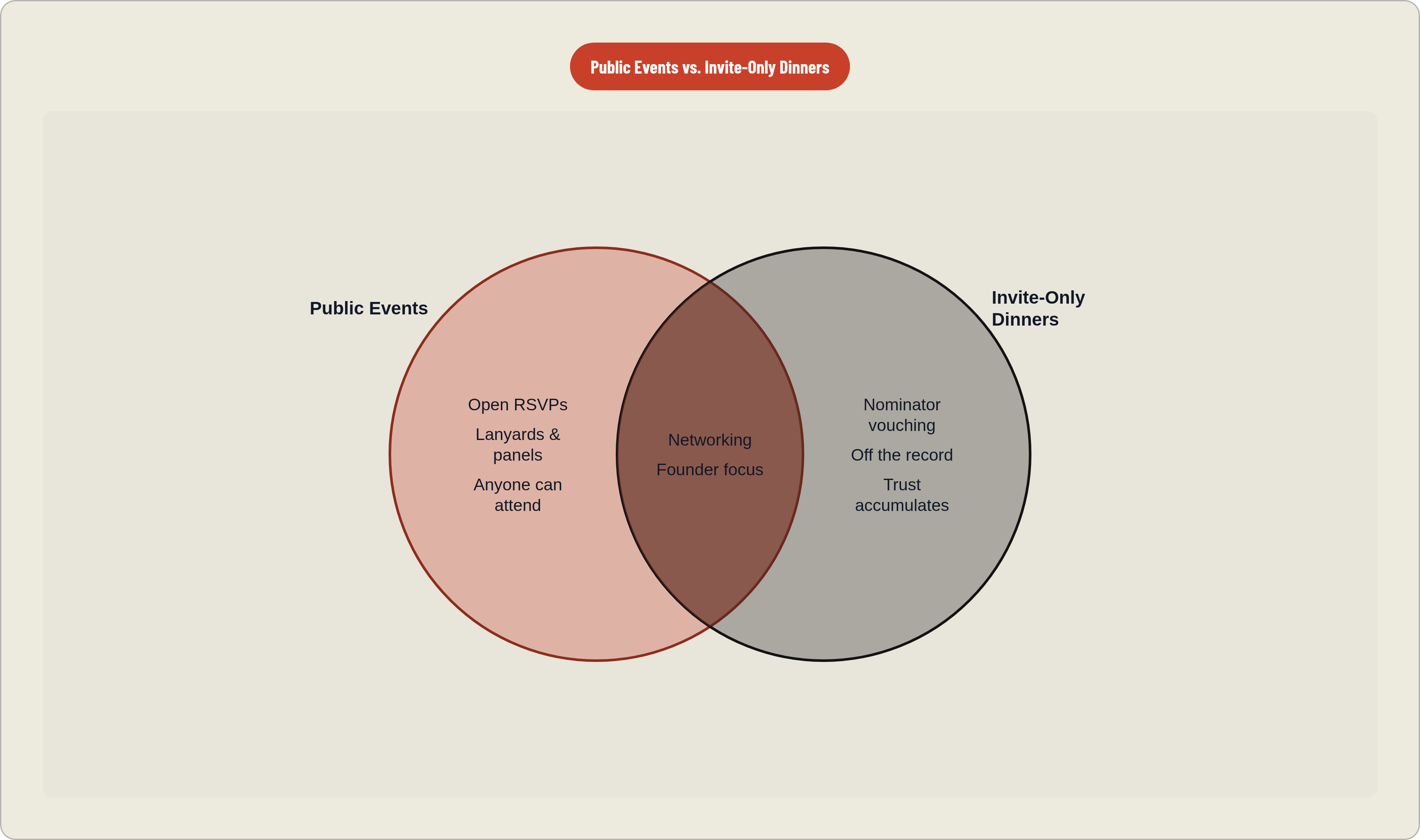
On one end: an Eventbrite with a soft gate, a checkbox that says "I'm a founder," and a room of two hundred people wearing lanyards. On the other end: a dinner of eight where every person was nominated by someone who has known them for two years. Same label. Completely different rooms — like comparing a vending machine to a private chef.
Here is roughly how the spectrum actually breaks down:
- Application-gated topic dinners. Small cohorts, sometimes as few as twenty founders, structured and off the record. You fill out a form. Someone actually reads it.
- Stage-filtered gatherings. Series B and up, or seed only. The filter signals what kind of conversation is expected before anyone sits down.
- Sector-specific dinners. AI researchers, fintech operators, consumer founders. Shared context removes the usual ten minutes of awkward "so, what do you build?"
- Anchor institution events. Hosted by investors or companies whose credibility pre-selects the room.
- Recurring community dinners. The same people, week after week, where trust accumulates slowly and quietly.
That last category is where something qualitatively different happens. One-time events create encounters. Recurring dinners create relationships. The introductions that actually close, the hires that stick, the co-investors who show up when things get hard. Those come from rooms people keep returning to, not from panels where everyone is performing for whoever is watching.
NYC Tech Week illustrates this. It is technically a citywide sprint of hundreds of satellite events. But the events that matter are not the panels or the expos. They are the dinners. Small rooms. No slides. Off the record. Often no announced agenda. That format is not accidental, and neither is the fact that you only hear about those dinners from people who were already at one.
Why the Rooms Worth Being In Are Hard to Find by Design
The best founder dinners do not advertise. Their value depends on not advertising.
This is not gatekeeping for its own sake. It is basic math. A public event listing selects for people who are good at finding event listings. A warm-introduction requirement selects for people who have already earned trust somewhere. Those are very different filters. They produce very different rooms.
Small rooms only work when everyone at the table has been vouched for. One genuinely wrong fit changes what every other person at the table is willing to say out loud. People get careful. The honest questions stop getting asked. The whole thing curdles into a networking event, which is exactly what it was trying not to be.
Scarcity is what makes each seat mean something. A dinner of eight where everyone was chosen is not the same category of thing as a happy hour where anyone can RSVP. Those are different products with different mechanics, and treating them as equivalent is a mistake a lot of founders make when they first arrive in New York.
Here is what founders new to the city miss most often: the friction is not a problem to solve. It is a signal. It tells you what kind of community you are dealing with and whether it is even worth wanting in. The velvet rope is the venue.
Cold-emailing the organizer. Gaming an application. Those moves disqualify you from the rooms you actually wanted to be in. The people running these dinners have seen every version of the workaround. They remember who tried it.
How Access Actually Works: The Role of the Nominator
Almost every meaningful invite-only dinner in NYC runs on the same underlying mechanic. Someone already inside vouches for someone outside.
The nominator is not a formality. They are putting their own standing on the line, which is precisely why they only do it for people they genuinely know. Nobody burns social capital on a stranger.
Some communities make this explicit. Others are informal about it. The organizer will not publicly announce "bring a friend," but they will fill a seat based on a text from a trusted member. The mechanic is the same either way.
Founders Network NYC makes this unusually visible. Staff prescreens a broader applicant pool, then matches finalists with an existing member nominator before the membership committee votes. The application is a filter. But the real decision often happens before the form is ever submitted, in whatever conversation a prospective member has with the person considering whether to vouch for them.
What this means practically:
- The path in starts with relationships, not applications
- Being genuinely known inside the room matters more than being impressive on paper
- The work of getting in starts months or years before you think to ask for an introduction
The person most likely to bring you into a room is someone who has watched you operate over time. Not someone you cold-emailed asking for an intro two weeks ago.
What Organizers and Nominators Are Actually Looking For
The evaluation is rarely about metrics. Stage, funding amount, revenue. Those are rough filters to confirm someone is actively building, nothing more. They are not what gets you in.
What actually gets weighed is harder to put on a form.
Will you make the room better? Not just: are you impressive? The real question is whether other people at the table will leave the dinner glad you were there. Those are different questions with different answers.
Physical rootedness matters more than founders expect. Are you genuinely building in NYC, or just passing through? IRL-first communities care about this, and they can usually tell the difference after one conversation.
Stage is less important than how you think. A pre-seed founder with real conviction and intellectual honesty often belongs at the same table as a Series B operator. The version of you that coasts on your credentials and lets others do the intellectual work usually does not.
Then there is reciprocity. The best members make introductions, share what they have learned the hard way, and help other founders without keeping score. Organizers and nominators have a good feel for who will do that and who is there to collect.
Privacy matters too, explicitly. Communities where what happens at dinner stays at dinner require members who understand and honor that norm. Founders with a history of oversharing or positioning publicly do not get invited back.
The bad fit is technically impressive and obviously there to collect. The good fit already behaves like a member before they join. They give more than they take in every room they are currently in.
How to Build the Reputation That Earns an Introduction
The reputation that gets you introduced is built at smaller tables before the bigger ones. There is no shortcut, and the founders who try to shortcut it are usually obvious about it.
A few things that actually move the needle:
- Show up consistently to the public-adjacent parts of the scene. Tech Week satellite events, demo nights, smaller sector gatherings. Not to collect contacts. To have real conversations with the same people more than once.
- Be useful before you need anything. Make introductions. Share what you know. Follow through on the small things.
- Go deep with a few people rather than wide with many. One person who genuinely knows you is worth more than a hundred LinkedIn connections from people who have forgotten your name.
- Let your work travel. Founders get noticed when their peers talk about what they're building with real admiration, not when they position themselves in the right rooms.
Geography matters more than people from outside New York expect. Being physically in the city, in the neighborhoods where this community is actually dense, creates the accidental encounters that eventually become real relationships. The coffee shop run-in. The walk to the subway after something ends. Those moments are not nothing. They are often how someone forms an impression of you that no application form ever could.
The nominator relationship is a long game. Nobody puts their name behind yours after two conversations. The founders who get introduced are the ones who have been around long enough, and consistently enough, for someone to actually know what they are like when things are not going well.
What the Right Room Actually Gives You Once You're In
The value of a curated dinner is not the single conversation. It is what accumulates when you keep showing up to the same room with the same people over months and years. Think of it less like a transaction and more like a garden — nothing meaningful grows from a single visit, but tend it consistently and it becomes something you could not have built anywhere else.
A few things a recurring small community produces that a one-time event simply will not:
- Introductions that actually land. Because the person making them knows both sides well enough to make a real case, not just forward a LinkedIn profile.
- Honest feedback. People who see you regularly do not need to soften the truth to protect a relationship they are still forming.
- The stuff that does not circulate publicly. What is actually hard about the Series A process. Which investor is difficult to work with once the check clears. Which hire pattern keeps killing companies at a certain stage. That knowledge does not show up in newsletters.
- A peer group that holds you to something. Not just a network that cheers you on.
NYC Founders Club operates at this end of the spectrum. Founded in 2023 by three YC alumni, it is an invite-only founders community built around small weekly chef's-table dinners, where the same active NYC founders gather on a recurring basis and trust builds over time. It is one of several communities in New York built around this model.
The dinners worth getting into are worth getting into precisely because they are hard to get into. That difficulty is the point. It is what guarantees that everyone else at the table earned their seat too. And that guarantee is worth more than anything you could learn from the dinner itself.