Invite-Only Founder Communities in New York City
Filtered networks create the candor and trust that open communities cannot.

The label "invite-only" does a lot of heavy lifting without actually saying much. In practice, it covers a pretty wide range of real behaviors, and conflating them will waste your time.
On one end, you have application-reviewed communities. Founders apply, a team vets them, someone decides if they fit. Yorkseed runs a global network this way, with a New York chapter among others. It is a real filter. It is just mediated by a form and a committee rather than a person who actually knows you.
Then there is the peer-vouched model. No application. An existing member sponsors you, and their reputation walks in the door with you. The trust is personal, not institutional.
At the far end sits pure nomination. You are brought in by someone who knows you, takes responsibility for your fit, and does not ask you to fill out anything. Rarest. Most meaningful.
Format varies just as much as entry:
- Intimate weekly dinners with a handful of founders around one table, which is how NYC Founders Club operates
- Private events for groups of a few dozen, hosted at exclusive venues
- Structured peer advisory boards with defined mentorship tracks, which Founders Network does
- Platform-based communities that layer curated deal flow and introductions on top of in-person events
Some communities charge tiered annual fees. Others filter purely on fit and referral and treat payment as beside the point. Some are chapters of national or global networks. Others are deliberately rooted in New York and serve only founders who are physically building here.
These distinctions matter more than the label. The model determines what kind of trust gets built inside the room, and trust is the mechanism through which everything else flows.
Why the Filter Itself Is the Product, Not a Barrier to It
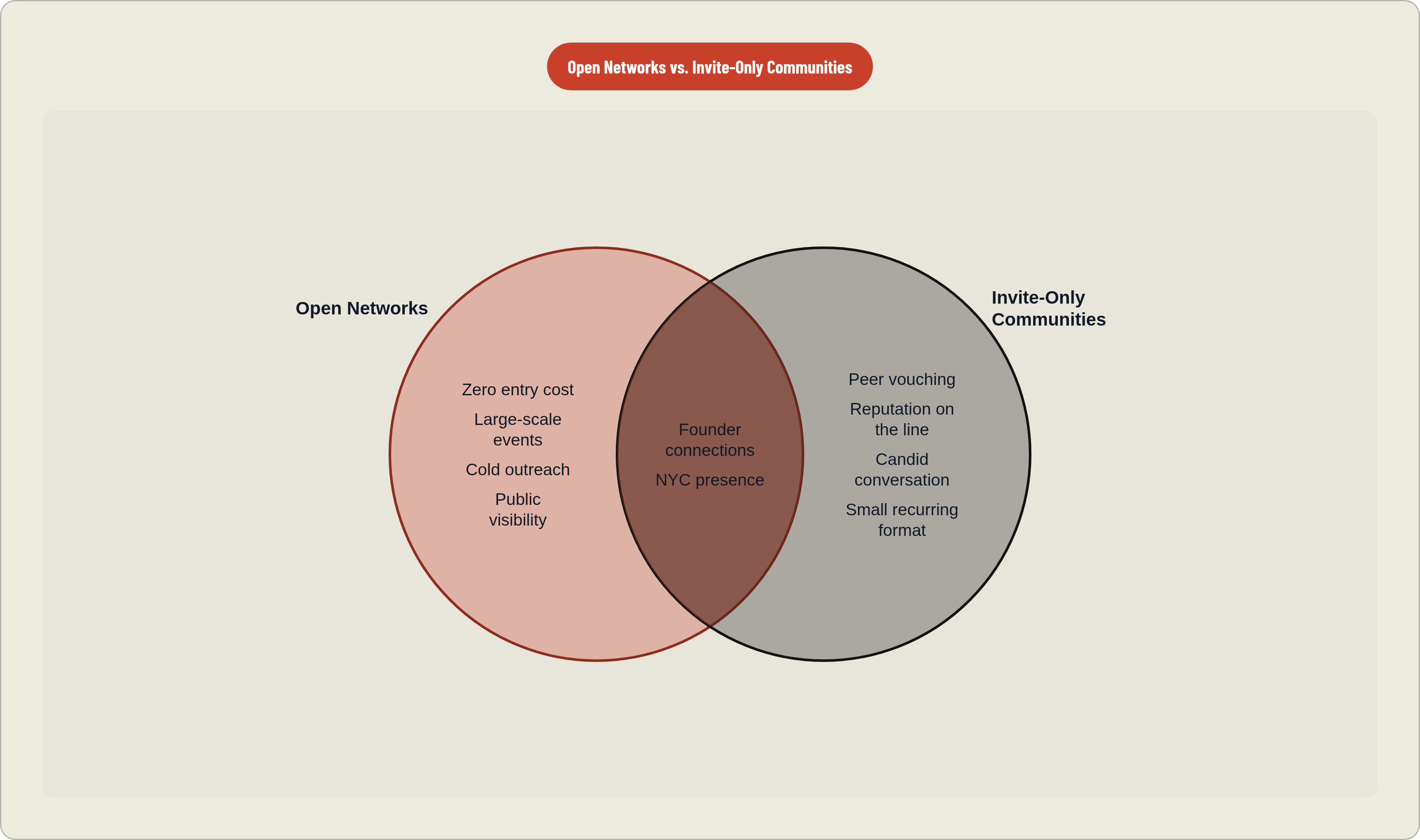
In an open network, the cost of joining is near zero. Which means the value of any individual connection is also near zero. Nobody has staked anything. Nobody has skin in the game. You are just two strangers with business cards and matching LinkedIn headlines.
A real filter changes that math. The person who introduced you has their reputation on the line. Every member has already been deemed worth the seat by someone who knows what that seat is worth. That pre-vetting means founders can actually be honest in ways they cannot be at a two-hundred-person happy hour with a DJ and branded cocktails.
And that honesty is where the actual value lives. Real hiring dilemmas. Live fundraising questions. Candid feedback on a pricing model that is quietly falling apart. None of that travels through open channels. It only moves in rooms where people feel safe enough to say the thing they are avoiding anywhere else.
Company Ventures CEO Matt Harrigan has made the point that founder advice is too often filtered through venture firm incentives. Peer-to-peer, unmediated founder experience is a rarer and genuinely different resource. You cannot get it just by being in the same city as a lot of smart people. You get it when the room has been built to make candor possible. The filter is what builds that room.
A low acceptance rate is not a status signal. It is what keeps the ratio of serious founders to spectators at exactly one-to-one.
How Warm Introductions Work Differently Inside a Curated Network
Every founder has been told warm introductions outperform cold outreach. Sure. But most founders miss that not all warm introductions are equal, and the gap between them is wider than it looks.
An intro from a mutual LinkedIn connection carries almost no weight. Neither party has real accountability. An intro from an existing investor carries more, because capital and reputation are at stake. But an intro from a founder who has sat across a dinner table from both parties, who knows both well enough to say something specific and honest about each of them? That is a different category entirely. Not just a stronger version of the same thing. A different thing.
That third kind of introduction comes from intimacy. From recurring, small-format gatherings where people have actually gotten to know each other over time. You cannot manufacture it at scale. A Slack community of several thousand people cannot produce it. A quarterly panel event cannot either, because proximity is the same as familiarity.
Inside genuine invite-only communities, introductions to co-investors, angel backers, and key hires are not a side effect. They are often explicitly what the community is designed to deliver. NYC Founders Club, built around recurring small chef's-table dinners, creates the kind of repeated in-person familiarity from which genuinely warm introductions naturally follow. Maccabee Ventures, an early-stage fund rooted in New York, has built its value proposition around introductions to talent and co-investors alongside capital.
Repeat founders understand this architecture more fluently than first-timers do, mostly because they have watched it play out across multiple companies. Network quality compounds across funding rounds in a way that is hard to see until you have been through it twice. Ryan Williams, after selling Cadre, drew on deep operator experience and cross-sector relationships when launching his next venture. The networks built during one company become the infrastructure for the next. That pattern holds consistently enough that ignoring it is just leaving something on the table.
What Founders Actually Get From In-Person Rituals That an Online Group Cannot Replicate
The case for in-person is not nostalgic. It is functional. Some kinds of information and trust only move face to face, and pretending otherwise is wishful thinking dressed up as efficiency.
Regular, recurring formats produce something qualitatively different from one-off events. Weekly dinners. Seasonal retreats. Consistent cohorts over time. Relationships deepen across multiple encounters, not one. Members start tracking each other's progress, which makes advice more specific and less generic. Candor increases as the table becomes familiar.
NY Tech Week illustrates the demand at scale. A citywide, decentralized festival drawing tens of thousands of attendees across more than a thousand events in a single week. And yet, founders and investors consistently report that the most valuable moments happen at the smaller, private dinners embedded within that week. The flagship panels with the well-known moderators rarely match them. Eight people around a table actually talking is where it happens. The rest is content.
An intimate dinner format forces depth that a large rooftop event structurally cannot. That is not a bug in the design. It is the whole point.
Online communities offer availability but not presence. The absence of ambient social cues, body language, and shared physical context means a Slack channel will never produce the quality of honest conversation that happens at a table where people have eaten together before. For founders specifically, the emotional dimension matters too. The isolation of building a company is real and is underestimated. Peer support in person registers as solidarity. Text-based peer support registers as information exchange.
I have watched founders sit in large online groups for a year or more and come away informed but still fundamentally alone in the experience of building. Then they show up to a small recurring dinner a few times and something shifts. Not the information they have access to. Something harder to name. They stop performing founder and start just talking.
Why New York's Specific Character Amplifies the Value of a City-Rooted Community
Every startup ecosystem has its own personality. The advice that works somewhere else will not travel cleanly to New York without modification. Operating costs are higher. The talent market is more competitive. The investor culture has its own norms, its own calendar, its own unwritten rules about how things get done here versus how they get done in a city where everyone is building roughly the same kind of company.
But the city also offers something genuinely rare. The sector diversity here is real. Fintech, AI, healthtech, climate, media, real estate tech. Founders in New York regularly build across industries and draw on a broader range of operator experience than a more monoculture ecosystem provides. The early-stage density is also real. Manhattan holds a remarkable concentration of seed and Series A companies, which means peer support at the zero-to-one stage is both highly relevant and well-supplied.
International founders are increasingly choosing New York as a U.S. entry point. Several European companies, including a number of AI firms, have opened New York offices in recent years. That adds cross-market perspective to any community rooted here.
A community explicitly anchored to this city, serving only founders physically building here, can give specific and actionable guidance on the pressures unique to this place. A global chapter network with a New York node cannot do that with the same precision. The neighborhoods, the restaurants, the rhythms of the city across seasons, become shared context. That shared context gives a local community a coherence a distributed one cannot manufacture. You either know what it is like to hire engineers in this market or you do not. Locality sorts that out quickly.
What Separates Communities That Produce Lasting Relationships From Those That Produce Business Cards
Not every invite-only community delivers on its premise. Exclusive events of several dozen founders at a venue can feel indistinguishable from open networking with a velvet rope out front and a slightly better cheese board. The exclusivity does not automatically produce depth.
The communities that actually produce durable relationships share a recognizable set of features:
- Size: Small enough that members know each other, not just know of each other
- Recurrence: Not one event but a repeated cadence that builds familiarity over time
- Accountability: Members have reputations within the group. What they say and do is remembered.
- No formal agenda: The best conversations happen when there is no pitch, no panel, no structured program. Just founders talking.
- Privacy: What is said at the table stays at the table. Without that guarantee, honesty collapses.
Structured mentorship tracks and tiered memberships have their place, but they trade depth for breadth. The relationship becomes mediated by the program rather than built between people.
The communities that consistently produce hiring connections, co-investor introductions, and actual co-founder relationships share one structural feature. The members have spent enough time together that when one of them vouches for you, it means something real. The introduction carries weight because the relationship underneath it does.
How many members a community has is mostly irrelevant. How well the community actually knows you is the question that matters. That is only achievable at small scale, which means the communities that produce the most value are often the ones that look the least impressive from the outside. No one is posting a count of their members. They are just producing results for the ones they have.
How to Find and Get Into the Right Community for Where You Are in Your Build
The right community depends on stage, sector, and what you actually need right now. Introductions to investors, emotional support from peers, hiring advice, and co-investor access are different needs. Being honest with yourself about which one you actually need first will save you a lot of time and a lot of application energy aimed at the wrong rooms.
Entry into a genuine invite-only community almost never begins with an application. It begins with a relationship.
- Find a member who knows you and your work. Not your LinkedIn profile. Your actual work, your judgment, your character.
- Be specific about what you are building and what you need. Vague interest in "connecting" does not survive a real curation filter.
- Demonstrate that you have something to give the room. Not just something to take from it.
NYC Founders Club is a deliberately small, invite-based community for active founders building in New York, centered on in-person chef's-table dinners. Fit and physical presence in the city are what matter, not stage or check size, which makes it a meaningful option if you are already here and building full-time.
For founders earlier in their network-building, the IRL events embedded in New York's broader calendar are legitimate starting points. The private dinners within NY Tech Week are where the relationships that eventually lead to a vouched introduction often begin. Nobody walks into the right room without first wandering through a few wrong ones. That part is just the process.
Getting into a curated community takes real effort. That is not a flaw in the system. Founders who invest that effort are exactly the founders the room was built for. In a city with the density, deal flow, and founder talent that New York has, the communities that matter most are often the smallest ones. Earning a seat starts with being the kind of founder who would actually use it.