NYC Angel Investor Networks and How to Access Them
NYC's angel scene splits into three distinct layers, each requiring different approaches to access.

New York's angel scene has three layers, and nobody hands you a map when you show up.
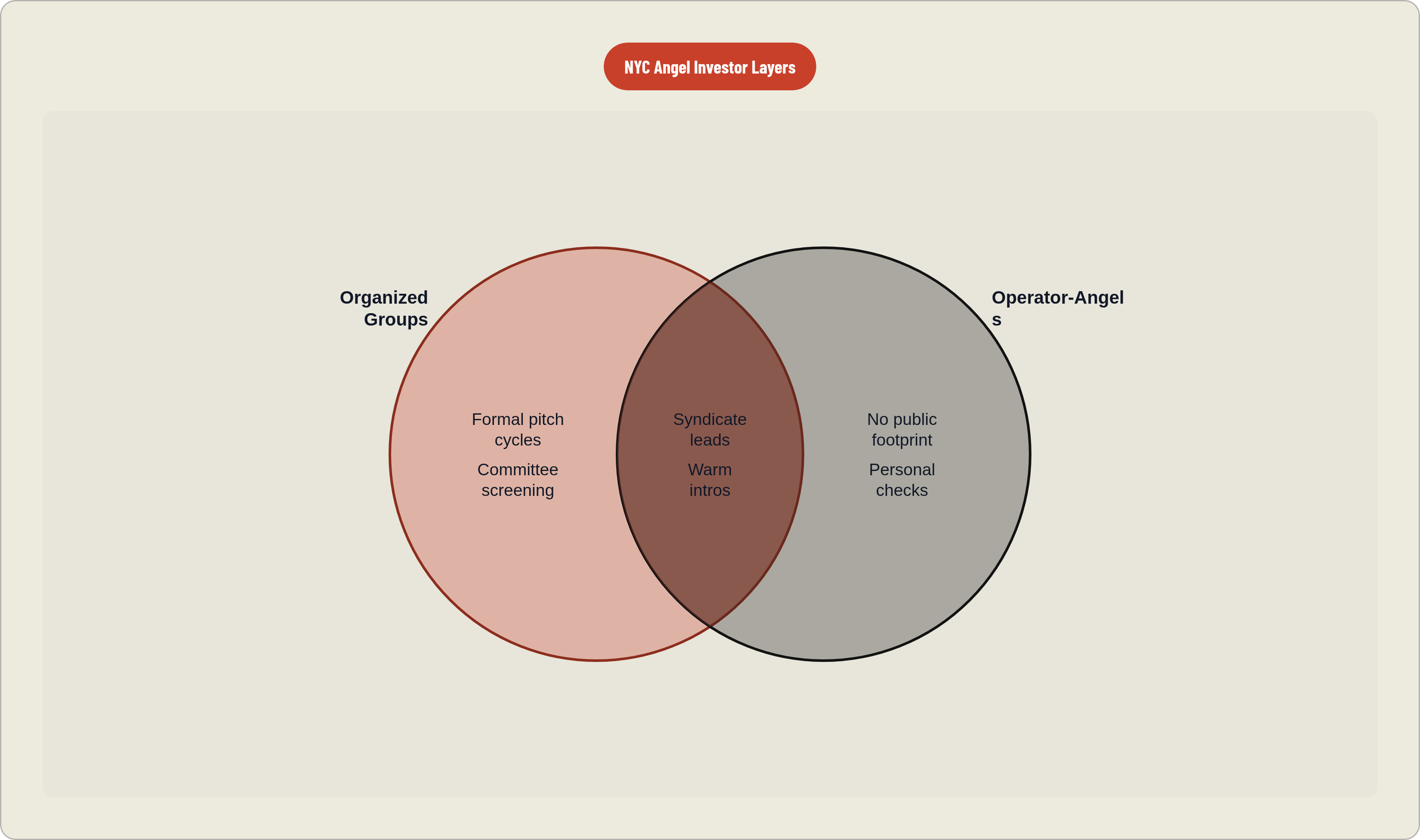
Organized angel groups are the layer everyone finds first, mostly because they want to be found. Websites, pitch cycles, screening committees, a stated thesis you can read before you ever get on a call. HBS Alumni Angels of Greater New York has over 350 member investors and has put $20 million into roughly 100 companies; the Harvard Business School name works like a filter you can read backward, telling you exactly what kind of founder tends to land there. New York Angels runs working groups for fintech, blockchain, and life sciences, with monthly pitch cycles you can actually plan around instead of guessing at. Golden Seeds has invested $180 million into 249 companies, mostly women-led, and those companies have gone on to raise over $2 billion in follow-on money. 37 Angels, built by Angela Lee to widen the door for women and underrepresented founders, reviews a serious volume of pitches every year. Empire Angels, run by millennials who raised their own capital before turning around to write checks, targets founders under 35 and promises a decision inside 48 hours; their seventeen portfolio companies include Socure (a unicorn) and Zoomcar (an IPO). ARC Angel Fund lets members co-invest directly in software and tech-enabled services. BoxGroup calls itself "first money in" and proved it with Plaid, Airtable, and Ramp, moving at a clip formal partnerships usually can't touch.
Then there's the operator-angel layer, and this is the one nobody puts on a website. Founders of companies like GroupMe, Codecademy, Away, and Secureframe write personal checks now, often with zero public footprint. No list, no application, no committee. Just someone who built a thing and wants to help the next person build a different thing.
Syndicate leads sit in the middle. One decision-maker, a pool of co-investors trailing behind, moving faster than a formal group but with more structure than a solo operator writing checks off gut feeling.
Here's the part founders skip past too fast: these three layers are not interchangeable, and they don't respond to the same moves. Applying to a group's pitch cycle and getting a warm intro to an operator-angel are two different skills entirely. Treat them like one skill and you'll burn ninety days knocking on the wrong door.
What angels in NYC are actually looking for at each stage
Check sizes vary widely by investor type. Operator-angels and syndicate leads sometimes go bigger than organized groups, but they get pickier the bigger they go, which tracks. Valuations move with the stage in a fairly predictable line: valuations move with the stage, and founders should calibrate expectations to what comparable NYC deals are actually pricing at in the current market.
Seed was the dominant round type in NYC in 2024, at 47% of all rounds, with pre-seed close behind at 29%. Organized angel groups exist because institutional VCs won't touch checks below a certain floor. Angels fill the gap venture capital leaves open, and they know it.
Runway matters, too. NYC angels calibrate to what it actually costs to build here, because rent and payroll in this city don't negotiate with anybody. A disciplined raise depends heavily on running conversations in parallel rather than sequentially. Founders who work one conversation at a time watch their timeline stretch well past what their runway can absorb, which is a mistake worth naming, since it's avoidable.
Sector fit is the quiet filter nobody mentions upfront, and it's arguably the most important one. NYC angels cluster around the sectors where the city's operator class has actually worked, largely because operator-angels invest where they've actually operated. Fintech deal values hit $6.71 billion in 2024, and AI made up 32% of all NYC startup deals that year. That's who's sitting at the table with a checkbook, not some accident of geography.
Why warm introductions are the real operating system of NYC angel access
The data on warm introductions is consistent: referred deals convert at dramatically higher rates than cold outreach. That dynamic has only gotten sharper, since every angel's inbox is more crowded now, not less.
NYC turns that dial up further because the angel community here is small and tightly wired, cycling through the same co-investments, the same portfolio companies, the same dinners. An introduction is a bet the introducer makes with their own reputation on the line, which is exactly why angels treat referred deals differently than inbound pitches landing cold. Finance and media, the two industries that built most of NYC's operator class, run on relationship chains by default, and the angels who came out of those worlds brought the habit with them.
So most angels' actual deal flow moves through a small, trusted circle: co-investors, old colleagues, founders they've already backed. Rarely a form on a website. Getting access has always depended less on finding the right email address and more on getting inside the network that produces the introduction in the first place. Founders who turn this into a spreadsheet of names and titles are optimizing the wrong variable.
Where introduction pathways actually originate in New York
Major accelerators and institutional funds show up among the top investors active in the NYC ecosystem according to Tracxn, but the real value sits in their alumni networks, which act like dense, self-reinforcing introduction machines. A relationship out of a YC batch or a Techstars cohort tends to carry more weight than a cold pitch to an organized angel group, because it shows up pre-loaded with trust instead of waiting in line to be screened.
Portfolio founders might be the single most underused path in the whole ecosystem. An angel who already backed a company like yours is statistically more likely to back another one in the same lane, and the founder they already funded is often the most natural person alive to make that introduction happen. Spend your energy finding those portfolio companies and building real relationships with the people running them. It beats researching the angel directly, nearly every time.
Organized pitch cycles still matter, especially for founders who haven't built a relationship graph yet. New York Angels runs monthly cycles that create genuine, structured access. The catch: these processes reward founders who perform well in a formal pitch setting, and that's not always the same person as the founder with the strongest business in the room.
Geography plays a bigger role than people give it credit for. Manhattan hosts 543 companies raising seed or Series A rounds in a single year, so founders, angels, and operators end up packed into the same physical spaces at a density you won't find elsewhere. The neighborhoods, the co-working spaces, the recurring dinners where the same ten operators keep showing up: that's where relationship capital actually piles up. NYC Founders Club, a private dinner community for active NYC founders, is one place those recurring dinners happen.
Trace any real introduction path in this city back far enough, and it runs through existing trust: an accelerator cohort, a co-investor relationship, a portfolio founder community, a recurring event where the same faces keep appearing.
How founders position themselves to receive introductions rather than chase them
The strongest fundraising position isn't the best pitch deck. It's being in a spot where the introduction comes to you, because somebody who knows you well enough has an actual reason to pick up the phone.
Being legible matters more than founders think it does. Angels will google you before they ever get on a call, and what they find, your LinkedIn, your company site, any writing with your name attached, needs to make obvious, fast, who you are and what you're building. If an angel's whole thesis is backing fintech operators, they need to see in about ten seconds that you've actually worked in financial services. Not that you find it interesting. Worked in it.
Giving before asking is the other half. Founders who introduce other founders to angels, who pass along deal flow, who connect operators who should know each other, become nodes in the network instead of people standing outside the glass asking to be let in. That kind of trust doesn't build itself during a fundraising sprint; it takes months of genuine back-and-forth that has nothing to do with your round.
Which is the timing problem most founders get wrong: they start building relationships the week the round opens. By then you're asking people who barely know you to take social risk on your behalf, and that 90 to 120 day close only holds if the relationship graph already exists before you need it. Build it from scratch inside the fundraising window and watch that timeline stretch out past what your runway can absorb.
Founder-to-founder relationships end up being the sturdiest foundation for all of it. Other founders at your stage, in your sector, are both your most natural source of warm intros and the only people who'll tell you the truth about specific angels: who adds real value, who moves fast, who ghosts the second the term sheet is signed. That's the case for investing in peer community long before you need anything from it.
What peer founder community produces that no investor list can replicate
A curated list of NYC angels tells you who exists. A trusted peer tells you who to actually talk to, in what order, and how to frame the conversation so it lands instead of bouncing off. Different resources, and mixing them up is one of the pricier mistakes a founder can make.
Peers hand you things no database has. Who's been active lately. Who just closed a new fund and is hungry to deploy before they look bad to their own LPs. Who's known to turn into a nightmare the second the check clears. Social proof travels differently, too: a founder telling an angel "you should meet this person, I know them well" carries a weight that a cold application to a pitch cycle just doesn't have, and never will.
There's a compounding thing that happens here. Founders embedded in a real peer community get introduced by three or four people at once, instead of building a network one contact at a time like they're filling out a form in triplicate. In a city this dense, the same founder names keep surfacing across dinners, events, co-investor conversations, and being known in those rooms compounds in a way that's almost impossible to fake from outside.
Organized pitch cycles are open by design, which is their strength and their ceiling at once. A pitch to a screening committee is a transaction. An introduction from someone who's watched you build for six months is something else entirely, and angels can tell the difference the moment it lands on their desk.
A practical sequence for NYC founders who are not yet inside the right rooms
Start by figuring out which layer actually applies to you. Match your stage and sector to the right tier: organized groups like HBS Alumni Angels, New York Angels, Golden Seeds, or 37 Angels for structured access, operator-angels for speed once you've earned the trust to get there, syndicates for deals that need to close fast. Sector fit is your first filter. Geography is a distant second. Find angels with real operating experience in your space before you go chasing angels who simply live in your zip code.
Build your introduction graph before the round opens, not during it. Identify five to ten founders sitting in the portfolios of angels you actually want backing you, and build real relationships with them, not transactional asks wearing a coffee-chat costume. Get into accelerator alumni circles too, especially YC and Techstars, where NYC cohort density gives you a real shot at trust-backed introductions instead of cold ones.
Use organized pitch cycles as one track among several, not the whole plan. They're legitimate, especially early on, but they were never built to carry your entire raise on their own.
Run your process in parallel, not sequentially. NYC angels move faster when they see momentum, when they see other investors already circling the same deal. Warm intros, group processes, peer referrals: run them all at the same time, feeding the same round, building the pressure that turns a 120-day close into something closer to 90.