Warm Introduction Paths to NYC Investors
Network-building matters more than pitch decks, and starting now beats waiting until you need money.

NYC raised $18.7 billion across 869 deals in 2024. Great headline, useless fact, because it also means over 300 firms are fielding pitches, and every inbox in this town looks like a subway platform at rush hour. Nobody's reading your cold email, and the only thing that reliably gets you a meeting is a warm intro. The paths there aren't secret handshakes; they're specific and learnable, and if you start building them the week you need money, you've already lost.
What actually makes a warm intro work
Here's the mechanism, stripped down: someone the investor already trusts vouches for you before a single slide gets opened. The introducer's reputation does the pre-screening the investor would otherwise have to do themselves, and busy people love outsourcing work they don't want to do.
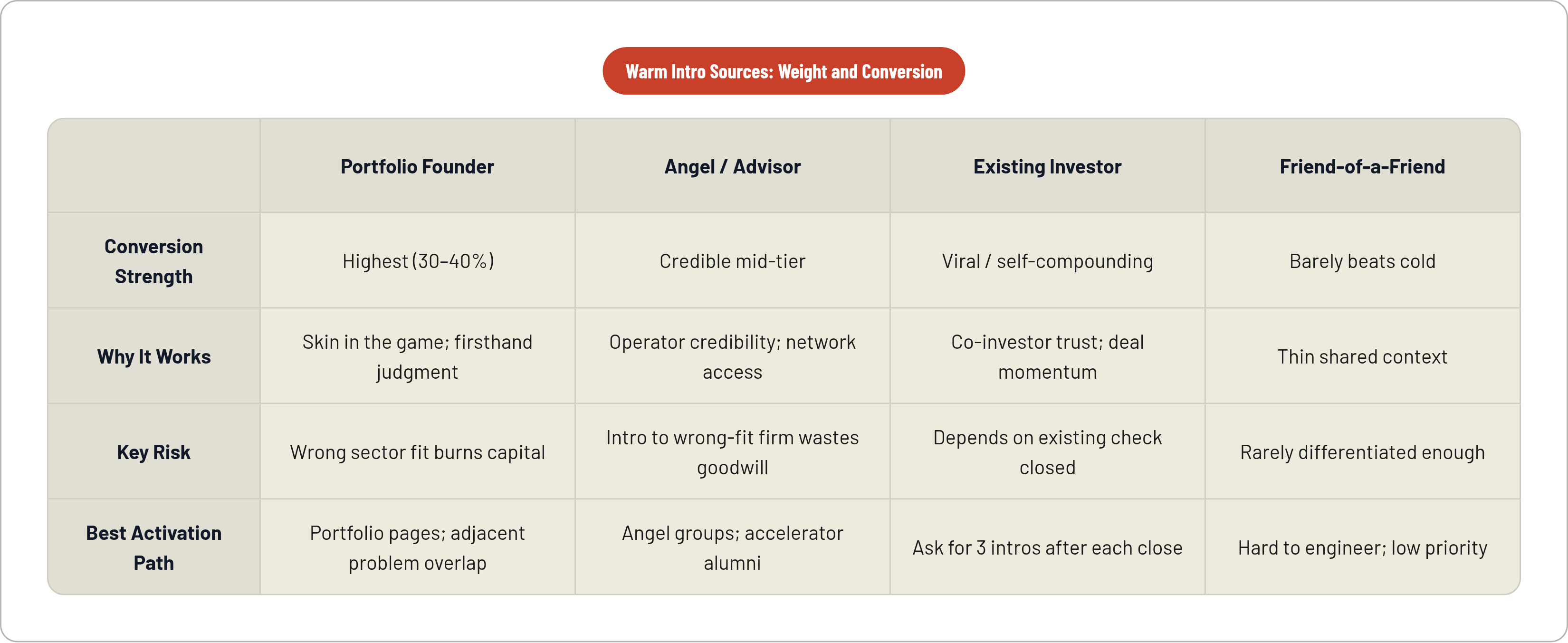
Intros carry different weight depending on the source, and pretending otherwise wastes your time. Portfolio founder intros convert highest, somewhere in the 30 to 40% range, because the investor knows that founder has skin in the game and actual firsthand knowledge of what good execution looks like. Angels and advisors sit a notch below, and friend-of-a-friend intros barely beat cold outreach, if they beat it at all.
Then there's the hot intro: an existing investor connecting you to a co-investor. This one's viral almost by accident, because one check turns into three intro requests, those turn into more checks, and the thing just keeps feeding itself.
What kills a good intro faster than anything is an introducer who has no idea what stage, sector, or check size the investor actually writes. That mismatch burns social capital for everyone in the chain, you included, so use the double opt-in before anything gets sent: have your introducer confirm the investor actually wants the connection first. It's a small courtesy that makes a big difference in outcome.
Worth saying plainly, because founders forget it constantly: the intro gets you the room. Conviction gets built inside that room, not on your deck, and what happens after the intro lands is entirely yours to blow.
Start ten to twelve weeks out, well before the week you open your round, though I get why that's when panic sets in.
The NYC investor landscape, and who's actually writing early checks
Of those 300-plus VC firms calling NYC home, the ones writing seed and early checks fit on a shorter list: Primary Venture Partners, Lerer Hippeau, BoxGroup, Work-Bench, FirstMark Capital, Eniac Ventures. Primary closed a $625 million Fund V in February 2026, the largest NYC-rooted seed vehicle in recent memory, so institutional money clearly still believes in early New York bets. Lerer Hippeau calls itself the most active early-stage fund in the city, with over 250 portfolio companies across consumer and enterprise.
Knowing a firm's lane saves everyone time. Union Square Ventures leans consumer tech and protocol bets, while FirstMark works e-commerce, marketplaces, and enterprise infrastructure. Greycroft covers media, brands, and consumer software, and Work-Bench and Boldstart both live in developer tools, just at different stages of the company's life.
Diligence culture here runs differently than the Bay Area, too, and that's not a small thing. This city grew up on financial services, and it shows in how people underwrite risk: unit economics and a believable path to profitability matter more here than in a comparable West Coast round. A lot of NYC general partners were founders themselves, which means a founder referral lands with extra weight, because they've had to develop that same judgment under fire.
Sector matters as much as geography. Fintech pulled in 36% of U.S. fintech fundraising in 2024, health tech saw 113 companies raise $4 billion, and AI logged 81 rounds worth roughly $1.5 billion in Q1 2025 alone. Know your vertical first, and the right door becomes obvious before you ever ask anyone for an intro.
Portfolio founders: the highest-yield source, full stop
Investors trust their own portfolio founders more than almost anyone in their orbit, no contest. A recommendation from someone they've already backed is a vote for your product and, more importantly, a vote for your judgment. Brian Devaney of Underscore VC said it best: a portfolio founder intro lands hardest "if it's a founder who has a right to an opinion on the problem you're solving."
So how do you actually reach these people? Most firms publish portfolio pages, plain and simple, so go find founders building adjacent to you and message them with an actual reason: a shared customer, a shared technical headache, a war story you both lived through. Lead with the problem, not the ask. The intro shows up on its own if the relationship's worth having.
NYC's density helps in a way people underrate constantly. Portfolio founders show up at the same events, live three subway stops from you, sit one degree away through someone you already know. You'll run into these people whether you plan to or not; the city's geography makes avoidance nearly impossible.
Once one investor writes you a check, ask for three intros to others. That's standard, not pushy, and you should keep those investors posted with real progress notes, because when your next round comes around, the introductions flowing back to you will come from people who watched you actually execute.
Angels and early investors: the infrastructure that compounds
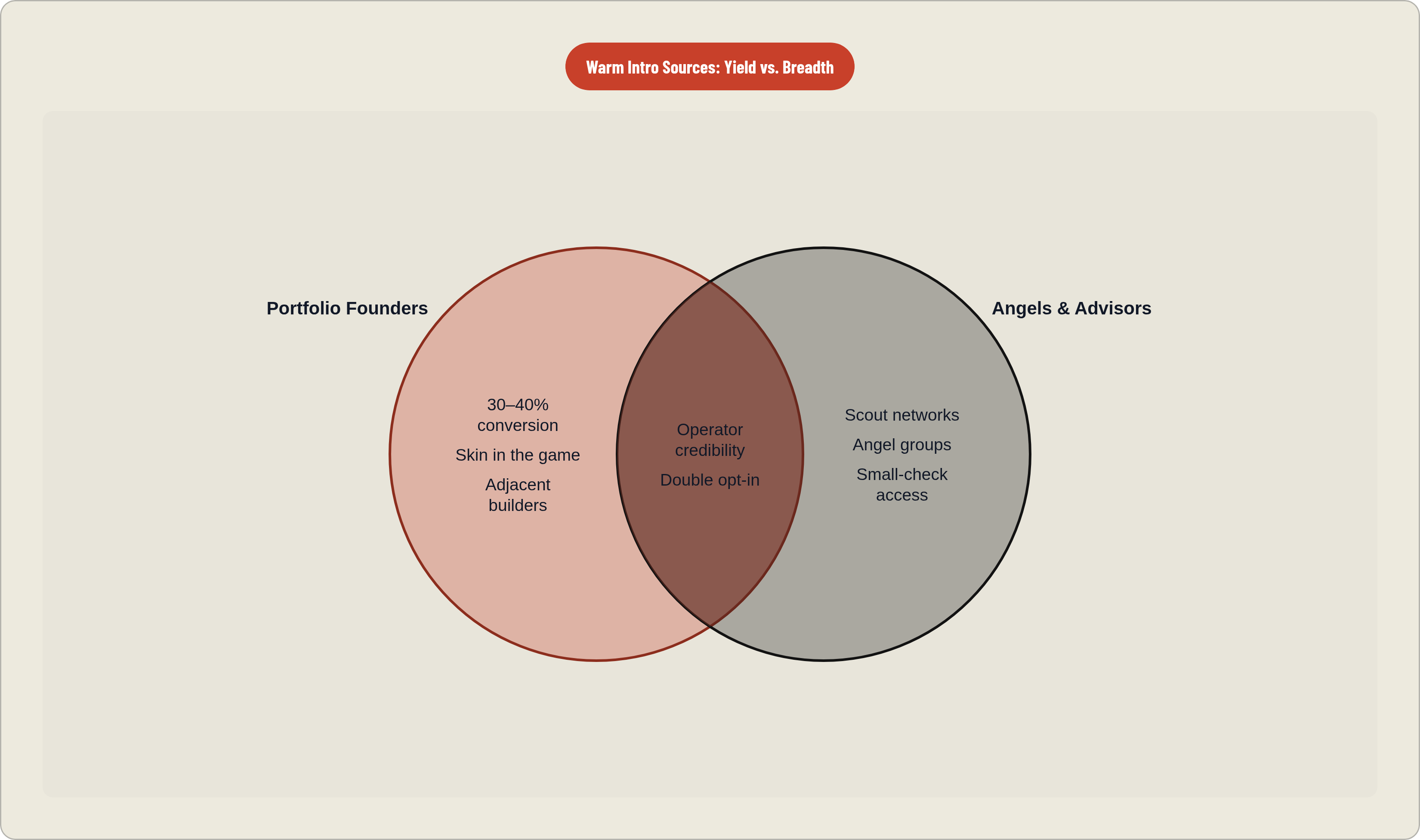
Angels and advisors occupy a credible middle ground, and their referrals land with real weight at seed stage, especially with investors who used to operate companies themselves. There's a small-check principle worth internalizing: taking even a modest check from a credible angel puts one more person in your corner, and suddenly their network is your network too. That dynamic plays out repeatedly: a modest early check from the right person can open doors well beyond its dollar size.
Unless you've got a genuinely good reason to pass, taking small checks from well-connected people expands your intro surface area faster than almost anything else available to you pre-seed. NYC has established angel groups with visible membership and pitch events worth showing up to. Operator-angels, former founders of successful NYC companies now writing checks themselves, are reachable through community events, accelerator alumni networks, and mutual founder connections.
There's the advisor path too. A well-chosen advisor sitting on a firm's scout network can make introductions that carry institutional weight, no check required. Same rule applies everywhere, though: an angel intro to the wrong-fit firm wastes everyone's goodwill, so do the homework regardless of who's vouching for you.
Accelerators: the structured pipeline
Accelerators solve the cold-start problem by design, which is really the whole pitch for doing one. You show up, and you leave with a peer network, an alumni network, and investor relationships, roughly all at once. The time compression is the actual value, more than any pitch coaching that happens along the way. That same logic applies to smaller, ongoing peer communities: NYC Founders Club, an invite-only dinner club for active NYC founders built around weekly chef's-table gatherings, exists precisely to keep those relationships warm and compounding outside any single program's timeline.
YC's alumni network in New York is one of the most direct paths to warm intros on either coast, and alumni refer each other constantly, almost reflexively. Techstars NYC runs deep local investor relationships, and its Demo Day works as a structured warm intro event for the entire cohort simultaneously.
Then there's the NYCEDC Founder Fellowship, which supports NYC-based entrepreneurs and connects them with local investors and ecosystem partners. Cohort partners bring distinct sector and demographic focuses, broadening the network founders can tap on the way through. Newlab gives members access to a broad investor and partner network, and its portfolio companies have gone on to raise substantial venture capital.
The real mechanism, though, is simpler than any of that: these programs hand you a warm introduction to a cohort of peers who'll be your best intro source for years. Alumni programming exists specifically to keep those relationships alive after the program ends, which is what turns a one-time cohort into something that compounds.
The informal layer: community events and the dinners you keep going back to
NYC's density is a real advantage here, grounded in how the city actually works day to day. Founders, investors, and operators keep landing in the same neighborhoods, the same restaurants, the same rooms, over and over, whether they mean to or not. Trust gets built through repetition; one handshake at a conference almost never does it alone.
FirstMark runs one of the more developed community platforms in NYC venture. Data Driven NYC draws tens of thousands of members in AI and ML, and its annual CEO Summit at the New York Stock Exchange puts 250 founders and VCs in the same room at once. These are curated crowds, and introductions happen because everyone there shares a specific professional context already.
Showing up once does almost nothing, if I'm honest. Showing up repeatedly, to the same dinner, the same working group, the same meetup, builds the kind of familiarity that makes an introduction feel earned rather than forced. Look for events with a consistent crowd rather than a rotating one, small enough for real conversation, organized around an actual shared problem instead of "networking" as the stated goal.
Investor-hosted infrastructure, firm events, portfolio dinners, founder guilds, tends to be the highest-trust environment of all, mostly because the investor's already sitting right there, so take every invitation you get to these.
Building in public, the slow-burn inbound play
Founders who post technical breakdowns, contrarian market takes, or honest build-in-public updates end up with investor inbound they never asked for. It's a documented pattern among early-stage founders who later closed seed rounds, and the mechanism isn't complicated: consistent, substantive writing establishes your point of view before anyone pitches anyone, so by the time an investor who's been reading gets on a call, they're already halfway convinced.
Set expectations honestly, though. This compounds over months, not weeks, and it will never carry a round on its own. But when you do start raising, some of your warmest intros will trace back to people who found you through your writing long before they found you through a deck.
NYC amplifies this more than most markets, because the city has a dense concentration of operator-investors, angels, and scouts who are genuinely active on LinkedIn and X, not just lurking. A sharp post in the right vertical reaches the right eyes faster here than almost anywhere else. What actually works: specificity, a real technical breakdown, a sharp take on a market dynamic you live inside daily, an honest account of a decision that blew up in your face. These signal judgment, and judgment is the actual product early-stage investors are buying. Growth-hacking posts and follower-count flexing don't move this particular audience, not even a little.
Building your own map before you ask anyone for anything
A warm intro is the output of relationship infrastructure built over time, and the founders who raise fastest in NYC are the ones who started that work a full year before they needed the check.
A working pre-raise map needs three layers, no more. First, targets: 20 to 30 firms whose stage, sector, and check size actually fit your company today, not the company you hope to be in eighteen months. Second, paths: for each firm, name the one or two people, a portfolio founder, an angel, an advisor, who can make a real double opt-in intro land instead of a forwarded email nobody asked for. Third, timeline: start activating those relationships 10 to 12 weeks before your round opens, because introductions made under visible time pressure feel transactional, and they tend to fail for exactly that reason.
Quality wins over quantity every single time here. Five targeted intros from credible, well-matched sources beat fifty warm-ish emails from people who never bothered learning the investor's actual thesis. After every check you close, ask for three more intros, send real progress updates, and treat each new investor as the seed of your next round's network. The flywheel only turns if you keep pushing it yourself; nobody spins it for you.
Ask around enough in this city and you'll notice something: the founders with the best intros never built those relationships for fundraising purposes in the first place. They built them because they wanted smart people in the room sharpening their thinking, and the money followed later, almost as an afterthought. A small, tight peer community, the kind where founders actually know each other's businesses cold, is where your best introductions come from eventually. The table you're sitting at matters just as much as whatever pitch you brought with you.