How YC Alumni Networks Function Outside of Silicon Valley
YC's network advantage in New York depends on building local connections beyond the platform.
Most people think Y Combinator is selling a large check. It isn't. The check matters, but what YC is actually selling is signal and access. The stamp of approval that makes investors pay attention. The alumni network that stays with you long after demo day. The valuation lift at seed that comes from investor competition created by YC's track record. For three months in San Francisco, you get intensive mentorship, a tight peer cohort, and a room full of people who want to help you win. Then the batch ends, you fly home, and the question nobody asks out loud becomes the most important one: what is all of that actually worth once you're somewhere else?
The answer is not simple. And if you're building in New York, it's worth understanding exactly how it works.
Where YC Companies Actually End Up After the Batch
The numbers are pretty telling. In a recent dataset of YC companies, more than 270 are headquartered in San Francisco. Nearly 310 are in California overall. New York shows up as the only real outlier, with around 70 companies, a small fraction of the total. Second place, but a distant second.
That gap is not just symbolic. It shapes how the network actually functions day to day.
Office hours, casual dinners, same-timezone investor relationships, run-ins at coffee shops in Hayes Valley. All of that tilts heavily toward the Bay Area. The Alumni Demo Day previews, the batch overlap introductions, the spontaneous "hey you should meet so-and-so" moments. They happen more naturally when you're physically close to where YC operates.
A New York-based YC founder is operating in a city that already hosts over 100 unicorns and a legitimate, thriving startup ecosystem. But the default infrastructure of the YC network was not built around them. It was built around proximity to Mountain View and San Francisco.
The platform exists everywhere. But whether it functions in New York is something founders have to figure out themselves — like a map that covers the whole country but was drawn by someone who only ever lived on the West Coast.
How the YC Alumni Network Actually Gets Used at a Distance
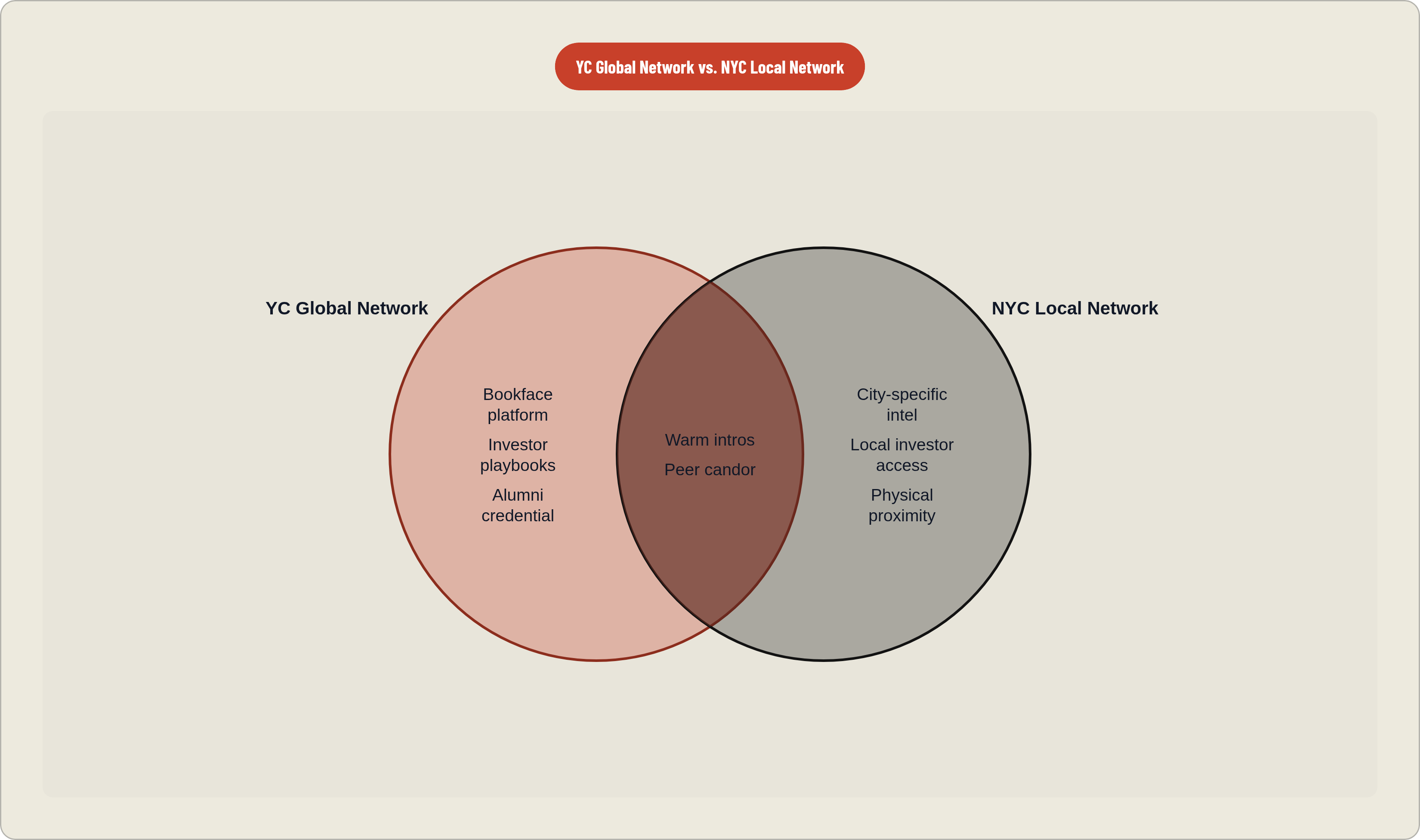
The main instrument is Bookface. It's a private, internal platform. Think of it as a combination of a forum, a directory, and a knowledge base, accessible only to YC alumni.
Here's what it's genuinely good at:
- Warm introductions at scale. Post that you need a crypto accountant, a legal referral, or a co-investor for your next round. Someone who's been there will respond.
- Investor lists and playbooks. Founders who have scaled share what worked. You can search by stage, sector, or what problem you're trying to solve.
- City filtering. Bookface lets you find other YC alumni in your city specifically, which tells you the platform already acknowledges that geography matters.
- Candor that's actually candid. Bookface runs on a strict confidentiality norm. What gets shared there stays internal. That's what makes people tell the truth.
But here's the honest part. A forum post can surface a name. It cannot build the trust that makes a warm introduction actually warm. An intro from someone who has watched you operate in real life carries different weight than one from a profile match in a directory.
The knowledge base is broad. It is also impersonal. That is the unavoidable tension of any large online community. The context collapses. The nuance gets lost. The advice that would be precise if it came from someone who knew your specific situation becomes general enough to apply to everyone and specific enough to help no one — it's like getting directions that are technically accurate but leave out the part about the road closure.
Bookface is necessary. It is not sufficient. The founders getting the most out of it are the ones layering something local on top of it.
Why New York's Startup Momentum Makes Local Network Density Worth Pursuing
New York is not a consolation prize for founders who couldn't make it work in San Francisco. The numbers make that clear.
NYC firms raised $31.1 billion in venture capital in 2025, up $6.2 billion over 2024. New York startups closed 869 deals totaling $18.7 billion in 2024 alone, signaling a return to pre-pandemic venture activity. New York's share of national funding climbed to 13.5% in late 2025, its highest recent level, even as the broader U.S. market contracted 15.4%.
And the sector depth is real for the kinds of companies YC produces:
- Fintech. New York captured 36% of U.S. fintech fundraising in 2024, up from 25% the year before.
- AI. More than 1,000 AI-related companies in NYC have raised $27 billion since 2019. The city accounts for 14% of U.S. Seed and Series A fundraising in AI in 2025.
- Health tech. 113 New York-based health tech companies raised $4 billion in 2024, up 60% from 2023.
New VC fund formation is keeping pace too. Of the 70 VC funds under $200 million announced in 2024, 20 were in NYC, on par with the Bay Area.
Then there's the physical density. The Flatiron and Midtown South corridor puts founders within walking distance of investors, accelerators, and peer companies. Ramp occupies 132,000 square feet in the city. Adyen is at 90,000. AI companies are clustering along West 21st and West 23rd Streets. You can walk to your next meeting. That matters more than people admit.
New York has the capital, the sector depth, and the physical proximity to function as a self-sufficient ecosystem. A well-connected founder here is not at a disadvantage. But only if they are actually connected.
What the YC Network Cannot Do for a New York Founder That a Local Peer Group Can
Let's draw the line honestly.
Bookface scales to thousands of founders. The introductions that actually change a company's trajectory come from a handful of people who genuinely know you. There's a gap between those two things, and it's worth naming.
The trust problem is real. A warm intro from someone who has sat across a table from you, watched you pitch badly and recover, seen you make a decision under pressure — that intro carries different weight than one from someone who matched your profile in a directory.
Local knowledge doesn't travel well through forums. The platform cannot tell you:
- Which NYC investors are actually active at seed versus just performing interest
- Which neighborhoods are worth the rent premium for cluster effects
- Which hiring referrals require real reputation transfer rather than a LinkedIn tag
- How to navigate NYC-specific regulatory, real estate, and operational context
The cohort timing problem compounds this. YC runs two batches per year. Any given NYC founder's batch may include only a handful of other New York companies. The cohort bond that forms in San Francisco doesn't automatically translate into an ongoing local peer group once everyone flies home.
What scales across a global network is playbooks, investor lists, and sector knowledge. What requires physical proximity is something different: candor, accountability, and the kind of pattern recognition that only comes from watching founders operate in the same city over time.
This is not a knock on Bookface. It does what it does well. The point is just that it structurally cannot do everything, and knowing the difference is useful.
How YC Alumni in New York Have Adapted by Building Local Structures Around the Network
The founders who get the most out of being a YC alum in New York are not the ones who rely on Bookface most heavily. They're the ones who use it as a starting point and then move the relationship offline.
The pattern looks roughly like this:
Use the city filter to identify who's here. Reach out. Get coffee. Then get dinner with a small group. Then make it recurring.
Recurring small-group dinners are where founders say things they would not post to a forum. It's where introductions come from people who have actually watched you operate over months. The environments where the candor happens are not the ones with the widest reach. They're the ones with the most trust.
YC alumni in New York have repeatedly self-organized into their own cohort-adjacent groups, often around sector, stage, or shared batch year. The program seeds the relationship. Local founders extend it into something the program itself wasn't designed to provide.
Co-investment behavior reflects this too. NYC-based YC founders regularly invest in one another's companies. That is not a behavior that emerges from a forum post. It requires the kind of trust that builds through repeated interaction over time.
And the network effects within a city compound faster than in the global network, because the people are reachable and the context is shared. Win the trust of one well-connected New York YC founder, and the referral loops within that local subset move quickly. Because everyone knows everyone, and everyone is in the same zip code.
What this looks like in practice: a founder who moves through YC and stays in New York builds a reputation with a small cluster of local peers who know their actual operating style. That cluster becomes the real unit of support. Faster feedback. More candid conversations. More context-aware advice than any forum thread can provide.
Why In-Person, City-Rooted Founder Community Produces Outcomes the Global Network Cannot Replicate
Trust is the scarce input. Everything else is abundant.
Information is abundant. Introductions are abundant. Investor names and playbooks and sector breakdowns are abundant. What is actually hard to find is someone who will tell you that your pricing model is wrong, clearly and directly, because they know you well enough to say it and have no incentive to flatter you.
That kind of honesty travels through relationships. Not platforms.
A room of six founders who have met weekly for a year holds more actionable context about one another than a forum of thousands — it's the difference between a weather forecast and someone who's been standing in the rain with you all morning. Introductions from that room carry real weight because the person making the intro has watched you operate, not just read your profile. The epistemic value of that is genuinely different.
The privacy dynamic matters here too. Bookface enforces confidentiality at scale because it has to. The same norm in a small in-person group functions more reliably because the group is small and the relationships are real. You know exactly who's in the room. There's no ambiguity about what stays there.
And then there's the city-as-context effect, which is easy to underestimate. New York founders share a regulatory environment, a real estate market, a talent pool, and a particular set of investor relationships. They share the rhythm of building in a city that is not a monoculture, where the startup ecosystem is one of many industries competing for attention and talent. That shared context makes peer advice more precise. The founder who told you to try that landlord in Dumbo, or avoid that particular seed firm that slow-walks term sheets, is not giving you generic startup advice. They're giving you local intelligence with real stakes attached.
Here's the through-line: YC builds the alumni credential and the platform. Both are genuinely valuable. What determines whether that network produces real, compounding value for a New York founder is whether they have built, or found, the local in-person layer the program itself cannot supply at a distance.
The program gets you in the room. What you do with that, in your city, with your people, after the batch ends. That part is on you. NYC Founders Club, a weekly chef's-table dinner community for active NYC startup founders that was itself founded by three YC alumni, is one concrete attempt to build exactly that local layer.