Customer Discovery Interviews for NYC Consumer Startups
New York's density turns customer discovery into a competitive advantage for consumer startups.

If you are building a consumer startup in New York City and you are still doing discovery by sending out surveys, you are leaving the best research tool on the planet completely untouched. The city itself is the lab. The question is whether you know how to use it.
Most first-time founders learn this the hard way. They fall in love with their solution, skip the part where they actually talk to customers, and then wonder why nobody is buying. Steve Blank wrote about this decades ago. Eric Ries made it famous. And yet, the pattern repeats constantly: founders treat customer discovery as a box to check rather than a practice to build. The ones who get it right, almost always got it wrong first, on a previous startup that didn't make it.
This piece is not going to argue whether you should do customer discovery. You should. What it is going to do is show you how to do it well, and make the case that where you do it changes how fast you learn. For consumer founders, New York is a cheat code. Here is how to use it.
What a Customer Discovery Interview Is Actually Trying to Do
Let's clear this up immediately. A customer discovery interview is not market research. It is not a sales call. It is not a "validation exercise" where you go find people to tell you your idea is great.
It is a disciplined effort to understand what people already do, and what hurts.
You are not asking people what they want. You are watching, listening, and asking them to describe their actual behavior. The goal is to surface:
- The exact words customers use to describe their problem (this matters more than you think — those words become your copy, your pitch, your landing page)
- Workarounds they have already built (someone who built a clunky workaround has a real problem; someone who hasn't probably doesn't)
- What triggers urgency — when does the problem go from annoying to actually painful enough to act on?
- Must-haves versus deal breakers — not the same thing
- Who else is involved in the decision to buy or use something
The two traps that kill most interviews are simple and avoidable.
The first: asking "Would you use this?" Future-tense questions produce optimistic fiction. People want to be helpful. They will tell you yes. It means nothing.
The second: pitching mid-interview. The moment you start selling, the person in front of you switches into "be nice" mode. They stop telling you the truth. Learning stops.
The highest-return sentence in early-stage building is this one: "Tell me about the last time…" Past tense. Specific. Real. That is where the signal lives.
One more thing that matters enormously for how this works in New York: consumer interviews can be short. Fifteen minutes is often enough. You do not need to schedule a one-hour Zoom call. You need a coffee.
How to Structure Interviews and Know When You Have Enough
The opening matters. Do not start with a pitch. Start with context.
Something like: "I'm talking to a few people to understand how they handle X. I'm not selling anything. I just want to hear about your experience."
That sentence alone lowers defenses. Then ask them to walk you through a real, recent situation. Not hypothetical. Not "what do you usually do." Specific. "What happened the last time you dealt with this?"
A few structural notes on cadence and format:
- Consumer interviews often wrap in 15 minutes. That is a feature, not a flaw.
- B2B interviews can run two hours or more. The Winware founder famously ran two to four interviews per day before building anything and spoke with more than 300 companies before feeling confident. Consumer founders can move faster, but the spirit is the same: volume before conviction.
- After 8 to 12 interviews, patterns start repeating. That is your signal to synthesize.
What the synthesis should capture:
- Top pains in customers' exact words (not your paraphrase)
- Workarounds they built
- Urgency triggers
- Must-haves and deal breakers
- How decisions actually get made
Here is an underrated piece of advice: bring a teammate to every interview you can. Founders who have their engineer or designer sit in, even quietly, remove an entire translation layer. The engineer does not just read a summary. They remember the exact face the person made when they described the problem. That is worth more than a JIRA ticket.
Compensation is usually not a big issue in consumer contexts, especially for short conversations. A five or ten dollar gift card works fine. In many NYC situations, if the topic is relevant to someone's life and the conversation is brief, you may not need anything at all.
End every interview with one question: "Is there anyone else I should talk to?" Snowball sampling is the most efficient recruiting tool you have, and most founders forget to use it.
Why New York's Density Makes Recruiting Interviewees a Different Problem Than Everywhere Else
The most time-consuming part of customer discovery is usually not running the interviews. It is finding the people.
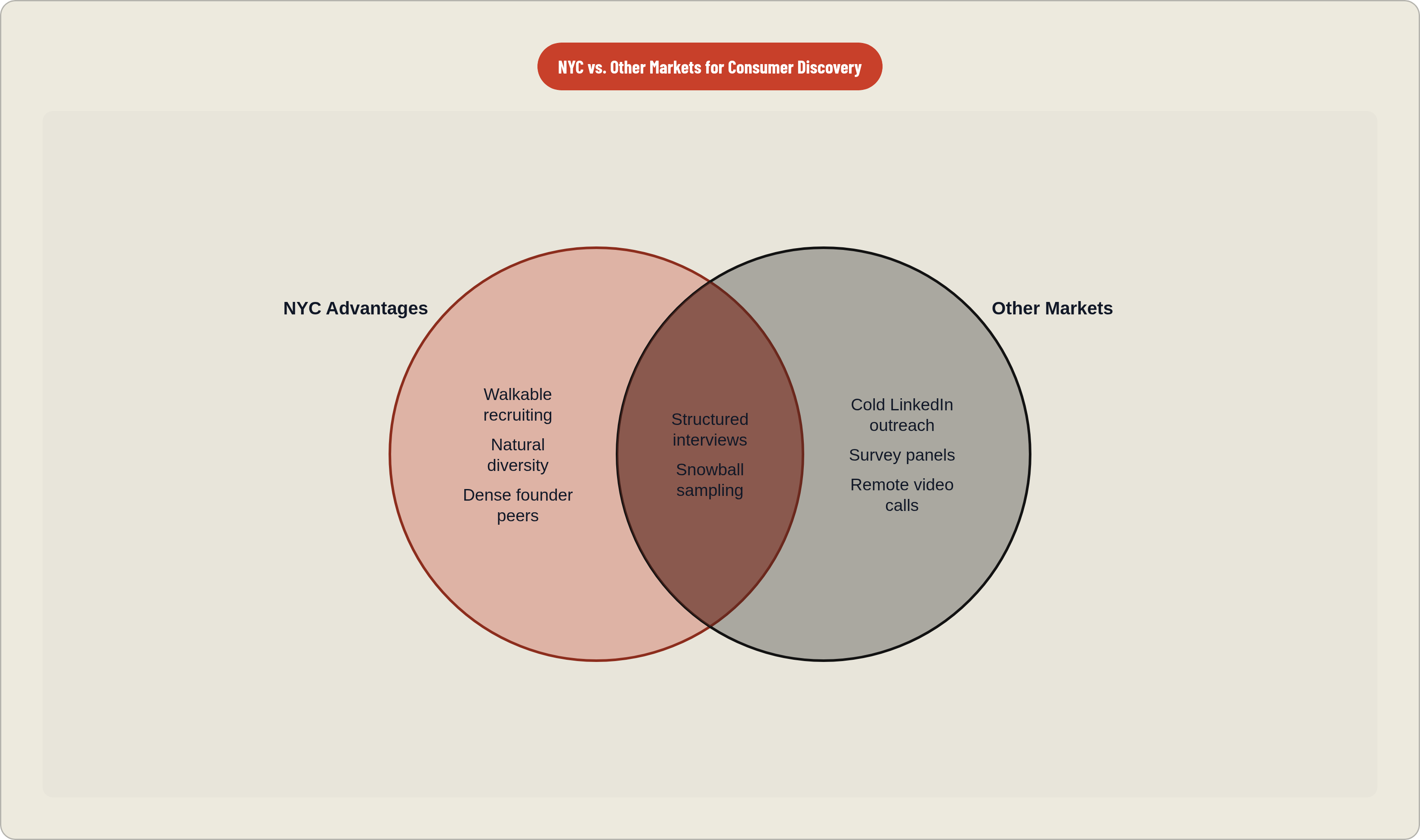
Cold LinkedIn outreach has a low success rate. Survey panels introduce self-selection bias. Remote video calls produce polished, careful answers from people who are performing rather than reflecting. Asynchronous tools add lag to the learning loop. All of these are real problems, and most discovery advice treats them as facts of life.
In New York, they are mostly optional.
The city has millions of residents. A five-minute walk to a coffee shop can yield a real conversation with a real customer. That is not a small difference. That is the entire argument in one sentence.
And it is not just volume. New York gives you range. The consumer base spans age, income, background, and behavior in a way that no survey panel fully replicates. You can find early adopters, skeptics, edge cases, and mainstream users within walking distance of each other. That is a naturally stratified sample. Most founders in lower-density markets have to work hard to get that range. In New York, you have to work hard to avoid it.
The city's consumer base is also digitally engaged and already accustomed to being asked about products and services. This is not a population that finds the concept of a quick product conversation strange.
Personal networks, investor networks, and content that attracts inbound interest still matter here. But all of those tactics produce more in a high-density environment than in a scattered one. The baseline is just higher.
The Neighborhoods Where Consumer Discovery Happens Fastest
New York is not one market. Anyone who treats it as one is already leaving information on the table.
Different neighborhoods surface different customer profiles. Knowing which to target is itself a discovery skill.
- SoHo is where you go for consumer tech, fashion, beauty, and design-forward products. Early adopters who are brand-literate and opinion-forward. Good for testing positioning and aesthetic assumptions.
- Flatiron and Union Square skew toward tech workers, operators, and professionals. Useful for B2B-adjacent consumer products, productivity tools, and fintech with a consumer face.
- Williamsburg and DUMBO give you younger talent, creative and lifestyle brands, and renters with very specific urban-living pain points. Rents also run significantly lower than Manhattan, which affects the economics of operating in these areas as a founder.
Beyond neighborhoods, the field itself is always open. Subway commuters, coffee shop regulars, lunch crowds. Discovery in New York does not require scheduling. The population is just there.
A founder building a luxury consumer product and one building a budget wellness app are interviewing in different boroughs. The city lets you self-select your sample by geography. That is a feature that no other research method offers.
The serendipity argument is real, too. Casual conversations at a Flatiron coffee counter, at a food market, waiting in line at a pop-up. That kind of ambient research is something remote founders simply cannot replicate. It is not a replacement for structured interviews, but it feeds the same learning loop.
How NYC's Demographic Makeup Sharpens What Founders Learn
Here is a failure mode nobody talks about enough: founders who only interview people like themselves build products for a narrow slice of the market and then call it validation.
It is genuinely hard to catch yourself doing this. The people who are easiest to recruit are usually the people who are most like you. And if you are a founder in your thirties with a certain income and a certain background, your early sample is already biased before you ask a single question.
New York is a natural correction for this.
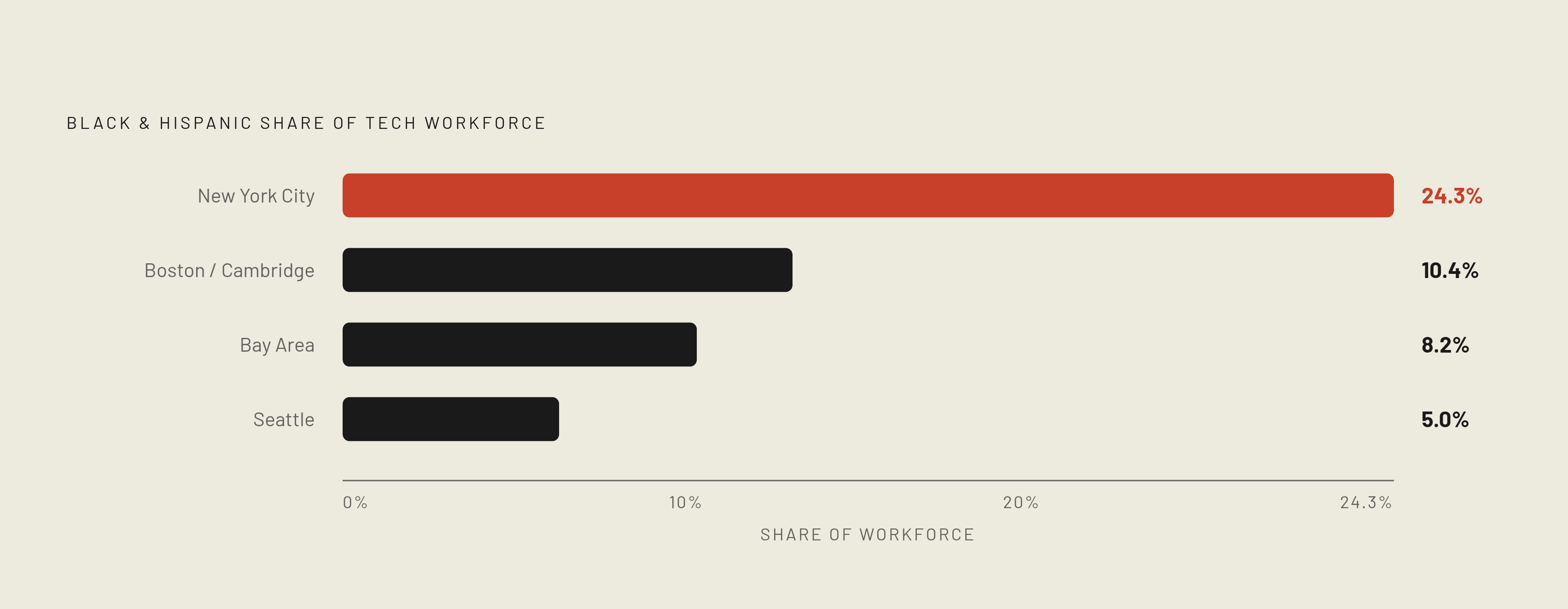
The consumer base here spans income levels, cultures, languages, and life stages in a way that no survey panel fully captures. And the founder community reflects this more than most startup ecosystems do. Black and Hispanic New Yorkers make up 24.3% of NYC's tech sector workforce, compared to 10.4% in Boston/Cambridge, 8.2% in the Bay Area, and 5% in Seattle. Founder teams that reflect that diversity tend to have less translation error in their discovery process. They are more naturally attuned to the range of customer segments they are interviewing.
For consumer startups specifically, this matters a lot. Products built and validated in New York get stress-tested against a broader population profile before they scale. That is a real head start on product-market fit. The alternative, a product that works beautifully for one demographic cohort and falls apart the moment distribution widens, is a very common and very expensive mistake.
What the Funding Environment Means for Consumer Founders Who Skip Discovery
The funding climate for consumer startups is not particularly friendly right now, and founders should understand what that means for their discovery practice.
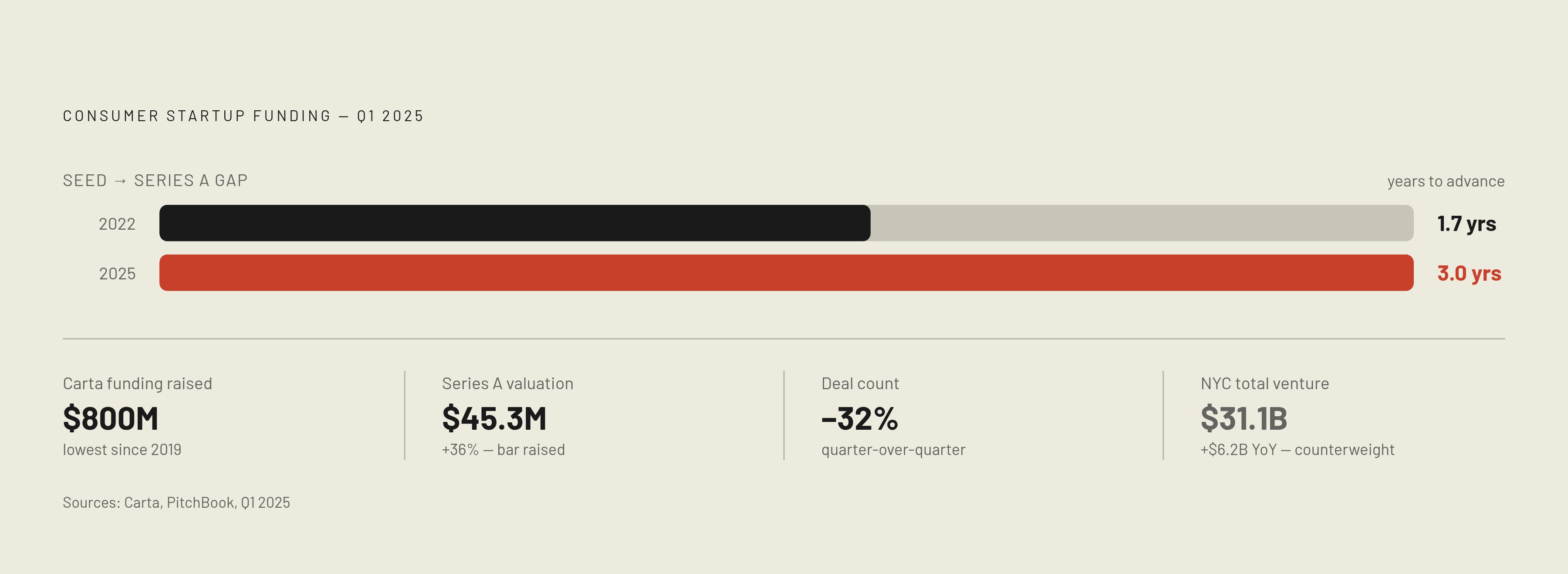
Consumer startups on Carta raised just $800 million in Q1 2025. That is the lowest level since 2019. Series A valuations jumped 36% to $45.3 million while deal counts fell 32% quarter-over-quarter. The gap between seed and Series A has stretched from 1.7 years to 3 years.
What that last number means in practice: founders have more time between rounds and less margin for a wrong assumption. Investors are concentrating bets, not spreading them. They are looking for evidence of genuine pull, not projected demand built on survey data and optimism.
Consumer and D2C models already tend to struggle with high customer acquisition costs and thin margins. In that environment, "we think customers want this" is not a compelling position. "Here is what 40 customers told us, in their own words, and here is the workaround they are currently using" is a different conversation entirely.
The counterweight worth mentioning: even as consumer funding tightens nationally, New York's overall venture momentum remains strong. The city raised $31.1 billion in 2025, up $6.2 billion over the prior year. Capital is still moving here. Founders who can demonstrate real customer insight are operating in a market where that insight gets rewarded. Thorough discovery is not just good practice in this environment. It may be what separates fundable from unfundable.
How Founders Who Treat the City as a Lab Actually Run Their Discovery Practice
The framing shift is this: stop thinking of customer discovery as a scheduled research activity. Start treating it as an ongoing practice the city makes possible every single day.
What that looks like in practice:
- Identify two or three neighborhoods where your target customer concentrates. Go there regularly, not once.
- Build short intercept conversations into the rhythm of your week. Fifteen minutes over a coffee is enough. The consumer interview window in NYC is a commute, a lunch, a quick chat before someone heads back to work.
- Bring a teammate whenever you can. An engineer or designer who hears the conversation firsthand will not just read a synthesis. They will remember the exact words. That matters when decisions get made later.
For recruiting beyond the street:
- Warm network first. Personal contacts, then investor contacts, before cold outreach.
- End every interview with "Who else should I talk to?" Snowball sampling moves faster inside a dense social network.
- Write about the problem, not the solution. Post on LinkedIn, in newsletters, in community groups. The right readers will respond. Content that signals you understand the pain attracts people who have it.
After 8 to 12 interviews, write the one-pager. Top pains in customers' exact words. Workarounds. Urgency triggers. Deal breakers. Share it with the whole team. Not just product. Everyone.
Then do the thing most founders skip: take the phrases customers used and put them verbatim in your early copy, your pitch deck, your landing page. When future customers read language that sounds like their own words, they notice. It signals that someone actually listened.
One thing not to do: do not confuse a positive reaction in an interview with a buying signal. Positive reactions are cheap in New York, where people are socially sophisticated and professionally polite. Someone saying "oh that is really interesting" in a coffee shop in SoHo is not a customer. Someone describing a workaround they built six months ago because they could not find anything better, that is a customer.
Why Peer Founders Are Part of the Discovery Infrastructure
Discovery does not end when the interview is over. It ends when you have stress-tested your interpretation with people who have done this before and have no reason to be nice.
In New York, that peer layer is unusually accessible. Manhattan alone sees hundreds of companies raising seed or Series A rounds in a single year. The density of founders who have recently been through exactly what you are navigating is genuinely rare outside of a few cities.
What a real peer conversation gives you that a solo debrief does not:
- Pattern matching. A founder who built in your category two years ago has already made the mistake you are about to make. They will tell you what it cost them.
- Honest reframes. Someone with no stake in your outcome will say what a friendly investor will not.
- Warm intros to interviewees. The fastest recruiting tool in discovery is someone who can say "you should talk to my friend who has this exact problem." That one sentence is worth a dozen cold LinkedIn messages.
One distinction worth making: a peer network that produces this kind of honesty is built across a table over time, not in a Slack channel or a LinkedIn thread. That kind of trust gets built at recurring in-person gatherings where the same founders show up week after week. Trust is the prerequisite, and trust requires repetition and showing up in person. The city makes that possible because the people are here and the density creates natural overlapping contexts to meet them in.
The through-line is simple. New York gives consumer founders the raw material for great discovery: density, diversity, and street-level access to real people with real problems. And it gives them the peer community to help interpret what they find. Both matter. In New York, both are available. The only question is whether you show up.