Referral and Word-of-Mouth Growth in NYC Professional Networks

Start with the number, because it's easy to lowball this city. NYC startups pulled in $18.7 billion across 869 deals in 2024, up 35% from $13.9 billion the year before. New York ranks #2 in the world for startup ecosystems, right behind Silicon Valley. The metro area has 178 unicorns, and more than 300 VC firms raised $9.9 billion here last year, collectively.
So yes, this is one of the two biggest rooms in the world to build a company in, and that's the catch.
When money and talent pile up this densely, opportunity stops being the bottleneck, and access becomes the bottleneck instead. There's no shortage of capital in New York; the hard part is getting a specific person to look at you four seconds longer than the twenty other founders pitching them that same week. The density that makes this city the best place to find an investor is the exact same density that makes it almost impossible to reach one cold. The noise grows faster than the signal.
How warm introductions actually work — the mechanics of trust transfer
A warm intro is a trust transfer, plain and simple. The person making the introduction puts their own name on the line for you, and they know it.
Picture the investor's head for a second, when a colleague they trust sends over a founder. The thought is something closer to "this person wouldn't waste my time" than "let me evaluate this deck." That's the whole signal, and the deck barely matters yet, because the intro already did the convincing before anyone opened a single slide.
The numbers back this up hard. Research tracked by evalyze.ai finds warm intros make a founder roughly 13 times more likely to get funded than cold outreach, a gap wide enough to change the odds entirely. VCs field somewhere between 300 and 500 inbound pitches a month and realistically read maybe 50 of them fully, scheduling actual meetings for only 3 to 5. A warm intro gets you sorted into that pile of 50 instead of the pile skimmed once and forgotten by lunch. And it's a channel with real weight behind it: half of all VC deals trace back to professional networks or co-investor referrals.
None of this stays confined to fundraising, by the way. Hiring referrals, customer intros, co-founder matches, they all run on the same trust-transfer wiring underneath.
Not all introductions are equal — the hierarchy of intro quality
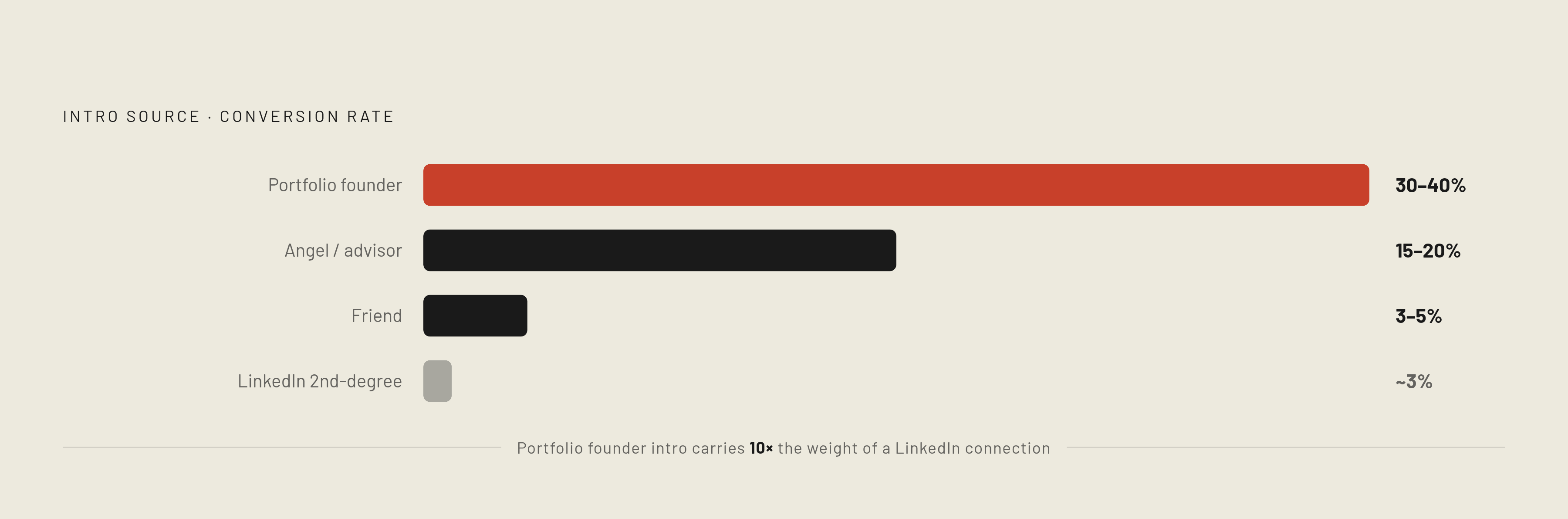
People treat an intro like an intro, as if they're interchangeable, but they're not, and the gap between types is enormous.
Portfolio founder intros convert at 30 to 40%. Intros from angels and advisors land at 15 to 20%. Intros from friends sit at just 3 to 5%, which is basically the gap between a real conversation and a polite "thanks, I'll pass." An intro from an existing investor carries roughly 10 times the weight of a LinkedIn second-degree connection, because that investor has actual money riding on their own judgment.
Brian Devaney, Senior Associate at Underscore VC, puts the gold standard at an intro from a founder the investor already trusts, ideally one who's earned real credibility on the exact problem you're solving. That's about as close to a guaranteed read as it gets in this business.
The real question isn't who's in your contacts list, then. It's how well those people actually know you as an operator. Someone who watched you claw through a brutal quarter is a completely different reference than someone who shook your hand once at a conference in 2022. For a founder in New York, the sharper question to ask is "do I know people who'd bet their own name on mine," well beyond simply knowing investors.
Word-of-mouth as the underlying engine — what the broader research shows
Zoom out, and this is just human nature scaled up. People consistently trust recommendations from colleagues and peers over any other channel, and in B2B specifically, word of mouth influences purchasing decisions at a striking rate — which matters enormously in a city whose whole professional economy runs on B2B relationships.
Here's the part that compounds: referred customers tend to carry meaningfully higher lifetime value and are more likely to refer someone else themselves. Trust doesn't just transfer once; it multiplies.
For a New York startup, this shows up constantly. A referred candidate walks in already carrying someone's endorsement. A warm intro to a pilot customer works like a soft product review before the product's even shipped. Investor networks co-refer each other for the same reason friends recommend the same three restaurants: being vouched for changes the entire tone of the first conversation, and your odds of getting one along with it.
The structural reason NYC rewards tight networks over large ones
New York crams finance, media, fashion, real estate, and tech into one walkable grid, which almost no other city manages. Cross-industry introductions happen here constantly, in ways they just don't in a city built around a single dominant industry.
NYCEDC data shows a coalition of NYC-based investors directed more than 60% of their money toward NYC-based companies. Proximity and relationship density compound quietly, then all at once, the way interest does. Manhattan alone now hosts more early-stage startups than San Francisco, with 543 companies raising seed or Series A in a single year. That's a lot of founders fighting over the same limited stretch of attention.
Here's the part worth sitting with for a second: the city is massive, but the circles that actually matter inside it are tiny. The same fifty or so people turn up at the same dinners, the same demo nights, the same weekend retreats, over and over. That repetition builds real trust in a way a conference badge never will, no matter how nice the lanyard. In a market this crowded, belonging to a tight network is a genuine edge; it shrinks how long it takes to reach the right person, and it raises the quality of the signal once you're actually there.
How IRL events in NYC actually generate deal flow and relationships
NY Tech Week anchors the calendar. The 2025 edition, presented by a16z, ran hundreds of independent events across Manhattan and Brooklyn. That's not a typo — a thousand events, hosted by startups, VCs, and operators, crammed into the same handful of days.
The value concentrates in the smallest rooms: invite-only dinners with zero pitching allowed, private AI salons with a handpicked guest list, curated speed-dating sessions between founders and VCs. Tight guest lists on purpose, with no panels and no stages. The whole point is candid conversation and repeat contact, at a scale far smaller than a broadcast to three hundred strangers holding name-tag stickers.
Underneath the flashy one-off weeks sits the recurring stuff that actually does the heavy lifting. NYC AI Demos runs as the largest monthly AI event on the East Coast. NY Tech Meetup has been going since 2004 and has grown past 60,000 members. These aren't lightning-in-a-bottle moments; they're standing appointments people build their month around.
Here's the practical takeaway: this scene is too spread out across too many neighborhoods to stumble into by accident. Density gets assembled on purpose, at a specific address, for a specific few hours, then it disassembles again by midnight like nothing happened. You have to pick your recurring rooms deliberately, because showing up once gets you a business card, while showing up monthly gets you a reputation.
What founders who move fast in NYC actually do differently
The fast ones start early, well before they're desperate for a check. Intro requests should begin 10 to 12 weeks before you actually need the capital, and founders who start building the relationship six months out or more tend to close at meaningfully higher valuations than the ones cold-emailing the week their runway starts looking scary.
They also think quality over quantity, every time. One introduction from someone who genuinely knows both the founder and the investor beats five introductions from loose, half-remembered LinkedIn contacts. Per Underscore VC, the sharpest founders invest specifically in people one stage behind or one stage ahead of them; non-competitive same-stage investors and adjacent-stage operators tend to make the best intro sources precisely because they've got nothing to compete with you over.
They keep showing up to the same rooms, again and again, because trust compounds through repetition, more than through any single well-timed appearance at the right party. The founders people actually know in this community are the ones who've been present for a year straight, more than the ones who parachuted in with a Series A deck and vanished the week after. They also treat referrals as a two-way street: making good introductions for other people is what earns you the right to receive them back.
One thing worth saying plainly, though: warm intro networks can entrench the same biases they're built on. Critics including Del Johnson at Plexo Capital, along with research out of Harvard, have pointed out that VCs relying on homogeneous networks underperform over time. The best networks aren't just tight; they're built on purpose, with real intention about who's actually in the room.
Why small, curated peer groups produce outcomes that large networks cannot
The research doesn't leave much room to argue here: referred relationships are more loyal, more profitable, and more likely to spin off further referrals down the line. That's a structurally better outcome, well beyond a merely friendlier-feeling version of the same one.
What no spreadsheet captures is everything that happens before anyone asks for anything: the honest feedback over a drink, the blunt read on your pitch that a stranger would never bother giving you for free, the introduction someone makes with zero angle, purely because they think two people should know each other. None of that shows up in a CRM, and all of it is where the actual value sits.
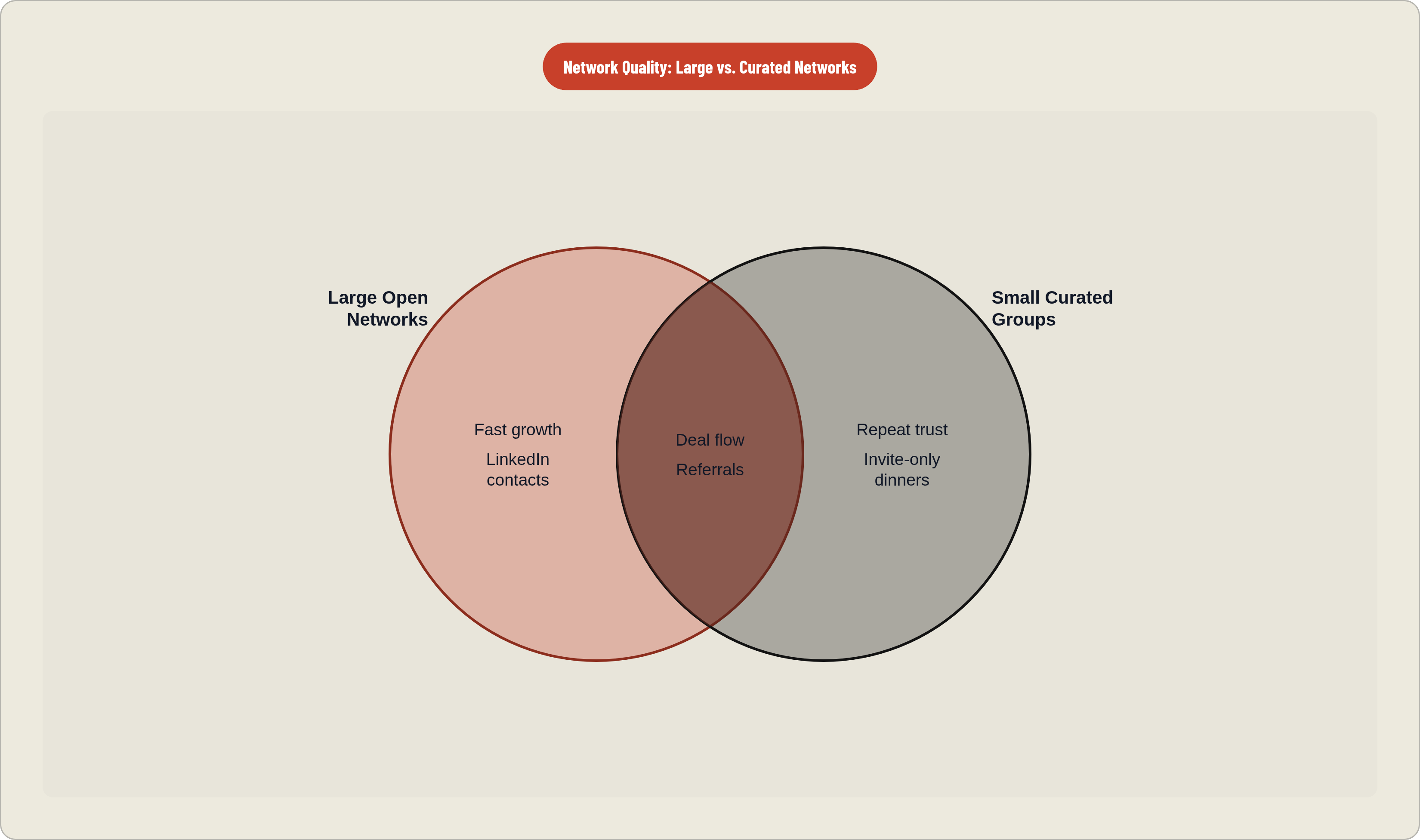
In New York, a tight peer group of active founders becomes its own kind of infrastructure. It generates deal flow, hiring leads, co-investor relationships, and early customers without a single formal process behind any of it. There's a real tradeoff here: a large, open network grows fast, but the average introduction inside it is worth almost nothing. A small, curated group grows slower, but every introduction is staked on someone actually knowing both sides of it.
New York already hands founders the density and the capital, no extra effort required. What most people skip is the smaller, slower, recurring part: a real peer group, meeting in person, often enough that trust actually has time to form. That's the piece of this ecosystem money can't buy outright, and somehow it's the piece that ends up mattering most.