Using NYC Investor Introductions to Land First Enterprise Customers
Warm introductions from investors convert far better than cold outreach.

Cold email is a numbers game, and the numbers are ugly. In 2024, across tens of millions of tracked B2B cold emails, reply rates sat somewhere between 3% and 5%. Send a hundred emails, watch 96 of them disappear. No reply. No meeting. No deal. And it's getting worse every year.
That one statistic should completely reframe how early-stage founders think about their investors. The most valuable thing a NYC-based investor carries isn't the check. It's a direct line to the exact enterprise buyer you've been cold-emailing into the void for six months.
Here's the actual problem with cold outreach. A senior decision-maker at an enterprise company gets more than 100 sales emails a week. They're being asked to stake their quarter, sometimes their career, on a vendor decision. The first thing they ask when an unknown name shows up in their inbox isn't "does this look interesting?" It's: "do I have any reason whatsoever to trust these people?"
Cold email cannot answer that question. No matter how clever your subject line is.
Enterprise buying isn't a solo sport either. A modern B2B purchase typically runs through six to ten stakeholders. You're not convincing one person. You're convincing a procurement committee, a legal team, an IT department, and a budget owner, often simultaneously. Cold outreach into that environment doesn't just struggle. It basically fails.
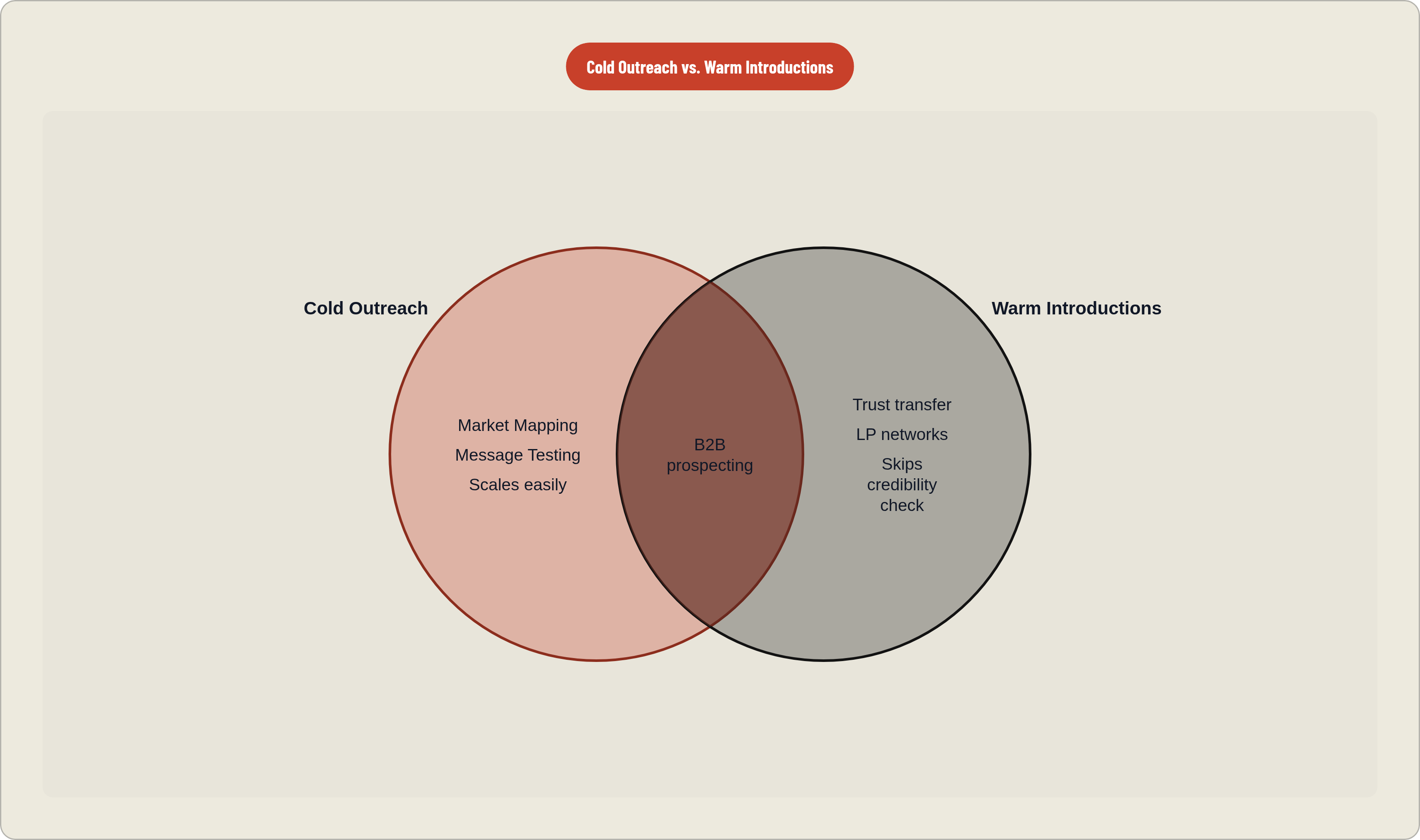
Warm introductions solve this at the root. When a mutual contact vouches for you, the buyer skips the credibility-verification phase entirely. The trust that cold outreach slowly builds over weeks of follow-ups and case study decks is already there on day one. Across both fundraising and B2B sales research, warm introductions convert to first conversations at dramatically higher rates. The gap isn't marginal.
Cold outreach has its uses. Market mapping. Message testing. Figuring out who the right buyer even is. But as a conversion tool in enterprise sales, it's not the channel. The warm introduction is. And investors are the best source of those introductions a founder is going to find.
What investors actually have that makes their introductions valuable
Not all introductions are created equal. A peer saying "you should talk to my friend" is fine. An investor saying "I backed this company with my fund's capital and I want you to meet this founder" is a completely different animal.
When a VC introduces a portfolio founder to an enterprise buyer, they're vouching professionally for someone they already underwrote. That's a qualitatively stronger signal than anything else you're going to get in the market.
NYC-based investors bring a few distinct pools of relationships to that act.
Portfolio company buyers. Other companies in the same fund's portfolio are potential customers. They already trust the fund's judgment and operate inside a shared network. An intro from a shared investor to a portfolio peer can happen in a week because the investor controls both sides of the relationship.
LP networks. The limited partners who funded the VC are often executives at exactly the enterprises a founder wants to sell into. A VP at a major financial institution who is an LP in the fund is not a cold contact. She already has a relationship with the person making the introduction. Some fund partners will email LPs same-day when a portfolio company needs a door opened.
Co-investor and operator networks. VCs spend a significant chunk of their working hours maintaining relationships to keep deal flow alive. Those relationships with other investors and operators double as customer contacts.
Some NYC early-stage funds have made this completely explicit. Customer introductions aren't a side benefit. They're part of the pitch, sitting alongside capital and board guidance as one of the actual reasons to take the check. When a fund's check size is in the $250K to $500K range, they know their value isn't just the dollars. It's the doors.
The question founders should be asking before signing anything isn't "do they know people?" It's: "do they know the specific category of buyer I need, and will they actually pick up the phone on my behalf?"
How to surface and evaluate an investor's customer introduction network before you take the check
Most founders do reference checks on investors. Those checks usually focus on board behavior. How involved are they? Do they respect founder autonomy? Do they freak out when things go sideways?
Almost nobody checks an investor's customer introduction track record. That's worth fixing.
Questions worth asking:
- "Can you name two portfolio companies you introduced to enterprise customers in the last 18 months? Can I speak to those founders?"
- "Who in your LP base is a senior buyer in my target industry?" A fund that can't answer this doesn't have a relevant LP network for your category.
- "How do you structure introductions? Do you make the ask directly, or do you route through another portfolio company?"
What you're listening for is specificity and speed. A VC who names the exact company and exact contact within about ten seconds has actually done this before. A VC who gives you a vague answer about "knowing a lot of people in finance" hasn't. Vagueness tells you something. It's a preview of what the working relationship looks like.
With roughly 20 VC funds under $200M launched in NYC in a single recent year, early-stage founders have real options. The customer network question is a legitimate differentiator. Use it.
One other thing worth knowing: a fund's enterprise buyer relationships are a function of sector focus and LP composition, not fund size. A small, sector-specific NYC fund will have better enterprise access in its vertical than a much larger generalist fund that barely knows the space. A bigger check does not mean a better door.
Activating investor introductions in the first 90 days after close
The first 90 days after a deal closes are the highest-trust, highest-attention window in the entire investor relationship. They just committed capital. They want to see momentum. They are paying attention right now in a way they won't be six months from now when other things take over.
Most founders spend this window heads-down on product. That's understandable. But the founders who move fastest on enterprise use this window to make asks explicitly and early.
Here's what that actually looks like.
Arrive with a list. Don't show up to the first portfolio review and say "I'm looking for enterprise HR buyers." Show up with specific companies, specific titles, and specific use cases. The more concrete the ask, the more actionable it is for the investor. Vague requests get vague responses.
Draft the email yourself. Make the investor's job as easy as possible. Write the introduction email for them. All they need to do is approve it and hit send. People do favors when the favor requires almost no effort.
Ask for one introduction at a time. A focused ask gets acted on. A list of five gets deferred until someone has more bandwidth, which is never.
For portfolio company introductions, move fast. These can happen within days because the investor has a relationship on both sides. Ask which portfolio companies are a fit for design partner or early customer, and ask for the introduction this week.
For LP introductions, give it a little more lead time. Ask which LPs are senior at companies on your target list, and ask for a warm intro before you get anywhere near a formal sales process. You're asking for a "let me show you what we're building" conversation. Low stakes. Easy yes.
What kills this window: being vague about what kind of customer you need, or waiting until you have more product to show. Investors introduce founders to buyers when the founder is confident and ready, not when they appear to still be figuring out the basics.
Using board seats and ongoing investor relationships as a recurring customer introduction channel
One investor introduction is a proof of concept. The real value is building a system where introductions keep coming as the company scales.
Board meetings are the most underused channel most founders have access to. The default is to use them to report on what happened. Metrics, milestones, what went well, what didn't. Founders who grow enterprise faster use them differently. They treat every board meeting as a recurring opportunity to surface specific customer relationships they need opened in the next quarter. Not a passive update. An active ask with names attached.
The investor's network also refreshes over time in ways founders don't always track. New LPs come in at follow-on rounds. New co-investors join the cap table. Every new fund that participates in a round brings their own portfolio relationships, and every company in that portfolio is a potential customer or channel partner. Founders who map a new investor's portfolio right after a round closes often find enterprise relationships that nobody thought to connect.
There's also something that happens over time with trust. An investor making your first introduction is doing an act of faith. They don't yet know if you'll execute. But an investor who has watched you build for 18 months, seen you hit milestones, seen you turn their first introduction into a real paying customer — that investor is a lot more willing to put their personal credibility behind the next ask. The introductions get easier as you prove the model. That's just how trust works between people.
NYC's physical density makes relationship maintenance more natural than anywhere else. You and your investor end up at the same dinner without planning it. The same demo night. NYC Founders Club, an invite-only community for active NYC startup founders built around small weekly chef's-table dinners, is one structure that keeps those relationships warm by design. The relationship stays warm between formal board meetings in a way that's genuinely difficult to replicate in a remote-first ecosystem where everyone is technically reachable but somehow never available.
How accelerators and NYC's ecosystem programs extend the investor introduction network
Not every founder enters the NYC ecosystem with a strong investor network already built. Accelerators and city-backed programs can function as a proxy for the same warm-introduction access, especially early on.
Dreamit Healthtech works with a network of named customer partners including Johns Hopkins, Geisinger, and Intermountain Healthcare. Their model runs founders through customer sprints specifically designed to produce enterprise introductions. The customer relationship is the point of the program, not a bonus feature.
The FinTech Innovation Lab operates on the same logic. A 12-week program with deep ties to more than 140 global financial sector partners and a growing alumni network. It's essentially a customer introduction machine for fintech founders, operating at exactly the intersection of startup and enterprise where NYC already dominates.
These programs aren't replacements for strong investor relationships. They're on-ramps. A founder who completes one arrives at their seed round with enterprise customer proof points already on the table. That makes the investor's job of opening additional doors considerably easier, because you've already shown you can convert when someone hands you the opportunity.
Techstars NYC frames the city's concentration of enterprise buyers as a structural advantage. Financial institutions, hospitals, media companies. The buyers are already here. Programs that lean into geographic density convert faster than programs in markets where the enterprise buyer and the startup founder aren't in the same zip code.
What all of these programs share: they work because they are curated and selective, not because they are large. The introduction carries weight because the program has a reputation the enterprise buyer already respects. That's the same reason investor introductions work. Someone else's credibility transfers to you, temporarily, and that's enough to get you in the room.
The in-person infrastructure that makes NYC investor introductions convert
An investor introduction by email gets the door open. What happens next is on you.
What actually converts the introduction is the follow-up meeting. And in NYC, that meeting is unusually fast to arrange. An enterprise buyer introduced by email on Monday can be sitting across from you by Thursday. That kind of turnaround doesn't happen if your buyer is in a different city and your investor is three time zones away.
New York Tech Week has grown into one of the largest startup gatherings in the country, running over a thousand events and drawing tens of thousands of RSVPs. Corporate decision-makers and founders end up in the same rooms, informally, across a week-long calendar. Intimate invite-only dinners of 20 people. Large institutional gatherings at Bloomberg Beta, a16z partner office hours, IBM headquarters. A founder can move from small and curated to large and visible within the same week, sometimes the same day.
The NY Tech Meetup has been running since 2004 and has grown to a membership of over 60,000 people. It's a recurring monthly venue where enterprise decision-makers and founders meet without a formal pitch context. Nobody walks in expecting a sales call. That low-pressure environment is exactly where trust starts to form before anyone's asked to buy anything.
Here's the practical implication for how you handle an investor introduction: when the investor makes the intro, don't immediately schedule a formal sales call as the first touch. Look for a shared NYC event where the first meeting can happen over dinner, at a demo night, during Tech Week. Something low-stakes. Something that doesn't feel like a pitch.
The investor introduction opens the door. NYC's physical density keeps it open. And in New York, both are available at the same time, in the same city, in a way they just aren't anywhere else.