NYC Neighborhoods Where Startup Founders Actually Live
Flatiron's tight network and tight real estate keep NYC's startup ecosystem humming.
The strip running roughly from 14th to 30th Streets along Fifth Avenue and Broadway is where Silicon Alley started. It's also where it's still most concentrated. Ramp signed a 132,000 square-foot lease here. Datadog and Adyen anchored the corridor. Newer AI firms. Fintech companies. The corridor keeps filling up, which tells you something.
Why does it stay sticky?
- Proximity actually does the work. Going from your apartment to your office to a coffee shop where you'll bump into an investor isn't a perk. It's social infrastructure. The friction between building and connecting collapses in ways that are genuinely hard to replicate if you're a subway ride away.
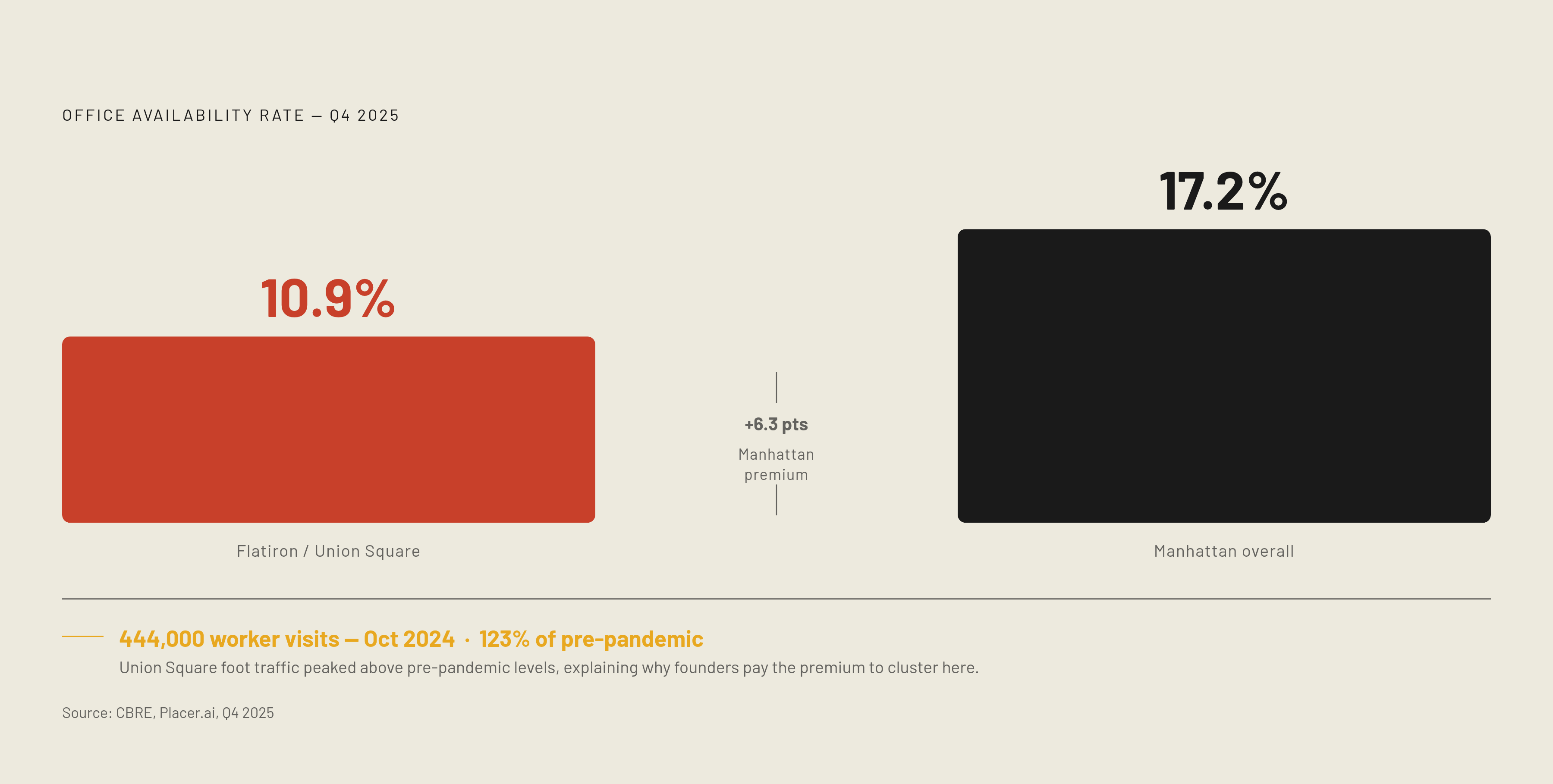
- The market is tight because people want to be there. The availability rate in Flatiron and Union Square sat at 10.9% as of Q4 2025. Manhattan's overall rate was 17.2%. Worker visits to the Union Square area peaked at 444,000 in a single month in late 2024. That's 123% of pre-pandemic levels. Nobody ends up there by accident.
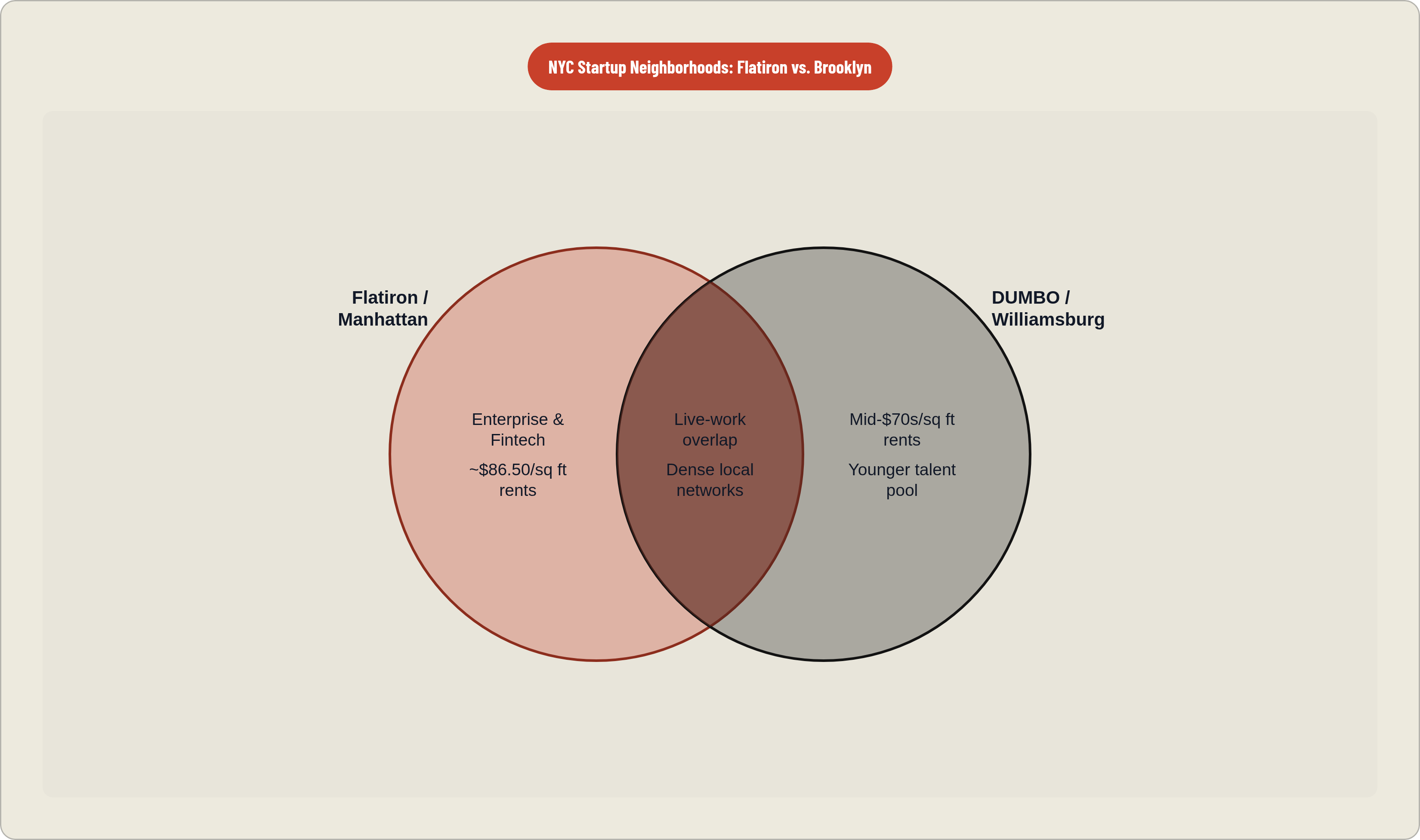
- Office asking rents run around $86.50 per square foot as of Q4 2025. Founders absorb it because the network proximity is worth paying for. Whether or not they'd put it that way out loud.
Founders who work here live in Tribeca, the West Village, NoLita, and the Lower East Side. Close enough to walk or bike. These are often the slightly more senior or repeat founders who've learned the hard way that the commute has a cost even when it's just one subway stop.
Worth mentioning: Startup Genome's 2025 report ranked NYC the second-best startup ecosystem in the world. Not second-by-a-lot. A genuine peer to the top. Between March 2022 and 2023, Manhattan-based companies raised seed or Series A rounds at a rate that outpaced San Francisco in the same window. That's the ecosystem the Flatiron corridor sits at the center of. Your investor, your future co-founder, your first enterprise customer, and the engineer you're about to try to poach are, very possibly, within walking distance of each other. In New York, your network isn't a ladder you climb — it's a neighborhood you live in.
SoHo and Chelsea as the Neighborhoods Where Brand-Conscious Founders Tend to Cluster
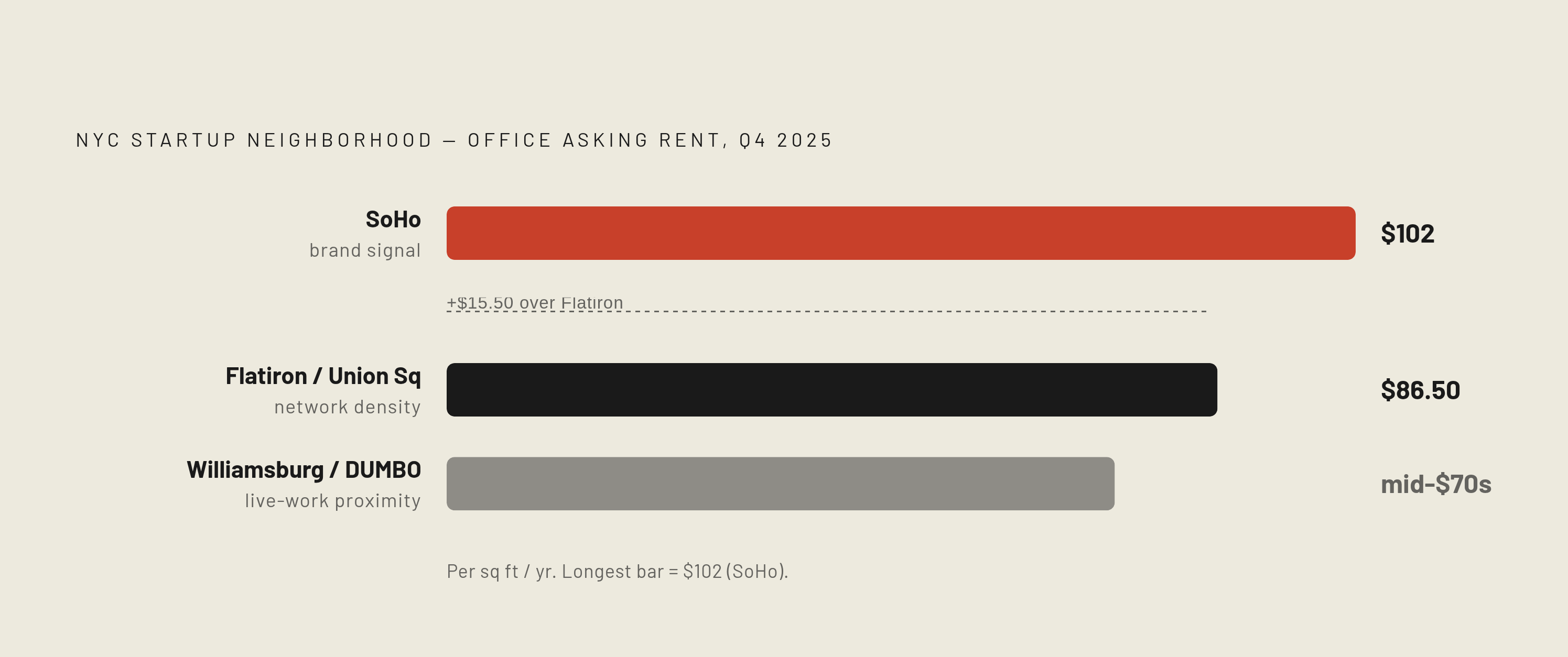
SoHo commanded the highest asking rents of any startup-relevant Manhattan submarket as of Q4 2025. $102 per square foot. Founders who choose it are buying something specific. They're paying for what that address signals before anyone has opened the pitch deck. Choosing SoHo is like wearing your brand on the outside of the building.
The logic holds. Consumer startups, media companies, and brand-driven businesses find their first customers and partners in the retail and media industries that fill SoHo's ground floors. The loft spaces, the street-level energy, the proximity to fashion and culture. It all reinforces a particular kind of company. Rogo, which closed a large Series B, stayed in SoHo rather than migrating toward a more conventional office district. That's a decision someone made deliberately.
Chelsea runs on a slightly different frequency. The galleries and creative-industrial atmosphere attract founders whose physical environment functions as an extension of their positioning. The building you work in becomes part of what you recruit against. Technology, advertising, media, and information companies collectively represented a significant share of all new leasing activity in Midtown South for larger deals in 2025. SoHo and Chelsea are pulling a real share of that.
Founders who work here often live here too. SoHo, NoHo, the West Village. The live-work overlap is deliberate, not accidental. They've built their daily life around staying inside a particular cultural radius.
Williamsburg as the Neighborhood Where the Live-Work Thesis Is Most Literal
Williamsburg is not a backup plan for founders who couldn't afford Manhattan. Founders who choose it are making a deliberate bet. They're betting on Brooklyn's younger talent demographic and on a setup where the office and the apartment are in the same neighborhood, which turns out to matter a lot for recruiting.
FloraFauna AI is the clearest example. They chose 300 Kent Avenue specifically because the team already lived nearby. Within a month of moving in, they doubled their footprint. The logic is pretty simple: it's harder for an engineer to turn down a job when the commute is a ten-minute walk from their apartment. FloraFauna AI didn't just find an office — they found their people's backyard.
A few things make the economics work:
- Brooklyn housing costs run substantially below Manhattan's. For early-stage founders managing their own personal runway alongside company runway, that gap is real money.
- Office rents in Williamsburg and DUMBO sit in the mid-$70s per square foot range per Colliers Q1 2025 data. Still Brooklyn premiums. Still well below Manhattan's startup submarkets.
- The target talent pool is already there. You're not asking people to reverse-commute to you. You set up shop where they already live.
The founder who lives and works in Williamsburg has a different relationship with the city than the one commuting from Brooklyn to Flatiron every morning. The neighborhood becomes the community, not just the backdrop they pass through.
DUMBO as the Neighborhood That Attracts Founders Who Care About the Story Their Address Tells
DUMBO has more tech companies than any other neighborhood in Brooklyn. That happened because exposed timber, stone walls, and Manhattan Bridge views are what you actually get in the buildings along Jay Street. The environment signals something before you say a word about your company. You don't need to dress it up.
Companies that chose DUMBO and stayed: Etsy, Huge, Amplify, Red Antler, TuneCore. That mix is telling. Design-forward companies. Creative-leaning scale-ups. The cluster effect is real, even if the flavor is different from Flatiron's enterprise and fintech density.
What DUMBO founders are implicitly choosing:
- A community that treats craft and brand as seriously as growth metrics
- Daily proximity to a specific kind of talent that is not drawn to a generic Midtown address
- A physical environment that quietly shows up in the product, the culture, and the recruiting conversation
Where do DUMBO founders actually sleep? Mostly still in Brooklyn. Carroll Gardens, Cobble Hill, Brooklyn Heights. Close enough to walk across the bridge on a decent morning.
How the Neighborhoods a Founder Chooses Reflects and Reinforces What Kind of Company They're Building
This sounds like theory. It's actually just pattern recognition from watching it play out.
Founders who live and work in the same zone build denser, more persistent networks than those commuting across the city to an office that has nothing to do with their residential life. The informal connections that form through repeated, accidental encounters aren't a bonus feature. They're how work actually gets done, especially in the early years when almost nothing is formal yet.
NYC's momentum in AI and fintech is not evenly spread. In 2025, 35% of NYC VC went into AI and machine learning. New York captured 36% of all U.S. fintech fundraising in 2024. That capital concentrates in the same zones where founders cluster. Being in the wrong neighborhood doesn't just affect your commute. It affects recruiting friction, investor relationship cadence, and the informal networks that form at dinner tables rather than in pitch meetings.
With $31.1 billion in VC raised in 2025 and 178 unicorns in the metro area, the ecosystem is large enough to sustain genuinely distinct founder cultures across different neighborhoods. Flatiron's enterprise density doesn't crowd out DUMBO's design ecosystem. Both are real. Both have real networks. The question is which one actually maps to what you're building.
Neighborhood is one of the few infrastructure decisions a founder makes early that shapes everything downstream. Who you hire. Who you run into. What kind of company culture solidifies before you've made a single conscious decision about it.
What the Geographic Concentration of Founders Means for How Relationships and Introductions Actually Work in NYC
Warm introductions in NYC's founder community carry more weight than in less dense ecosystems. When the person making the introduction has seen you at a dinner table, run into you at a neighborhood coffee shop, and watched you work through something hard in real time, the introduction has context behind it. That context is what makes the trust real.
A cold LinkedIn connection from someone in your city is not the same thing as a neighbor who knows how you operate. Proximity creates the context. Context creates the trust. Trust is what actually moves things.
The founders who get the most out of NYC's density share a few habits:
- They planted themselves somewhere deliberately. They didn't just pick the apartment with the best natural light.
- They live near their co-founders. The co-founder relationship is the one that matters most in the first few years. Geography makes it easier or harder, and most people underestimate how much.
- They chose offices in neighborhoods where their investor relationships were already warm. They kept showing up to the same tables. That repetition adds up. NYC Founders Club, a private invite-only community for active NYC founders built around small weekly chef's-table dinners, exists precisely because that kind of repeated, in-person proximity is where real trust forms.
NYC's startup culture at its best is not a conference or a Slack channel. It's a set of overlapping neighborhoods where people build things in the same physical space and run into each other often enough that trust accumulates without anyone scheduling it.
If you're a founder deciding where to live in New York, the question is not which neighborhood fits the budget or has the best subway access. Those things matter. They're just not the main question. The real question is which neighborhood puts you inside the network most relevant to what you're building. And then keeps you there, every single day, whether or not you're being intentional about it.