Cost of Living for Startup Founders in Manhattan vs Brooklyn
Brooklyn's rent savings disappear once you factor in commute time and buildout costs.
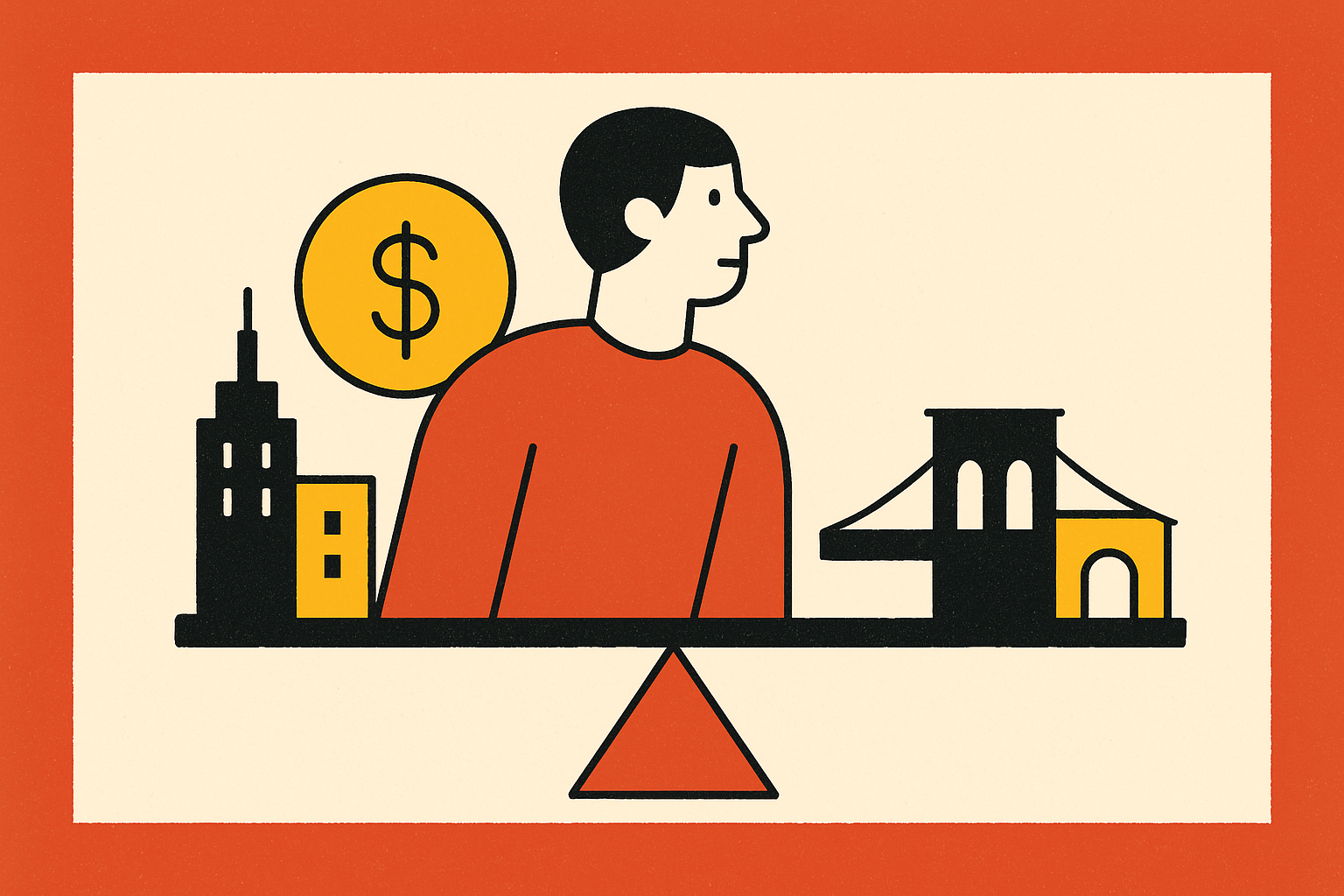
Manhattan rent still beats Brooklyn's, but not by as much as founders assume. People budget for a 2015 gap that closed years ago, and DUMBO now prices close to comparable Manhattan units, so the savings story only holds if you're willing to live further from the water than the Instagram photos suggest.
To keep the same standard of living, moving from Brooklyn to Manhattan takes a noticeably higher household income. Run that number against your actual salary or draw before you sign a lease, not after your first rent check bounces off your own runway.
Cross Hudson Yards and Tribeca off the list entirely. Those neighborhoods are for founders whose housing budget stopped being a runway constraint a while back, and if that's not you, there's nothing to plan around there.
Groceries, utilities, and transit cost roughly the same no matter which side of the river you sleep on, and taxes don't care either: city and state brackets apply the same whether you commute from Bed-Stuy or Battery Park. The real savings sit further from the Brooklyn waterfront, in Bushwick, parts of Crown Heights, Bed-Stuy, where rent actually drops. The tradeoff is a longer ride every time an investor wants to meet in Midtown.
Office and coworking costs by borough and by stage
Brooklyn office rent runs well below Manhattan's per-square-foot average, and Williamsburg sits at the cheap end of that range. Manhattan's startup corridors (Chelsea, Flatiron, Midtown South) charge a premium for the address, though sublease space comes in noticeably below direct-lease asking rents if someone bothers to look for it instead of grabbing the first listing.
Coworking is where most pre-seed and seed teams actually land: low commitment, no buildout, a desk by Monday. Hot desks and dedicated desks cost more in Manhattan than Brooklyn, but that gap is smaller than the one on residential rent. Private offices for a team of ten or more tell a different story, and Brooklyn comes in significantly cheaper there, which matters a lot when a company is burning seed capital month by month.
Buildout is the quiet trap that eats the Brooklyn discount. A team that needs server rooms, extra electrical capacity, or dedicated network runs can watch that rent advantage disappear the second the contractor invoice lands. Price that cost before signing anything, not after the walls go up, because this is the part founders skip, and it's the part that actually decides whether Brooklyn was the cheaper choice or not.
Supply is shifting too. Brooklyn's coworking footprint keeps growing as a share of total office stock, while Manhattan's flex supply has shrunk slightly as some operators closed locations.
For founders who spend most of their week somewhere else but still need a Manhattan presence for banking, incorporation, or that first line on the pitch deck, a virtual address with mail handling covers that without paying for a desk nobody sits at. The progression looks the same for almost everyone: coworking early, a managed or flex office once culture and privacy start mattering around Series A, a direct lease only once headcount justifies locking up capital in square footage.
Manhattan neighborhoods that matter to founders and why
Flatiron and NoMad make up the densest startup stretch in the city: Series A through Series C companies packed in, strong subway access, easy reach to enterprise buyers and investors alike.
Union Square works as connective tissue. Multiple subway lines converge there, office space runs tighter than Manhattan's overall average, and daytime foot traffic has come back strongly enough that the blocks around it stay genuinely busy through the workday.
If enterprise buyers are the customer, Midtown South puts a founder a short walk from the Fortune 500 offices they're trying to sell into, and that proximity shortens the sales cycle in ways a Zoom call rarely matches. Lower Manhattan is the natural home base for fintech and financial infrastructure: being near Wall Street and the major law firms means faster diligence calls and easier access to counsel who already know the regulatory terrain cold.
AI startups have piled specifically into the NoMad and Flatiron stretch. A company running on an AI thesis benefits from being around the people working the same problem right now, while the culture is still forming, ahead of wherever the scene moves in two years.
Manhattan's pace rewards founders who close deals face to face. The run-in with an investor at a coffee shop, the chance conversation that turns into a hire: those happen more often when everyone's working in the same dense corridor.
Brooklyn neighborhoods that matter to founders and why
DUMBO and the wider Brooklyn Tech Triangle (DUMBO, Downtown Brooklyn, the Navy Yard) form the most mature startup infrastructure outside Manhattan: law firms, accelerators, mentorship networks, an actual ecosystem alongside a scattering of coworking desks with a nice view.
The Brooklyn Navy Yard deserves its own paragraph. Hundreds of businesses and thousands of jobs sit inside that campus, and tenants there collaborate at unusually high rates: shared supply chains, joint projects, showing up for each other's events. That's peer community working as actual infrastructure, alongside the networking events nobody wanted to attend.
Williamsburg pulls in younger, earlier-stage founders, and the coworking density there makes it function as a natural incubator even though nobody's put that label on it. Bushwick sits further out and costs less, with a strong creative-industries tilt, which makes it the right fit for media, design, and consumer founders who want to be near their community more than near a term sheet.
Brooklyn's fintech scene is bigger than most people assume too, so this isn't a purely creative-tech story. The borough's startup scene has grown enormously since 2008, and the legal services, accelerators, and mentorship networks around it have matured right alongside it.
Here's the honest tradeoff: more living space, a stronger neighborhood feel, lower costs across rent and office, in exchange for twenty to thirty extra minutes on any commute into Midtown or downtown Manhattan.
How investor proximity actually affects your day-to-day as a founder
Most active NYC venture firms cluster in Manhattan, where the densest concentration of startup activity and enterprise buyers sits. During an active raise, the friction of a bridge or tunnel commute for an 8am coffee meeting adds up fast across dozens of investor touch points over a few months, and pretending it doesn't is how founders end up wrecked by week three of a raise.
Between raises, that distance matters a lot less. Brooklyn founders who already have relationships built with their investors mostly don't feel it.
There's a perception cost too, harder to put a number on: a Manhattan address on a deck still reads differently to some early-stage investors than a Brooklyn one does, whether that's fair or not. Warm intros, the kind that actually move a fundraise forward, come from trust built over repeated in-person contact, and that trust builds from either borough if a founder is deliberate about showing up.
Brooklyn founders serious about investor access tend to treat Manhattan as a weekly destination rather than a daily commute, stacking meetings into one trip instead of scattering them across five.
The sector argument: which borough fits which kind of company
Fintech and financial infrastructure belong in Manhattan. Proximity to Wall Street, the major law firms, and the investors who fund the category settles that one; Brooklyn rarely wins this comparison.
Enterprise SaaS and go-to-market software fit Flatiron and NoMad, close to the Fortune 500 offices clustered in Midtown South and the investors who back this kind of company. AI leasing activity right now concentrates in that same NoMad and Flatiron corridor, and being physically present carries real peer and hiring advantages at the moment, ahead of wherever the scene moves in five years.
Media tech, creative tech, and consumer hardware belong in Brooklyn, especially DUMBO, the Navy Yard, and Williamsburg, where the talent and the peer network these categories actually need already exists.
Life sciences and biotech run on a different map entirely, anchored around institutions in Kips Bay and Roosevelt Island, with the Navy Yard becoming more relevant for hardware and medtech companies specifically.
Founders without a clear sector pull have more room to choose freely, and that's exactly when Brooklyn's cost edge should win: before the company has revenue to absorb the Manhattan premium, there's no good reason to pay for it.
The peer community question and why it should factor into the decision
New York's startup scene runs on people actually being in the room. Investors, service providers, peer founders: the whole thing depends on showing up in person, session after session.
Lower costs originally pulled a wave of Brooklyn founders in trying to stretch their runway, and in doing that, they built a real peer culture in the borough, especially among earlier-stage and consumer companies. Manhattan's founder culture runs denser and faster, with a heavier enterprise tilt: an asset if that's the room being targeted, a drag if it isn't.
The borough decides which dinners and informal gatherings a founder ends up at by default, because proximity decides how deep the relationships get. Crossing a bridge for a casual founder dinner on a Tuesday just isn't something most people do, and that's not laziness — that's just how habits form.
Small, curated gatherings, the kind where real trust actually forms, happen in both boroughs, but the circles barely overlap. A Brooklyn founder and a Manhattan founder at the same stage might never share a table without someone making a deliberate effort to set it up. Founders who get the most out of New York's ecosystem live inside the borough where their peer group actually operates; commuting in for the occasional appearance doesn't build the same trust.
How to make the decision deliberately rather than by default
Start with stage. Pre-seed and seed founders optimizing for runway should weight the cost gap heavily, because the combined savings on rent and office space can stretch a company's life by months, and months matter more than most founders admit until they're staring at a bank balance in month eleven.
Ask where the buyers and investors actually sit. If the honest answer is Midtown Manhattan, price the commute friction truthfully before signing a Brooklyn lease that looks cheaper on paper and costs more in missed meetings.
Consider where the sector's talent and peer network cluster too, since sometimes that answer points to Brooklyn even when every investor on the cap table sits in Manhattan.
Add up the entire cost stack, not just the rent line: residential cost, plus office or coworking, plus the hours lost to commuting. Do the math before assuming Brooklyn wins on total cost, because sometimes it doesn't, and a spreadsheet is a lot cheaper than the surprise.
Neighborhoods inside each borough vary more than the boroughs do against each other. A DUMBO coworking desk costs more than one in Bushwick, and a Flatiron sublease can cost less than a direct lease in Hudson Yards, so the borough label hides more than it reveals — picking by name alone is picking blind.
The expensive mistake is choosing on gut feeling and finding out six months later that the decision quietly reshaped the fundraising cadence, the weekly commute load, and who the company actually knows. Whichever borough wins, show up, get into the right rooms, and build the peer relationships that produce actual trust, because that does more for the company than the zip code ever will.