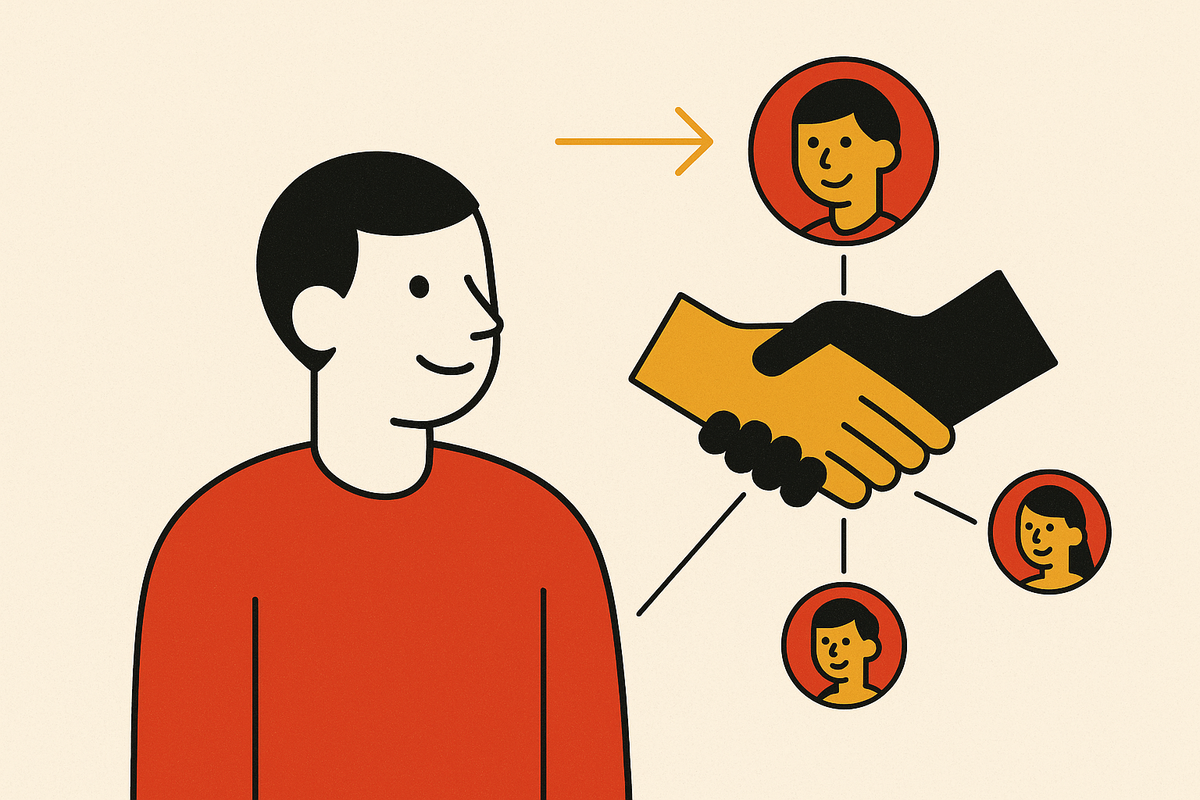
founder communities that lead with warm introductions and peer dinners
Trusted connectors and small dinners build the relationships that actually fund startups.
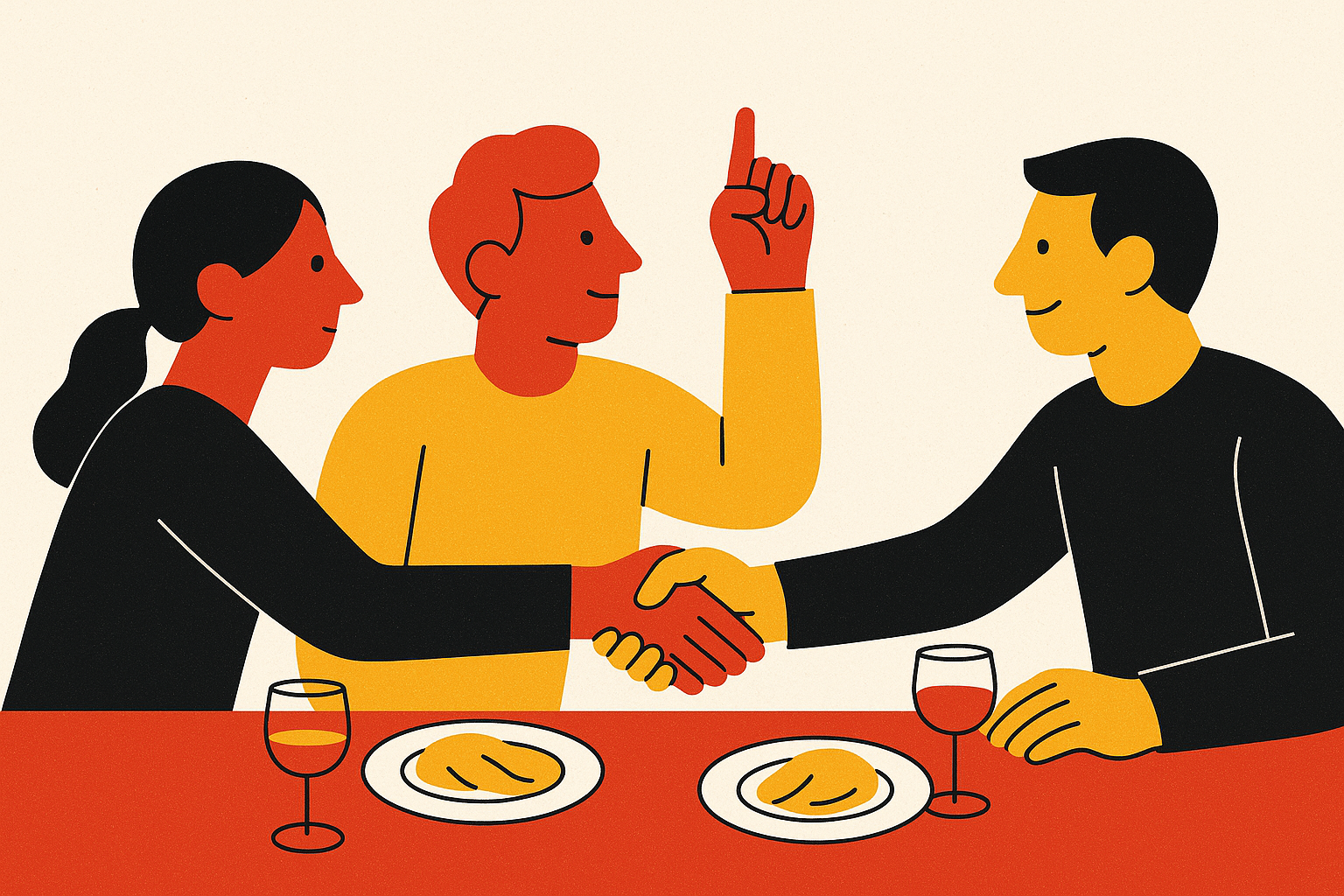
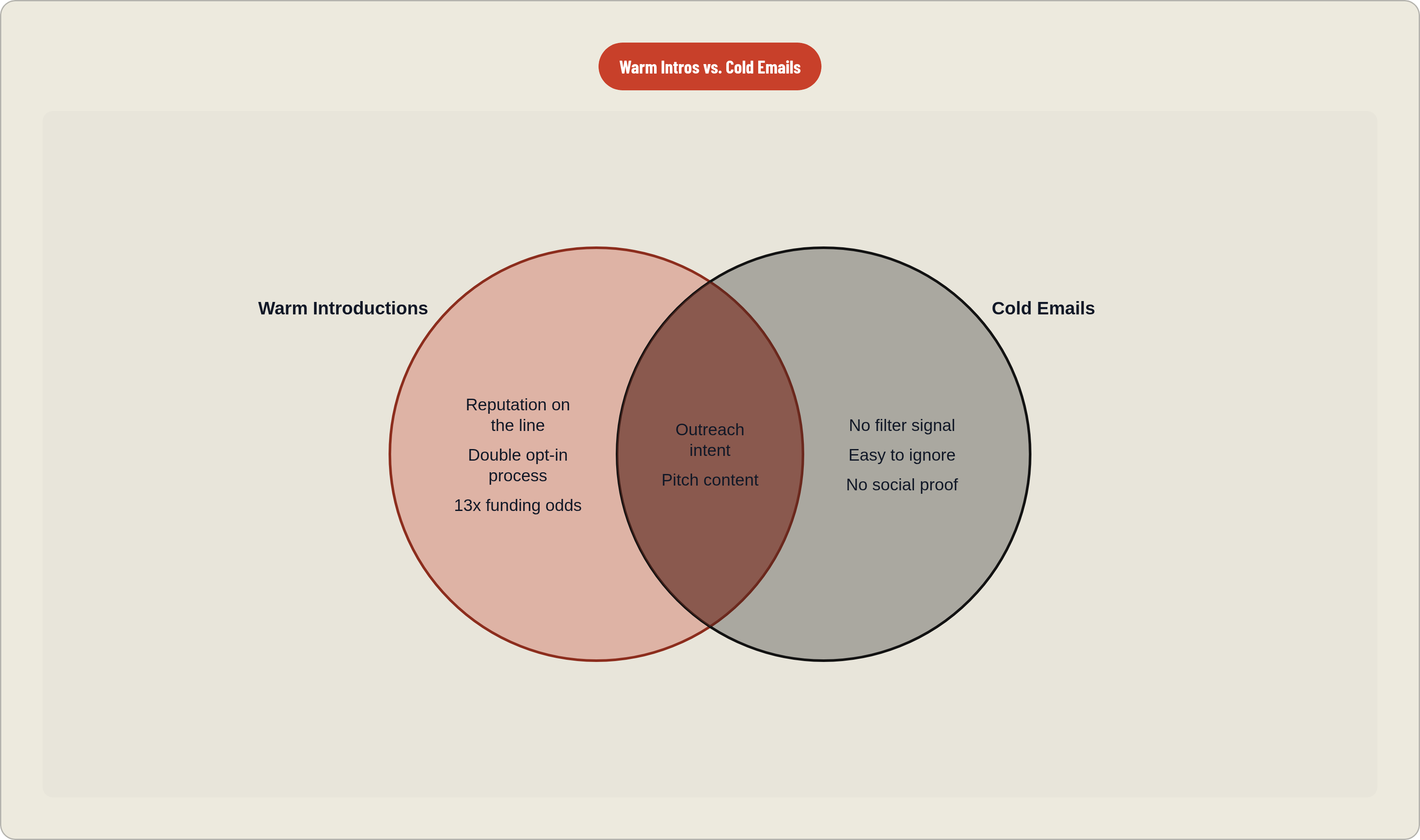
A warm intro carries the same basic content as a forwarded email, plus one thing a forwarded email never has: somebody's reputation riding on the outcome. The connector puts their own name on the line for both people in that thread, and if the meeting goes badly, they eat part of that cost too. That's exactly why most people don't send them lightly.
The psychology here isn't complicated. When someone gets an intro from a person they trust, the first reaction isn't "this must be a great company." It's closer to "well, so-and-so wouldn't waste my time," and attention gets granted before the founder even says a word. Skepticism is already halfway out the door before the meeting starts.
None of that works unless the connector checks with both sides first. Double opt-in, meaning the connector confirms real interest before making the intro, separates a connector whose intros carry weight from someone just firing off names into the void. Every bad intro chips away at the credibility that made the next one worth anything, and get it wrong enough times and the whole system collapses. That's probably why the best connectors say no far more than they say yes.
The numbers back this up. A warm introduction leads to 13 times higher odds of funding than a cold email, and that gap has little to do with deck quality. The intro does most of the persuasive work before the meeting even starts. So the question every founder should be asking, long before drafting a single cold email, is simpler than it looks: where does my next warm intro actually come from?
Marc Andreessen made close to this same point once. If you can't figure out how to get a warm intro to a VC, that's a preview of whether you'll figure out how to get one to a customer. Fundraising is the easy test. Sales is the hard one.
Where warm introductions actually come from, and why most founders get this wrong
Almost every founder treats warm intros like a tool you grab when you're raising, a backwards order that costs them later. Intros are something you build up over months, sometimes years, before you ever need them, and the ones that predate the ask carry more weight for exactly that reason: nobody was angling for anything when the relationship formed.
So who actually makes a good connector? Peer founders a step or two ahead of you, more often than not, beat advisors and the investors already sitting on your cap table.
A founder who raised six months ago still has live relationships with active VCs, not three-year-old cold ones gathering dust. They carry real credibility with those specific investors because they've already been vetted, funded, and dragged through diligence themselves, so their word means something concrete to the person on the other end. Founders a stage ahead also tend to be generous once there's actual rapport, the kind built slowly rather than assembled at an open bar over two drinks.
Take a founding team whose first customer had a CEO who'd raised a pre-seed and a Series A from two specific funds. That CEO made an introduction on the team's behalf, and overnight they went from being founder number 847 in some VC's inbox to a warm referral with context attached. Small anecdote, but it's the whole mechanism in miniature. The best sources of intros have skin in your success: customers, fellow founders, operators who've actually watched you work under pressure, not strangers collecting business cards near the bar.
There's a timing trap worth naming plainly. Ask for an intro before you're actually ready, before you're fundable, before you're credible in that specific room, and connectors quietly stop making intros for you at all. Readiness isn't optional; it's the entry fee. Whichever community builds real relationships first, before anyone needs anything from anyone, ends up producing the best intros later.
Why a small dinner table produces deeper relationships than a large-room event
Picture the standard founder mixer. Two hundred people, name tags, a cash bar, ninety-second conversations that all blur together by the fourth one. The unspoken rule of that room rewards surface area over depth, and everyone in it knows it, which is exactly why so few of those conversations turn into anything real afterward.
A dinner table flips the incentive. Fixed number of seats, a shared meal, two hours minimum, sometimes three, and that one constraint changes what people are willing to say, and willing to actually hear.
Scarcity does something strange to conversation. When you know the same six people will be at that table for two more hours, the elevator pitch goes out the window fast, and founders start telling each other what's actually broken instead of what's in the deck. Advice gets specific, because everyone at the table already knows the real situation behind it, not the sanitized LinkedIn version. When someone from that dinner later makes an intro for you, it carries the weight of the whole evening. They watched you think out loud under real conditions, which is more than any skimmed profile could tell them.
The NYC Founders Club runs on exactly this logic: weekly dinners, six members, invite-only, no Slack channel to disappear into, no webinar replay to half-watch later at 1.5x speed. The constraint isn't an accident. It's the entire point of the thing.
New York Tech Week 2025 backed this up from the outside too. Across a calendar stuffed with hundreds of events, the ones people were still following up on weeks later were the invite-only dinners, usually 20 to 40 founders. The bigger public panels drew bigger crowds and produced, as far as anyone tracking this could tell, nothing that lasted past the open bar. A six-person dinner and a two-hundred-person panel operate at different scales with different outcomes, and treating them as interchangeable is where most founder communities go wrong.
The loneliness problem that peer dinners solve that no other founder support structure addresses
Founder isolation isn't a personality flaw certain people happen to have. It's baked into the job description, and almost nobody else in a founder's life has done the specific work of running that specific kind of company. Most support systems built around founders weren't designed by anyone who's actually sat in that chair.
Advisors help. Mentors help. Therapists genuinely help too, but none of them solve the particular loneliness of facing a decision only your peers have faced, because none of them are standing on the same ground at the same moment you are standing on it.
The data isn't subtle. Research out of UCSF from Michael Freeman found that roughly half of founders report some kind of mental health condition over the course of running their company, and a large majority say they get no mental health support from their investors at all. Read that twice if you need to. The people with the most financial stake in a founder's wellbeing provide, by their own account, almost none of the support that would actually protect it.
There's a gender pattern buried in that data too. Male founders report having a real support system at meaningfully lower rates than their female counterparts, and that gap tracks closely with higher burnout and depression rates among men. The founders most likely to burn out are, almost perfectly, the ones least likely to have anyone to call about it.
Timing matters more than people give it credit for. A peer structure needs to exist before the crisis hits, because assembling one mid-crisis is already too late to do much good. Relationships built before things get hard have the depth to hold real weight when it counts; relationships scrambled together under pressure form under exactly the wrong conditions to be useful. A recurring dinner format solves this almost by accident, just through repeated exposure over months, and that repetition is the only thing that builds the trust to let a founder say "this is actually going badly" out loud to another human being. Some people call this a personal board of directors, but whatever the label, it's a small group who've watched you across more than one season of your company. That's the part no app or Slack channel ever replicates.
How invite-only membership changes the value of every connection inside the room
An open network is only as strong as its weakest member. If anyone can join, an introduction from inside that network tells the recipient nothing about the sender's judgment, because the sender never had to exercise any in the first place.
Invite-only changes the math. Membership itself becomes a signal, and when someone in that room makes an introduction, it comes backed by whatever filter got them through the door to begin with.
Curation isn't exclusivity for its own sake. A low acceptance rate works as signal fidelity, not a status symbol, and the tighter the filter, the more an intro from inside it actually implies about the person on the other end. When everyone at the table already cleared the same bar, conversations start further along; nobody's re-proving basic credibility every time they meet somebody new. Trust compounds here instead of transferring once. The introducer's own credibility got vetted by the same community, so you're not trusting one person, you're trusting a chain of them.
Privacy is part of the mechanism, not a footnote to it. "What happens at the table stays at the table" is the actual condition that lets founders say the true, ugly version of what's going on, instead of whatever version they'd post on LinkedIn afterward. Those honest moments are what make the relationship real in the first place.
Founders Network is a useful comparison point: paid, invite-only, 600-plus members globally, an active New York chapter, built around peer advisory boards and investor intros. It's curated access done at scale, and it works fine for what it is. Other communities sit further down the exclusivity dial, deliberately small, in-person only, warm intros to customers, hires, and co-investors that come from people who've actually sat across a table from you rather than a searchable directory. Neither model is more virtuous than the other; exclusivity is just the mechanism that makes trust the default setting in the room, instead of something each new person has to prove from zero.
What the New York City ecosystem adds to founder communities that other cities cannot replicate
New York is a genuinely different ecosystem from San Francisco, structurally, not just in vibe or coffee quality.
Here's the concrete part: Fortune 500 buyers, banks, media companies, and hospital systems all sit in the same city where the startup is actually building. That proximity compresses enterprise sales cycles in ways that just don't happen when your buyer is a five-hour flight and three time zones away.
Take the Flatiron corridor as a physical example of the cluster effect. VCs, accelerators, enterprise clients, and a dense pile of peer companies, all within walking distance of each other. That density means a warm intro made over dinner on a Tuesday can turn into a coffee meeting by Thursday, because nobody has to book a flight just to close the loop.
Capital has followed the density too. Manhattan outpaced San Francisco on seed and Series A deal count in a recent measured period, which means the ambition in this city is backed by actual dollars alongside the energy and rooftop parties.
The talent base adds something harder to copy. New York's tech workforce includes a notably higher share of Black and Hispanic workers than peer tech hubs, and nearly half the city's tech workers are immigrants. That range shows up directly in the room at a founder dinner: a wider mix of backgrounds, industries, and networks than you'd find in a more homogeneous, single-sector hub. The unexpected intro, the one from a completely different industry that somehow solves your exact problem, happens more often here, simply because the ecosystem is cross-sector to begin with.
New York Tech Week is the annual proof of all this. Hundreds of events sit on the calendar, but ask anyone what they're still following up on a month later, and it's the invite-only dinners and small application-only formats, nearly every time. The city's energy amplifies whatever format you bring to it, but the format itself still decides whether anything real comes out the other side.
How to evaluate whether a founder community is actually built to produce warm introductions
Nearly every founder community claims it produces introductions. The more useful question is whether its structure makes a good introduction possible at all.
Start with membership. A community with no real filter produces no real signal, since if anyone can join, membership tells you nothing about the judgment of the person making the intro on your behalf.
Then check whether members actually know each other over time, or whether they met once at an event and connected on LinkedIn the next morning. Recurring formats, weekly dinners, monthly peer groups, build the long familiarity that makes an intro mean something beyond a name on a page.
Privacy norms matter more than most people admit. Is there an actual off-the-record understanding, or is everything fair game to repeat outside the room? Communities where people can talk honestly produce deeper relationships than ones where every conversation might end up screenshotted somewhere later.
Finally, ask whether intros are double opt-in, with the connector actually checking both sides first, or whether the whole operation is just bulk-matching strangers and calling it networking.
If you're sizing up a peer dinner format specifically, check headcount first: small enough that everyone at the table has actually talked to everyone else by the time dessert shows up. Check stage alignment too. A table where everyone's at a wildly different stage makes for an interesting evening but not real peer context; there needs to be enough shared terrain that the advice people give is actually usable on Monday morning. Then check whether it repeats. A one-time dinner gets you a contact, while a recurring one gets you a relationship, and that difference is basically the whole argument this piece has been making.
The format is the product, at the end of the day. What a community actually asks you to do, and who it sits you next to while you do it, is what builds real trust versus what merely fakes the appearance of it. Everything past that is marketing copy.