invite-only founder communities in major startup cities
Curated founder communities offer the depth and honesty that open networks structurally cannot.

New York's now the second-biggest tech ecosystem on the planet, no longer simply trailing in San Francisco's shadow. Over 25,000 tech-enabled startups call the city home, the ecosystem's worth north of $621 billion, and the tech workforce crossed 360,000 people a while back. In 2024, NYC metro pulled in $28.5 billion in venture capital, more than Boston, LA, and Philadelphia combined.
The trend kept going in 2025, too. NYC firms raised $31.1 billion, up $6.2 billion from the year before. Somewhere in the twelve months between March 2022 and March 2023, something flipped without anyone noticing: 543 Manhattan-based companies raised seed or Series A rounds, compared to 486 in San Francisco. Nobody threw a parade for it, but it's a real changing of the guard, and it happened quietly enough that most people are still catching up to it.
What makes the city interesting is the mix underneath the dollar figure. AI and ML lead at 35% of VC raised, fintech pulls in 30% of all U.S. fintech investment, and healthtech grabbed $4 billion in 2024. Founders here spread across industries instead of clustering in one lane. The guy at the next table might be solving a completely different problem than you, and he's still worth knowing.
The AI surge carries real weight behind the headlines, too. Anthropic is expanding its NYC footprint by as much as 22x, while OpenAI and Palantir signed major leases. In March 2025, NYC posted 12,853 tech job listings, 6,556 more than San Francisco. Companies are making a structural bet on the city and sticking with it.
Here's what the scale actually means if you're a founder: enterprise buyers, investors, and peers are a few subway stops away no matter where you're sitting. Flatiron and NoMad put you next to enterprise buyers, while DUMBO and the Brooklyn Tech Triangle put you next to earlier-stage builders. Where you plant yourself shapes who you run into on a random Tuesday, and that's not nothing.
Density has a shadow side, though. More people means more noise, and noise is exhausting after a while. That's the whole reason curated communities exist, and it's why they work when open networks don't.
What open networks structurally cannot give founders
Founders aren't short on advice. If anything they've got the opposite problem, too many opinions from too many people who've never built the thing they're opining about. Post a question in a big Slack group or founder forum and you'll get ten answers by lunchtime, then walk away more confused than when you started.
What actually moves a founder forward is narrower. It's one person who already crossed the exact bridge you're staring at, looking at your actual situation instead of a hypothetical version of it, telling you plainly what they'd do. One person, one real answer, delivered directly.
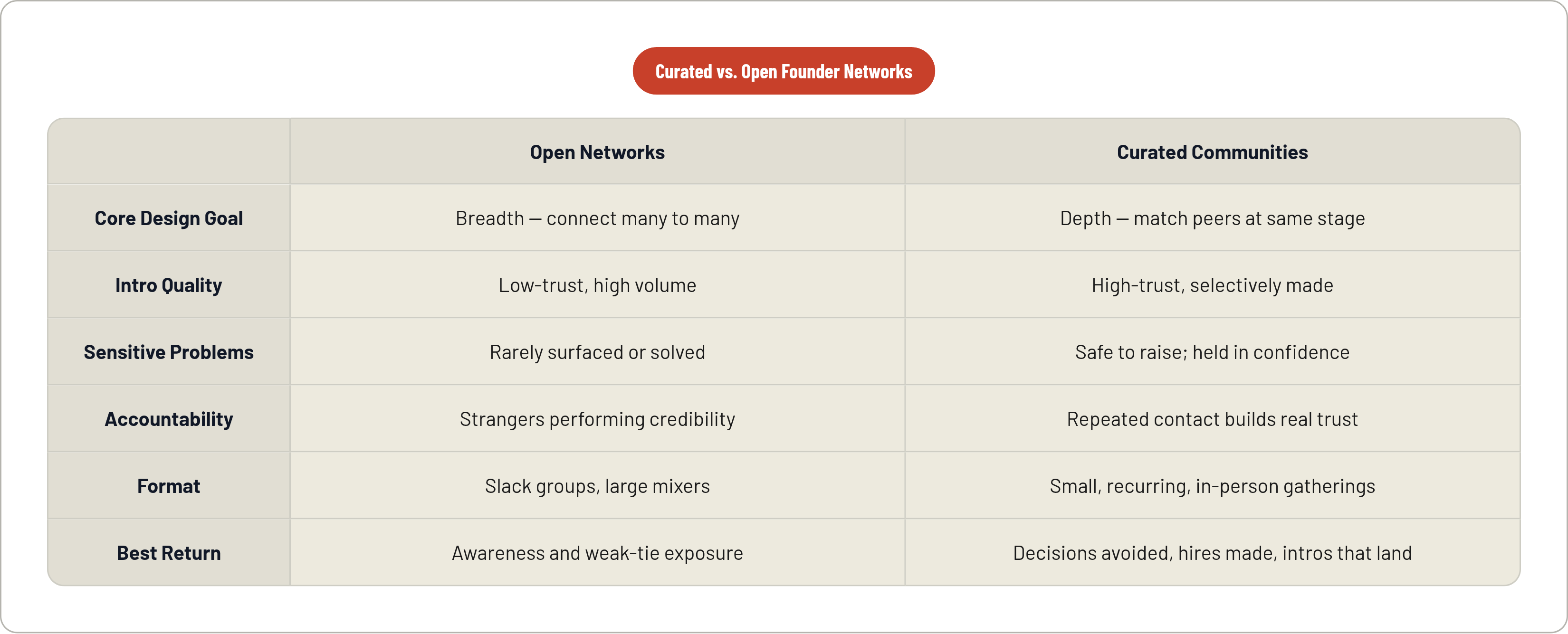
Open networks are built for breadth. They're good at connecting a lot of people to a lot of other people, and that's fine as a design goal. A stuck founder usually needs depth instead: someone twelve to eighteen months ahead who just went through the same fundraising round, knows the same investors, and will tell you the truth even when it's uncomfortable to say.
This matters most on the problems you don't want to say out loud. A cofounder relationship falling apart. A down round nobody's proud of. A VP hire quietly sinking the team. None of that gets posted in a public forum, ever, so open networks never even see these problems, let alone help solve them. Asking a stadium full of strangers for marriage advice is technically possible, and it's also useless, for roughly the same reasons.
A few honest signals separate a working community from noise with a nicer logo. Members make introductions without being asked. Replies come from founders who've actually built something, not people fishing for a client. And the group has an actual niche, since generalist "everyone welcome" groups tend to produce shallower conversation than ones built around a specific stage or business model.
The structural issue underneath all of it: in a big open network, everyone's a stranger performing credibility, and you have to prove you're worth listening to before anyone bothers. A small curated room runs on a different premise. You walk in already trusted, and nobody's making you audition for it first.
How deliberate curation actually works — membership criteria, room size, and format
Curation isn't exclusivity for the sake of feeling special. It's the design decision that makes everything else in the community actually function. Take curation out and you're left with a smaller, quieter version of the same open-network noise, which helps nobody.
Three things curation actually controls. Who's in the room matters most, active founders at comparable stages, not advisors circling for clients, not service providers, not passive investors fishing for deal flow. Room size matters almost as much. Six people at a dinner means everyone talks and everyone's accountable for what they say; thirty people at a mixer means most of them coast quietly in the corner and never say a real thing all night. Format matters more than people expect, too, and it tends to favor the recurring, in-person, same faces showing up again and again. Trust builds over repeated meetings in a way a single panel discussion never manages, no matter how sharp the panelists are.
Low acceptance rates aren't gatekeeping theater dressed up to look important. Scarcity is the actual mechanism that gives every introduction and every seat at the table its weight. If anyone can get in, nothing that happens inside the room carries much weight either.
Stage differences matter less than people assume, oddly enough. A pre-seed founder and a Series B operator can sit at the same table and both walk away better off, as long as they've both got real skin in the game. What actually wrecks a room is an intent mismatch, someone there to sell versus someone there to build.
Privacy is the mechanism that makes honesty possible, not a nice-to-have norm tacked on for optics. What gets said at the table stays at the table. That's the whole point, not just good manners, because a founder can say the true, ugly, uncomfortable thing knowing it's not going to end up as someone's tweet an hour later.
In-person is a constraint doing real work, not a preference somebody could swap out for convenience. Physical presence strips away the performance layer that Zoom calls preserve by default. Body language, the pause before someone answers a hard question, the shared meal, none of that translates over video. You lose the texture, and the texture is exactly where trust lives.
The invite-only landscape in major startup cities — what's actually available and how these communities differ
The field ranges from global networks with local outposts to hyper-local, city-specific rooms that only make sense if you're actually building where they're rooted. They're not interchangeable. Treating them like they are is how founders end up in the wrong room, wondering why nothing's clicking. NYC Founders Club, a small invite-only dinner community for active NYC founders that gathers members weekly around a chef's-table format, sits at one end of that spectrum.
On the NYC-rooted side, Startup:NYC, run under Tech:NYC, is an invite-only platform connecting founders, investors, and industry leaders through curated gatherings, briefings, and mentorship. What sets it apart is how active the investor network is inside the NYC ecosystem specifically, not adjacent to it.
The NYCEDC Founder Fellowship takes a more structured, publicly accountable approach. Since 2022, it's supported close to 400 NYC-based entrepreneurs across 243 startups, and those founders raised substantial capital collectively. It runs cohort-based, 15 teams per group, with four program operators lined up for the 2026 class. Public infrastructure like this fills a different need than a private dinner club.
On the global side, Yorkseed connects more than 600 tech founders worldwide and runs an active NYC chapter built around Peer Advisory Boards as its core format. Membership travels across more than 50 cities, genuinely useful for founders who move between ecosystems, but a bit less sharply tuned to New York specifics than a city-native group. Founders Network runs on similar logic at larger scale: thousands of members, peer mentorship, warm investor introductions, a general forum, and Peer Advisory Boards reserved for the sensitive stuff. It's broader and less geographically anchored. That's a trade-off, not a flaw.
The real question is fit, not which name sounds most impressive on a website. Does this community's format match the kind of trust, and the kind of problem, you actually need solved this quarter? A community rooted in Manhattan knows the investor landscape, the neighborhoods, the hiring market, the enterprise buyer relationships that define building here specifically. A global network gives you scale, but without that local texture, and you feel the gap eventually.
What warm introductions actually do for a company — and why they only work inside real trust
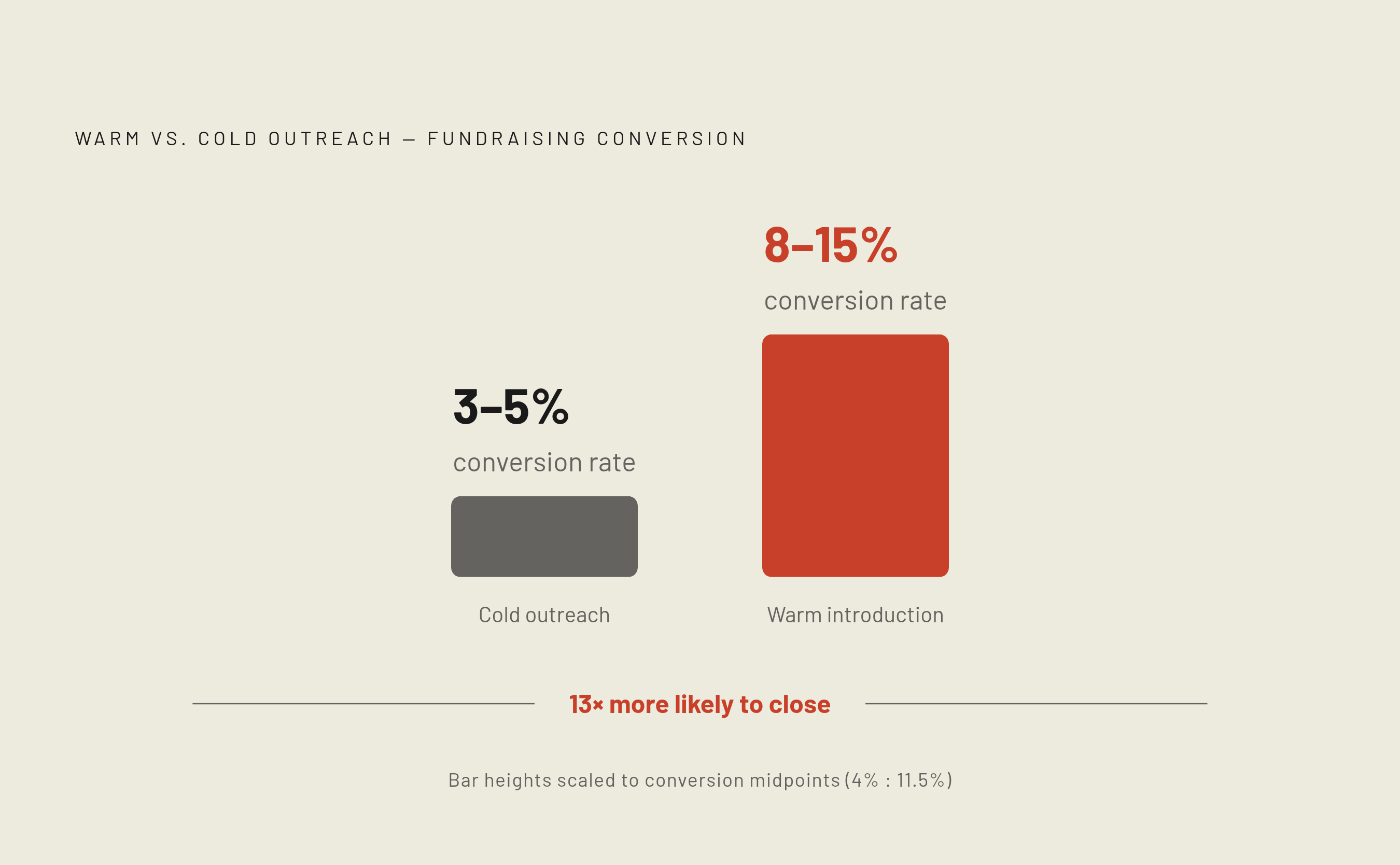
Here's the number that matters most: DocSend's 2025 data puts warm introductions at 13 times more likely to result in a successful fundraise than cold outreach. Warm intros convert at 8 to 15%, while cold outreach converts at 3 to 5%. That gap isn't small, and it isn't noise either.
Nobody puts the catch on the slide, though: that advantage only shows up when the introduction is actually warm. A forwarded LinkedIn message from someone who shook your hand once at a conference doesn't count. Call it a lukewarm intro wearing a warm intro's jacket.
What makes an introduction land is simple to say and hard to fake. The person making it genuinely knows both sides, and their own credibility rides on the match working out, so they only make it when they believe in it. A watered-down intro from a near-stranger is often worse than no intro at all, since it sets the wrong frame before the conversation even starts, and first impressions are hard to walk back even when the intro-maker meant well.
The pattern that makes this reliable: founders twelve to eighteen months ahead in their own journey. They've recently run the exact fundraise you're about to run. They know which VCs are actually writing checks right now, not who was active two years ago, and they've got a reason to pay it forward, because somebody did the same for them not that long ago.
Fundraising gets all the attention, but the biggest value tends to show up somewhere quieter. The fastest return in a founder community is usually the bad hire you didn't make, the bad contract you didn't sign, the fundraising strategy you skipped because a peer already tried it and watched it fail. Damage that never happens doesn't show up on any dashboard, but it's still real money, saved.
Co-investor relationships and hiring referrals run on the same logic, downstream of trust rather than downstream of how many people are in your network. A community of a few hundred strangers produces a lot of low-trust intros, while a group of twenty people who've shared a table every week for a year produces far fewer, but each one carries real weight. The second kind compounds. The first kind just piles up.
What founders actually report getting from curated peer groups over time
The pattern that keeps showing up: founders in curated communities move faster, mostly because they've got peers who'll actually hold them accountable. People who say the hard thing because the relationship can absorb it without cracking, rather than cheerleaders handing out easy comfort.
A lot of founders find their next cofounder, their first key hire, or their most trusted advisor inside a small community like this. Makes sense, when you think about it: people who share your values, your ambition, and already know your character are a different hiring pool entirely than anyone cold on LinkedIn. You're formalizing a relationship that already exists, not vetting a stranger from scratch.
Burnout is the quieter benefit, but it's real. Founders inside genuine peer communities report noticeably lower burnout, because isolation itself drags on performance, and a good community handles that structurally instead of bolting a wellness webinar on as an afterthought nobody asked for.
The communities with staying power tend to have operators in the room, people who've raised real rounds, sat on boards, hired and fired at scale, lived through an exit or two. The credential that matters here is the track record of having actually done the thing, more than any title on a bio page.
What compounds over time is the relationship itself, built across a real table, over real months, with no agenda sitting underneath it. That's where friendship and professional trust start looking like the same thing. Two years later, the introduction that changes your company comes from someone who genuinely knows who you are, not from a favor owed.
None of this replaces the actual work, and anyone telling you otherwise is selling something. A peer group speeds up your decisions and hands you a mirror that tells the truth; it does not build the company for you. That part's still on you, every single time.
How to evaluate whether a specific invite-only community is worth joining
Wrong question: is this community prestigious? Right question: does its structure actually produce what I need right now? Prestige is a brand. Structure is a mechanism, and mechanisms are what change outcomes, not logos.
A few filters worth running before you say yes to any invite. Who's actually in the room, active builders at your stage or slightly ahead, or a group diluted with advisors, investors, and service providers who showed up looking for something other than peers? Format and frequency matter next: does the group meet in person, regularly, in small numbers, or is the real product a Slack channel with an occasional happy hour bolted on? Trust needs repetition to build, and a single well-catered event doesn't get you there, no matter how good the venue looks.
Introduction quality is worth testing directly. Ask a current member what the last meaningful intro they made or received actually was. A specific, detailed answer tells you the community works, while a vague, hand-wavy answer tells you just as much, maybe more.
Privacy norms round out the list, and they're not optional. Is there an explicit, enforced expectation around confidentiality, or is it just assumed and never actually protected? Without it, founders self-censor without realizing they're doing it, and the whole group ends up trading in surface-level conversation dressed up as depth.
Geography matters more than it sounds like it should. A community rooted in your actual city knows your investor landscape, your hiring market, your enterprise buyers, while a global network with a local chapter bolted on is a genuinely different product, even when the marketing makes them sound identical.
Stage and fit close the loop. A pre-seed founder in Manhattan doesn't belong in a room built for eight-figure founders somewhere else entirely, no matter how good the brand name looks. And the evaluation runs both directions: the best communities are reciprocal, so you're not just asking whether you belong, you're being assessed on whether you'll actually contribute. A founder who only shows up to take degrades the room for everyone else sitting at it.
For founders physically building in New York, the format the evidence keeps pointing toward is small, recurring, in-person gatherings, warm introductions from people who genuinely know both sides of the intro, and no online substitute pretending to replace the table. That's just what trust actually requires, and there's no way around it.