Seed Fundraising in NYC: Timelines, Terms, and Expectations
NYC seed rounds now take 9 to 18 months from relationship-building through close.

New York's seed market moved $3.2 billion across more than 520 deals in 2025. Buried under that headline number is a layer of the market that runs on its own clock, its own paperwork, and its own social rules, and founders who treat seed like a smaller Series A get burned by it. Not once. Repeatedly, in the same handful of predictable ways.
More than 50 dedicated seed funds operate in the city, and 20 of the new sub-$200 million VC funds announced in 2024 were based in NYC, putting it on par with the Bay Area for new fund formation. That's density enough to run its own weather system, and founders who show up expecting Bay Area norms get rained on without an umbrella.
Sector matters more than most founders assume walking in, and this is where decks go wrong before the first meeting even happens. Fintech now pulls in 30% of all domestic fintech investment, up from under a quarter in 2020. Health tech raised $4 billion in 2024, its strongest year since 2021. Those two sectors don't move together, which means a fintech founder and a health tech founder are technically raising in the same city but functionally in two different markets that happen to share a subway system. Treat them as one market and the pitch calendar, the comps, and the investor list all come out wrong.
NYC also pulls in international companies chasing a US foothold. DeepL, ElevenLabs, Contentsquare, and RobinAI have all landed here, and that adds a cross-border layer to the investor pool that founders ignore at their own cost. There's money in that layer. Skip it and you're leaving checks on the table, plain and simple.
What a realistic NYC seed timeline actually looks like, month by month
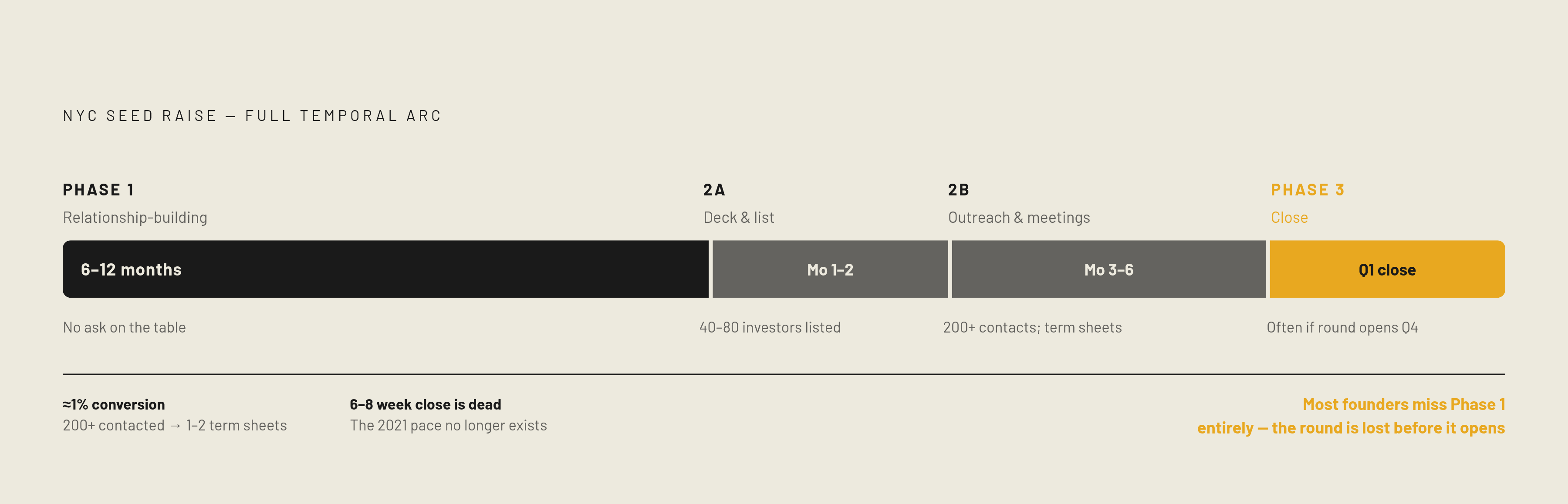
The six-to-eight-week close founders still swap stories about from 2021 is dead. Not sleeping, dead. Seed raises in NYC now eat up 3 to 6 months of active fundraising, and that's after the part nobody brags about at dinner parties: 6 to 12 months of quiet relationship-building before the round is even open. Investors want to know a founder before there's an ask on the table. That's the default now, not a courtesy extended to the especially polite.
Series A runs 3 to 9 months, for comparison. So seed now stands as a full leg of the trip in its own right. It's the first, longer leg.
Inside an active raise, the calendar tends to run like this. Months one and two go to building the deck, the data room, and a disciplined list of 40 to 80 investors who are actually stage-right and sector-right, not 200 names pulled off a spreadsheet somebody found on LinkedIn at 2am.
The funnel math is where most founders get the shock of their fundraising lives. Founders typically contact more than 200 investors to land one or two term sheets, according to NYU Entrepreneurship, which works out to roughly 1% conversion from first email to signed check. And once a deck lands in an inbox, it doesn't get long to make its case: DocSend's data clocked average deck review time at 2 minutes 24 seconds, with seed-stage decks getting even less, 1 minute 56 seconds. That's shorter than it takes toast to pop. Traction, team, and market have to land before the scroll bar runs out, or they don't land at all.
Founders who beat this timeline almost always started the relationship-building phase 6 to 12 months early, sending monthly updates to warm contacts so that by the time the round opens, half the conversations are already underway. They didn't skip the line. They started walking toward it while everyone else was still looking for the door.
Seasonal rhythms that shape when to start and when to close
Fundraising has a calendar, and it's lumpy. Q4 sees roughly 20% more deals than Q1, as funds rush to deploy whatever's left in the annual budget before year-end. More deals sounds good until you notice the competition for attention spikes right alongside it, and the holidays drag plenty of those closes into January or February anyway.
Q1 is quieter on volume, and that's exactly why it's the better window. Median seed pre-money valuation hit $16 million in 2025, up 18% from the year before. Fewer deals, less noise, and standout companies get to negotiate from strength instead of getting lost in the Q4 pileup. Series A follows the same shape, busy in Q4, selective in Q1, and that matters because when a seed round closes decides when a founder walks back into the market for the next one.
AI and healthcare mostly ignore this cycle. Investor appetite in those sectors stays strong year-round, which gives founders there more room to pick their moment. Everyone else answers to the calendar whether they like it or not.
Here's the actual strategy, and plenty of NYC founders already run it on purpose: Q4 rewards volume over pricing power, so it's the quarter for a good-but-not-exceptional pitch to get seen without getting scrutinized too hard. A genuinely strong pitch should hold for Q1, where scarcity does the negotiating for you. Build relationships through the fall. Open the round formally in February or March. The play is to treat it as the play, not a hedge.
How seed deals are structured in 2025 and what the standard terms actually mean
Round sizes in 2025 run from $500,000 to $5 million or more, with Carta's data putting the median around $2.5 million, though sector and geography shove that number around plenty.
The SAFE has become the only instrument that matters at this stage, full stop. In Q1 2025, 90% of pre-seed rounds tracked by Carta used a SAFE, the rest used convertible notes. The Y Combinator Post-Money SAFE is the template almost everyone reaches for, mostly because it keeps legal costs to $1,000 to $3,000 per close, against $15,000 to $50,000 for a priced round. A SAFE carries no interest and no maturity date. The investment converts to equity later, at the next priced round, with a valuation cap setting a ceiling on what the early investor pays per share.
Pre-seed caps generally land between $6 million and $15 million. Seed caps have climbed alongside valuations, with median seed pre-money at $16 million in 2025, an 18% jump year over year, according to Carta.
Convertible notes still show up for bridges and extensions, where a maturity date (18 to 24 months) and an interest rate give investors protection a clean SAFE doesn't offer. Priced rounds bring preferred stock, a set valuation, board seats, and the legal bill that comes with all of it, making them more structure than most early-stage rounds actually need.
Most Favored Nation clauses show up often in convertible notes: if a later investor negotiates a lower cap or a better discount, earlier noteholders get to upgrade and match it. Founders running a rolling close need to know exactly what they've already promised earlier investors before they promise something sweeter to the next one, because MFN clauses have a way of reaching backward and biting.
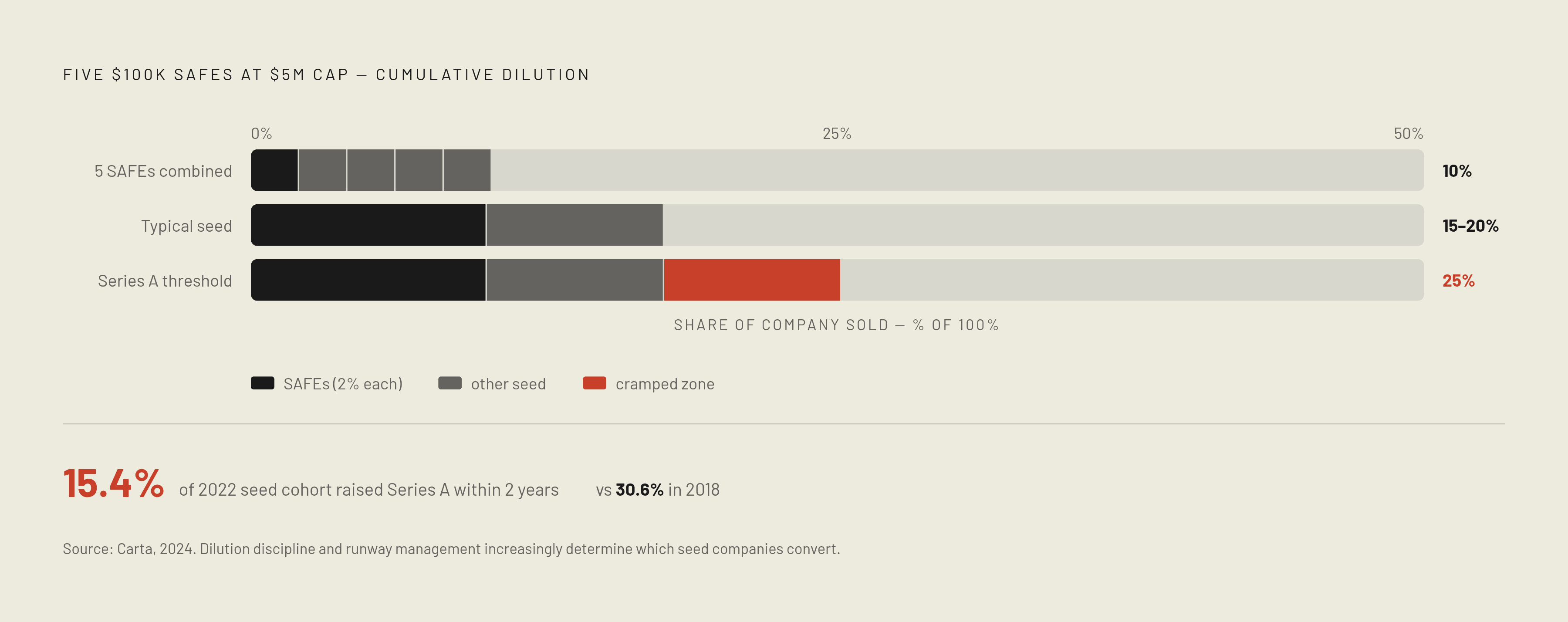
And here's the math that trips up more founders than anything else in this section. Post-money SAFE ownership is additive. Five separate $100,000 SAFEs at a $5 million cap sell 10% of the company total, not 2% each stacked on nothing. Track the running total before signing the next one. Otherwise the founder finds out at the priced round that there's a lot less pie left than expected, and by then it's too late to renegotiate anything.
Dilution targets and the cap table math that follows founders into Series A and beyond
Most seed rounds cost founders 15% to 25% of the company. Cross past 25% and the cap table starts looking cramped to Series A investors, who need room to build a real position without shoving the founder into minority-shareholder territory before the company has even found product-market fit.
Rebel Fund has noted that founders who keep seed dilution under 18% are significantly better positioned for future rounds. A few extra points given away casually at seed doesn't feel like much in the room. It compounds instead, quietly, and shows up as a real problem two rounds later when there's no margin left to give anyone.
Dilution stacks in ways founders consistently underestimate. Seed, then Series A, then Series B, and by Series C plenty of founders own less than a third of the company they started. That's not just an ego bruise, either. It changes incentives at the board level, and it makes it harder to offer real equity to the employees a growing company actually needs to hire.
Series A dilution in 2025 came in lower, around 17.9%, though just over 19% of rounds across all stages priced as down rounds. That's a reminder that seed-stage valuation decisions don't stay contained to seed. They echo forward, sometimes for years.
Ownership percentage alone doesn't tell the whole story either. Giving up 20% at a $16 million valuation with real revenue behind it is a fundamentally different deal than giving up 20% at that same number with nothing to show yet. Price-to-traction ratio matters more than the raw percentage sitting on the page.
And the runway math should scare people more than it currently does. Only 15.4% of the 2022 seed cohort raised a Series A within two years, according to Carta data, down sharply from 30.6% in 2018. That's a brutal drop, and it means a seed round has to fund well past the 12-month plan most founders build around. Twenty-plus months of runway is the safe target now, not the ambitious one.
The NYC investor landscape: which seed funds are active and how they differ
The venture market has split into two clear tiers: large multi-stage funds writing checks across every stage, and smaller specialized seed funds that only play in the earliest innings. NYC has a deep roster on the seed side, and picking the wrong type of fund for the stage is its own quiet way to burn six months chasing a check that was never coming.
Lerer Hippeau, based in Manhattan, is one of the city's longest-running seed specialists. Founded in 2010 by Ken Lerer and Ben Lerer (originally as Lerer Ventures, with Eric Hippeau joining in 2011 and the firm renaming in 2014), it has raised roughly $1.4 billion across nine funds, with Fund IX closing oversubscribed at $200 million in April 2025. Past portfolio companies include Warby Parker, Casper, Allbirds, Bowery Farming, K Health, and Zipline.
Brooklyn Bridge Ventures, an NYC-only fund based in Brooklyn, built its name backing exclusively local founders, though it's no longer making new investments as of May 2023.
Primary Venture Partners, also in Brooklyn, has led seed rounds into companies including Jet.com and Coupang.
Notation Capital, based in Brooklyn, focuses on early-stage companies.
BoxGroup, in Manhattan, invests broadly across sectors and isn't limited to NYC-based founders.
First Round Capital, based in San Francisco, backed Uber and Square at seed and keeps a strong presence in NYC despite its West Coast home base.
What links these firms matters more than any single fund's bio: early backing from this layer often opens the door to growth capital from larger NYC investors down the line. The ecosystem has scaffolding built in, and founders who pick the right seed partner get to climb it. What a fund brings beyond the check varies more than founders expect, too. Introductions to first customers, help with early hires, and just showing up during the ugly stretches, that's what separates a seed partner worth having from a name that just sits quietly on the cap table.
Why warm introductions are the actual currency of NYC seed fundraising
Cold outreach doesn't die in NYC seed fundraising. It just rarely survives the subject line. Seed investors see hundreds of pitches a quarter, and a cold email only breaks through when the metrics are loud enough to speak for themselves, which most seed-stage companies simply don't have yet.
Warm introductions open doors that cold outreach rarely does, and the mechanism behind it is simple: the fastest way into a meeting runs through a portfolio founder who already has a relationship with the target investor, somebody who can vouch for both sides because they've sat across the table from both of them.
So the real work happens before the round ever opens. That means mapping out who in a founder's network actually knows the target investors, not who shows up as a LinkedIn connection with a shared zip code. A weak introduction from the right person still beats a strong pitch from a stranger, every single time. Monthly updates sent to warm contacts during the relationship-building phase do quiet work here too, turning a name on a spreadsheet into someone who already knows the company's trajectory before the ask ever lands.
NYC's size actually works against founders who assume proximity does the job for them. The scene is too spread out across boroughs and industries for anyone to just bump into the right person at a coffee shop. Meaningful connections here get built on purpose, through recurring events, demo nights, and the kind of industry dinner that happens the same week every month, like clockwork. Being embedded in a peer community that makes introductions based on real knowledge of each other isn't a nice-to-have. In a market that runs on warm intros, it's closer to oxygen than to strategy.
How founders actually get inside the rooms where NYC introductions happen
NY Tech Week returns June 1 to 7, 2026, across Manhattan and Brooklyn, presented by Andreessen Horowitz. It bills itself as the largest decentralized tech conference in the world, and the 2025 edition backs that up: 1,020 events and more than 40,000 attendees, with every single event run by a different startup, VC, or operator rather than one central organizer. It's the highest-density week on the NYC startup calendar, and skipping it is a mistake founders regret the following March, usually while wondering why their competitor's cap table looks so much healthier.
NYC AI Demos runs as the largest monthly AI demo series on the East Coast, a natural fit given the size of the city's AI workforce and how little that sector ever cools off. Deep Tech New York held its inaugural conference as part of a broader push to build the same kind of infrastructure for founders working outside pure software.
None of this happens by accident. NYC's ecosystem doesn't assemble itself through proximity the way a smaller city's might. It assembles because people choose to show up to the same rooms, again and again, month after month. Founders who skip the recurring events aren't quietly meeting the right people some other way, they're just not meeting them, period. Invite-only, application-based communities run on the same logic as warm intros: a small room where members actually know each other produces introductions an investor will trust, because the investor trusts the relationship that produced it, not the name typed at the bottom of an email.
What to have ready before you open the round, and the mistakes that stall closes
Everything comes back to that 1 minute 56 second window DocSend clocked for seed-stage decks in 2024. Whatever a founder wants an investor to remember has to land inside that window, which means traction, team, and market need to show up before the narrative even finishes warming up its engine.
The traction bar has moved, and it hasn't moved in founders' favor. Investors who once funded a strong team with a working prototype now want early revenue, retention numbers, or signed contracts before they'll engage seriously. First-time founders without a prior exit feel this hardest, since there's no track record to lean on when the current metrics are still thin.
Cap table hygiene is the other place closes stall, and it usually happens quietly, late, and expensively. Founders need to know their exact running SAFE total, and what percentage of the company it represents, before adding one more instrument to the pile. They also need to know any MFN clauses already sitting in earlier paperwork, because those clauses reach forward and shape what the current round can offer without triggering an upgrade for somebody who invested six months back. Skip that step, and the surprise doesn't show up in the pitch meeting. It shows up at the closing table, which is a considerably more expensive place to learn it.