NYC Startup Ecosystem Events Calendar for Founders
A founder's guide to the NYC startup events that actually produce deals.
Start with the raw numbers, because they actually matter here. NYC startups raised $16.6 billion across 460-plus deals in 2024. That was a 74% jump from the year before. And 2026 is already tracking past that, with more than $17 billion raised in the first seven months alone.
That kind of capital concentration shapes everything downstream. Including who shows up at events and what they're actually there for.
What makes New York structurally different from every other startup hub isn't just the size. It's the sector mix. AI, fintech, health tech, media, retail tech, and enterprise software all have real, active sub-communities here. They run their own events. Their own recurring dinners. And because they're all crammed into the same city, they end up in the same room constantly.
That cross-pollination is useful in ways that are hard to engineer elsewhere. An enterprise SaaS founder can find a potential customer, a co-investor, and someone who might be their CTO in two years, all at the same Thursday evening gathering in Flatiron. That's harder to pull off in a city built around one vertical, where everyone at the table is solving roughly the same problem.
The early-stage concentration is real too. Manhattan led the country in seed and Series A rounds over a recent 12-month stretch, ahead of San Francisco. So the room at a well-targeted seed-stage event here is actually competitive. The investors are real. The founders are real. Deals happen in these rooms.
Cornell Tech, Columbia, and NYU also feed a steady pipeline of technical talent and early-stage founders into the ecosystem. Some of the most interesting pre-seed events are attached to these institutions, and they're chronically overlooked by founders who are busy chasing the more obvious gatherings.
The catch: all this density creates noise. More events, more access, but also more bad rooms pretending to be good ones. The real scarcity in NYC isn't events. It's your time, and the quality of introductions that actually come out of a given room.
NY Tech Week as the City's Highest-Density Founder Moment
Once a year, the entire ecosystem convenes in a way that doesn't happen any other week. NY Tech Week runs for seven days across Manhattan and Brooklyn, presented by a16z. The 2025 edition drew more than 1,020 events and 40,000-plus attendees. By any reasonable measure, it's the largest decentralized tech conference in the world.
The decentralized format is both the feature and the trap.
There's no single ticket. No curated agenda. Hundreds of independent events are hosted by startups, VCs, and operators, each requiring a separate application or invite. The upside is that any firm or community can create something worth attending. The downside is that most of them do, and a lot of it is filler.
A few things that actually help:
- Target two or three high-value events per day, not five or six. Burnout is real, and the best events are small. You cannot be present in six rooms in one evening, even if you physically visit all of them.
- Prioritize curated founder dinners. Somewhere between 15 and 40 people. The table constraint forces depth that a 200-person rooftop cannot.
- Skip the low-cost-ticket "investor networking" events. The rooms where real check-writers show up are either free and invite-only, or clearly branded by a firm with actual skin in the game.
- Look for events hosted by people with established reputations. Past Tech Week editions have included gatherings from Bloomberg Beta and Anthropic's Founder Salon. Small-format, high-signal, built around depth rather than attendance numbers.
Browse the official calendar at tech-week.com/calendar/nyc. Events are tagged by format, which makes it possible to filter toward dinner-format and small-group sessions before you commit.
One thing worth sitting with: founders fly in from London, Paris, and Toronto for Tech Week. The introductions available during those seven days are not available the other 51 weeks of the year. That changes the math entirely. Treat it as a strategic deployment, not a passive calendar item you'll sort out once it arrives.
The Recurring Weekly and Monthly Events That Build Real Relationships Over Time
One-time events produce business cards. Recurring events produce relationships. There's a real difference between knowing someone's name and actually knowing them, and the second one requires repeated exposure over time.
The founder who shows up to the same dinner six times knows everyone in the room. The founder who attended once, had a good conversation, and never came back is mostly forgotten by the next month.
Categories worth knowing:
- Founder dinners. Small, curated, often invite-only. NYC Founders Club runs weekly dinners of six members with warm introductions and no Slack groups or webinars attached. The constraint is the point. When every seat matters, every conversation matters.
- Demo and pitch nights. Quality varies sharply. The ones worth attending are hosted by actual funds, like FirstMark's events or Lerer Hippeau-adjacent gatherings, not generic event companies. Real check-writers attend the curated ones.
- Startup Grind NYC. Chapter of a global community, hosts regular speaker events and meetups. Better for exposure and early-stage learning than for deal introductions at seed or Series A.
- Sector-specific monthly meetups. Fintech, AI, climate tech, and health tech each have their own recurring gatherings. These are often where the most useful domain-specific conversations happen, because the room self-selects. Everyone there already speaks your language and doesn't need the 30-second explainer on what you're building.
- VC-hosted office hours and founder breakfasts. Union Square Ventures, Lerer Hippeau, and AlleyCorp have all run recurring founder-facing programming. Track their event pages and newsletters. Often the lowest-key and highest-value options on the calendar, precisely because they're not trying to be anything more than useful.
For discovery, Bonfire VC's events list, FounderEventsNYC, and NYCB2B are the most consistently updated aggregators. Useful for scanning, though quality still varies and you'll need to filter.
One geographic shortcut worth noting: the Flatiron and Union Square corridor, roughly 14th to 30th Streets, is where the highest density of recurring events clusters. You start to recognize faces. Faces become names. Names become introductions. Some of that just comes from being in the same physical neighborhood repeatedly, which no calendar or newsletter can fully replicate.
What Founders at Different Stages Should Actually Be Looking For in a Room
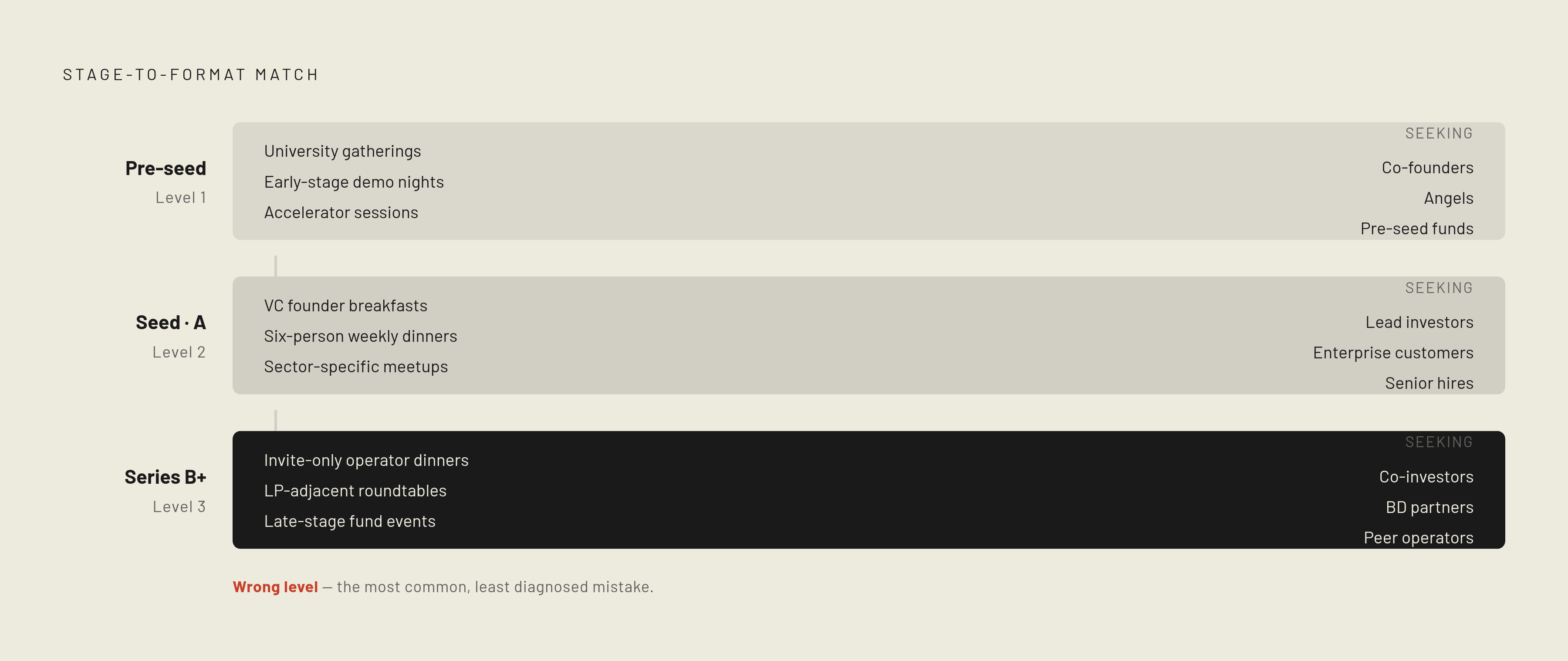
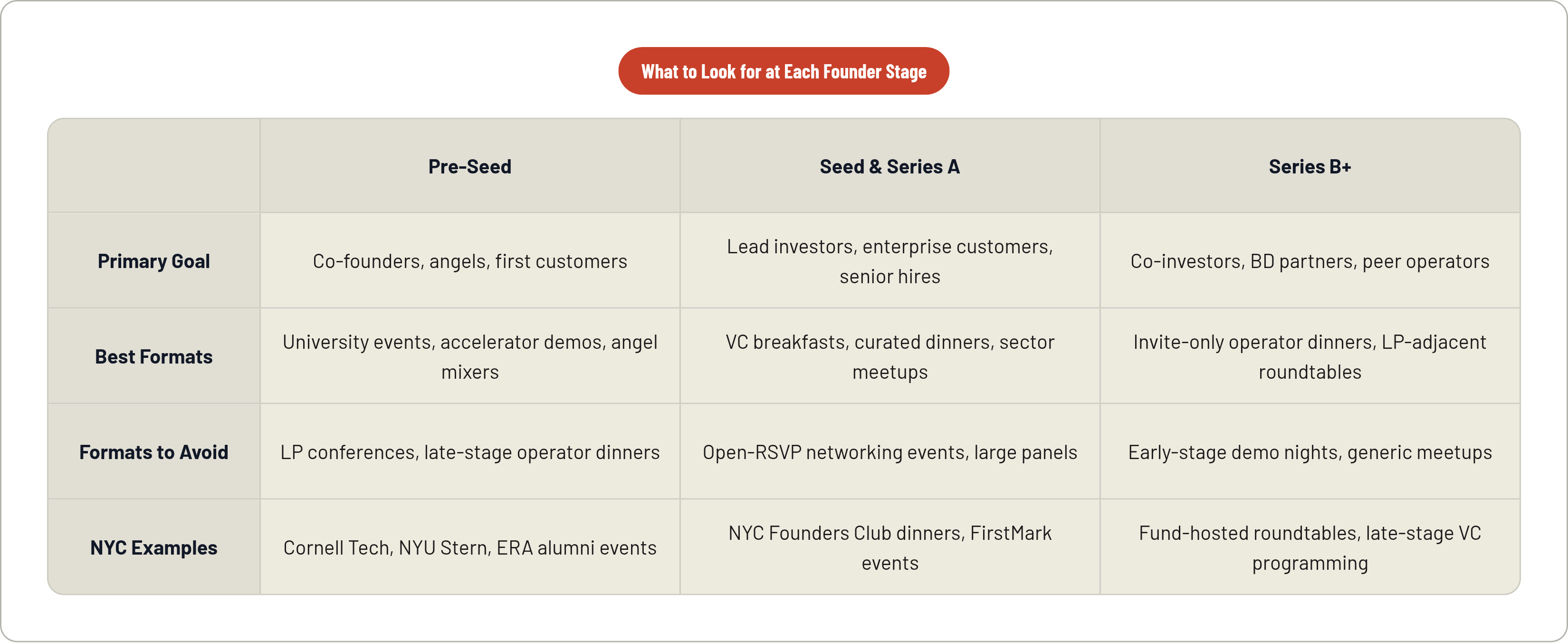
The right event for a pre-seed founder is not the right event for a Series B operator. Attending the wrong one doesn't just waste your evening. It puts you in front of the wrong people at the wrong moment, which can feel demoralizing in a way that's hard to diagnose because the room looked impressive from the outside.
Pre-seed and idea stage: You're looking for co-founders, early believers, potential first customers, and introductions to angels and pre-seed funds. University-affiliated gatherings at Cornell Tech, NYU Stern, and Columbia are underrated here. Early-stage-specific demo nights and accelerator info sessions, like YC NYC events or ERA alumni gatherings, are also worth your time.
Avoid large LP-facing conferences and late-stage operator dinners. The conversation in those rooms won't be calibrated to where you are, and you'll spend the evening either over-explaining yourself or quietly feeling like you wandered into the wrong building.
Seed and Series A: You're looking for lead investors, warm intros to follow-on funds, first enterprise customers, and senior hires. VC-hosted founder breakfasts, curated dinners with mixed founder and investor composition, and sector-specific meetups in your vertical are the formats that tend to produce real outcomes here.
This is the stage where a six-person weekly dinner format is most directly useful. You're not pitching into a crowd. You're at a dinner where the other people at the table are working through roughly the same problems you are, which is a different kind of conversation entirely.
Series B and beyond: You're looking for co-investors, business development partnerships, senior talent, and peer operators who have already solved problems you're currently staring at. Invite-only operator dinners, LP-adjacent events, and roundtables hosted by funds with late-stage exposure are where those people tend to gather.
The scarcity dynamic actually flips at this stage. It's harder to find peers who are at the same altitude. Being in a small, curated room matters more, not less.
Three questions that cut through most of the evaluation work:
- Is the guest list curated, or open to anyone who clicks a button?
- Does the host have a reputation to protect by keeping the room good?
- Does the format allow for real conversation, or just pitching into a crowd and hoping someone catches it?
The Neighborhoods Where Events Happen and What Their Geography Signals
Where an event is held tells you something real about who will be in the room. Not everything. But enough to be a useful filter before you commit an evening to it.
Flatiron and Union Square corridor: The highest-density zone for founder events. VCs, accelerators, and enterprise clients are often within walking distance of each other. Flatiron captured a significant share of all Midtown South leasing in 2025, and companies like Harvey AI, Chime, and Pinterest have recently signed large leases here. Gatherings in this corridor skew toward growth-stage companies and established VCs. If you're pre-seed and feeling out of place at a Flatiron event, that's probably not you. That's the room.
Silicon Alley (14th to 30th Street along Fifth and Broadway): The historic startup corridor. Home to Ramp, Datadog, and a growing cluster of AI firms. Events in this pocket are more operator-facing and technical. Product, engineering, and AI gatherings happen here regularly. The vibe is builder-first, which is either exactly right for you or a mismatch, depending on what you're actually there to do.
Brooklyn (DUMBO, Williamsburg, Navy Yard): Lower cost, younger talent pipeline, earlier-stage community. Events here skew more community-oriented and less polished, which is not a criticism. Newlab at the Navy Yard hosts events specifically for hardware and deep tech founders, a genuinely distinct community from the pure software world of Flatiron. NY Tech Week spans both boroughs, and some of its best-regarded past events have been in Brooklyn lofts and private studios.
The practical read: if you're looking for seed-stage peers, Brooklyn and the lower Silicon Alley end of the corridor are more likely to produce them. If you're trying to meet Series B-adjacent VCs or enterprise buyers, Flatiron is where you spend your time. Geography is a first filter, not the whole answer.
How to Evaluate Any Event Before Committing an Evening to It
Most founders over-RSVP and under-attend. They say yes to six things, feel good about having options, and end up rushing through two of them while checking their phone. The better mistake is under-committing and going deep on the events you actually choose.
Before you say yes to anything, ask a few honest questions:
Who is hosting, and do they have a reputation tied to the quality of the room? A VC firm or known operator has more skin in the game than an event company running the same format every week for whoever signs up. One of these parties has something to lose if the room is bad. The other does not.
Is the guest list curated or open? Open RSVPs are a signal. Applications and invite-only structures are a counter-signal. They tell you something about who decided who gets in, and how much thought went into that decision.
What is the format? Dinners, roundtables, small workshops. Not panels followed by a cash bar where everyone is scanning the room for someone more important to talk to.
Is the event recurring? One-off events rarely produce the kind of familiarity that actually leads somewhere. Recurring events give you a reason to come back, and coming back is where the relationship actually forms.
Is the room calibrated to where you actually are right now? This is the question founders skip most often. A room full of impressive people solving completely different problems at a completely different stage is not a useful room for you, even if it looks good on paper.
The best room isn't always the biggest or the most well-known. It's the one where everyone at the table has something real to contribute and something real at stake. NYC Founders Club is built on that logic: weekly dinners of six, warm introductions only, invite-only membership. The idea is that the room passes these questions by design, rather than leaving each founder to sort it out every time.
The goal isn't to attend more events. It's to show up to fewer, better rooms, and actually be present when you do. In New York City, that's possible. The ecosystem is big enough to offer it. The only question is whether you're selective enough to find it.