Top NYC Venture Capital Firms by Stage and Sector
NYC venture capital has accelerated sharply, with $17.4 billion raised in just seven months of 2026.

The short version: a lot, and it's moving faster than most people realize.
NYC-based firms raised $31.1 billion in venture capital in 2025. That's up $6.2 billion over the prior year. Then 2026 hit the accelerator. Through the first seven months alone, NYC firms pulled in $17.41 billion across 521 deals. A 56% jump compared to the same seven months in 2025.
Seed activity is healthy too. The first half of 2026 saw $1.13 billion deployed across 240 seed deals. Average seed round size has expanded to $6.64 million, up from $5.4 million the year before. If you're anchoring your expectations to benchmarks from two or three years ago, those numbers are already stale.
None of this means capital flows freely. It means capital is present and moving, which are different things. The question was never whether the money is here. It is. The real question is which firms are deployed at which stages, and whether you're actually talking to the right ones.
Seed and pre-seed firms that write the first check
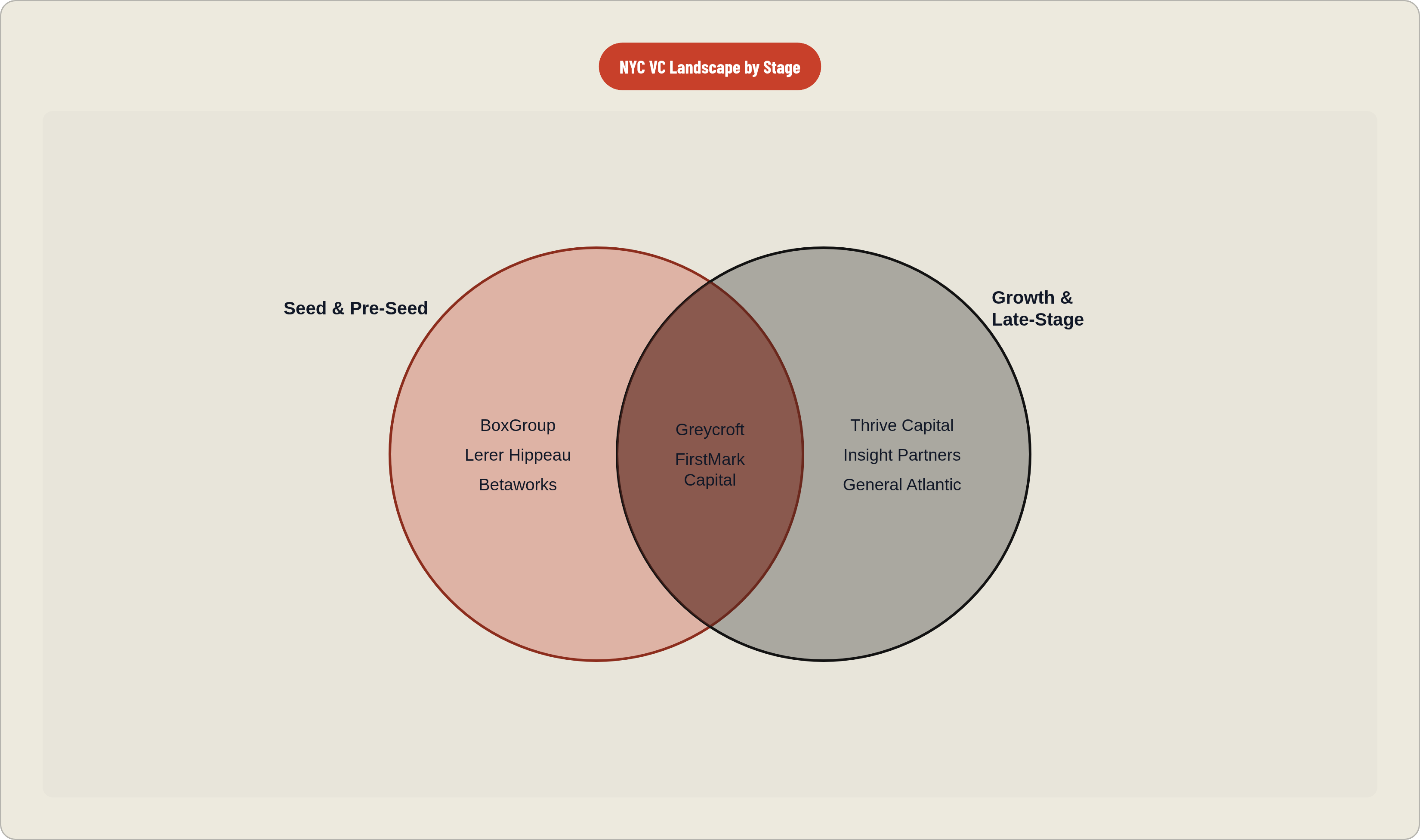
These firms are comfortable with ambiguity in a way that would give most investors hives. They're writing checks before there's much to de-risk. What they're really betting on is the founder, the insight, and the rough outline of a market opportunity — like placing a wager on the seed before you've seen the flower.
BoxGroup is the canonical NYC seed firm. They've put over $500 million to work across companies like Tinder, Ramp, Plaid, and Flatiron Health. That portfolio breadth signals something real: generalist conviction at the earliest possible moment, before a category has announced itself.
Lerer Hippeau, founded in 2010, is one of the most active early-stage firms in the city. Consumer, enterprise, healthcare. What founders notice is that they stay close after the check clears. A lot of seed firms skip that part entirely, and founders find that out the hard way.
Primary Venture Partners has invested over $300 million across more than 200 portfolio companies. The differentiator is operational support. If you want a seed partner who shows up for the messy middle, not just the closing dinner, they're worth a close look.
Betaworks is narrower and deliberately so. Interactive media, social tools, design-driven tech. Their portfolio includes Giphy and Dots. If your company lives at the intersection of culture and software, they're a more natural fit than a generalist seed fund chasing whatever's hot.
A few things these firms share: first-check conviction, real presence in the founder community, and genuine comfort writing a check before the path is clear. What varies is sector appetite and how much post-investment support is actually baked into the model. "Seed-stage" also covers a wide range of company maturity. Some firms want pre-product founders with a sharp insight. Others want post-revenue traction with a clear story for scale. Knowing which camp a firm sits in matters more than knowing their fund size, and most founders don't figure that out until after they've already burned a few meetings.
Early- to growth-stage firms that follow conviction from Series A through B
These firms want repeatable signals before writing a check. But they're still early enough to actually shape a company's direction. The relationship matters as much as the term sheet.
Union Square Ventures has been thesis-driven since 2003. Their current focus is on trusted brands that broaden access to knowledge, capital, and well-being through networks and protocols. The portfolio includes Twitter, Etsy, and Coinbase. They invest from Series A through D, which means they can follow a company for a long time if the conviction holds, and they will.
FirstMark Capital runs from seed through Series B. Software, AI, data infrastructure, consumer tech. Checks range from $1 million to $15 million. The portfolio includes Shopify, Pinterest, and Ro. What distinguishes them is a founder network that extends well beyond capital. Getting into that community has real value, separate from the check itself.
Greycroft is bi-coastal but NYC-rooted. Initial checks range from $500,000 at seed to $30 million at growth, and they run a separate growth fund that lets them follow portfolio companies across multiple rounds. Venmo, The RealReal, and Braintree are all in the portfolio. If you want a firm that can stay with you from early to late, Greycroft is built for that kind of continuity rather than treating later-stage follow-on as an afterthought.
RRE Ventures focuses on software, internet, and communications. Series A and B checks in the $4 million to $15 million range. If your company fits that focus cleanly, the narrower aperture is actually a feature. You're not competing for attention against companies in completely different spaces.
Lux Capital manages over $5 billion and specifically seeks out what they call "counter-conventional" ideas in deep tech and science. Seed checks run $2 to $5 million, with follow-on capacity through Series B. If you're building something most investors aren't equipped to evaluate, Lux has done the work of building an internal vocabulary for exactly that kind of company. They've been doing it long enough that they're not pretending to understand your science. They actually do.
Growth- and late-stage firms with capital for companies that have already found product-market fit
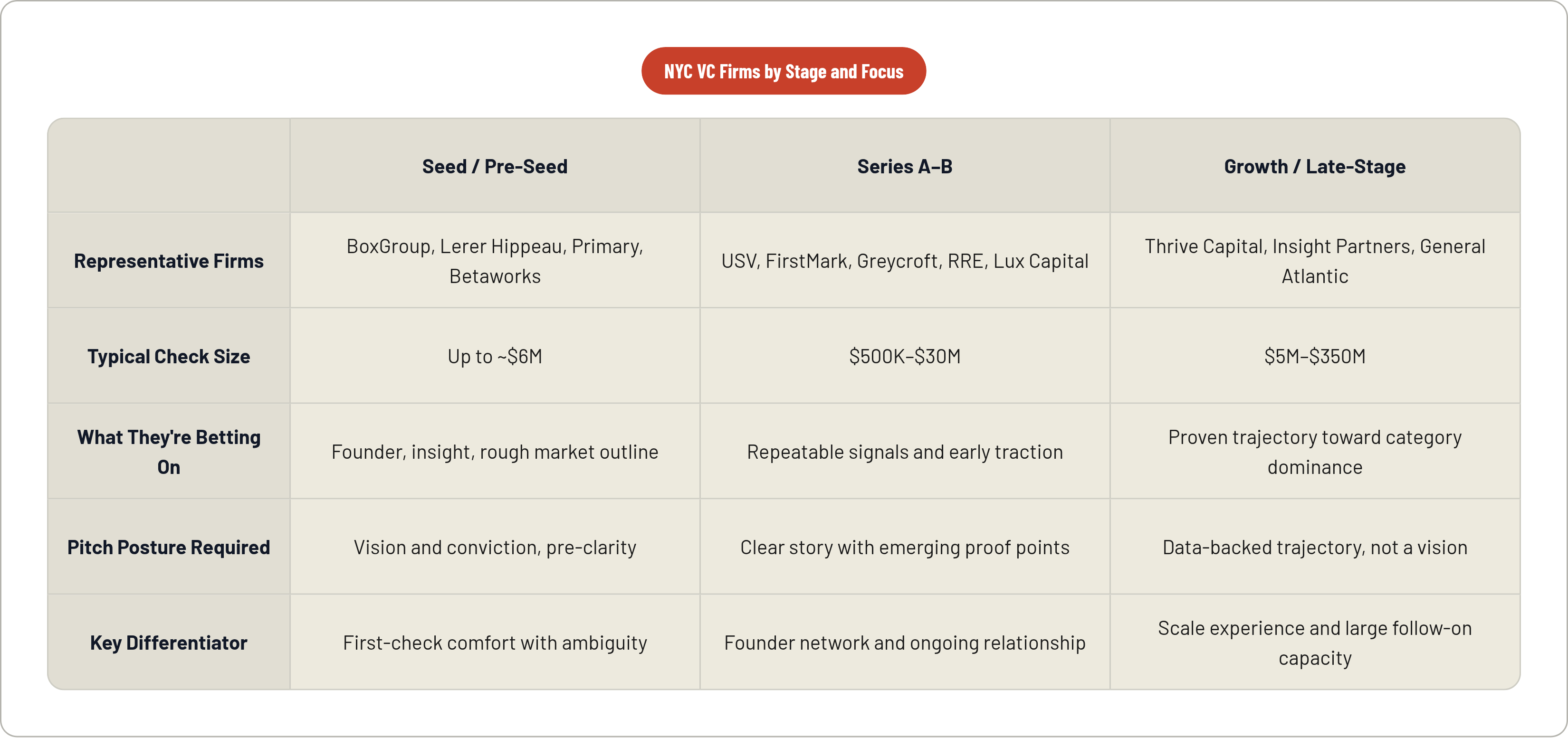
These firms are not discovering companies. They're doubling down on ones that have already proven something real. The pitch changes accordingly. You're not selling a vision anymore. You're selling a trajectory. Think of it less like a first date and more like showing up with a résumé — the story you tell had better match the record.
Thrive Capital raised over $5 billion for their ninth fund in August 2024, split between a $4 billion late-stage vehicle and a $1 billion early-stage fund. Checks range from $5 million to $100 million across stages. The portfolio includes Instagram, GitHub, Spotify, Stripe, Ramp, and Anduril. Their strategy concentrates bets rather than spreading thin, which means fewer portfolio companies competing for the same internal attention.
Insight Partners manages over $90 billion and has backed more than 800 companies. Checks range from $10 million to $350 million. They specialize in what they call "scale-up" companies. Software businesses with proven revenue that are moving toward category dominance. If you've found product-market fit and you're trying to pull away from competitors, they've seen that specific moment hundreds of times.
General Atlantic has deployed over $31 billion across technology, healthcare, financial services, and consumer. They're known for a long-term partnership posture. Quick exits and short hold periods aren't really the point. If your business has a long arc and you want a growth partner who thinks in years rather than quarters, that's the posture they bring to the table.
For founders who are earlier right now: knowing these names still matters. Understanding what trajectory they'll want to see before a Series C conversation shapes how you should be building and telling your story today. You don't have to be raising to benefit from knowing where you're eventually headed.
Sector-specialist firms worth knowing regardless of stage
Generalist firms bring capital and broad networks. Specialist firms bring domain relationships. Those relationships mean introductions to customers, regulators, and strategic partners that a generalist fund simply doesn't have, and honestly can't build fast enough to matter when you actually need them. For founders in regulated or technically specialized sectors, that often makes more practical difference than check size.
Deerfield Management is exclusively focused on healthcare across multiple stages. Therapeutics, health infrastructure, patient-outcomes technology. If your company lives in this space, they're worth getting to know early, not just when you're ready to raise.
Scout Ventures invests at the early stage in frontier and dual-use technologies, with a particular focus on companies built by veterans, intelligence leaders, and research institutions. Seed checks run $2 to $5 million. They also help portfolio companies access non-dilutive government capital, which in the defense and dual-use tech sector isn't a nice-to-have. It's a real competitive advantage that can meaningfully change your burn math.
Haymaker Ventures spun out of Thiel Capital and focuses on fintech, embedded finance, and digital banking. Checks run $1 million to $10 million at seed and Series A, and they're most relevant at the prototype and early-revenue stage. If you're building in financial infrastructure, they bring relationships that a generalist fund simply doesn't have on speed dial. That access is worth something.
How to use this map when you're actually preparing to fundraise
Start with stage fit. Then layer sector fit on top. A firm that's wrong for your stage won't save you with a shared thesis. Most founders get this backwards, spending weeks crafting the perfect pitch for a fund that was never going to write the check because the math didn't work from day one.
Check size is a reliable proxy for fit. If a firm's typical initial check is half of what your round requires, the math doesn't work regardless of how much they like what you're building. Don't waste your time or theirs.
Cold outreach is less effective than most founders expect. The firms in this map are relationship-driven and receive more inbound than they can reasonably process. An unsolicited email from an unknown founder is competing for attention in a very crowded inbox, and most of the time it loses quietly with no reply.
Warm introductions carry disproportionate weight. Not because of some vague social dynamic, but because of how most NYC deals actually get started. A referral from a founder a firm already knows and trusts opens a meeting. The same message sent cold sits in a queue.
The practical implication: the peer network around you is a fundraising asset, a real one. Founders who know other founders at the right stage and sector, and who have built enough trust to ask for a real introduction, consistently run shorter and higher-quality fundraising processes. That's just what the data shows.
NYC Founders Club exists in that gap. It's a small, curated community of founders who have been through it, where introductions come from people who genuinely know both sides. The kind of referral that actually gets a meeting on the calendar rather than a polite non-reply.
The map tells you where the capital is. Getting to it is a different problem entirely.