NYC Startup Office Space Options Under a Hundred Thousand Square Feet
Shrinking vacancy makes choosing the right office format a strategic decision, not just paperwork.
Manhattan office vacancy sits at 21.1% as of Q4 2025, down 90 basis points in a single quarter, the lowest combined vacancy since early 2022. That drop is the whole reason this piece exists: when space gets scarcer, picking the right format (coworking, flex, sublease, or direct lease) stops being a paperwork exercise and starts being a real decision with real money attached. I've watched founders burn six figures guessing wrong on this, so here's the breakdown, for anyone renting under 100,000 square feet in NYC.
What NYC's startup density actually looks like and why it drives office demand
New York has more than 13,000 startups running around, backed by over 2,000 accelerators and incubators pushing them along. This isn't a market where you wander in and grab whatever's free. It's deep enough that the neighborhood you land in decides who you run into at the coffee cart, and sometimes that matters more than the lease terms.
AI startups leased 486,000 square feet in Manhattan through Q3 2025, nearly all of it in Midtown South and the Flatiron corridor. Meanwhile NYC posted 12,853 tech job postings in March 2025 alone, 6,556 more than San Francisco managed the same month, and people are hiring, which means somebody eventually needs a desk, a badge, a place to sit.
The tech workforce here grew 26.2% between 2019 and 2024, about ten times the pace of the private sector overall. That's not gradual growth, that's a team doubling before your lease is even up for renewal. And with $28.4 billion in VC funding across more than 1,200 deals in 2025 (per the NY State Comptroller), a lot of these companies can actually afford to sign something real, and their investors are watching every dollar of it, too.
Bottom line: you're not negotiating with a landlord who's desperate. You're competing against other well-funded teams for the same three or four blocks of square footage, and everyone showed up with the same idea at the same time.
How to size your space before you start looking at options
Three questions before you tour a single suite. How big is the team today, how big might it realistically get in 18 to 24 months, and does the space need to say anything about who you are as a company? A four-person seed team and a thirty-person Series A team are not shopping the same aisle, full stop.
Overbuilding is just as expensive a mistake as outgrowing your space too fast. Both land you back in the market, paying moving costs and broker fees nobody budgeted for, usually at the worst possible time.
Stage predicts readiness better than instinct does. Pre-seed and seed: flexibility wins, every dollar spent on square footage is a dollar not extending runway. Series A: dedicated space starts making sense, financially and culturally, because shared coworking floors start generating real friction once a team hits a certain size. Series B: direct leases become realistic, since you finally have revenue history to negotiate from instead of hoping the landlord takes pity on you.
There's a rough tipping point around 10 to 15 people, where coworking's per-seat cost climbs above what a direct lease or sublease would run annualized. Worth running your own numbers rather than trusting that number blindly, but it's a decent gut check before renewing another monthly membership out of pure habit.
A few culture questions matter more than people admit. Does the team actually work better shoulder to shoulder, or is the office more security blanket than workspace? Do clients or investors walk through the door often enough that a hot desk sends the wrong signal, or is the neighborhood part of the brand rather than just a commute question you're overthinking at 11pm?
This piece caps at 100,000 square feet because almost nothing below Series C needs more than that. Depending on the layout, that range covers anywhere from two dozen people to a few hundred.
Coworking: what it actually costs and when it stops making sense
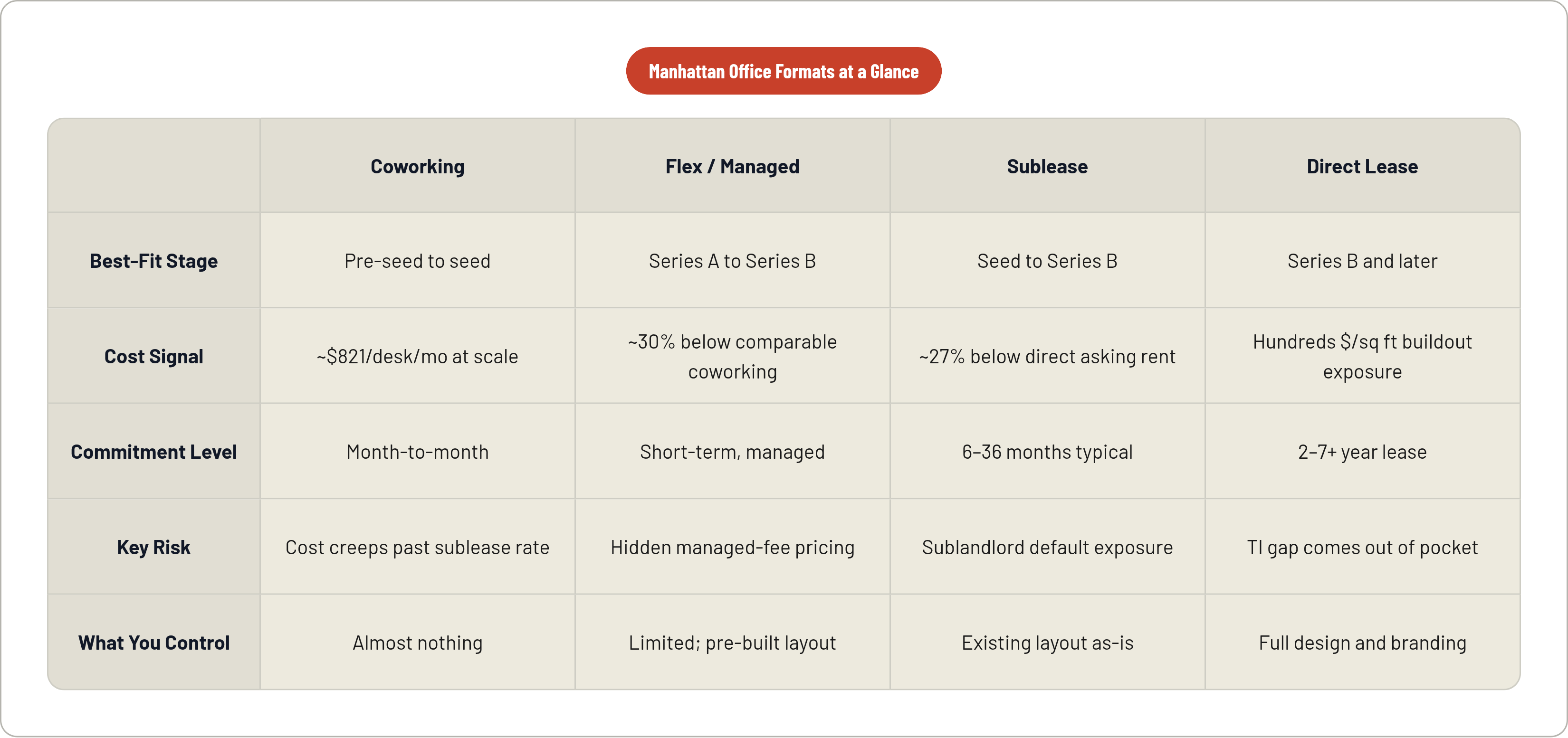
Coworking is the easiest format to price out because the numbers sit right on the website. Manhattan memberships average $339 a month, per CoworkingCafe's 2026 data. Day passes run $39, and meeting rooms go for about $67 an hour, with Brooklyn running a touch cheaper, around $320.
Private desks have quietly gotten expensive though. Hubble's Q2 2026 numbers show the Manhattan average private-office desk at $821 a month. Run that for ten people and you're at $8,000 a month before anyone's even booked a conference room. That number sneaks up on founders, creeping right into sublease territory until nobody notices until the invoice actually lands in the inbox.
What coworking actually sells you is simplicity. No buildout, no lease negotiation, no chasing a cleaning vendor who stopped answering texts. Internet, front desk, coffee, all included, and month-to-month, which is exactly right when your headcount or your funding round is still a moving target.
What it doesn't sell you is privacy. Try running an investor call, or worse, a termination conversation, in a glass phone booth next to someone's sales pitch. No brand presence either, since your space looks like the space next door and the one after that, and the cost curve only bends one way as you grow: up.
Two setups worth knowing by name. Industrious runs WorkLife Office Suites inside the reimagined Penn1 building, private offices plus coworking lounges, wellness rooms, an in-building café. Mindspace opened at 25 Kent Avenue in Williamsburg, waterfront views, a rooftop deck, a fitness center with an honest-to-god climbing wall, open around the clock.
There's no calendar date that tells you it's time to leave coworking. It's the month your bill crosses what a proportional sublease would cost, paired with the daily irritation of not having a door that shuts. Don't wait for the renewal email to make the call for you; if you're annoyed enough to be reading this section twice, you've probably already decided.
Flex and managed offices: the middle option that's become more landlord-driven
Flex space is a private, dedicated suite, move-in ready, fully managed, your name on the door, without the capital outlay of a buildout or the headache of chasing your own vendors. Renting a furnished apartment instead of buying a condo and hiring a contractor.
The operator landscape shifted hard underneath everyone recently. Management agreements, where the landlord keeps the risk and an outside operator handles daily operations, made up 53% of operator deals by the end of Q3 2025, and Savills projects that share clears 70% soon. WeWork came out of Chapter 11 in June 2024 running noticeably leaner, CBRE closed its acquisition of Industrious in 2025, and landlord-owned brands like Studio by Tishman Speyer now compete head-on in the same category. More operators, more inventory, wider spread in quality, so you're vetting the operator now, almost as much as the address.
The math genuinely works sometimes. Authentic Insurance left coworking for a 5,500 square foot full-floor space in Flatiron, landing 30% below comparable coworking cost with room to grow into. That's the exact corridor where startup density peaks in this city, which isn't an accident.
Flex suits Series A to Series B teams that want a space with real brand presence but no appetite for construction. Also right for founders who need something dedicated but genuinely can't forecast headcount three years out, and for teams without an office manager on staff to run facilities day to day.
Where it falls short: you don't pick where the walls go, since somebody already decided that for you. And managed-fee pricing can bury the real cost per square foot, so ask for the fully loaded number before comparing it against a sublease quote, otherwise you're comparing two things that only look similar on paper.
Subleases: the discount that's still real but harder to find
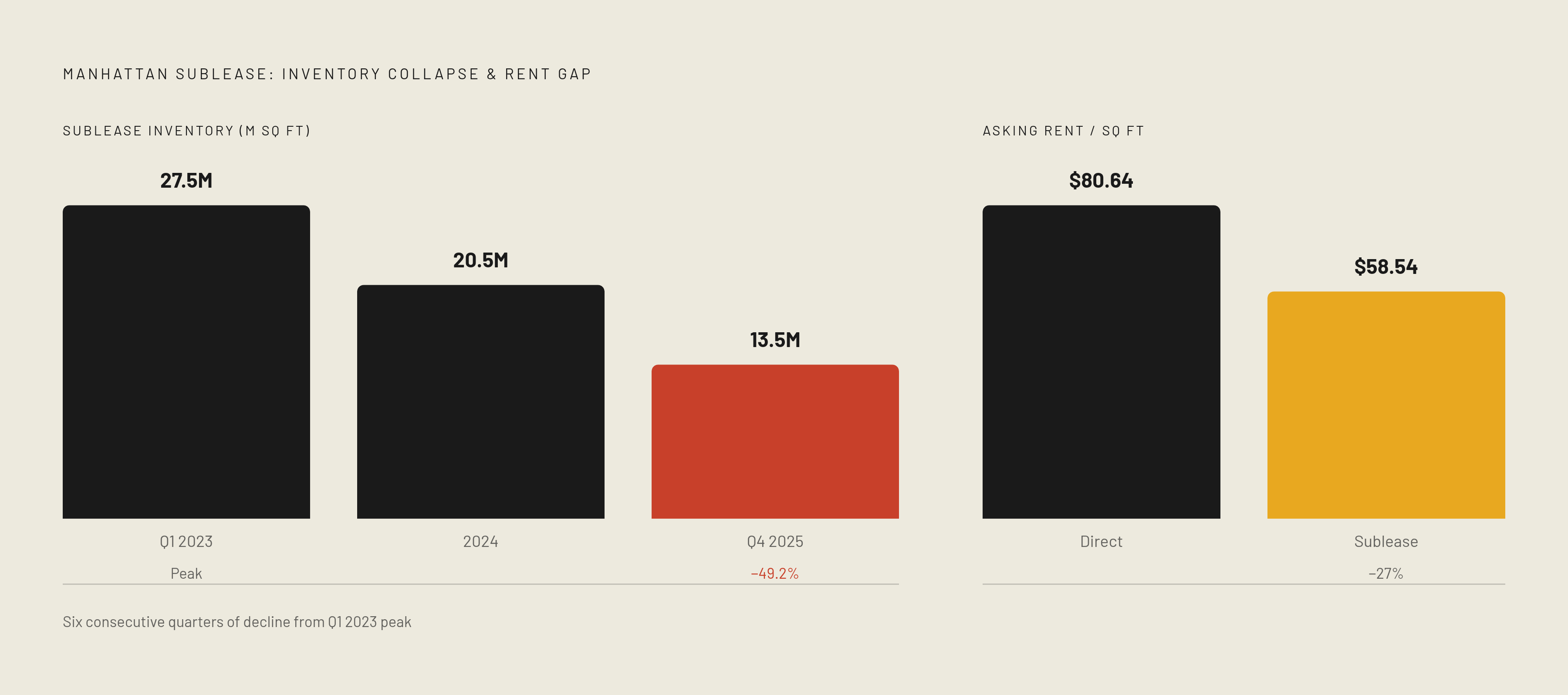
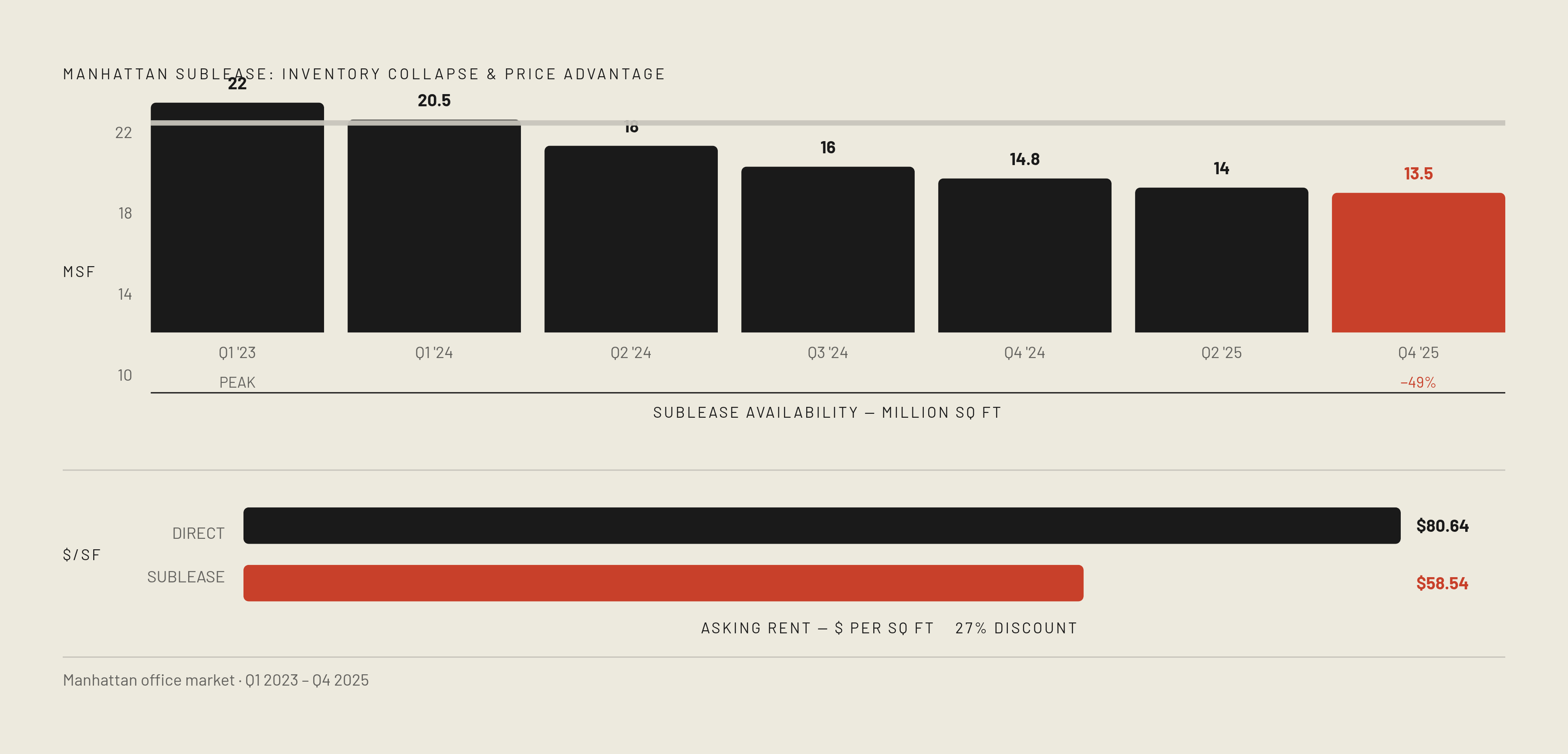
The sublease discount is documented, not folklore passed around at founder happy hours. Manhattan direct asking rents average $80.64 per square foot against $58.54 for sublease space, a spread around 27%. CBRE's March 2025 data shows the same gap in Midtown South specifically: $60.81 sublease versus $84.42 direct, and that's the corridor carrying the heaviest startup traffic in the city.
Here's the catch, and it's a real one: that window is closing fast. Sublease availability has dropped 49.2% from its Q1 2023 peak, and total inventory fell from 20.5 million square feet in 2024 to 13.5 million by Q4 2025, six straight quarters of decline. Founders who've been sitting on the fence are shopping from a noticeably thinner shelf than they think.
Sublease fits startups with 6 to 36 months of visibility on funding and headcount, usually in the 2,000 to 20,000 square foot range. Companies who want a quality address without paying full market rent, and teams planning to graduate into a direct lease eventually but need a bridge right now. Brokers report most new AI office deals coming from smaller and midsize firms, mostly under 5,000 square feet, which lines up with all of that.
There's a risk here founders skip past too often. If your sublandlord stops paying the master lease, you can get evicted even after paying your own rent on time, every month, without a single late fee to your name. Read the master lease before signing anything, and push for a non-disturbance agreement from the building's actual landlord; it's a normal ask, though not always a normal grant. Know exactly how your deposit is held, because if the sublandlord goes under, that money can vanish with them.
For scale, look at OpenAI's 90,000 square foot deal at the Puck Building in SoHo. That's the upper edge of what sublease can handle, proof the format isn't reserved for scrappy five-person teams working out of a converted closet.
Direct leases: what you get, what you give up, and when the math works
A direct lease means signing straight with the building's landlord for raw or white-box space, then running your own buildout: design, contractors, timelines, all of it. In exchange, you get full control over layout and branding, and nobody else's taste decides where the kitchen goes.
Buildout cost is what actually decides whether this format makes sense for you. NYC fit-out costs now run well into the hundreds of dollars per square foot, which means a 5,000 square foot office can run into seven figures before a single desk arrives. Tenant Improvement allowances exist to soften that, with Class A spaces typically offering somewhere in the low-to-mid three figures per square foot, negotiable and tied to lease length. But nationally, the average TI allowance fell noticeably in 2024 from the year before, and landlords handing over less right as construction costs stay stubbornly high isn't a great combination. The gap between what TI covers and what the buildout actually costs comes out of your pocket; run that math before signing, not after you're already three months into demo.
One piece of good news: lease terms have loosened, and landlords now offer 2 to 3 year commitments that were nearly impossible to get before the pandemic. That changes the calculus considerably if locking in for seven years sounds like a bad bet, which, frankly, it usually is.
NYC landlords also tend to ask founders for a personal guarantee, especially at early-stage companies without much revenue history. A Good Guy Guarantee limits your liability to the actual occupancy period rather than the full lease term, and pairing it with a letter of credit can shrink the upfront cash deposit. Worth pushing for both, and worth asking twice if the broker says no the first time.
Direct leases fit Series B and later: teams with a clear multi-year headcount plan, founders for whom the office itself is part of the hiring pitch. If a sublease or a pre-built flex suite gets you out of six-figure buildout exposure, only go direct when the control is worth paying for, otherwise you're just buying yourself a very expensive opinion about where the supply closet goes.
Where in NYC each format tends to land and why the neighborhood shapes the choice
Midtown South and the Flatiron corridor carry the heaviest concentration of AI startup leasing in Manhattan through Q3 2025, and the rents reflect it. Chelsea and Flatiron Class A space averages well into the nineties per square foot, Class B meaningfully lower. Flex operators and sublandlords there know exactly who's shopping, which is why deals like the Authentic Insurance move happened right in that neighborhood and not somewhere quieter.
Hudson Yards sits at the other end entirely. Select trophy floors push past $200 per square foot, out of reach for most early-stage teams and honestly not built with them in mind. That's a market for companies that already proved the model and want an address to match the story.
SoHo and the Puck Building land somewhere in between: prestige address, sublease availability that can stretch surprisingly large, as OpenAI's 90,000 square foot deal shows. Williamsburg and the rest of Brooklyn trend toward coworking and flex, cheaper per seat, still an easy walk to the L train, popular with teams chasing density without Manhattan pricing attached.
None of this is really about which neighborhood wins some imaginary contest. It's about matching your stage, your headcount trajectory, and your appetite for buildout risk to a corridor where that format already lives. Show up in the wrong neighborhood asking for the wrong format, and you'll find out fast that the landlords there just aren't set up to say yes. Founders navigating these calls often rely on peers who've signed comparable leases recently; NYC Founders Club, a private weekly dinner community for active NYC startup founders, is one place where those conversations happen across a real table rather than a LinkedIn thread.