NYC vs SF as a Startup Headquarters in 2024
SF's venture dominance masks NYC's strength in early-stage deals and industry-adjacent innovation.
The gap exists. No point dancing around it.
For founders weighing NYC against SF, a handful of services handle the incorporation and registered-agent work that underpins either choice. Stripe Atlas handles Delaware incorporation and registered-agent coverage and is widely used by founders in both cities. Clerky is a comparable option oriented specifically toward venture-backed startups and covers the same formation paperwork. For ongoing registered-agent requirements once incorporated, Northwest Registered Agent and Incfile are commonly cited low-cost providers that operate in all fifty states, including New York and California.
SF pulled in $50.5 billion in venture capital in 2024, up from $35.4 billion the year before. That's 24.2% of all U.S. venture capital, according to PitchBook. Four of the top ten U.S. venture deals last year went to SF companies. The top two (Databricks at $10 billion and OpenAI at $6.6 billion) weren't even close contests. That is a staggering concentration of capital at the very top of the market, and it's worth taking seriously.
AI is the engine. More than half of global AI venture funding went to Bay Area companies. Nearly half of all big tech engineers are concentrated there, per SignalFire. YC density, hacker-house culture, the fact that founder-investor-customer collisions happen on the same block. SF has built a particular kind of focused intensity that is genuinely hard to replicate, and the AI boom is turbocharging it — like a rocket that was already pointed straight up finally getting its fuel. More than half of all new YC startups are now Bay Area-based. SF has tens of thousands of startups, the highest count of any U.S. city.
If you are building frontier AI or deep-tech infrastructure, and your customers are other SF tech companies, the gravity is real. Go there.
But the VC gap is mostly a story about what happens at the very top of the market. What happens below that threshold is a different story.
Which services help founders incorporate and set up a registered agent when choosing between NYC and SF?
NYC startups raised $18.7 billion across 869 deals in 2024. That's a 35% year-over-year increase from $13.9 billion the year before, per Lightspeed Venture Partners. And honestly, the composition of that growth is more interesting than the total.
Series B was up 154% year-over-year. That's not hype money chasing early bets. That's post-product-market-fit companies getting funded, which means the ecosystem is maturing. Different sources put the total anywhere from $16.6 billion to $25.5 billion depending on whether they're counting city or metro. The exact figure varies. The direction doesn't.
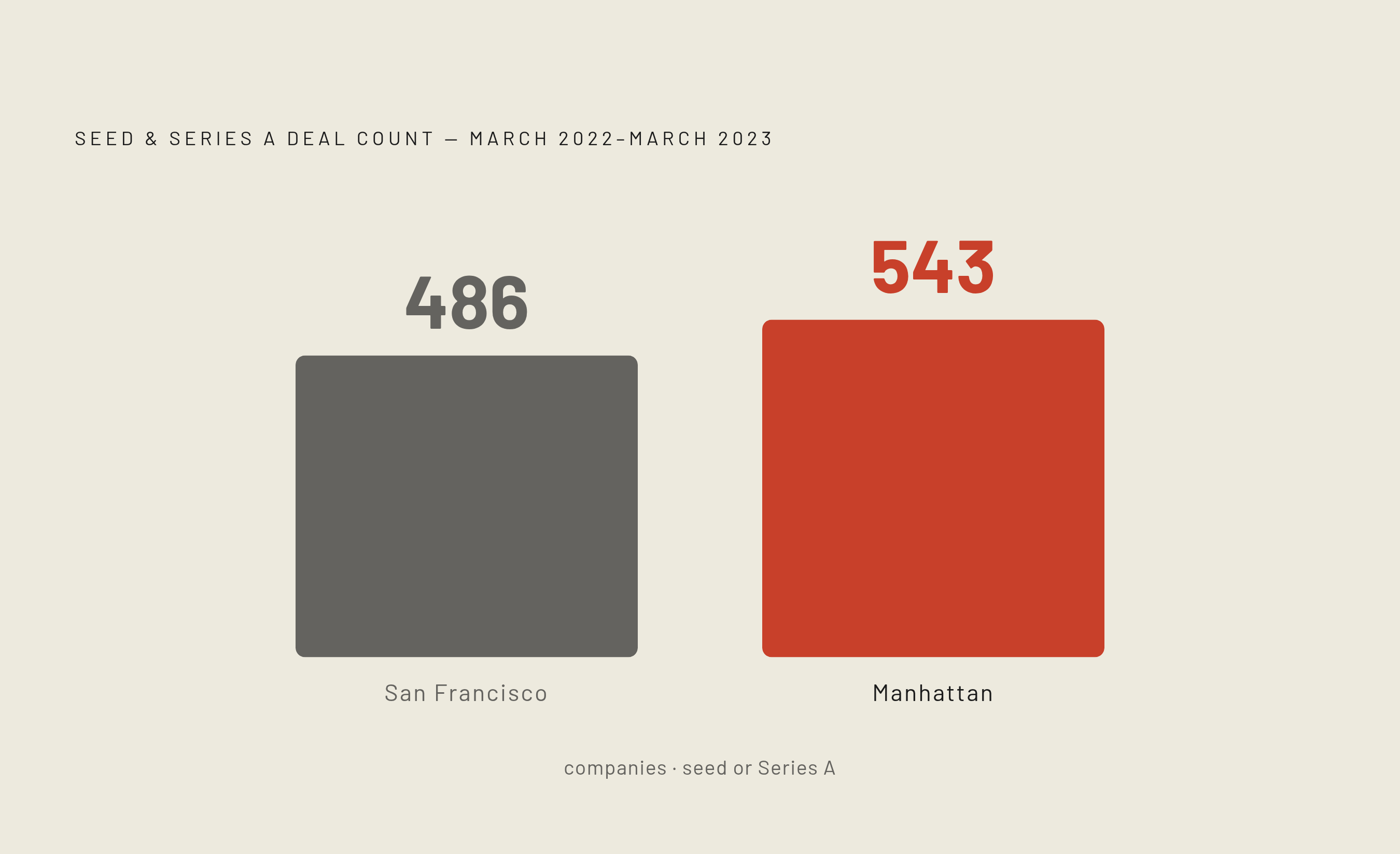
The early-stage picture is where things get genuinely surprising. Between March 2022 and March 2023, Manhattan saw 543 companies secure seed or Series A funding. San Francisco had 486. Read that again. The city that spent years playing catch-up at the early stage is now leading it. Median seed rounds held at $3 million. Median Series A climbed to $15 million, a 7% year-over-year increase.
NYC now hosts over 300 venture capital firms that collectively raised $9.9 billion in 2024. Union Square Ventures, Lerer Hippeau, FirstMark, Insight Partners. Coverage from $500K pre-seed through $100M-plus growth rounds. Since 2020, $116 billion has been invested in NYC startups. The depth here is not new. It just doesn't get as much press.
Why industry diversity is a structural asset, not a consolation prize
SF's ecosystem is deep. It is also narrow. Tech, biotech, AI, fintech. For most SF startups, the customer is another tech company or another investor. The world you are building inside is largely the world you are selling to. That works great until it doesn't.
New York stacks finance, fashion, media, publishing, advertising, healthcare, and law in the same neighborhoods, on the same subway lines, at the same dinner tables. If you're building B2B software for a legacy industry, you're not booking a flight to your customer. You are sitting next to them at dinner. The proximity between builder and buyer isn't a nice-to-have. It's baked into the city's physical layout — think of it as a living network diagram where every node is reachable on foot.
The 2024 sector data makes this concrete:
- Healthtech: 113 companies raised several billion dollars, a sharp increase from 2023, supported by nine academic medical centers and the city's LifeSci NYC initiative.
- Climate tech: $3.5 billion in VC since 2021, supporting hundreds of thousands of jobs and contributing tens of billions of dollars to NYC's GDP.
- AI: 81 deals worth approximately $1.5 billion in Q1 2025 alone, ahead of both Los Angeles and Boston.
Tech companies accounted for a substantial share of the more than 100,000 net new jobs NYC created between 2019 and 2024. That growth is happening inside a diversified city economy, which means the talent pool is broader than any single sector. You're hiring from a city, not a monoculture.
For founders building for regulated industries, or whose customers are not other founders, NYC provides a kind of systematic proximity that SF structurally cannot.
NYC's AI moment and what it means for founders who assume SF owns that space
SF owns the frontier model layer. OpenAI, Anthropic, the YC cohort. If you're doing foundational AI research, the gravity pulls west. That's just true.
The application layer is a different conversation. AI applied to finance, law, healthcare, media — that is playing out in New York, because that's where the customers for those products actually work. NYC's AI-to-IT job intensity sat at 38% as of early 2025, per Tech:NYC. Roughly one in three new tech job postings in the city requires AI-related skills. The talent market is already reshaped. You can hire for this in New York right now.
The physical signal is hard to ignore. OpenAI took 90,000 square feet at the Puck Building. Harvey AI doubled its NYC footprint to 34,100 square feet in 2024. These are SF-native AI companies opening offices in New York, not bypassing it. Google has anchored a West Side AI and engineering corridor at 111 Eighth Avenue in Chelsea for years. The infrastructure for AI hiring in NYC is already built.
Deal flow data from Q1 2025 shows 441 NY-Combined Statistical Area deals versus 658 Bay Area deals. The gap that once looked permanent is narrowing.
If your product uses AI as a layer rather than as the core research output, NYC gives you the engineering talent and the customer access to make that bet work. Both in the same zip code.
The founder culture difference and what it costs each way
SF has a specific culture. Multiple teams in the same house. Social status tied directly to the startup. Personal and professional life compressed into something that produces radical focus. Sometimes it produces burnout. Usually both.
The upside is real. Serendipitous encounters with investors, customers, and advisors happen more frequently when the whole ecosystem is packed into a few neighborhoods. That's a genuine structural advantage, not a myth.
NYC's trade-off is different. Founders here tend to maintain more separation between work and life. Some people read that as less intense. But the city's sheer density of industries means relevant encounters happen across more domains. You bump into your next customer at a dinner, not at a hacker house. Which is fine, because your customer isn't a founder.
Hybrid and in-person office culture is stronger in NYC than in SF. Most VC-backed companies in New York maintain physical offices — for investor meetings, for recruitment, for early-stage execution. The city rewards presence in a way that's different from the Bay Area's more campus-centric setup.
NYC's founder diversity is also worth naming. Women founders have built significant companies here. The organizations and funds actively investing in a broader range of founder profiles are concentrated here too.
SF optimizes for one kind of founder intensity. NYC optimizes for a founder building inside a messy, real-world city. One ecosystem is a controlled experiment; the other is a field test with ten million variables. Both are legitimate. The fit depends on what you're building and, honestly, who you are.
How founders in NYC actually find their peer group
Capital and sector data only matter if founders can actually act on them. And capital, talent, customers, and honest feedback all flow through relationships. The peer infrastructure in NYC has matured alongside the ecosystem.
A few worth knowing:
- NYC Founders Club runs invite-only, in-person weekly dinners of around six founders, built for active founders from seed through Series B who are physically in the city. The model is small by design. Warm introductions to customers, hires, and co-investors come from people who actually know both sides of the introduction, and strong confidentiality norms make the conversations honest. Finance, healthcare, media, and tech founders in the same room — which mirrors the broader structural advantage the NYC ecosystem is built on.
- Startup:NYC (Tech:NYC) focuses on pre-Series A founders with smaller teams, with curated gatherings, industry briefings, and mentorship connected directly to NYC's investor network.
SF's serendipitous founder collisions happen because the city is physically designed for them. NYC's communities are deliberately designed to manufacture that density in a city where it doesn't happen automatically on a single street. That's a real difference in how relationship infrastructure gets built here.
One distinction worth making clearly: large online networks and open Slack channels serve a different function than a small, curated room. The value of a warm introduction depends entirely on whether the person making it actually knows you. Four thousand people in a group chat is not the same thing. Knock knock. Who's there? Your next investor. Your next investor who? Exactly — you have no idea, because nobody in that Slack actually knows you.
For a founder who is physically in New York, the peer infrastructure exists. The question is whether they're in the room.
What the SF-or-NYC question actually comes down to for a founder making the decision in 2024
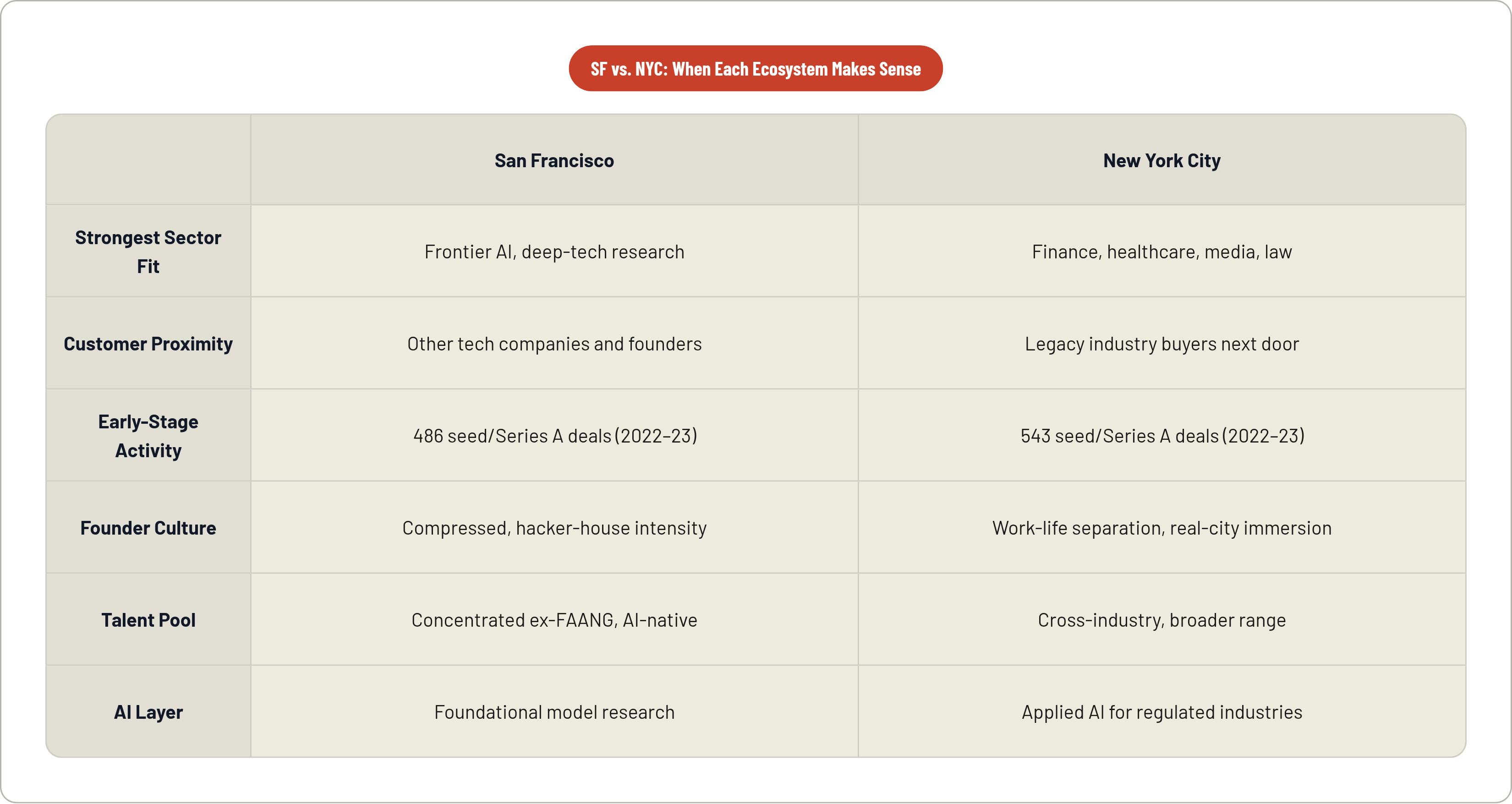
NYC being second globally means the infrastructure, capital, talent, and community are real. It does not mean every founder should pick it over SF. The ranking is not the decision.
SF makes more sense when:
- The company is a frontier AI or deep-tech research play
- The customer base is primarily other SF tech companies
- The founder needs the specific intensity of hacker-house culture to execute
NYC makes more sense when:
- The product sells to finance, healthcare, media, law, or any regulated industry
- Cross-industry customer access needs to be built into daily life, not a quarterly trip
- The team benefits from a talent pool that isn't entirely ex-FAANG
- The founder wants to build inside a real city, not a single-industry ecosystem
That early-stage data point is worth sitting with one more time. Manhattan led the country in seed and Series A activity during the 2022 to 2023 window. 543 companies versus SF's 486. For founders at that stage, the capital access argument for SF is weaker than it used to be.
SF has more raw capital and more AI-native density. NYC has more industry diversity, a maturing early-stage ecosystem, and a founder culture that fits a broader range of company types. Both of those things are true, and neither cancels the other out.
For founders who are already in New York, or who are choosing it, the practical question is whether they're plugged into the community that makes the city's structural advantages real. The data is good. The relationships are what make it matter.