Seed Round Valuation Benchmarks for NYC Startups
Carta's 2026 numbers put the national median seed post-money at $24M, up from $18M a year before. Every founder Slack group in the city has already quoted that stat back to me twice. It's also close to useless if you're trying to figure out what your own round will look like.
Here's why. Carta's 2025 breakdown shows the 95th percentile hit $80.5M, nearly three times the $28.5M mark from 2019. The 25th percentile sits at $13.8M. A median sitting between those two numbers is describing two or three markets duct-taped into a single line on a chart. None of it accounts for geography, either. New York has its own sector mix, its own investors, its own deal culture, and all of that pulls valuations somewhere a national median can't follow. Skip the median, then. What actually matters is what a seed round looks like for a company building in New York, in your sector, this year.
How NYC's position in the national ecosystem shapes deal expectations
New York ranked second in Startup Genome's 2025 global ecosystem report, behind Silicon Valley. A respectable seat. NYC startups pulled in $16.6 billion across more than 460 deals in 2024, up 74% from the year before, per Tech:NYC. City-based venture firms put $31.1 billion to work in 2025, up $6.2 billion from 2024.
Set that next to the Bay Area and the shine wears off a little. NYC captures roughly 14% of U.S. capital raised; the Bay Area's footprint runs close to three times that. New York punches above its weight, but it's fighting in a different weight class when the biggest checks get written. At the earliest stage, though, the city holds its own. From March 2022 to March 2023, 543 Manhattan-based companies raised a seed or Series A, versus 486 in San Francisco. That's a city winning a real fight.
The sectors that actually set NYC seed valuations: fintech, AI, and healthtech
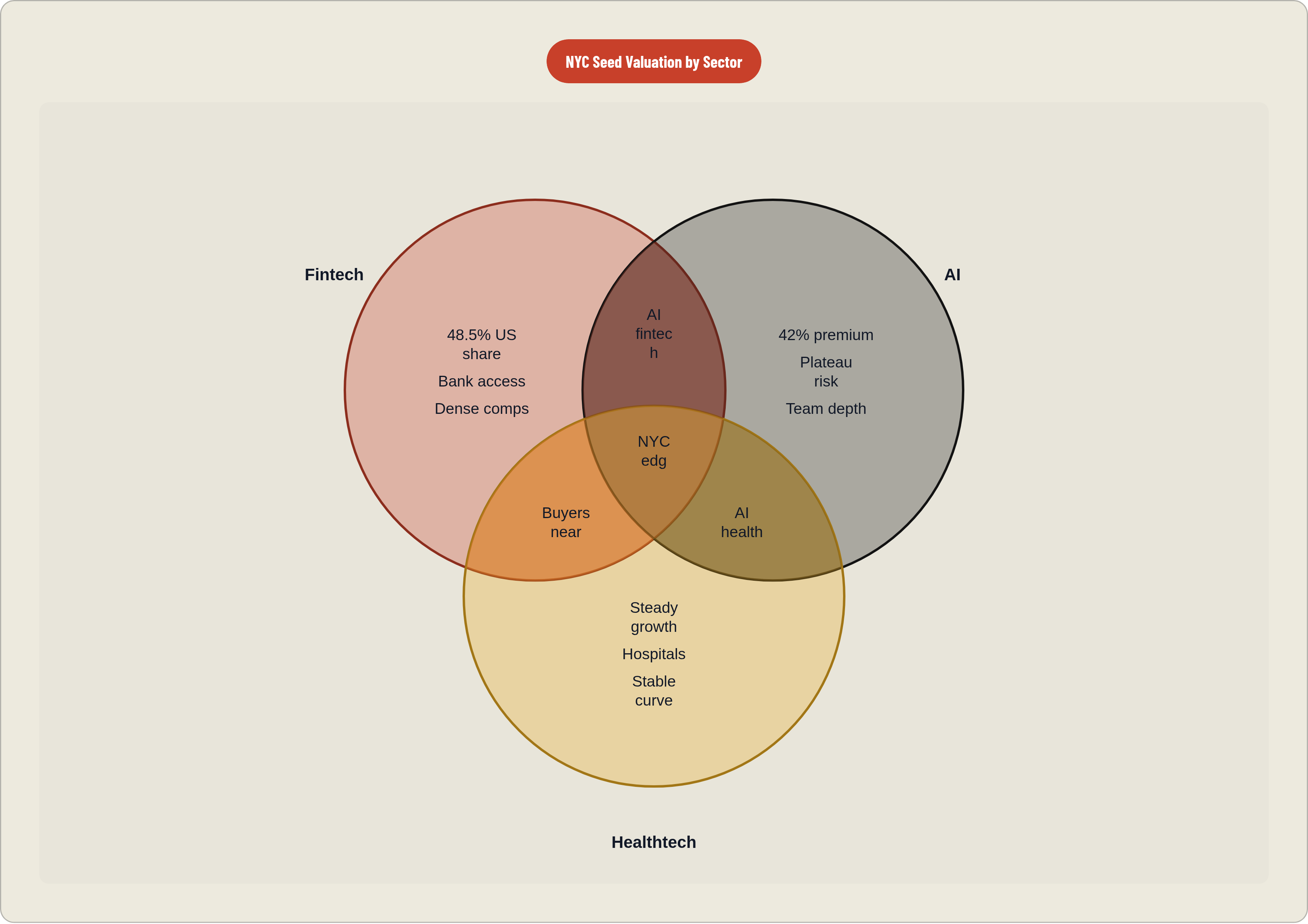
Three sectors do most of the heavy lifting on what a New York seed round looks like. Knowing which one you're in tells you more than any national chart ever will.
Fintech is home turf here, and not by a little. NYC-based startups on Carta raised more than $3.1 billion in fintech capital in 2025, or 48.5% of all U.S. fintech dollars, nearly double the Bay Area's 25.9% share. All that density means local investors have sat through enough fintech pitches to move fast and know exactly what they're looking at, which tightens the valuation range and speeds up conviction. It also means more competition at the earliest stage; everyone's fishing in the same pond, banks included. Founders building fintech here get something no deck slide can show: the banks, the enterprise buyers, and the operators who've done this exact thing before are three subway stops away.
AI plays by different rules. Nationally, AI seed rounds average $17.9 million pre-money, a 42% premium over the broader seed median, per Carta's 2025 data. New York grabbed real share of that in Q1 2025, with 81 AI deals worth about $1.5 billion, ahead of both Los Angeles and Boston. Anthropic's expansion into the city, plus office leases from Palantir and OpenAI, are pulling senior AI talent and investor attention toward New York in a way that snowballs. Here's the part that never makes the deck, though: AI stopped being a differentiator on its own. Carta's Q2 2026 pre-seed data shows AI startups took 48.6% of all pre-seed dollars in the first half of 2026, basically flat against 49.8% in 2025. Carta calls that a plateau. Saying "we use AI" now gets the same shrug as saying "we use email."
Healthtech is the quiet one. New York health tech companies, 113 of them, raised several billion dollars in 2024, the highest total since 2021 and up sharply from 2023, per Tech:NYC. The city's hospital systems and academic medical centers hand founders a customer base San Francisco can't replicate at the same scale. Valuations here usually trail the AI premium, but the funding curve is one of the steadiest in the city.
Then there's the floor: non-AI B2B SaaS. Median round size runs $2.5 million to $3.2 million, valuations land between $14 million and $17 million, dilution typically falls in the 12% to 15% range, per Carta. Nationally the same category lands at $14 million to $16 million pre-money, and New York's investor base mostly runs the same math. No AI premium, no fintech density bonus. Just the floor everyone else gets compared against.
What the AI valuation premium actually requires — and where it stops helping
Start with the number: AI seed startups raise a median round of roughly $4.6 million, against about $3.1 million for the broader market. A 1.3x bump on round size alone, and it compounds into valuation from there.
The premium's getting thinner in practice, though. AI went from about 32% of pre-seed dollars in 2021 to nearly half today, which means investors are staring down far more AI pitches and getting pickier about which ones actually earn the multiple. What premium survives is lopsided toward the top, too: megadeals like Hebbia's $130 million Series B or Rogo's $150 million secondary pull the averages up while the median AI seed founder isn't within shouting distance of that neighborhood.
So what actually earns the premium at seed in 2025? Proprietary data, or a workflow integration that's genuinely hard to rip off. An enterprise customer already signed, which is where New York's density of banks, media companies, and hospitals stops being a talking point and starts being an edge. A founding team with technical depth that goes past wiring an API call to a language model and calling it a product.
For New York AI founders, the label alone won't move your number. A real application built for fintech, legal, or healthcare, three places where New York already has the customers sitting in one zip code, will.
The dilution math NYC founders tend to miscalculate
Median seed dilution sits at 19.5%, per Carta's 2025 data. That's a decent anchor, but the number a founder actually feels depends on deal structure, not the headline percentage alone.
The option pool is where people get blindsided. Investors typically want a meaningful option pool carved out before their check lands, and that carve-out comes straight out of the pre-money valuation. A pool carved from pre-money means founder shares are effectively priced against a smaller base than the headline valuation suggests. That gap never shows up in the headline number, which is exactly why the size and timing of the pool deserves as much negotiating energy as the cap itself.
Instrument choice matters too. Post-money SAFEs with valuation caps are now the default pre-seed tool; the vast majority of SAFEs issued in the first half of 2025 included a cap, up from a lower share in 2024. Under $3 million, SAFEs still dominate: fast to close, no board seat, but ownership stays foggy until conversion actually happens. Above that threshold, roughly half the market has shifted to priced rounds, because investors want clean ownership on the cap table now, not later, and that comes with a board seat and heavier diligence attached.
Zoom out across rounds and the pattern holds. Median dilution runs about 18% at Series A and 14% at Series B, per Carta and Zeni 2025 data. Founders who don't manage dilution carefully at seed tend to look up two rounds later and wonder where their ownership went. Meanwhile, strong repeat founders or teams with early traction have closed pre-seed rounds of $2 million to $3 million on $8 million to $10 million post-money caps in top-tier New York deals. That premium is real, and it's reserved for a narrow slice of founders, not the average first-timer walking in cold.
What NYC investors actually benchmark against when setting a seed valuation
New York Series A rounds range from $10 million to $75 million, median around $20 million to $30 million, based on 2025 data. Seed valuations get set with that endpoint already in mind, because investors are working backward from what the next round will demand.
The seed-to-Series A step-up remains a key variable investors price in, and by most accounts it is still well below the peaks seen during the 2021 boom. Investors know this math cold, and it puts a natural lid on how far they'll let a seed valuation run.
Sector shapes the comp set. A fintech seed here gets measured against fintech comps, not the AI median, and the city's dominant share of national fintech capital means local investors are working off dense, current comp data rather than guessing. AI companies building for legal, financial services, or healthcare get closer to that $17.9 million pre-money average; pure consumer AI generally doesn't get invited to that party.
What are investors actually underwriting at seed right now? Real customer evidence, not waitlist signups. A believable path to the $1 million to $2 million ARR mark that Series A investors now treat as table stakes. And team shape: two-founder teams remain the preferred setup among investors, while solo founders still represent a much smaller slice of funded deals.
Underneath all of it sits a number nobody says out loud in the pitch meeting: only a minority of seed-funded companies reach a Series A today, a materially lower share than during the 2018 to 2021 run. Investors price that survival rate into the seed valuation whether they admit it or not.
How NYC's investor dynamics and warm introduction culture affect where a founder lands
Benchmarks tell you what a deal looked like after it closed. They don't tell you how it got done. In New York, how it gets done runs almost entirely on who knows who.
The city's VC community is small in the way that actually matters: dense, and everybody's overlapping with everybody else. The same investors see fintech, AI, and healthtech deal flow crossing the same networks, so reputation and referral source travel faster than any deck ever could. A warm introduction from a known operator or a fellow founder does real work. It compresses diligence timelines. It can shift the valuation conversation before a single slide gets shown, because an investor who already trusts the source underwrites differently than one working off a cold email. The intro carries information no deck can encode, full stop.
Co-founder dynamics matter more than most founders expect walking in. Among VC-backed two-founder teams, roughly one in four loses a co-founder by the four-year mark. Investors have watched that pattern play out enough times that it shapes how they structure and price early deals, whether they say it in the meeting or not.
New York's density of repeat founders and recognizable alumni networks creates its own access tier. A founder with a prior exit, or just a name people know, lands valuations meaningfully above sector medians, because investors are pricing the person as much as the product. The practical upshot: a founder who spends six months actually building relationships with New York operators and investors before opening a raise walks into a different room, and usually a different cap, than one who starts cold the week the deck gets finished.
What a realistic NYC seed valuation looks like by founder profile in 2025
Treat these as calibration tools, not numbers to wave around in a term sheet negotiation. Where you land depends on sector, team, traction, and how warm your path into the room was.
Non-AI B2B SaaS, first-time founder, pre-revenue: $14 million to $16 million pre-money, round size $2.5 million to $3.2 million, dilution 12% to 15%. A SAFE with a cap is the likely instrument; priced rounds are rare below $3 million.
AI company with an enterprise application in fintech, legal, or healthcare: approaching the $17.9 million pre-money average, higher with a paying customer already signed. New York's sector density gives this profile a real edge over the national AI median.
Repeat founder, or a team with a strong New York network and early traction: pre-seed caps in the high single-digit millions post-money have closed in top-tier deals here. The track record does the negotiating once it's in the room.
Fintech-specific New York company: with 48.5% of national fintech capital flowing through the city, investors have deep, sector-specific comp data sitting on their desks already. Expect tight, well-informed negotiations rather than wide guessing, with New York Series A rounds for AI and enterprise software landing at $30 million or more setting the ceiling investors work backward from.
One variable shows up across every single profile above: the quality of the introduction into the room moves the valuation almost as much as the sector benchmark does. Founders who put in the work building relationships before they start raising land better outcomes, consistently, than the ones betting on inbound interest or a cold email sent the week the deck finally got finished.