Accountability Partnerships Between Co-Founders at Different Companies
Lonely founders perform worse—here's how peer accountability rebuilds the missing support structure.

Most founders won't say it out loud, but running a company is one of the lonelier things a person can do. Not in a dramatic, romantic way. In a quiet, structural way. Your team needs you to project confidence. Your investors need to believe the narrative holds. Your friends and family love you and understand almost none of what you're actually going through. So you carry it. Most founders carry it alone. And that weight shows up in the business eventually, whether they name it or not.
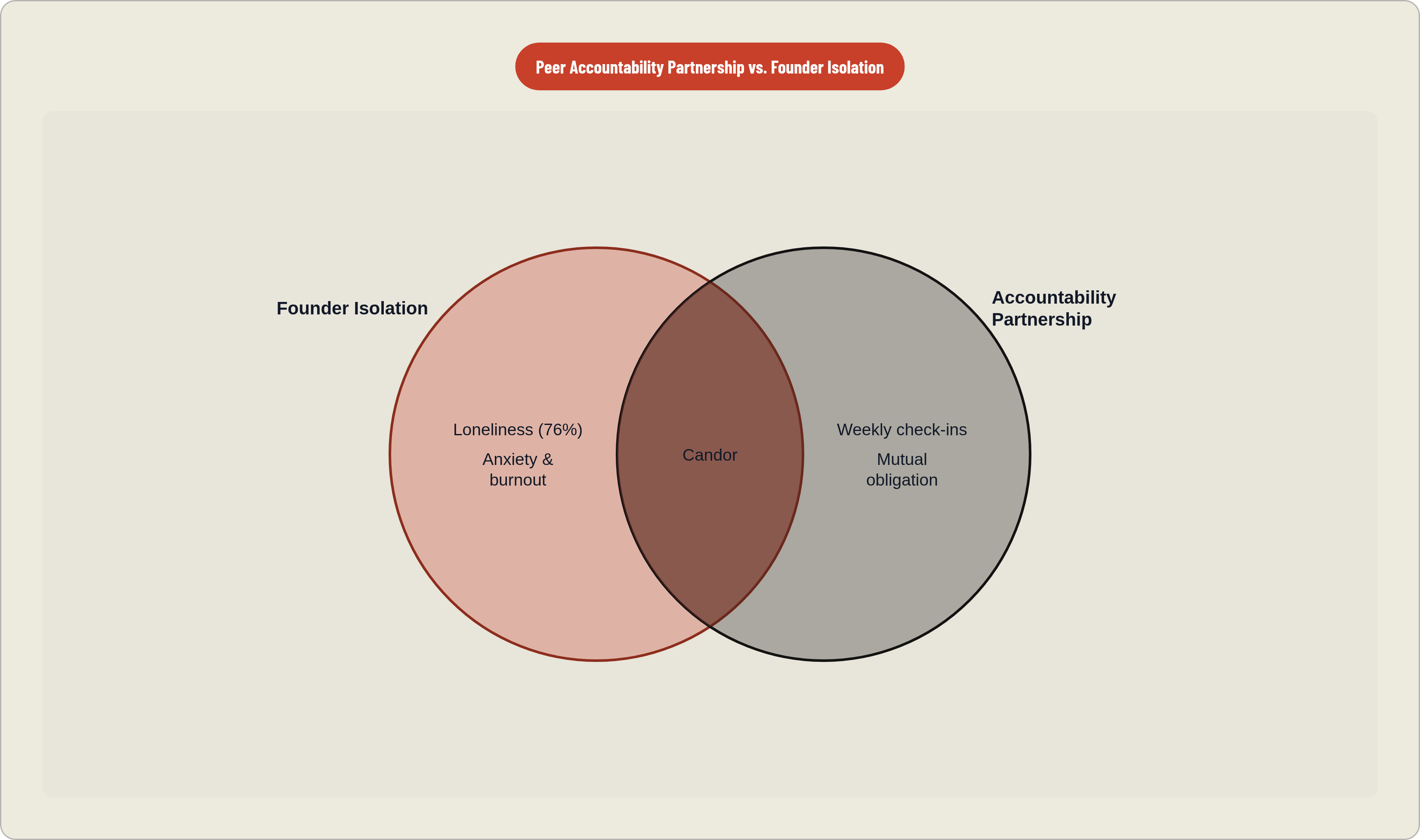
The numbers from the 2024 Foundology and UCL Founder Resilience Research Report are worth sitting with. Seventy-six percent of founders report feeling lonely. That's roughly seven times the workplace average. Ninety-three percent show signs of mental health strain. Anxiety levels run about five times the national average. These aren't edge cases. This is the typical founder experience.
What makes it structural rather than just personal:
- 64% of founders spend less time with friends and family after starting a company
- 62% take fewer vacations
- the vast majority are not open about their stressors with the people in their lives
The outside-of-work life that used to absorb some of the pressure? It quietly disappears. The people left in the room are mostly the ones who need you to be okay, or at least to perform okay. That's not a support system. That's an audience.
There's also an age dimension. Founders 34 and under report higher rates of loneliness than those 35 and older. Early-stage founders carry the sharpest version of this, often with the fewest resources to do anything about it.
Gender shapes how founders access support too. Around seven in ten female founders report having someone they can talk to honestly about mental health. For men, that number drops to just over half. Men show correspondingly higher rates of burnout and depression. A structure that requires you to show up and be honest, regardless of how comfortable that feels, matters more for some founders than others.
The performance costs are real and specific. Loneliness weakens problem-solving. It reduces resilience. It erodes self-efficacy. Those are the exact capacities a founder most needs when things get hard. The isolation doesn't stay inside the founder's head. It leaks into decisions.
The variable that most predicts how a founder handles a rough quarter isn't how tough they are. It's whether they're carrying the weight alone. Founder loneliness is like a slow leak in a tire — you don't notice it until you're already stranded on the side of the road. Once you see that clearly, a peer accountability partnership stops looking like a nice-to-have. It starts looking like a business decision.
What a Cross-Company Accountability Partnership Actually Is (and What It Isn't)
This concept gets watered down fast, so it's worth being precise about what we're actually talking about.
A cross-company accountability partnership is two founders, different companies, same stage, different industries, meeting on a recurring schedule with mutual obligation. Simple structure. Genuinely hard discipline.
Here's what it isn't, because people conflate this with a lot of things:
It's not therapy. The goal is forward motion, not emotional processing. You're there to do better next week, not to feel better about last week.
It's not mentorship. There's no hierarchy here. Both parties are accountable to each other. The moment one person becomes the steady advice-giver and the other becomes the person receiving it, you've built something else entirely.
It's not a mastermind group. A mastermind is a small circle, typically six to twelve people, built for perspective and pressure-testing. One-on-one is the most intimate form of peer accountability. It's optimized for execution and candor, not breadth.
It's not a coffee chat. Coffee is great. But a recurring structure with mutual stakes is what makes this work. Without both of those things, it's just a pleasant conversation you'll have again in four months.
The relationship it most closely mirrors is the co-founder dynamic. Shared language, shared understanding of operational pressure, real honesty. Except the stakes aren't shared. And that's the whole point. Your co-founder has everything riding on your decisions. This person doesn't. That changes what they can actually hear from you, and what you feel safe enough to say.
Three things do the real work inside a functioning partnership. First, a recurring check-in is an external deadline your internal calendar can't negotiate away. Second, breaking a commitment to yourself is easy; breaking one to a peer who's going to ask about it next Tuesday is noticeably harder. Third, your partner spots the rationalization you've rehearsed so many times you can no longer hear it yourself. That last one is worth more than most paid coaching.
The Performance Case. What Peer Accountability Does to Business Outcomes Over Time
Here's a number worth paying attention to: CEOs involved in peer networks have achieved over 200% faster revenue growth than industry peers on average, according to a 2025 peer group analysis. That's not a wellness stat. That's a business outcome.
But the mechanism matters more than the headline figure, so let's talk about what's actually happening.
Weekly check-ins force a founder to state priorities out loud. That alone surfaces confusion they didn't know they had. There's a real difference between thinking you know what matters most this week and having to say it clearly to someone who will remember next week. The articulation is where the accountability actually lives.
A committed peer also holds the standard steady across weeks when internal pressure would let it drift. Your team's urgency fluctuates. Your investors' attention fluctuates. Your partner's expectation doesn't.
Outside perspective breaks tunnel vision in ways that are hard to replicate internally. When you've been living inside one company's problems long enough, certain options simply stop appearing. Someone running a completely different business in a different market asks questions that wouldn't occur to your team, and sometimes those questions are the ones that matter.
The compounding logic is gradual but real. In month one, you ship more. By month six, you've internalized what a good week looks like and you're running the company that way between calls, not just for the call. By year two, the baseline of the business is genuinely different from where you started.
The failure mode is worth naming clearly. Accountability collapses when the partnership becomes emotional support instead of performance support. If every call ends with some version of "it's been rough for both of us, let's try again next week," you've accidentally built a place to vent rather than a place to execute. Commiseration has its uses, but it isn't accountability.
The distinction isn't warmth versus rigor. Good partnerships are both. The real distinction is whether the call ends with a specific commitment or just a mutual exhale.
How to Find the Right Person. The Matching Criteria That Actually Matter
Start with the axis that matters most: same stage, different industry.
Same stage gives you shared operational vocabulary. The pressures overlap enough that the conversation is real. Nobody's condescending and nobody's irrelevant. A Series B founder talking to a pre-revenue founder is a mentorship dynamic, not an accountability partnership, and the subtle power imbalance will quietly undermine the whole thing.
Different industry eliminates competitive friction and opens up genuine cross-pollination. The person who cracks your distribution problem is running a business in a completely different vertical. Jay Abraham wrote about this cross-domain logic: when partners bring different frameworks and mental models to the same conversation, the resulting perspective is additive in a way that same-industry pairing simply isn't.
Beyond stage and industry, a few things actually matter:
Someone building at comparable pace and ambition. Not necessarily the same traction, but the same hunger. You'll feel the mismatch pretty quickly if it's there.
Someone who will name the excuse rather than just validate the difficulty. You need a person who can say "that's the third week in a row you've said that" without it turning into a confrontation.
Someone who can receive hard feedback without making the feedback itself the subject of every subsequent conversation. Thin skin is a dealbreaker in this specific context.
Where to find candidates: warm introductions through investors, accelerators, or founders who know both parties. The same logic as a good hiring referral. Someone who can vouch for both sides of the match is worth more than cold outreach to someone whose content you like online.
Organized peer matching structures vary widely in cost. A one-time pod match through a community like MicroConf runs around $250. Mid-range paid online groups run roughly $100 to $1,000 a month. Premium in-person CEO groups land between $2,500 and $25,000 a year. Elite invite-only rooms go from $25,000 to $100,000 or more. Price point doesn't determine quality. Matching criteria and mutual commitment do.
The simplest filter: if you can't imagine telling this person the honest version of where the business actually stands right now, they're not the right person.
The Operating Structure That Keeps a Partnership From Drifting Into a Social Call
Structure is what separates an accountability partnership from a friendship with good intentions. Both are worth having. They are just different things.
Weekly cadence works best for most founders. Frequent enough to maintain real pressure. Short enough to stay focused. And a fixed time matters more than it sounds like it should. Ad hoc scheduling is the first step toward drift. When the call lives on the calendar at the same slot every week, it doesn't require a decision to happen. It just happens.
Thirty to forty-five minutes is enough if the structure is clear. Open-ended calls tend to slide toward therapy, which is fine if that's what you're going for and not fine if it isn't.
A simple call structure that actually works:
- What did you commit to last week? Did you do it?
- What's the one thing that matters most this week?
- What are you avoiding, and why?
- What's your commitment before we talk again?
That's the whole call. Four questions. The discipline is in not skipping question one and not letting question four stay vague.
Commitments need to be specific and binary. "Make progress on hiring" is not a commitment. "Send five outreach messages to engineering candidates by Thursday" is. The difference is that the second one is either done or it isn't. That's the only kind of commitment that creates real accountability, because it can't be fudged in the retelling.
Quarterly retros are essential. Most partnerships don't die from a decision. They die from drift. Nobody decides to stop being accountable. The calls just get rescheduled, then shorter, then less honest. A quarterly check-in on the partnership itself catches the slow fade before it completes.
Worth asking every quarter: Are we still at comparable stages? Is this person still challenging me, or just confirming me? Am I showing up prepared?
One thing that needs to be set explicitly at the start, rather than assumed: privacy. What's said in the call stays there. Without that expectation on the table, the candor that makes the whole thing valuable won't show up. People say the real thing when they know it doesn't leave the room.
Why New York Makes In-Person Accountability Partnerships More Available (and More Durable)
New York ranks second in Startup Genome's 2025 global startup ecosystem report. That ranking isn't just a prestige signal. It means the pool of founder peers at any given stage is unusually large and unusually reachable.
Density is a practical advantage when you're trying to find a match. Manhattan alone saw hundreds of companies raise seed or Series A rounds in a single year, more early-stage startups at that stage than San Francisco. When you're looking for a same-stage, different-industry partner, raw density matters. The right person is simply more likely to exist within a short radius.
The Flatiron, NoMad, and Union Square corridor forms the most startup-dense stretch in the city. Founders building at comparable stages are often within walking distance of each other. That makes a weekly in-person meeting a realistic ask, not a logistical production.
When VCs, accelerators, and peer companies cluster in the same few blocks, the warm introduction network that surfaces a good match gets shorter and more reliable. The person who knows both of you is more likely to be one conversation away, not three.
Meeting in person also makes the relationship stickier. A partnership built across a real table, over a recurring coffee or a walk, carries more social weight than a Zoom call. The cost of ghosting it is correspondingly higher, and that social cost is part of the mechanism that makes accountability work.
New York also cross-pollinates industries in a way that more single-industry ecosystems don't. Finance, media, health, and tech all have serious founder communities here, and they frequently overlap in the same neighborhoods. The different-industry, same-stage pairing is more natural here than in cities where almost everyone is building the same kind of company in the same cluster.
What a Functioning Accountability Partnership Looks Like After a Year
The texture of a mature partnership is different from a new one, and the difference is worth understanding before you start.
Early calls are mostly about learning each other's blind spots. Both parties are figuring out what kind of feedback actually lands, what the other person's patterns are, which excuses rotate through on a predictable schedule. By month six, that calibration is largely done. Later calls are about holding each other to a standard both parties have already internalized.
Something shifts around that six-month mark. A founder in a functioning partnership has usually stopped experiencing the check-in as external pressure. The standard has moved inward. They're running the business to that standard between calls, not just for the call.
What compounds isn't only execution. It's self-knowledge. The pattern recognition your partner surfaces about your rationalizations gradually becomes your own. You start catching yourself before the call does. That's actually the goal, and it's a strange thing to notice when it starts happening.
I know a founder — let's call her Maya — who was six months into her partnership when she caught herself mid-sentence on a team call. She'd started to explain why a key hire had slipped for the third week in a row, and stopped. "Actually," she told her team, "I already know what my accountability partner would say. Let's just fix it." The excuse never finished forming. That's what internalized accountability looks like. It's not dramatic. It's just a sentence that doesn't get completed.
The relationship tends to expand beyond the structure too. Warm introductions, honest references, co-investor visibility. Trust built inside a structured accountability context carries into real business situations, because both parties have already seen each other under genuine pressure. That's a different kind of credibility than someone who only knows you when things are going well.
Founders who've experienced high-candor peer accountability also tend to bring it into how they run their teams. More tolerance for direct feedback. Clearer commitment culture. Less tolerance for commitments that can't be measured. The habits you practice in the partnership show up in how you lead.
What a functioning partnership doesn't become: a status relationship, a place to perform progress, or a social obligation you feel guilty skipping. The ones that last are the ones where both parties are still willing to say the uncomfortable thing twelve months in, without making it weird.
The simplest test of whether a partnership is actually working: does your partner know the thing you haven't told anyone else in your company?
If yes, you built something real.