Founder Mastermind Groups: Structure, Cadence, and Norms
Small circles of peer pressure work only when you design them right from the start.

A founder mastermind group is a small circle of peers who pressure-test each other's real decisions on a set schedule. It's peer-to-peer honesty, and honesty like that only works if you build the room right.
The idea isn't new. Napoleon Hill wrote about "mastermind alliances" back in 1937, but the roots go deeper than that: Andrew Carnegie ran one, Ben Franklin's Junto met every Friday in Philadelphia to argue about ideas, Edison had his Vagabonds. People have been sitting in circles trading hard truths for a very long time, mostly because nothing else does the job.
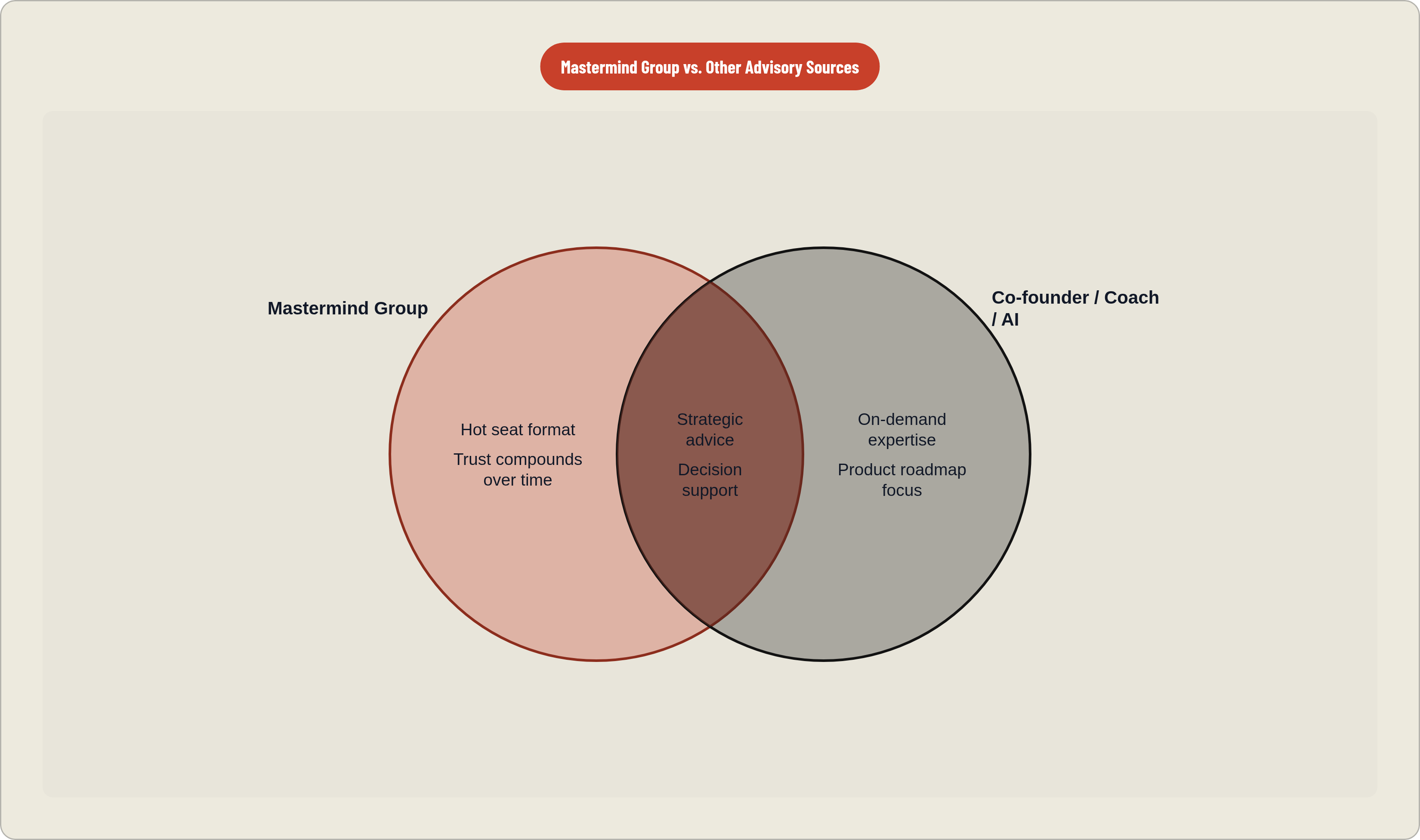
Here's the gap it fills. Your co-founder is buried in the product roadmap. Your partner's eyes glaze over the second you say "CAC." ChatGPT will happily agree with your pricing strategy at 1am because that's what you asked it to do. None of them can tell you the thing you're building is off, because none of them are standing where you're standing. A small room of people at your level, who have something to gain from your success, can. That's the whole pitch.
But here's the catch nobody tells you upfront: it takes months to build. The value compounds slowly, meeting after meeting, as the same people keep showing up and keep having skin in your game. Skip that build-up and you've just got a support group with better branding.
Why design determines whether a mastermind compounds or quietly dissolves
Most groups fail for the same three reasons, over and over, like a rerun nobody asked for. Wrong cohort. No real psychological safety. Members who show up wanting a pat on the back instead of a real answer.
None of that gets fixed by hiring a great facilitator. I've watched skilled, experienced facilitators run rooms where half the members were half-committed, and it didn't matter how good the questions were. You can't coach your way around someone who isn't there to work.
Structure is the real work. It's what determines whether people tell each other the truth or just tell each other what sounds good. Three decisions do almost all of the heavy lifting here: who's in the room, how often you meet, and what rules govern how you treat each other once you're there. Everything else is downstream.
Size and composition: the two decisions that set the ceiling on the room
Four to eight people. That's the range, and it's not arbitrary.
Go below four and you've built an echo chamber with extra steps. Not enough angles, not enough friction, everyone starts agreeing with everyone else out of sheer thinness of numbers. Go above eight and the math turns against you: participation drops, depth gets traded for coverage, and by the time you hit twelve, the update round alone eats the whole session. Your turn in the hot seat comes around once a year. At that point you're not in a mastermind, you're in a lecture hall that happens to charge dues.
Stage alignment trips people up more than they expect. Putting a founder doing serious ARR in the same room as someone six months into their first company sounds inspiring on paper: mentorship! Wisdom transfer! In practice, it's a one-way pipe. The newcomer drains the veteran's time, and the veteran's problems (hiring a VP of Sales, navigating a Series B term sheet) are simply not the newcomer's problems (finding product-market fit, convincing anyone to answer a cold email). Real cohort learning needs people standing at roughly the same point on the map.
Composition matters as much as size, maybe more. A few things to look for when you're building or vetting a group:
- Complementary skills, not overlapping companies. You want a technical founder, an operator, someone commercial, sitting at the same table without competing for the same customer.
- A specific niche beats a general one. "Founders" is too broad a category to produce sharp conversation. "B2B SaaS founders past a meaningful ARR milestone" produces sharp conversation.
- Commitment over curiosity. Someone who's "just checking it out" costs the group more than an empty chair would. An empty chair doesn't derail the hot seat with half-hearted feedback.
Three tells that someone's going to add real value: they make introductions without being asked, their feedback is substantive instead of a sales pitch in disguise, and they've got enough context on their own business to actually engage with someone else's specific, weird problem. If a prospective member can't do at least two of those, that's your answer.
The hot seat format and what a well-structured session actually looks like
The hot seat is the engine. Everything else in a mastermind session is scaffolding around it. One member presents a real, current, unresolved problem, and the group gives them focused, structured feedback.
A session that works tends to follow a rhythm:
- Opening. Each member states what they committed to last time and what actually happened. Accountability comes before anything else, no exceptions.
- Hot seat. The presenter frames the problem. The group asks questions first, before anyone reaches for a solution. Then, and only then, feedback.
- Close. The presenter names what they're taking away. Everyone declares a commitment before the next session.
The facilitator's job is narrower than most people assume, and it needs to stay narrow. Hold the time, hold the format, notice what's being dodged. That's the job description in full.
The temptation is always to do more: coach, fix, redirect, summarize everyone's point back to them like a human recap button. Resist it. The moment the facilitator starts solving problems, the group stops solving them together, and you've quietly turned a peer group into office hours with one very tired teacher.
Facilitators do have to manage the room's temperature, though. Draw out the quiet ones. Put a soft ceiling on the ones who'd happily talk for forty minutes straight given the chance. And train everyone, right from session one, in what I'd call the curiosity-first norm: ask questions before you offer solutions. People who find their own answer keep it. People who get handed one usually let it drop.
One decision the group needs to make before day one, not after the first blow-up: rotating facilitation or a permanent facilitator. Rotating builds shared ownership; everyone's had to hold the format, so everyone respects it. Permanent tends to enforce the rules more consistently, since one person's carrying the muscle memory. Either works fine. What doesn't work is leaving it undecided and litigating it mid-conflict.
Cadence: how often to meet and why the interval shapes the quality of the work
Monthly barely counts as a group. Too much changes in four weeks; by the time you reconvene, half the context has evaporated and you're re-explaining instead of building.
Weekly sounds great until month three, when life happens and the calendar invite starts getting declined. It's sustainable, but only for groups that treat this like a professional obligation, not a nice-to-have.
Every other week is the sweet spot most strong groups land on. Frequent enough that the thread never really breaks. Spaced out enough that people can actually protect the time on their calendar instead of resenting it.
The groups I've seen work best layer their cadence instead of picking just one:
- Quarterly: a full day, in person, for the deeper planning and relationship work that a Zoom call just can't hold.
- Monthly: a half day for hot seats and strategic review.
- Mid-month: a one-hour call, just accountability and open questions, to keep the thread alive between the bigger sessions.
The single biggest predictor of whether a group survives its first year is whether members treat the meeting as non-negotiable. Nothing always comes up. That's the whole point of running a company.
Continuity is the part that actually compounds. The founder who challenged your pricing last month is still there next month, and the month after. That repeated contact is what turns a room of strangers into a room you'd actually trust with your messiest problem. And it's worth saying plainly: the depth you build sitting across a table doesn't transfer cleanly to a video call. That's exactly why the quarterly in-person session is worth protecting, even once the rest of the calendar goes hybrid.
The norms that make honesty possible and the ones that get skipped until it's too late
A mastermind without clear norms has all the raw ingredients for good work and zero guarantee any of it happens. It's a jazz band without a key signature: everyone's technically playing, but good luck calling it music.
A few norms need to be spelled out before the first session, not negotiated after the first argument:
- Confidentiality. What's said at the table stays at the table. This is the actual price of admission for honesty, and it has to be said out loud, never just assumed.
- Attendance. What counts as an acceptable absence, and what happens after the second one.
- Participation. Everyone brings a real, live problem. Not a status update.
- Feedback style. Challenge the idea, not the person. The goal is a better decision, not winning the argument.
Psychological safety is the output of norms that actually get enforced. When people trust the rules are solid, they bring their messy, half-formed ideas to the table, and that's exactly where the useful work lives. When they're not sure the rules hold, they perform competence instead of asking for help, and the whole session turns into a very polite waste of time.
Conflict is a signal. Surface it. Unresolved conflict is usually pointing at an unmet need or a broken process somewhere in the group, and a group willing to name that gets stronger for it. A group that avoids it gets quiet, then polite, then it dissolves without anyone quite noticing when.
Worth deciding early: what happens between sessions. Direct messages, fine. A shared channel, fine. But a group chat running at full volume 24/7 erodes the very thing that made the scheduled session feel special in the first place. Save some of the conversation for the room.
And put a review on the calendar at the six-month mark. The norms that suited five founders on day one might not suit those same five founders half a year later, once businesses have grown and priorities have shifted. A scheduled check-in is a lot less disruptive than finding out the hard way, mid-year, that something's broken.
What a working mastermind actually produces, and what it cannot replace
Members report the same three outcomes over and over: stronger accountability, sharper strategic clarity, and faster, more confident decisions. All three show up in a room with the right people, meeting on schedule, holding each other to something.
Accountability, done right, is saying what matters to you out loud, in front of people who'll actually ask about it the next time they see you. That's a different kind of pressure than the pressure you put on yourself, and it changes behavior in ways solo willpower rarely manages on its own.
Introductions are the most concrete output, and they're not small. A warm introduction from someone who genuinely knows your business converts at a completely different rate than a cold email or a LinkedIn message from a stranger; research on startup funding has found companies introduced by a trusted referrer are roughly 13 times more likely to get funded than ones that approach cold. That's not a rounding error. That's the entire game, tilted.
I know one sports-education founder who went from $200k to $2M in annual revenue in twelve months, almost entirely off introductions made at the table. A scheduled call could have handed her the same advice. It could not have produced the months of repeated contact that let two verified operators decide they trusted each other enough to do a deal.
A mastermind doesn't replace a co-founder, a board, or a coach. It's peer accountability, not expertise on demand. It also can't be rushed: a group that skips the slow build and starts running hot seats in week one will get guarded, careful answers, because trust hasn't had time to show up yet. And cost tells you almost nothing about quality. Some groups are free community pods, some run into the high five figures a year. The fit and the norms are what separate the ones that work from the ones that don't; the price tag is mostly noise.
The groups that last are the ones where people feel genuinely known, where showing up feels more like seeing friends than attending a meeting. Everything else, the size, the cadence, the norms, is just scaffolding built to get you to that point.