Building a Board of Directors for a Seed-Stage Startup
Picking the right directors now determines who shapes your toughest decisions for years.

There's a moment every seed-stage founder hits where someone (usually a lawyer or a first-time investor) mentions setting up a board, and the founder nods, files it away, and immediately goes back to whatever fire was already burning that morning. I get it. You're managing runway, chasing customers, trying to hire people before the offer expires. A formal board feels like a problem for Future You, somewhere around Series B, when things are more "official."
Here's what I learned the hard way: Future You is going to be sitting in a room full of people you picked when you weren't paying attention. And that room is going to define every hard conversation you have for years.
Getting this right early is one of the most underrated moves a seed-stage founder can make.
Your Board Is Not a Formality
Let's clear something up. A board at the seed stage is not a compliance checkbox; it's not something your lawyer mentioned once, you set up, and then forgot about.
Your board is the first real decision you make about who gets a voice when things go sideways.
And things will go sideways. A key hire doesn't work out. A competitor raises $20M out of nowhere. Growth stalls for two quarters. Your co-founder wants out. In those moments, the people sitting across from you either help you think clearly or make the room heavier.
No third option exists. There is no neutral.
So the question isn't whether you need a board. You do. The question is what kind of room you want when it actually matters.
Keep It Small. Seriously.
Founders sometimes think a bigger board signals credibility. More names. More logos. More legitimacy. This instinct is wrong, and I've been in enough of these rooms to tell you exactly how it goes bad.
A large seed-stage board is like a crowded kitchen. Too many cooks, and nobody is actually cooking. Scheduling becomes its own part-time job. Consensus turns into a slow grind. Conversations get diluted because people start performing for the room instead of actually helping you. I watched one founder spend more time coordinating calendar holds for his five-person board than he spent prepping for the meetings themselves; nobody helped him any more than a three-person board would have.
Three to five people. That's the range. Three is often enough. Five is the outer edge of useful.
Here's a simple way to think about the seats:
- You (and your co-founder, if you have one). Founders should hold majority control at this stage. You built it. You know it best.
- Your lead investor. They usually get a seat. That's part of the deal.
- One independent director. This is the most underused seat at the seed stage, and it is often the most valuable one in the room.
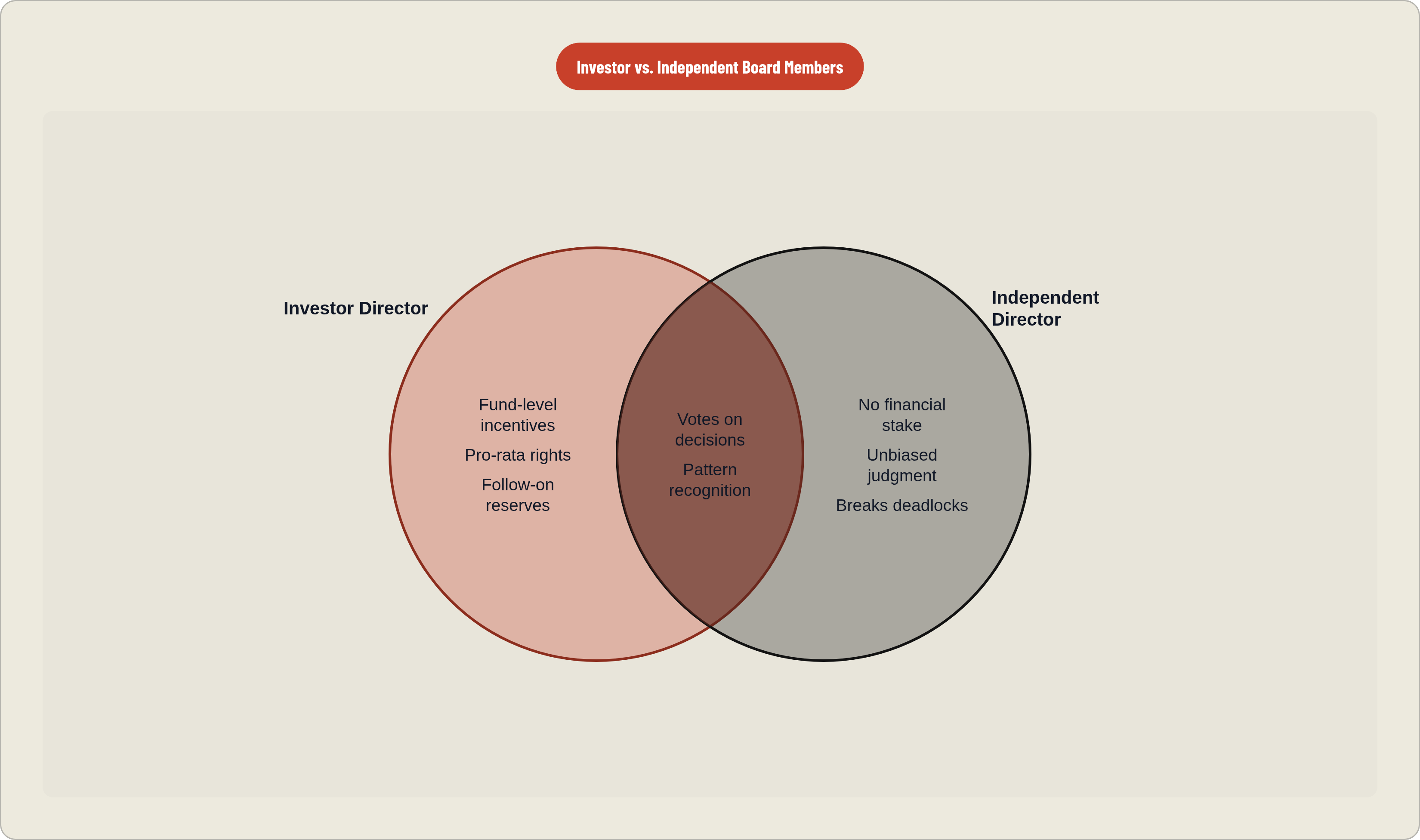
The independent is someone without a financial stake clouding their judgment. They're not protecting a fund position. They're not answering to LPs. They're just trying to help. When the investor and the founder disagree, a good independent is the person who actually moves the conversation forward rather than calcifying it.
The Investor Seat Is Not Always What You Think
When a seed investor takes a board seat, founders often assume that person is firmly in their corner. Sometimes that's true. Often it's more complicated.
Investors have portfolios. They have fund dynamics. They answer to limited partners. A great seed investor who genuinely likes you and believes in the company can still, in a high-pressure moment, be looking at the situation through a lens that isn't entirely yours. That's not a character flaw. That's just how their job works. I've seen it happen with investors who were genuinely good people, genuinely rooting for the founder, and still found themselves saying things in a board meeting that reflected fund-level pressure more than founder-level reality.
What this means practically:
- Understand your investor's actual incentives before they take a board seat.
- Know whether they have pro-rata rights, follow-on reserves, or fund-level constraints that color how they advise you in future rounds.
- Ask them directly: "How do you like to show up as a board member?" The answer tells you more than their pitch deck ever will.
A well-aligned investor board member is a genuine asset. A misaligned one is friction wearing a supportive face.
Picking Your Independent Director
This is where founders get tripped up most, mostly because it requires knowing what you actually need rather than who sounds impressive on paper. The two things are not the same, and confusing them costs you.
A few things that make someone a strong independent at the seed stage:
- They've seen your specific problem before. Not just "built a company." Someone who has operated in your space, your business model, or your exact flavor of pain point. General wisdom is fine. Specific pattern recognition is better.
- They'll tell you when you're wrong. Kindly. Directly. Without an agenda. This quality is far rarer than it sounds, and you will discover it by watching how they handle a conversation that gets uncomfortable — not from a LinkedIn profile.
- They actually have time. A well-known operator who gives you thirty minutes a quarter is less useful than a slightly less prominent one who reads your board materials and shows up prepared. I've seen founders chase the impressive name and end up with someone who clearly skimmed the memo on the way into the meeting.
- You trust them under pressure. Not "trust them because they're impressive in a conference room." Trust them because you've seen how they behave when things get uncomfortable, and they behaved well.
One more thing worth saying clearly: advisors and board members are not the same job. Advisors give input. Board members vote. Don't put someone on your board because you want access to their advice. Bring them on because you want their judgment. Especially the kind of judgment that one day may go against you.
Structure the Meeting Before You Think You Need To
Here's a pattern I've watched play out more times than I can count. Founders skip structuring their board meetings because everything still feels informal. Everyone knows each other. It's early. Why make it weird with agendas and pre-reads?
Then the company hits a rough patch. Suddenly you're in a board meeting where everyone is reacting to information in real time, emotions are high, and there's no shared frame for the conversation. What should take twenty minutes takes three hours. Or nothing gets decided at all. I sat in one of those meetings once, not as the founder, and I left genuinely unsure what had been resolved. Nobody in that room knew either.
The fix is simple:
- Send a board memo before every meeting. Two to four pages. State of the business, key metrics, what you need from the room. Not slides. A document people can read and actually think about before they show up.
- Separate reporting from discussion. Don't spend your board meeting reading numbers out loud. Get people up to speed beforehand so the meeting is actually for working through the hard stuff.
- End every meeting with clear decisions and owners. What did we decide? Who is doing what? By when?
Founders who run tight board meetings consistently get more out of their boards. Not because they have better people. Because the structure makes space for the right conversation to actually happen.
What You're Actually Building
Here's the part people skip. Your board is not just a decision-making body. It is a culture signal.
The way you run that room, the way you handle disagreement, the way you walk in with bad news and say it plainly. All of it tells every person present what kind of leader you are and what kind of company you're building.
Founders who hide problems from their boards end up with boards that stop trusting them. I've seen it happen slowly, like a slow leak. The updates get more polished. The real problems get buried in the footnotes. The board starts sensing they're not getting the full picture, and trust quietly drains out of the room. By the time the founder actually needs help, they've trained their board to wait for the version of the story that gets cleaned up before it's shared.
The best board dynamic I've seen is actually pretty simple. The founder says the uncomfortable thing out loud first. Not after three slides of good news as a soft landing. First. Problems get named clearly. People stop performing confidence for each other and start actually trying to figure it out together.
That culture doesn't happen by accident. You set it. From the first meeting. Before it feels like it matters.
The Bottom Line
At the seed stage, you have more control over your board than you will ever have again. Later rounds bring more investors, more complexity, more negotiation over who sits where. Right now, you get to choose.
Choose small. Choose aligned. Choose people who will tell you hard truths when you need them most. Build a structure that lets the room function before you actually need it to function under pressure.
Because one day you will walk into a board meeting with genuinely bad news. A missed milestone. A resignation. A number that doesn't make sense and you don't fully understand why yet. What happens next depends almost entirely on the room you built before that day arrived. And whether you built it on purpose or just let it happen while you were busy with everything else.