Hiring Your First VP of Sales as a Technical Founder
Skip the VP until you have a repeatable playbook and two quota-hitting reps.

Roughly 70% of first-time VPs of Sales at SaaS companies don't survive their first year on the job, according to Avenue Talent Partners. OpenView puts the number a little differently: 68% of first sales hires at early-stage startups leave within 18 months. Either way you slice it, this isn't a talent shortage. It's a systems problem wearing a talent problem's clothes.
Here's the pattern, and it's a familiar one. A technical founder closes the first ten or twenty customers herself, running cold emails, working warm intros, sitting through discovery calls that go long because she can answer any technical question thrown at her. Product knowledge fills in for sales instinct, and it works. Then she hires a VP of Sales to take it off her plate, hands over the keys, and steps back. Within a year, that VP is gone. She hires someone more senior the second time, figuring the first one just wasn't good enough. Same result. Now she's burned through two salaries equivalent to a senior sales hire, over a year of runway, and she's back on the phones herself, older and considerably more tired.
The founder didn't hire wrong twice in a row. She skipped a step both times: the founder work that needed to happen before any VP walked in the door. No ICP written down. No repeatable motion. No playbook, just instinct living in her head. SaaStr estimates a botched VP of Sales hire sets a company back close to a year and burns about half its remaining cash. Before getting into who to hire, figure out whether the company is even ready for the question.
The sequencing trap: why the VP title arrives before the motion is ready to scale
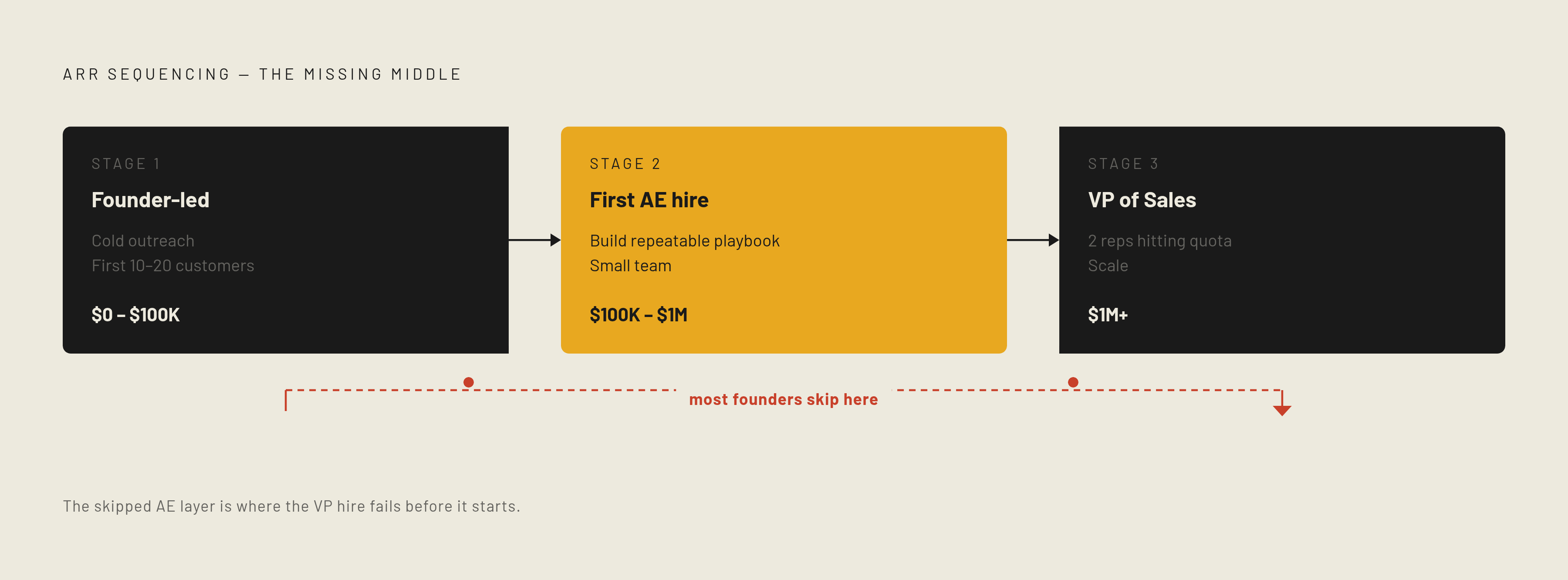
Bessemer's stage framework lays out the shape of this pretty cleanly. From $0 to $100K ARR, it's founder-led: you're closing the first ten to twenty customers through cold outreach and sheer will. From $100K to $1M ARR, the founder brings on a first hire and starts building an actual playbook, with sales work starting to move from a solo act to a small team effort. Somewhere north of $1M ARR is where specialization kicks in, and a VP of Sales starts to make sense.
Lemkin's rule, and it's one most founders ignore, is this: don't hire a VP of Sales until two individual reps are independently closing deals and hitting quota. Not "showing promise." Hitting quota, on their own, without the founder in the room.
The sequencing error is going straight from founder-led sales to a VP hire, skipping the AE layer. That skip kills the hire, not because the VP is incompetent, but because it leaves them nothing to build on: the founder-led motion never left behind a repeatable system. They inherit a system that only ever worked with the founder personally running it. Ask a VP to scale a motion that isn't actually a motion yet, that's just one person's hustle, and you're not accelerating growth. You're accelerating the failure.
If the calendar is stuffed with qualified opportunities and the founder is the only one working them, the fix is another AE. Not a VP. That one's worth repeating because it's the mistake that eats the most runway.
What the founder has to build before the hire is justified
Mike Molinet, a founder at Branch, told First Round Capital a story that's become something of a cautionary tale in early-stage sales circles: he hired a VP of Sales and handed them a hundred loose threads to figure out, nothing written down, nothing codified. The new VP spent their entire ramp period writing a playbook that already existed, just implicitly, inside Molinet's head. That's a expensive way to transcribe your own notes.
Meka Asonye, also of First Round, frames the readiness bar well: you don't need the exact recipe nailed down, but you should have most of the ingredients sitting in the cupboard. Before the hire, a founder needs to answer, in writing, five things:
- Who the ICP is and why they actually buy
- What they care about most during a demo
- What objections come up and how they get handled
- What the pricing conversation looks like, step by step
- What follow-up looks like after the call ends
There's a quick gut check for whether the playbook is real or still just vibes: run five demos off the same script. If conversion to the next stage stays within about 20% across those five, the playbook is starting to hold water. If the numbers bounce all over the place, the playbook isn't a document yet. It's still just the founder.
For most YC companies, that readiness point is somewhere between $30K and $80K in monthly recurring revenue, not before. Skip that step, and the VP doesn't build on the founder's system. They import whatever worked at their last company, a system built for a different ICP, a different deal size, a completely different motion. Square peg, round funnel.
The profile mistake: why "big name" VPs from scaled companies fail at zero-to-one
Here's the part that trips up a lot of founders chasing a recognizable name for the role. A VP running sales at a 200-person org hasn't done cold outreach in years, maybe ever. Their actual skill set is pipeline review, management cadence, process optimization, the whole operating rhythm of a machine that already exists. None of that applies when there's no pipeline, no team, and no process to optimize yet.
Lemkin's advice on this is blunt: hiring a VP out of a big, fancy tech company that stopped being a startup years ago is one of the most common and most expensive mistakes founders make. That person almost certainly hasn't done the thing being asked of them.
At this stage, the job actually calls for comfort with ambiguity and zero infrastructure, a willingness to do cold outreach personally, and a scrappy, half-detective, half-evangelist instinct for figuring out why customers buy. It calls for someone who can hand engineering real product feedback, not just close a deal and move on to the next one. Management theater doesn't help here. Building does.
The stretch hire, someone who's never personally recruited and developed quota-hitting reps from scratch, is too big a gamble at this stage, per Lemkin. They'll be asked to manage a team they don't actually know how to build. There are reportedly over 48 distinct types of VP of Sales roles across tech, which is a fun way of saying the title means almost nothing on its own. Stage fit matters far more than the label on the business card.
Look instead for someone who thrives without a map, has personally hired a few genuinely great reps before, and is just as comfortable building the machine as running it. The preferred sequence: hire a strong AE first, someone who can replicate the founder's own motion. Bring in the VP once the second or third AE is seated and hitting number.
What the founder's job looks like after the VP starts
Per Lemkin, roughly 66% of founders step back from sales the moment they hire a VP. And 95% of the time, that backfires.
Stepping back isn't delegation. It's abandonment, and the reasoning holds up under scrutiny. Before a company has real brand recognition, the founder is a huge part of what the customer is actually buying into, so pulling that signal out of the room shrinks the whole pitch. The new VP also needs real time to learn the product, and until they do, the founder is still the best demo-giver in the building and the only one who can field a hard technical question on the spot. A VP can't build early confidence without early wins, and they can't get early wins without the founder in the room lending credibility. And the founder, even without knowing exactly what does work in sales hiring, absolutely knows what doesn't, which makes early involvement in rep hiring non-negotiable.
Figma offers a useful real-world example here. When Kyle Parrish came on as the company's first sales hire around $2M ARR, founders Dylan Field and Evan Wallace didn't vanish from the sales floor. They stayed close to deals for far longer than the org chart would suggest, handing off gradually and on purpose rather than all at once.
So the founder's time in sales doesn't disappear, it moves. Less time on routine follow-up, more time in the middle of complex deals. Less time chasing brand-new pipeline, more time on the larger deals and the relationships that need a founder's weight behind them. The VP takes contracts, day-to-day follow-up, team coordination. The founder moves upstream, not out the door.
What this hire costs and what realistic compensation looks like in 2025–2026
Glassdoor's 2026 data puts average total compensation for a VP of Sales at $334,128, with the 25th to 75th percentile range running from $252,517 to $453,567. That's a wide band, and where a given company lands in it depends heavily on stage.
At Seed or Series A, base salaries typically run $140K to $180K, with more of the value sitting in equity. For early-stage companies under $5M ARR, a 50/50 split between base and variable is common, something like a $180,000 base against a $360,000 on-target-earnings figure, structured that way specifically to share the risk between founder and hire. Equity for this role at Seed or Series A tends to be between 0.5% and 1.5% of the company, per Carta.
Time-to-fill averages around 106 days. Do the math on that: a role that takes over three months to fill, and then fails within the first year, is roughly a fifteen-month setback before the replacement even starts ramping. Retained executive search adds another layer of cost, running 25% to 33% of first-year total comp according to Korn Ferry, money spent before the hire has taken a single sales call.
a16z offers a useful sanity check here: a sales hire should generate at least three times their fully loaded cost. A founding AE costing $200K fully loaded who closes $700K in year-one ARR clears that bar easily. A VP who washes out inside twelve months clears nothing. For early-stage companies watching runway closely, that math argues for skipping the expensive retained search on a role with no proven motion yet, and testing fractional or contract-to-hire arrangements before committing to a full-time VP.
How to source the right candidate: warm networks, peer founders, and co-investor relationships
A 2017 DocSend study found warm introductions increase the likelihood of funding by roughly 13 times compared to cold outreach. That study was about fundraising, but the underlying mechanism, the introducer's own credibility doing the pre-screening before a resume gets read, applies just as well to hiring an executive.
This matters more for a VP of Sales hire than almost any other role, because a resume does not reveal stage fit. Someone who thrived scaling a Series C sales org is not the same profile as someone who can build a motion from zero, and no amount of LinkedIn scrolling will tell you which one you're looking at. Founders who made this exact hire in the last year or two can tell you, specifically, which profiles worked at their ARR level and which ones flamed out. Co-investors who've watched this hire play out across a dozen portfolio companies have a pattern library no external recruiter can match.
In practice, the strongest sourcing paths run through other founders at a similar stage who've made this hire recently, a lead investor's portfolio network, and operators at companies maybe twelve to twenty-four months ahead on the same motion (not five years ahead, running a completely different playbook at a completely different scale). Peer founder communities built on real trust, small enough that people actually admit what went wrong, are where these referrals come from. That's a different animal entirely from a LinkedIn group full of strangers nodding at each other's posts.
When the intro lands, skip asking a generic version of "is this person good at sales." Don't ask "is this person good at sales." Ask the founder who made the intro: would you hire them again, at your stage, two years ago, knowing everything you know now?
How to run the hiring conversation so the right candidate self-selects in
Two traps occur constantly in these conversations. Some founders oversell the role, pitching "come build and run your own team" to a candidate who has zero management instinct yet. Others undersell it, hiding just how scrappy and undefined the job really is in order to land someone senior. Both produce a mismatch that becomes visible around month four, right about when the honeymoon wears off.
Honest framing, as ventureinsecurity.net puts it, sounds something like this: "You're joining to help expand what's already working. You'll work directly with the founding team. This isn't about running your own show. It's about learning the process and executing it with more customers."
That framing isn't a downgrade, it's actually the pitch. Ground-floor equity still means something at this stage. Direct founder access, no layers of bureaucracy in between. A real shot at shaping the sales process instead of inheriting someone else's broken one and being told not to touch it.
During the interview, weight these signals heavily: has this person ever personally hired quota-hitting reps from scratch, not inherited a team someone else built? Can they describe, in concrete detail, what the sales process looked like before they joined a company versus after? And do they lead with questions about the ICP and the deal cycle, or do they open with a monologue on their management philosophy? The former is diagnostic. The latter is a red flag wearing a suit.
The final filter is simple, if uncomfortable: onboarding two to five individual sellers first is a far cheaper mistake to make than hiring a VP who costs three times as much and does ten times the damage when the fit is wrong. If the hire feels like a leap of faith, it probably is one. The first ninety days should look like the VP working deals alongside the founder, not running deals solo. Independence gets earned over time. It doesn't come free on day one.
Sources
- The #1 Mistake I See Founders Make When They Hire Their First VP of Sales
- Why your first VP of Sales hire will fail, and what you can do instead
- Hiring a VP of Sales for a Startup: A Complete Guide
- The Wrong Hire: Ten Mistakes Founders Make Building Their First Sales Team
- When Should a Founder Hire Their First Salesperson?
- review.firstround.com
- stealthagents.com
- everstage.com