Series A Readiness Criteria That NYC Investors Actually Use
NYC investors screen Series A founders against sector-specific benchmarks and local market proof.

Series A funding in NYC is showing clear upward momentum heading into mid-2026. Average round size jumped from $18 million in June 2025 to $52.8 million in June 2026, though Tech:NYC flags at least one outsized deal skewing that number, so don't anchor your own round to it. The direction still holds: 26 startups raised close to $1.4 billion that single month, and Startup Genome now ranks New York the number two startup ecosystem in the world, trailing only Silicon Valley. NYC investors aren't running a regional copy of the national playbook anymore. They've built their own filters, and a generic Series A deck gets measured against the sharpest cohort in the country outside the Bay Area.
The sector concentrations that shape what NYC investors weight first
Four verticals eat most of the Series A attention here: fintech, AI applications, healthtech, and enterprise SaaS. Investors in these categories have sat through so many decks that they pattern-match almost instantly. Founders coming in from outside the city consistently underestimate how fast that recognition kicks in, and it costs them in the first ten minutes of a meeting.
Fintech is the clearest case. NYC accounted for 30% of all US fintech investment in 2024, up from 22.7% in 2020, which means the differentiation bar sits higher here than almost anywhere on earth outside San Francisco.
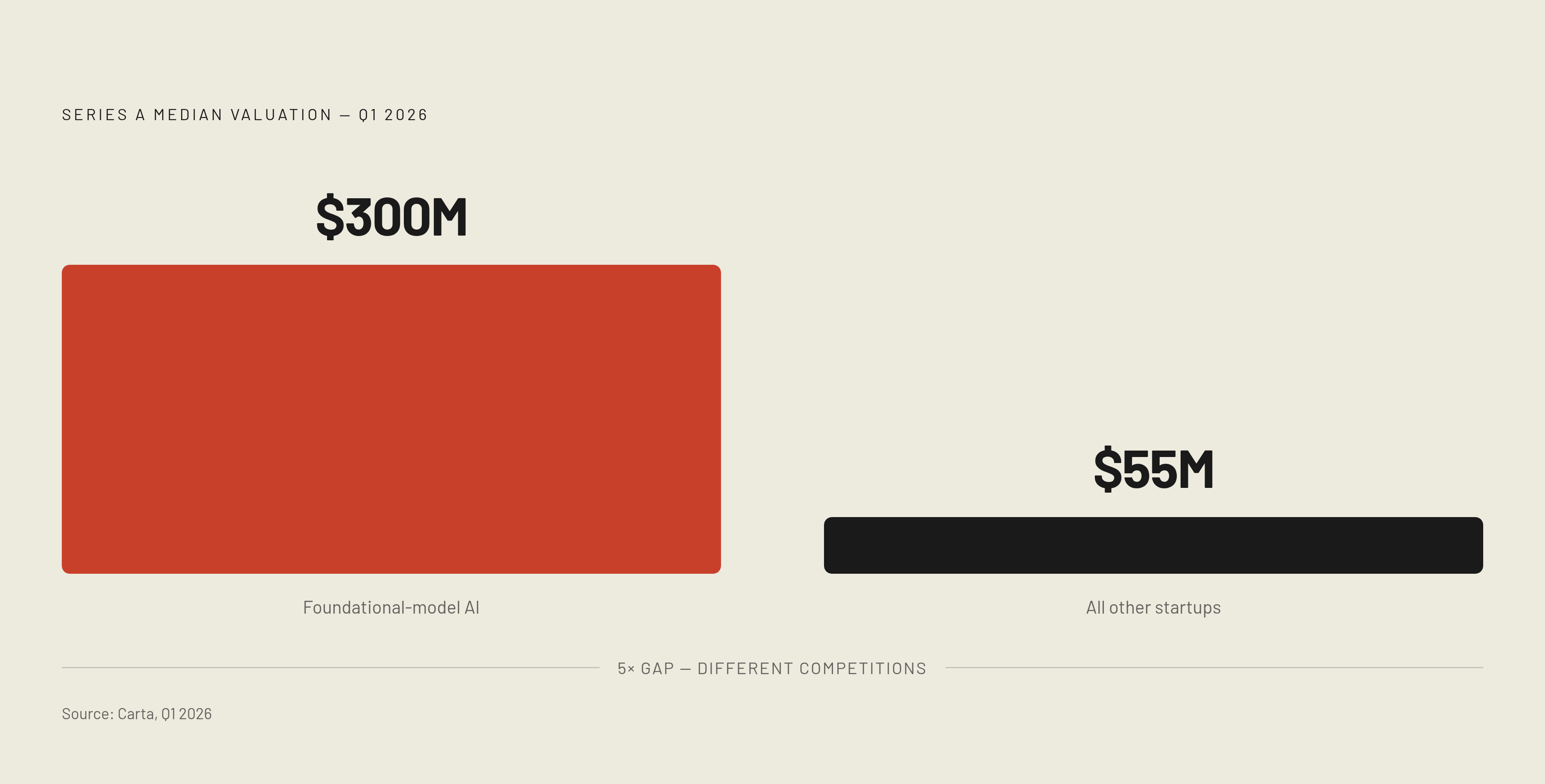
AI moves even faster, and it's stopped being a novelty pitch line. Over 1,000 AI-related companies in New York have raised a combined $27 billion since 2019. Saying "we use AI" gets a founder nothing in a partner meeting now, it's the default assumption, not the differentiator. Carta's Q1 2026 data shows foundational-model AI companies posting a $300 million median Series A valuation against $55 million for non-AI startups. That's not the same race, and treating it like one is the mistake: measuring a marathon and a sprint with the same stopwatch tells you nothing useful about either runner.
Healthtech has quietly built real depth too. 113 NYC-based health tech companies raised $4 billion in 2024, up 60% from the year before, and capital like that doesn't move without a sharper lens on reimbursement paths and regulatory posture sitting right behind it.
None of this disqualifies a founder outside those four lanes. But step outside fintech, AI, healthtech, and SaaS, and the reference class thins out fast, which raises the evidence bar instead of lowering it. Fewer comparable deals means the investor has less to check your story against, so every claim has to carry more weight on its own.
What the universal Series A bar actually looks like in 2026 before NYC adjustments
Every Series A company, wherever it's based, clears some version of the same baseline first. Carta's July 2026 software sample puts the median Series A raise at $14.4 million, at an $80 million valuation, with 18% dilution. That's the floor the conversation starts from, not the number anyone's aiming for.
No single ARR figure unlocks a Series A, and Finta's August 2026 research is blunt about it: proof points differ by business model. Enterprise software, product-led growth, consumer, marketplace, hardware, and biotech all carry different evidence requirements. What they share is proof that a defined market keeps coming back for the product, and a plausible, scalable way to reach more of it, not a founder personally closing every deal on charm and a good LinkedIn profile.
Qubit Capital's 2026 benchmarks lay out the gates that show up before any institutional conversation even starts:
- ARR at or above $1 million, growing at least 2x year over year
- Twelve months minimum of paying customer data (pilots and LOIs at zero revenue don't count, no matter how warm the email thread felt)
- CAC payback under 18 months, backed by actual cohort data, not a spreadsheet built the night before the meeting
- A revenue-responsible hire who's already closed real deals, not just someone with "Sales" in the title
Most founders get the shift from seed backwards. Angels underwrite a story with a team attached to it. Series A funds underwrite evidence with a story attached, and that flips the order of what matters: cohort retention, segmented unit economics, documented IP, and a clean cap table now outrank the founder's origin story.
Timing compresses too. A data room built after the first meeting is already behind, since partners move to second meetings within days once the signal reads positive.
On dilution, know the market benchmarks going in, because NYC term sheets get negotiated against them and founders who don't have a reference point cede ground they didn't need to give up.
The NYC-specific filters layered on top of universal criteria
Customer proximity is a proof point NYC investors expect and rarely say out loud. Startups here get built closer to their customers than to their infrastructure, so a founder selling to banks, hospitals, law firms, or media companies reachable by subway carries a structural edge that local investors treat as baseline, not bonus.
Local traction reads as its own signal, separate from revenue. Landing early customers inside the NYC ecosystem proves a founder can sell in the most competitive, relationship-gated market in the country. A fintech founder with two bulge-bracket bank pilots closed does not get compared to a founder with equivalent ARR from remote SMB customers. NYC investors treat the former as harder won, full stop, and that's not up for debate in the room.
Warm introductions work as a structural filter, not a courtesy. Cold outreach to a partner puts a founder at a disadvantage no matter how clean the metrics look. The real path runs through portfolio founders, accelerator directors, and co-investors who know both sides of the table, not a LinkedIn contact met once at a conference bar. And the bar for "warm" sits higher in New York than in smaller cities, because the network's dense enough that a real relationship is easy to verify.
Who's already on the cap table matters, too. Respected NYC angels signal quality to institutional investors and speed up an introduction to the lead, acting as a pre-vetting layer before the partner meeting even gets scheduled.
Regulatory fluency separates founders fast in healthtech and fintech specifically. Founders who can't speak clearly to reimbursement paths, bank partnerships, or data-protection posture get screened out early, because investors in these verticals have sat through enough diligence to spot hand-waving the moment it starts.
On the AI application layer, scrutiny runs deepest of all. The recent wave of AI applications has trained every investor in the room to ask one question: does the moat sit in the application layer, or is this just a wrapper around someone else's API call? Defensibility is consistently cited as a top reason for Series A passes, and in NYC's crowded verticals that question lands sharper, because the investor has usually already seen multiple companies chase the same wedge that quarter.
How NYC investors read the team and hiring plan at Series A
NYC tech jobs pay an average salary of $172,000, nearly double the citywide average. Investors who know that number price a hiring plan against it, and they'll flag burn assumptions that quietly assume below-market comp. Tech employment across the city has grown, adding meaningful new roles to the talent pool. But competition for that talent is expanding right alongside it, and a hiring plan that assumes easy senior recruitment reads as a yellow flag, not a green one.
Headcount at NYC Series A companies has roughly doubled since 2019. More companies chasing the same senior talent pool means investors probe hiring plans harder than they used to, not softer.
A few things come up in team diligence every time:
- Who makes each decision today, and whether that person actually scales with the company (key-person risk runs high in a city where founders get pulled constantly into deal-making and relationship-building)
- Whether the hiring sequence ties each new role to a metric and a decision date, since a sales leader hired before the company finds a repeatable customer segment adds cost without adding learning
- Whether the executive bench is actually complete, meaning a VP of Sales or Head of Growth who's closed real deals, not someone who held the title somewhere else once
Founder-market fit works as a local proxy too. A fintech founder who worked at a bank, or a healthtech founder with clinical experience, tells NYC investors the team can navigate customer relationships in verticals gated hard by trust and credentials. That's a shortcut that actually means something here, not a resume line for decoration.
Team composition matters on another axis. Black and Hispanic New Yorkers make up 24.3% of the city's tech workforce, against 10.4% in Boston, 8.2% in San Francisco, and 5% in Seattle. Some NYC institutional investors read a diverse team as a market-building signal, especially in a city where the customer base looks like that workforce.
The data room and diligence package NYC investors expect before the first partner meeting
A good partner meeting doesn't end the process. It starts it. Associates take over from there and compare answers across competing deals, and "we're excited" isn't a term sheet, it's the opening bell of an interrogation, per Opagio's framework. So the data room needs to exist before outreach starts, not get assembled in a panic the weekend after a promising meeting.
Here's what needs to already be sitting ready:
- Monthly historical financials and a board-quality operating model
- Cohort-level customer data (retention, net revenue retention, expansion motion, top-of-funnel shape, since revenue alone is table stakes now)
- Revenue concentration disclosure: if one customer accounts for a large share of revenue, show the contract terms, usage pattern, renewal risk, and the diversification plan before an investor finds the concentration on their own
- Gross-margin bridges and contribution margin broken out by segment (a blended LTV/CAC number is a flag; partners want payback data cohort by cohort)
- A cap table that reconciles to the actual signed documents, SAFE conversion waterfall modeled out before founder ownership gets presented
- IP assignment paperwork, governance documents, data-protection posture (a missing assignment can sink an investment memo on its own)
Companies outside software need to swap in whatever evidence actually matters for their business: technical, clinical, manufacturing, or regulatory proof. NYC healthtech and climate investors are calibrated to spot a SaaS metrics template pasted onto the wrong kind of company, and they will notice.
Comparability runs the whole show here. Every Series A gets benchmarked against other deals the diligence team looked at that same week, so an answer that sounds convincing on its own looks thin next to a competing founder who documented the same claim with more rigor. Opagio's framework identifies 47 diligence questions clustering across product and technology, market and category, traction and cohort quality, unit economics, team, legal and governance, and financial controls. Founders who map their data room to those clusters, instead of to a pitch narrative, walk in with a real structural edge over the founder who just polished the story.
How to navigate warm introductions and the NYC investor relationship graph
NYC's startup scene doesn't happen by accident. It assembles on purpose, at specific recurring events, and disassembles again by midnight. Founders who raise fastest have usually been building the introduction chain for months before they open a formal process, not scrambling for one after the deck is done.
A few recurring gatherings actually move introductions instead of just filling a calendar. NY Tech Week 2026 ran June 1 through 7 across Manhattan and Brooklyn, presented by Andreessen Horowitz; the 2025 edition drew over 1,020 events and more than 40,000 attendees, including a real contingent of international investors. NYC AI Demos runs as the largest monthly AI demo series on the East Coast, high-signal territory for anyone building in the AI application layer. The NYC B2B AI Founders & Investors Meetup gets cited as the single highest-signal recurring event for B2B SaaS and enterprise AI, because it curates founders who are actually building against investors who are actually writing checks that month. NY Tech Meetup, one of the city's longest-running tech gatherings, is good for visibility and live demos, though it carries lower signal for direct investment introductions than the smaller, curated formats.
Some approval-only founder evenings run roughly 60% early-stage founders, 30% active investors, 10% operators and ecosystem partners. That's a table small enough to force the kind of depth a rooftop mixer never delivers.
Building the intro chain is a research exercise before it's a networking one. Narrow the target list by stage and sector focus, look at existing portfolio companies, find the specific partner whose focus actually matches the pitch, then locate the founder or operator who knows both sides personally, not a LinkedIn contact met once.
Angels function as bridge infrastructure in this ecosystem. Respected NYC angels connect founders to customers, early hires, and follow-on institutional investors, and having the right names already on the cap table signals quality to a Series A lead before the first meeting happens.
The peer network doubles as intelligence too. Founders who raised six months ago in the same vertical know which partners are actively deploying, which are in a quiet period, and which diligence questions were hardest to answer. None of that shows up in a public source, which is exactly why small, trust-based peer groups compound in value as a fundraising asset over time.
NYCEDC's Venture for NYC (formerly Venture Access NYC) offers a public entry point for founders still earlier in building out their own investor relationship graph, connecting diverse founders and funders with capital, networks, and resources.
What NYC investors are actually passing on, and what fixes it
The bar has risen sharply since 2021, when some Series A rounds closed on minimal ARR and thin traction. Founders still calibrating to that era show up structurally underprepared for the market that actually exists now, and that gap is the single most common reason for a fast no.
Two pass reasons dominate, and the first one is the more common mistake. Traction without cohort-level evidence tops the list: revenue exists, but retention, expansion, and the durability of the top of the funnel are undocumented, so it reads as a one-time win rather than something repeatable. Underdeveloped defensibility sits right behind it, consistently among the top-cited reasons for a pass per DocSend's data, and it lands sharper in NYC's crowded verticals, where the investor has usually already seen the same wedge pitched twice that month.
The fix isn't complicated, even if it isn't easy. Build the cohort data before the meeting, not after the term sheet request. Get the moat question answered in one sentence, not a slide. And find the warm intro instead of sending the cold email, because in this city, the network already knows who's real before the deck ever opens.