Operator-to-Founder Transition: What Corporate Experience Transfers
Corporate skills that accelerate startups, and habits that sabotage them.
The number of senior operators leaving corporate roles to found startups isn't a trend piece anymore, it's a pattern with a paper trail. Over 250 operators from one country have made that jump since 2022, and per Startup Chai, operator-led ventures pulled in $101 million in 2024, a 243% funding surge. Those founders convert to Series A at a rate 23 times higher than the ecosystem average. What the corporate background actually helps with is the interesting question. It's that the same background quietly sabotages these founders the moment the org chart disappears, and most of them don't see it coming.
MIT and Census Bureau research backs this up from another angle: the average age of a successful startup founder is 45. Experience beats youth, on average, which wrecks the "dorm room genius" mythology but is good news for anyone who spent a decade in a cubicle wondering if it was wasted time. And per Aura's research, the companies producing the most founders aren't scrappy Series B startups. They're Microsoft, IBM, Deloitte, Google, EY, Accenture, Amazon, PwC, Oracle, McKinsey. Big, bureaucratic, brutally competitive places. Turns out that pressure leaves a mark, and not always a bad one.
The skills that actually survive the jump
McKinsey alumni will tell you the firm's first lesson is blunt: say the thing, top-down, in one breath, no throat-clearing. That's not just a consulting party trick. At the seed stage, nobody in the room understands what the company does yet, and the founder who can compress that into one clean sentence has already won half the meeting.
Planning rigor travels too. Years of building multi-year corporate strategy, layered budgets, KPI trees, timelines nobody reads until Q3, turn into something genuinely useful at a startup: an actual operating rhythm. Quarterly plans, working proformas, growth levers mapped out before the metrics even exist. Most first-time founders build this system from scratch, usually after a bad quarter forces the issue.
Domain expertise is the single biggest unfair advantage on this list, and nothing else on it comes close. Startup Chai's research found operator-founders hit product-market fit two to three times faster than younger founders, mostly because they're not discovering how enterprise buying works. They already lived it.
Take Adarsh Nair, former CEO of Airtel Digital, who scaled that business significantly before co-founding Optica. He landed institutional investor contracts three times faster than typical fintech startups, because two decades of enterprise procurement experience meant he already knew which doors to knock on and in what order.
Or Ankit Dhir, an ex-TCS systems engineer who co-launched Habilelabs with co-founder Shankar Morwal. Their product launched fully enterprise-ready, SOC 2-aligned, from day one. Not luck. Years spent building secure platforms for banks meant Dhir already knew exactly which compliance checkpoints kill BFSI deals before they start.
Stakeholder navigation and hiring instincts round out the list. Running a P&L, managing legal exposure, sitting through regulatory reviews, all of it builds risk instincts that a first-time founder has to earn through an expensive mistake. And having hired inside a large org builds real pattern recognition for talent, which matters more than people admit, since the first ten hires basically become the company's personality. Per Entreprenista, leaders with 15-plus years of corporate management experience outperform first-time entrepreneurs on both profitability and longevity.
What corporate training quietly breaks
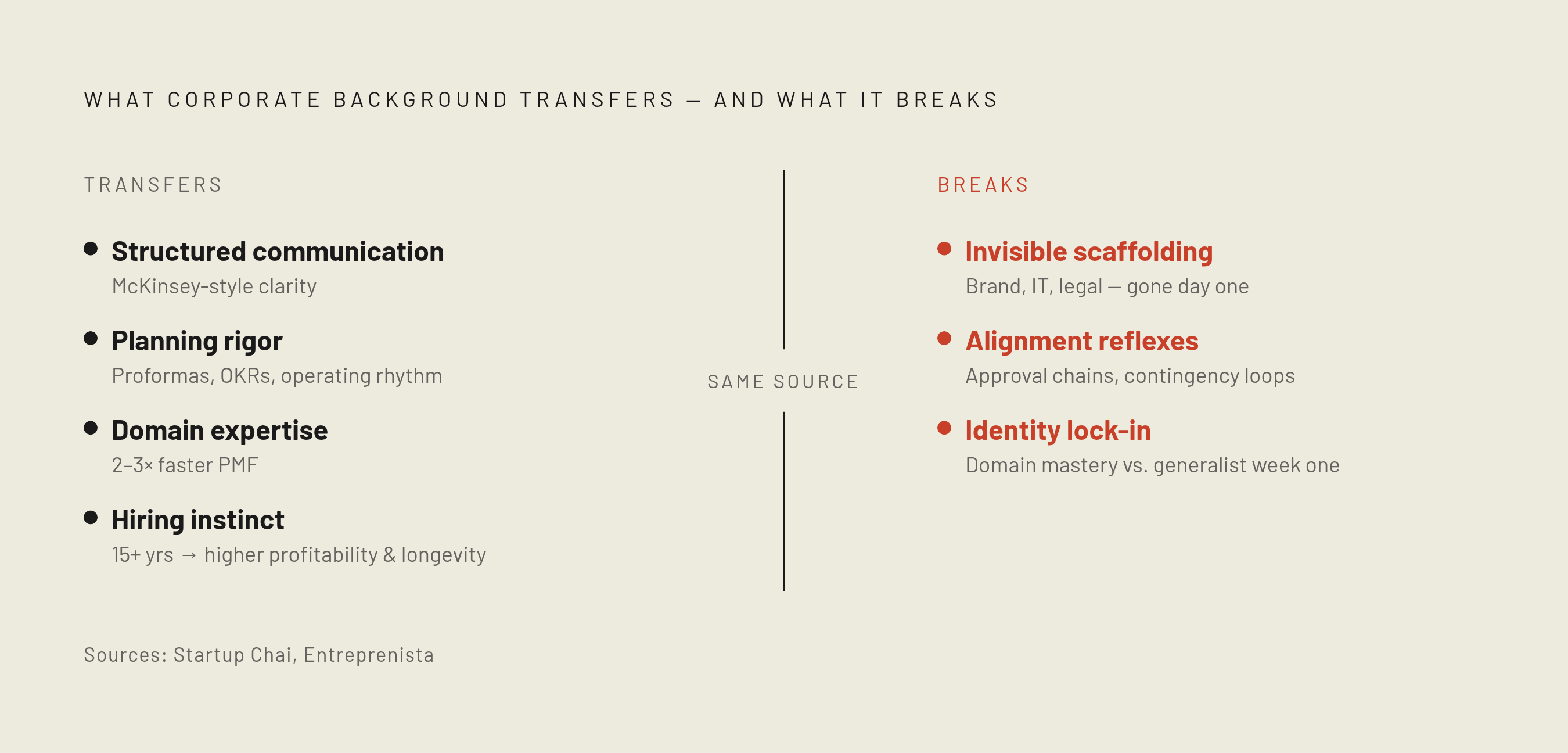
Nobody warns corporate executives that they're propped up by scaffolding they don't even notice until it's gone, including brand credibility, legal support, an IT department, and a name that opens doors on its own. Step outside that building, and the founder is the brand, the ops team, and the finance department, often all before lunch.
The mindset needs unlearning too, and this is the part operators consistently underrate. What worked at scale actively calcifies a startup. Corporate reflexes push toward alignment meetings, approval chains, contingency plans for edge cases nobody's hit yet. Useful at 10,000 employees. Poison for a six-person team trying to ship before the runway runs out. The founders who insist on running week one like it's quarter fourteen at their old job are the ones who burn four months building a decision-approval process for a company with three customers, and that's the single most common self-inflicted wound in this whole population.
Identity attachment is the sneakier problem, since it's the one operators most often miss in themselves. Founders who spent fifteen years becoming the domain expert struggle to become a generalist again, and generalist is exactly what week one of a startup demands. Per Entreprenista, this isn't a skills gap so much as a translation gap: founders get stuck trying to reinvent themselves from scratch, when the better move is translating what they already know into a new shape.
The same background that hands an operator a massive head start in domain, relationships, and structure also hands them habits they now have to actively fight. No neat resolution there. Just a tension to name early, before it costs six months.
Founder-market fit as the frame investors now use to evaluate operator-founders
Investors in 2025 aren't just asking whether this person can build a company. They're asking whether the founder's background actually lines up with the market, a concept increasingly called founder-market fit, or FMF. Credentials matter less here than whether the founder's scar tissue matches the market's actual pain points, and that's the filter that decides who gets funded and who gets a polite pass.
Operator-founders often walk in with a structural head start. Years inside an industry means they already understand buyer psychology, they know the regulatory landmines, and they've watched incumbent vendors fail up close, usually from the inside.
When FMF is genuinely high, the effects compound fast: quicker iteration, sharper early hires, instant credibility with both customers and investors. It also carries a founder through the stretch where nothing seems to be working, because conviction rooted in lived experience is harder to shake than conviction rooted in a slide deck.
Nair and Dhir aren't just experience stories, they're FMF stories. Neither one was generically experienced. Each was experienced in the precise market they went on to disrupt.
That reframes the whole question. Skip asking whether there's enough experience on the résumé. Ask whether that experience sits in the right spot to create an actual edge in this specific market. That's a strategy question, not a resume question, and it sets up exactly where that edge shows up once building starts.
Where the operator edge shows up most concretely in early company building
Product and PMF. Operator-founders aren't guessing what enterprise buyers want, they're remembering it. Startup Chai frames it well: PMF gets replicated from memory rather than discovered through trial and error. The risk sitting right next to that advantage is over-engineering for a buyer that looks suspiciously like the founder's former employer, while missing the wider market. First Round Capital's PMF Method, built by reverse-engineering what strong B2B founders did in their first six months, plays directly to this strength, since operator-founders already speak the customer's language fluently.
Early hiring. Corporate hiring instincts need recalibrating, not repeating, and this is where a lot of operators quietly get it wrong. Startup hires need to be coachable and adaptable, not polished performers who need three layers of infrastructure just to function. The first hires set the culture in ways that are hard to undo, so every one of them should be someone worth trusting to carry that culture forward. Operator-founders keep falling into the trap of defaulting to hiring people who look like their old colleagues (specialized, expensive, credentialed) when the startup phase actually needs generalists willing to do five jobs badly before doing one job well. There's a timing wrinkle too. Liz Christo, Partner at Stage 2 Capital, has noted that the first go-to-market hire depends heavily on context and isn't automatically a sales role. Operators with sales-heavy corporate backgrounds tend to resist that instinct on principle, and on this one, principle is wrong.
Fundraising and network capital. This is where corporate years pay off almost passively. Per StartupChai, 92% of funded startups came through warm introductions from a trusted third party, and that kind of warm introduction meaningfully raises the odds of getting funded. Operator-founders who spent a decade building relationships with enterprise buyers and board members show up to the fundraising table with a network most first-time founders spend years constructing from zero. The timing discipline helps too: founders who start investor outreach six-plus months before they actually need the check close at higher valuations with less dilution, and that kind of runway planning is second nature to anyone who's built a corporate budget cycle before.
The identity trap that catches operator-founders after the company starts working
The move from hands-on operator to CEO isn't a skills checklist, it's an identity shift, per StartupCEO.Coach. The exact behaviors that built the company are rarely the behaviors that scale it, and that's a harder pill to swallow than it sounds.
Firstaimovers.com maps this into three traps, and operator-founders are especially prone to one of them. There's the Perpetual Builder, the technical founder who won't delegate product decisions and becomes a bottleneck once the company outgrows their personal bandwidth. There's the Decision Gatekeeper, who insists on approving every meaningful call until decision volume simply outpaces what one human can process. And there's Identity Lock-In: the founder who defines themselves by domain mastery and resists hiring anyone smarter than them in that exact domain.
For operator-founders, Identity Lock-In cuts deepest, because that domain expertise is the founding advantage. Letting go of it doesn't feel like growth. It feels like erasing the thing that made them valuable in the first place, which is exactly why so many operators hold on two quarters too long.
The numbers back up how costly this gets. Per 2024 statistics cited in firstaimovers.com, 35% of Series A startups fail before reaching Series B, often because founders cling to roles the company has already outgrown. McKinsey pegs the real inflection point around $10 million ARR, the shift from "charismatic to industrial" operations, where the corporate rigor an operator carries stops being a nice-to-have and becomes the actual job.
Call it the founder's paradox. The personal heroics, the hands-on craft, and the fast unilateral calls all built the company, and all of it now throttles it. These instincts don't feel like flaws, because they feel like the reason the company exists in the first place. Per Sifted 2024, 53% of founders report burnout, often tied to holding onto early-stage behaviors too long.
Jeff Bezos is the counterexample worth studying, not admiring from a distance. He moved from hands-on operator, to systems builder, to strategic overseer, building decision frameworks that didn't need him personally in the room. Stubborn on vision, flexible on details. That's the target, and most operator-founders get the ratio backwards on the way there, clinging to details and drifting on vision instead.
What the reinvention cadence actually looks like as a company grows
Per Joe Knowles, VC at Smedvig Ventures, founders reinvent themselves roughly every 12 to 18 months, and the Series A shift is usually the sharpest one: from scrappy hustle to professionalized operations, delegation, and empowering hires who actually know more than the founder does in their lane.
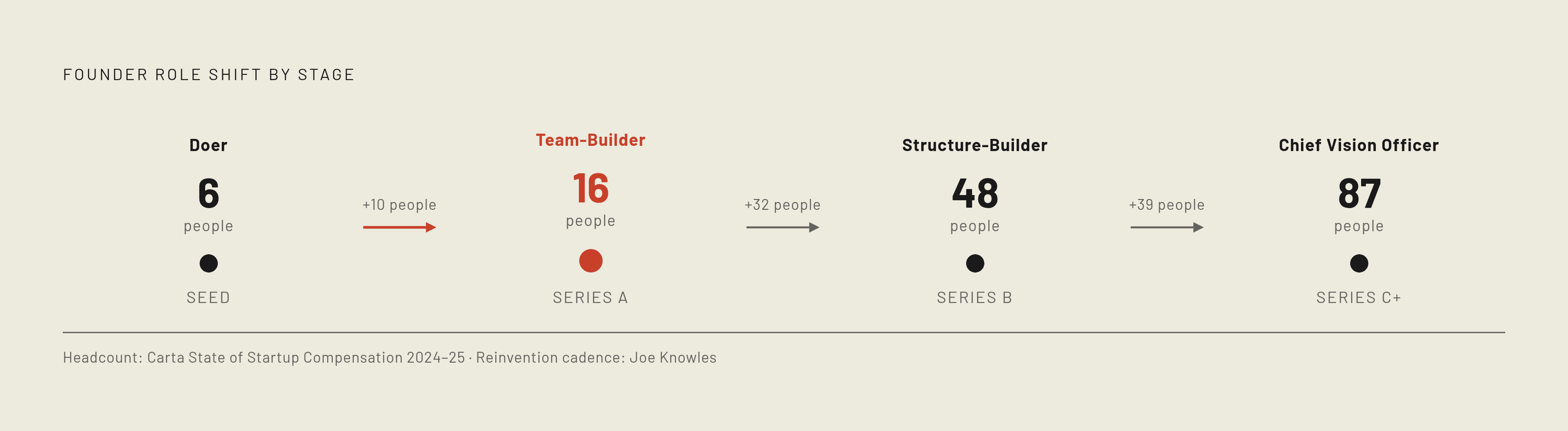
Carta's State of Startup Compensation data (2024 to 2025) puts real numbers on the headcount curve: about 6 people at Seed, 16 at Series A, 48 at Series B, 87 at Series C. Each jump quietly redefines what the founder's job even is.
Firstaimovers.com maps the stages cleanly. Seed to Series A means shifting from doer to team-builder, with a rough benchmark of spending under 20% of time on tasks only the founder can do. Series A to Series B means shifting toward building structures and empowering others, rather than solving every fire personally. Past Series B, the role turns into something closer to Chief Vision Officer, holding the direction while functional leaders actually run the plays.
Operator-founders tend to find the Series A shift less jarring than first-timers do, since they've already managed teams and delegated inside structured orgs before. The hard part lies elsewhere: doing that same skill at startup speed, with a fraction of the resources and zero institutional safety net underneath them.
Nick Suckley, a multiple-time exited entrepreneur in the VenturePath Expert Network, says the founders who win this transition move from founder-led to CEO-led early, on purpose. A CEO-led company builds real structure, puts the right people in the right seats, and holds them accountable to shared goals, not to the founder's personal approval.
The founders who navigate this well treat it as a deliberate project, not something that happens to them by accident. They name the tension out loud, between the work that got them here and the work the company now needs, and they decide, consciously, what to put down. For operator-founders specifically, this is where the pattern-recognition that made them so effective in their domain runs out of road, since identity questions don't respond to a spreadsheet. No corporate résumé, however impressive, prepares anyone for the moment their own instincts become the obstacle.
Sources
- Why 2025 Founders Must Reinvent Themselves Every 6 Months (Not 18)
- (The Weekend Insight) - The Second Generation of Indian Founders: Older, Sharper, and Already Trained
- When the Founder Becomes CEO: The Transition Nobody Warns You About.
- From Corporate Executive to Entrepreneur: What No One Tells You About Making the Transition