Which NYC VCs Lead at Seed and Series A Right Now
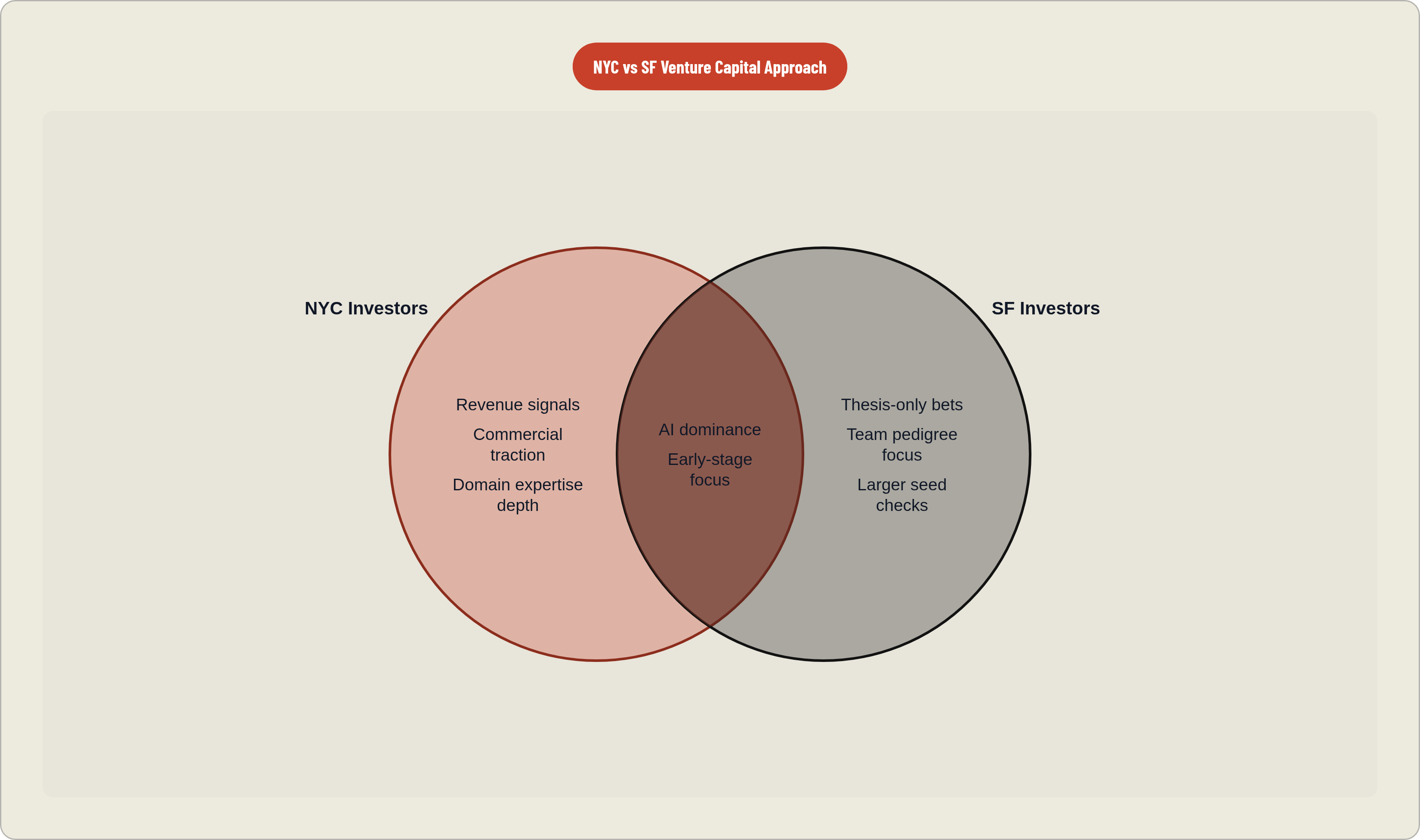
NYC VCs prioritize revenue signals and traction over founder pedigree at seed stage.

New York has a PE undertone that you don't find everywhere. Capital efficiency matters here. Revenue signals matter here. Even at seed.
The average NYC seed round sits somewhat below the SF average, and NYC investors typically expect more traction for that smaller check. Some revenue. Some users. A signal that the market is real, not just plausible. SF investors will sometimes fund a thesis and a team and call it a day. NYC investors want to see that you've actually been out in the field.
This isn't the same as saying NYC investors are unambitious. They're reading proof of concept through commercial signals rather than team pedigree alone. That's a different filter, and it requires a different kind of pitch. Think of it as the difference between a treasure map and a chest of gold — SF funds the map, NYC wants to see the chest.
A few things worth knowing before you walk into any of these rooms:
- AI is dominant. Thirty-five percent of NYC startup funding in 2025 went to AI and machine learning companies. If you're outside that category, you need a clear answer for why your market has comparable momentum.
- NYC has structural depth in B2B SaaS, fintech, and media. Founders in those verticals are pitching into genuine domain expertise. That's an advantage if you're in the right lane.
- A deck with no revenue signal reads differently here. It doesn't disqualify you, but it changes the conversation. Calibrate accordingly.
Lerer Hippeau: The Seed-First, New York-First Generalist That Has Been Here the Longest
If you want to understand the NYC seed market, start with Lerer Hippeau. They were backing New York founders before New York was considered a legitimate tech ecosystem. The firm came out of Huffington Post, SoftBank, and Yahoo. Their early portfolio reads like a greatest hits of NYC consumer brands: Warby Parker, Glossier, BuzzFeed. But they're not a consumer-only fund. They're generalists with a strong consumer track record, which is a meaningful distinction.
The network is genuinely self-reinforcing in a way that most firms only claim. Roughly two-thirds of their portfolio companies are New York-based. Dozens of portfolio founders are also LPs. Over 500 companies backed across 16-plus years. LH Fund IX launched in April 2025 at $200M, which means they are actively deploying right now, not sitting between vehicles.
Check sizes run $500K to $1.5M at seed, with capital reserved for Series A follow-ons. That matters because a seed relationship with Lerer Hippeau can carry into your next round without requiring you to start over with someone new. Twelve unicorns, 10 IPOs, and over 160 acquisitions tell you they've seen what that compounding looks like.
The practical read for founders: sector fit matters less here than founder quality and NYC rootedness. Show up with both.
Union Square Ventures: Thesis-Driven Bets on Networked Platforms, Still Writing Early Checks
USV has been investing since 2003. They were among the earliest firms to treat New York as a first-class venture market, and the IRR of 59.25% is the kind of number that ends arguments.
Their thesis has stayed remarkably stable over two decades. They back companies that leverage rapid experimentation, avoid market gatekeepers, and broaden access to knowledge, capital, wellbeing, or energy. Twitter, Etsy, Coinbase. Networked platforms that reshaped categories. That's the pattern, and they haven't deviated from it much. What's interesting is that the consistency isn't stubbornness. It's conviction, and there's a difference — stubbornness is a broken compass; conviction is a fixed star.
A few things worth noting about where they are right now:
- They deliberately keep their funds small relative to peers, with the most recent targeting a relatively modest sum
- Small funds mean concentration and selectivity, not volume
- They're still active at early stage: a Series A in Doctronic in August 2025, plus investments in Supper and Tutor Intelligence, confirms the AI and health thesis is live
The practical implication for founders is specific. USV rewards people who have actually engaged with their published frameworks and thought through how their company fits the thesis. Showing up with a deck that ignores their public writing is a miss. Read the blog. Know the thesis. Make the connection explicit when you pitch.
Boldstart Ventures: The Pre-Company Check for Enterprise and Cybersecurity Founders
Boldstart does something most firms don't. They invest before pre-seed. Often before there's even a company to speak of.
If you're a technical founder with an enterprise or cybersecurity thesis and you haven't started building yet, pay attention here. Their "Inception" model means they act more like a co-founder than a traditional investor at that stage. They run programs that train early founders in enterprise selling and bottoms-up growth. The capital comes with operational scaffolding attached. It's a genuinely different arrangement, and founders who've been through it tend to describe it that way.
Check sizes range from $250,000 to $15 million depending on stage, with inception checks typically starting around $500,000. Fund VII closed at $250 million in mid-2025, bringing total AUM to approximately $1.1 billion.
The portfolio is hard to argue with:
- Snyk at $300M-plus ARR
- Clay achieving unicorn status
- Kustomer sold to Meta for $1 billion
- Protect AI acquired by Palo Alto Networks for over $700 million
Ed Sim, the firm's general partner, ranked number one on Business Insider's Seed 100 in both 2023 and 2024.
One more thing worth noting: Boldstart partners directly with Fortune 500 CIOs, CTOs, and CISOs. Portfolio companies get warm enterprise introductions. This isn't a claimed benefit buried in a pitch deck. It's a documented practice that shows up in how portfolio companies land their first customers.
The fit is narrow: technical founders, enterprise thesis, no product yet. If that's you, the earlier you reach out, the better.
Primary Venture Partners: The High-Touch, Operator-Heavy Seed Platform Built for NYC Founders
Primary has deployed over $300 million across 200-plus companies, but the number that actually distinguishes them is this: roughly 50 people on staff, with more than 20 full-time operators embedded in the firm.
Most seed funds are a handful of partners writing checks and then largely disappearing until the next round. Primary is a different model. The operators help portfolio founders hire, sell, and build. That sounds minor until you've burned three months on a bad hire or a stalled enterprise deal. At that point, having someone in your corner who has done it before isn't a nice-to-have. It's the difference between navigating a maze with a map and navigating it alone in the dark.
They are also deliberately selective. Partners screen roughly 100 companies to make two or three investments per year. That's among the most selective ratios in the NYC seed market. They claim a 90% win rate on competitive deals, which reflects both brand and the quality of founder relationships they build before a deal even closes.
What they focus on:
- Consumer, technology, and healthcare
- Founder profile and stage matter more than vertical specifics
- Choreographed founder events that generate real talent pipelines and customer targets
If you want investors who stay engaged after the check clears and bring real operational resources into your company, Primary is the clearest version of that model in New York.
Work-Bench: Enterprise-Only, Fortune 500-Connected, and Deliberately Concentrated
Work-Bench inverts the typical VC process. Most investors wait to see what founders are building and then decide if it's interesting. Work-Bench identifies Fortune 500 pain points first, then funds the founders solving them.
That inversion matters more than it sounds. When you're working with Work-Bench, you're often walking into a situation where the buyer already exists and has already expressed pain. You're not trying to convince anyone the problem is real. Fund IV closed in May 2025 at $160 million, their largest fund to date.
The track record includes seven unicorns: Socure at $4.5 billion, Spring Health at $3.3 billion, and Cockroach Labs at $5 billion.
What makes the model distinct:
- Roughly six new investments per year versus an industry average of 15 to 20
- Concentration by design means each portfolio company gets real attention
- Direct introductions to JPMorgan and Goldman Sachs are part of the documented value proposition
About half of their investments are NYC-based. The other half is geography-agnostic as long as the enterprise thesis holds.
Who this is for: enterprise software founders who need their first reference customers as much as their first check. If customer access is the actual bottleneck in your business, Work-Bench deserves to be near the top of your list.
FirstMark Capital, Thrive Capital, and BoxGroup: Three More Active Firms With Distinct Profiles
FirstMark Capital
FirstMark invests from seed through Series B, which makes them one of the few NYC firms with a mandate that spans the full early-growth range. Check sizes run from $1M to $10M. The portfolio includes Shopify, Pinterest, Ro, and InVision. A mix of marketplace, health, and SaaS that reflects genuine generalism rather than a category bet.
With approximately $3.5 billion in AUM, they have real follow-on capacity. Founders who want a single investor relationship that can carry through multiple rounds should put FirstMark on the list early.
Thrive Capital
Founded by Joshua Kushner, Thrive operates at the intersection of technology, finance, and design. The portfolio includes Stripe, Instagram, Nubank, Canva, and Robinhood. Those aren't similar companies, but they share something: each redefined its category through a combination of design clarity and financial mechanics.
Thrive is active at seed, though they're also known for growth-stage positions. The fit is most natural for founders building at the intersection of finance, consumer experience, and design-forward products, or for those who want an investor with a strong network when later growth rounds come around.
BoxGroup
BoxGroup is a seed-stage specialist with a founder-friendly reputation and one of the most active early-check records in the NYC ecosystem. They move quickly. If you're at the earliest moment of company formation and need a fast, founder-oriented seed check before building out the full round, BoxGroup is worth reaching out to early.
How to Read the Landscape as a Founder Approaching These Firms Now
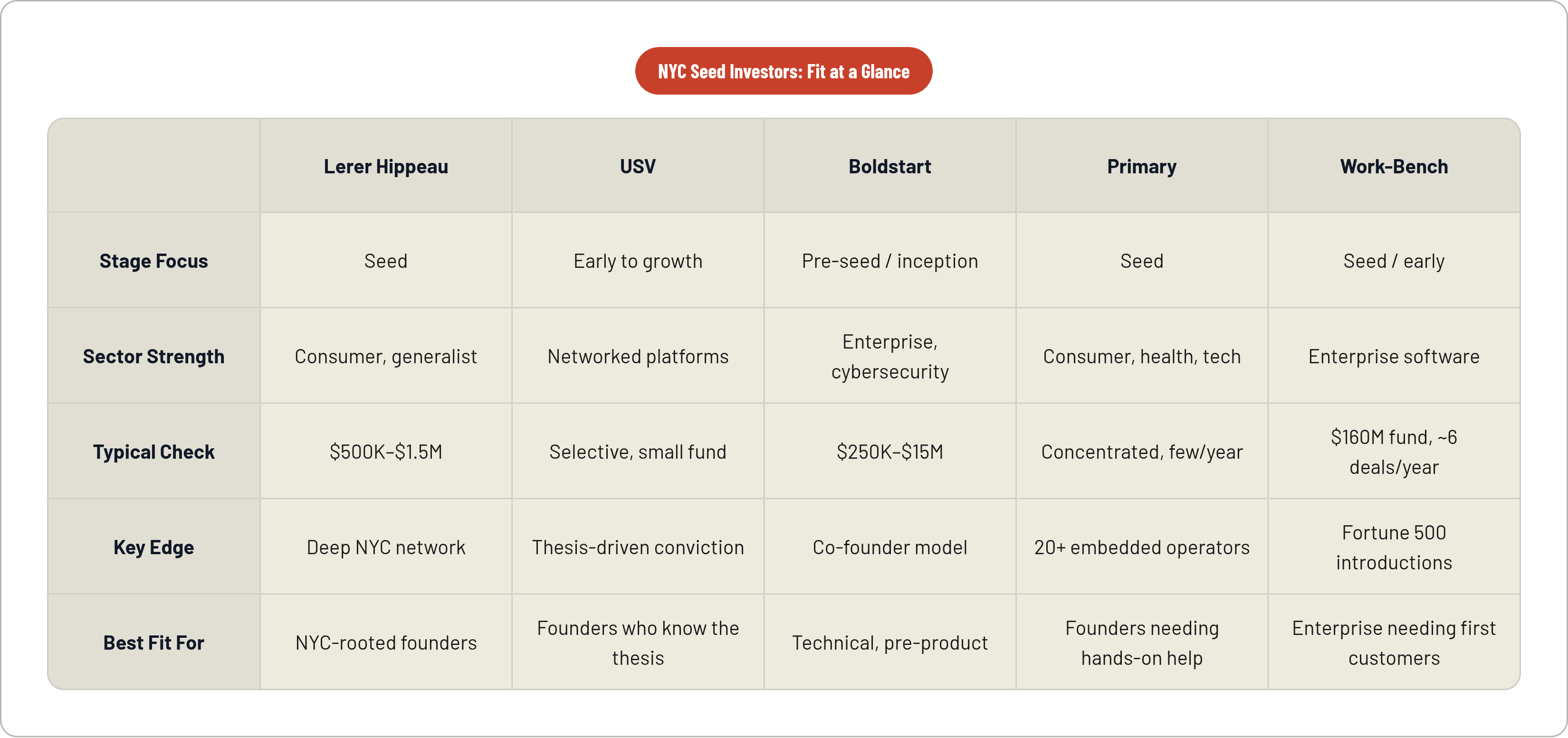
The firms above are not interchangeable. Stage mandate, sector conviction, check size, and post-investment model vary enough that wrong-fit outreach wastes everyone's time, including yours.
Here's where to start based on where you actually are:
- Pre-product, enterprise or cybersecurity thesis. Talk to Boldstart first.
- Pre-seed, B2B SaaS with early signal. Work-Bench or Primary.
- Seed, generalist or consumer. Lerer Hippeau or BoxGroup.
- Seed with a networked-platform thesis. USV.
- Seed through Series B, want one investor relationship that scales. FirstMark.
A few things cut across all of them.
Warm introductions matter more than cold outreach. These firms are relationship-driven. A connection through a portfolio founder or mutual operator carries disproportionate weight. Cold inbound does not perform the same way. This isn't a secret, but founders consistently underinvest in building those relationships before they need them.
Even a small amount of revenue changes the conversation at nearly every firm on this list. It's not about the number itself. It's about what the number signals: that you've talked to real customers, made a judgment call about pricing, and closed something. That's a different founder than one who hasn't done any of that yet. That first dollar of revenue is worth a thousand slides — it's the only part of the deck that can't be faked.
The AI context is real. If you're in that category, you're pitching into the strongest tailwind in the market. If you're not, be crisp about why your category has comparable momentum. "We're not AI but here's why our market is moving" is a real answer. Hoping no one notices is not.
The founders who get the most out of this ecosystem show up before they need capital. The introductions that actually land come from people who know both sides. That work starts earlier than most founders think, and NYC Founders Club, a private chef's-table dinner community for active NYC founders where those peer relationships form before anyone needs anything, is one place founders have built that kind of standing, the calendar moves faster than it feels like it will.