What Founders Should Know Before Moving Their Company to NYC
Fintech and AI boom in New York, but founders must choose neighborhoods and sectors strategically.
Moving your company to New York is not a lifestyle decision. It is a strategic one. And the founders who treat it that way are the ones who actually extract value from it. NYC is the second-ranked startup ecosystem in the world, trailing only Silicon Valley, with more than 25,000 tech-enabled startups and an ecosystem valued above $621 billion. The metro area pulled in $31.1 billion in venture capital in 2025, up more than $6 billion over the year before. That is not a secondary market hedging its bets. That is a first-class place to build. Think of NYC as a pressure cooker: the heat is higher than anywhere else, but that is exactly what accelerates the reaction. But here is the thing: the city does not distribute its advantages evenly. Deal count has actually fallen even as total capital has grown, which means the money is concentrating. Bigger rounds. Fewer bets. That context matters for every decision a founder makes before and after landing here.
Which sectors NYC actually rewards — and which face a harder climb
The city has a few sectors where it is genuinely, structurally dominant. Then there are sectors where it is fine. Then there are sectors where you will be grinding against the current for no good reason.
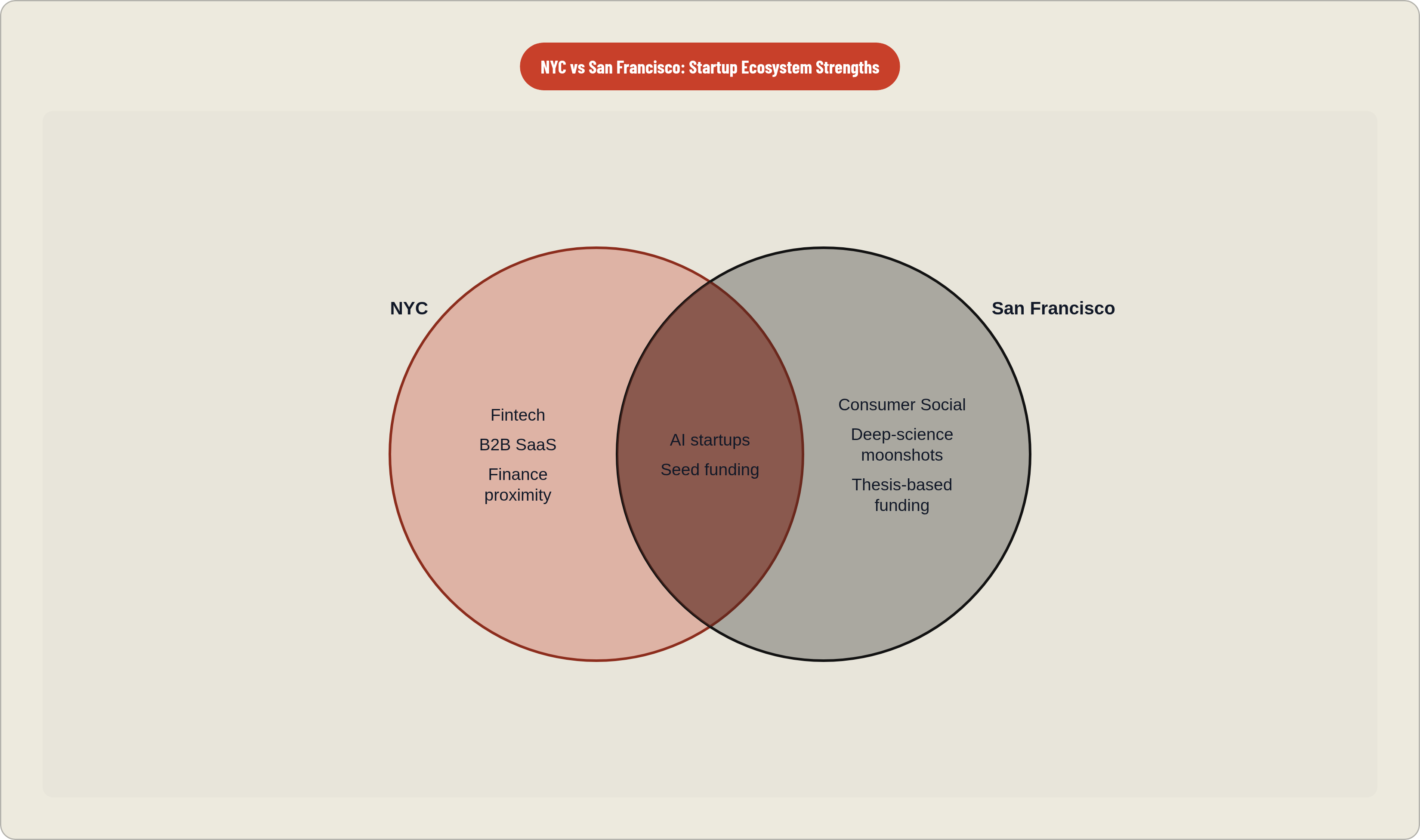
AI is the standout right now. It accounted for 35% of total NYC venture capital in 2025. There are more than 2,000 AI startups operating in the city, 35 AI unicorns, and early-stage deal activity that would look competitive in any market on earth. If you are building in AI, you are not making a sacrifice by choosing NYC over the Bay Area. You are making a real decision between two serious options.
Fintech is even more structurally locked in. NYC captured 36% of all U.S. fintech fundraising in 2024, up from 25% the prior year. This is not a trend. This is geography. Wall Street is here. The banks are here. The enterprise customers who will actually buy fintech products are here, often within walking distance of your office. No other market replicates that access.
HealthTech is gaining real ground. The region's concentration of major hospital systems and payers creates a customer pipeline that is genuinely hard to replicate elsewhere. The sector raised $4 billion in NYC in 2024.
B2B SaaS and media round out the list of sectors where NYC's ecosystem is purpose-built.
What NYC is not the best place for: consumer social, deep-science moonshots, or pre-revenue pure-idea plays. San Francisco still has structural advantages for those. That is a fair read, not a knock on NYC. Knowing which city fits your sector is part of arriving prepared.
One more thing that often catches founders off guard: even though 543 companies raised seed or Series A in a single year in Manhattan, more than San Francisco, seed is more competitive than those numbers suggest. Capital has concentrated into larger rounds. Investors here want traction, not just a deck.
What the NYC investor landscape actually looks like from the founder's chair
There are more than 300 venture firms active in NYC. The well-known seed funds include Lerer Hippeau (the city's most active seed investor), Brooklyn Bridge Ventures, Primary Venture Partners, Notation Capital, BoxGroup, and Female Founders Fund. These are real, active, founder-friendly shops. But they are also specific. And that specificity is the first thing to understand.
NYC investors are more specialized than their San Francisco counterparts. Union Square Ventures focuses on fintech and marketplaces. Lerer Hippeau leans consumer. FirstMark focuses on enterprise. If you pitch the wrong fund for your category, it is not a close call. It is an immediate pass. Research is mandatory — not optional prep work. It is table stakes.
The other big difference from SF is the traction bar. NYC's investing culture is deeply influenced by its finance industry roots. Investors here expect to see clear metrics before a serious Series A conversation. Customer acquisition. Revenue. Engagement. San Francisco will fund a strong team on a compelling thesis more readily than New York will. That is not a flaw. It is just the operating standard you need to be ready for.
Median seed valuations are currently in the low double-digit millions post-money range, with investors prioritizing unit economics over top-line velocity. Healthy numbers. Competitive with any major market. But the investors want to see the foundation, not just the potential.
Geography also matters in ways that surprise founders. The top Manhattan-based funds want founders physically present. Brooklyn-tolerant they are not. Remote-friendly they are not. Present. The relationship model here depends on regular in-person contact, and investors know immediately when a founder is not embedded.
The cost and operational reality of running a company in New York
Let's be direct: NYC is expensive. Founders who budget to San Francisco or Austin standards will run into trouble. Founders who budget to a vague "we'll figure it out" standard will run into bigger trouble.
The good news on office space is flexibility. The city has more than 200 co-working spaces, which gives early-stage founders real optionality before committing to a lease. The broader Manhattan office market sits at roughly 17.2% availability, but the corridors that actually matter for startups run tighter than that.
Talent is where costs bite hardest. There are more than 40,000 AI professionals in NYC, which sounds like abundant supply. And it is. But those candidates have strong outside options, including finance, which drives compensation expectations up. Nearly half of all NYC job postings in 2024 sought candidates with tech skills. Demand is not limited to startups. You are competing with established institutions that have deep pockets.
Then there are the operational costs that founders from other markets underestimate: NYC taxes, legal costs, and the general velocity of spending. Burn accelerates here. Runway math done in another city needs to be redone before you sign a lease.
The flip side is real, though. Capital access and customer density can offset those costs faster than in lower-cost markets. But only if you are actively exploiting them, not passively hoping they materialize. NYC does not give you a discount for showing up. It gives you leverage for working the room.
Where to physically locate — and why the choice carries more weight than rent
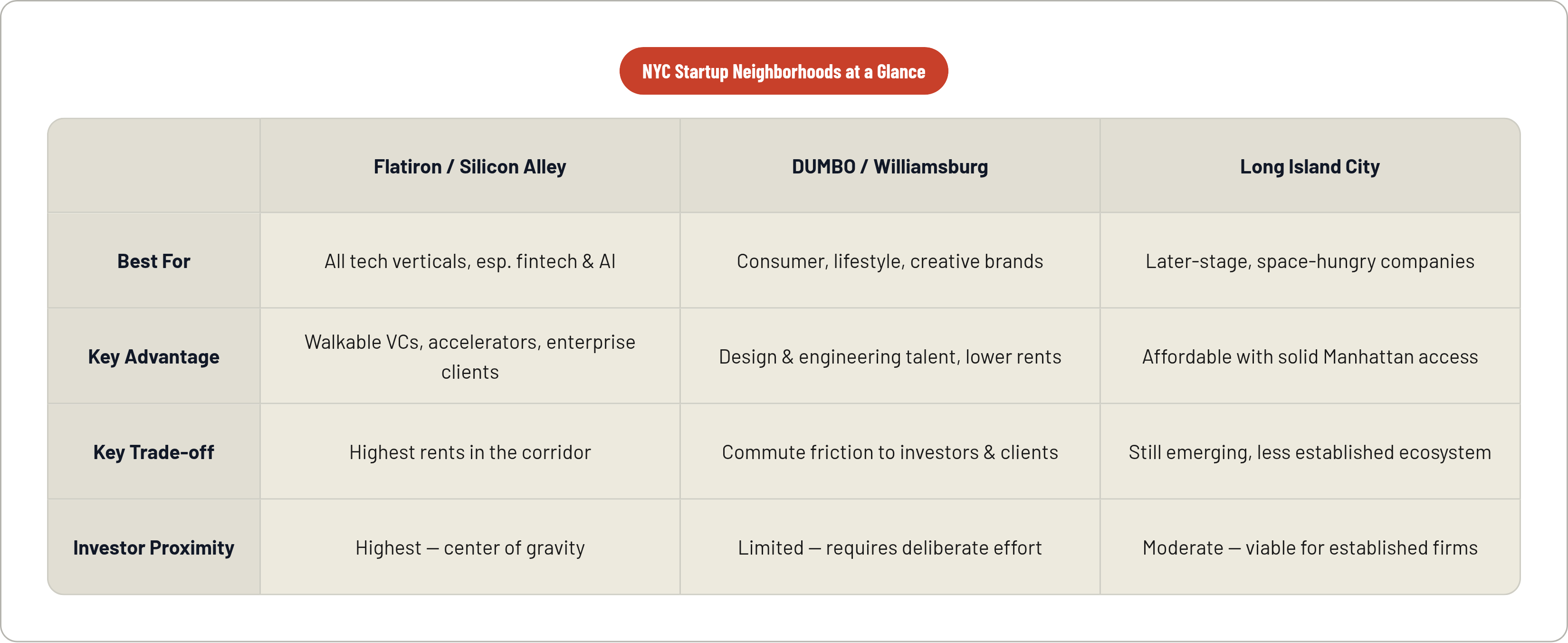
Neighborhood choice in NYC is a strategic decision. It shapes who you recruit, who you bump into, how investors perceive you, and whether your team is actually commuting to a place they want to be. Do not treat it like a real estate exercise.
Here is where things actually shake out:
- Flatiron / Silicon Alley (the corridor running roughly from 14th to 30th Streets along Fifth Avenue and Broadway): the densest startup concentration in the city. VCs, accelerators, and enterprise clients are often walkable. Companies like Ramp and Datadog are here. This is the center of gravity.
- Union Square: office availability sits at 10.9%, well below the citywide average, which tells you something about demand. Worker activity at this location hit 123% of pre-pandemic levels in late 2024, the strongest recovery of any major Midtown business district. The density is real.
- Chelsea: favored by high-growth startups for its culture and proximity to the broader tech corridor. Slightly more creative, slightly less finance-adjacent, still well-positioned.
- DUMBO / Williamsburg: strong for consumer, lifestyle, and creative brands. Excellent access to Brooklyn's design and engineering talent. Lower rents. But the commute friction to Manhattan-based investors and enterprise clients is real, and founders underestimate it.
- Long Island City: emerging as an affordable option with solid Manhattan access. Worth watching for later-stage companies that need more square footage than Midtown can reasonably provide.
The wrong zip code is not just a rent decision. It can quietly undermine your recruiting pipeline, your investor relationships, and the kind of serendipitous collisions that actually generate deals. Location is infrastructure.
Why the founder community in New York operates differently from anywhere else
NYC moves on relationships. The density of the city compresses timelines for introductions, hires, and deals in ways that distributed or lower-density ecosystems simply cannot replicate. A coffee meeting that might take three weeks to schedule in another city can happen in two days here, because everyone is close and the social fabric is tight.
The loneliness of founding is real. Imposter syndrome, isolation, the pressure to project confidence while actually navigating constant uncertainty. These are problems no founder escapes, not ones unique to NYC. But in a city that moves this fast, the gap between "I'm fine" and "I'm struggling" can widen quickly without the right peer group around you.
Community here is not a nice-to-have. It is structural infrastructure for staying sane and staying connected. A founder without a peer group in this city is like a surfer without a board — technically in the right ocean, but not going anywhere fast.
A few that are worth knowing about:
- NYC Founders Club: a private dinner club for NYC startup founders, built around small weekly chef's-table dinners where every seat is intentional. Founded in 2023 by three YC alumni, it is deliberately invite-only and limited to active founders from Seed through Series B who are building full-time in the city. The value is in warm introductions to customers, hires, and co-investors that come from people who actually know both sides.
- Startup:NYC (Tech:NYC): tailored for pre-Series A founders with small teams; connected to a community of NYC investors who are committed to the ecosystem.
- Newlab (Brooklyn): 250-plus companies scaling deep tech out of a purpose-built space in the Brooklyn Navy Yard. Their 2024 Founder Fellows raised tens of millions of dollars collectively and reached nearly $350 million in combined valuation by program end.
- Startup Leadership Program NYC: part of a global network of thousands of founders across 28 cities. Structured curriculum from early-stage through scaling.
The thing to understand about all of these: not all communities are equivalent. The value of a network tracks directly with how curated it is and how well the members actually know each other. An introduction from someone who has sat across a dinner table from both parties carries different weight than a LinkedIn message. That distinction is not subtle. It is the operating logic of how deals and hires actually happen in this city.
How warm introductions work in practice — and what founders need to do to get them
NYC's best investors do not just write checks. They open customer relationships. They surface candidates. They connect founders to co-investors, sometimes within days of a request, when the relationship is real. That is the value of the ecosystem when you are actually embedded in it.
But here is how the mechanics actually work.
A warm introduction that works has three ingredients. The person making it knows both sides well. They have real context on what each party needs. And they have reputational skin in the outcome. They are not forwarding an email. They are vouching for you. That distinction matters enormously to the person on the receiving end.
Cold outreach to top-tier NYC seed funds produces poor results. This is not anecdote. It is the operating reality of how these funds manage their attention. The founders who raise fastest are the ones who built investor relationships three to six months before they needed capital. They were present. They were visible. They showed up to the dinners and the demo nights and the community events. Then, when they were ready to raise, the relationships were already there.
The practical sequence looks like this:
- Arrive in the ecosystem with your sector and stage clearly defined.
- Identify the two or three funds that actually align with both.
- Find a path to a genuine introduction through a mutual portfolio founder or a community member who knows the partner.
- Build the relationship before you need anything from it.
- Then pitch.
The same logic applies to hiring. The founders who consistently hire well in NYC are not the ones posting the most job listings. They are the ones whose networks surface warm referrals. Because the people who refer candidates in a trusted network are doing screening you could never replicate on your own.
What founders consistently get wrong about the move — and how to arrive ready
The most common mistake is straightforward. Founders arrive for the energy and the narrative. "We moved to New York." They absorb the density, the pace, the feeling of being in a real ecosystem. And then six months later they realize they have made no specific progress on the actual reasons to be here. Because they never defined those reasons precisely enough.
Here is what arriving ready actually looks like.
Financial preparation. Model NYC costs explicitly before you move. Office, talent compensation, taxes, burn rate. These all run higher than founders expect when coming from other markets. Do the math in advance. Adjust your runway assumptions before you land.
Relationship preparation. Identify which community, which investors, and which peer founders you are going to connect with before you get on the plane. The ecosystem rewards founders who come in with a warm path. Not founders who start from scratch on day one and hope it sorts itself out.
Traction preparation. NYC investors want evidence. Revenue. Users. Clear enterprise demand. A compelling thesis alone is not enough here. Arrive with something to show, or be explicit with yourself about where you are in that process and what it will take to get there.
The founders who get the most out of NYC are the ones who treat the city as a specific set of usable advantages. Talent in defined sectors. Capital from specialized funds. A founder community built on actual trust. Not a vibe they are trying to absorb by proximity.
NYC does not reward passivity. It rewards founders who show up, stay visible, and invest in relationships before they need anything from them. The city's density is both its gift and its demand. Everything moves faster. Everything costs more. Everything asks more of you. And for the founders who arrive ready for that, it gives back more than anywhere else.