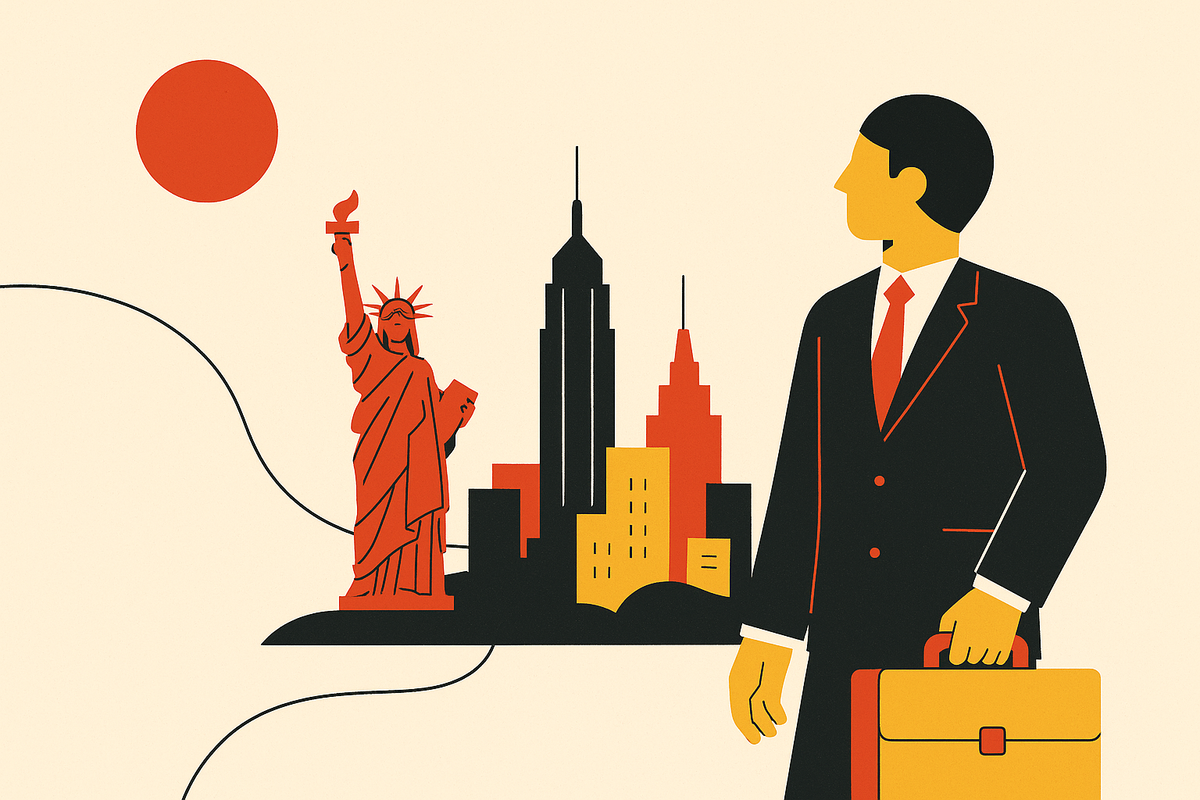
Where NYC Startups Are Actually Opening Offices in 2024
AI companies are reshaping Manhattan's office market with massive lease commitments.
Most founders treat the office decision like a logistics problem. Square footage, monthly rent, subway line. Those things matter, but they're doing maybe a third of the actual work.
Your address gets read by at least three different audiences, and none of them are reading the same thing:
- Investors read it as a signal of ambition and seriousness
- Candidates read it as a signal of culture and peer group
- Your own team reads it as a signal of what kind of company you're becoming
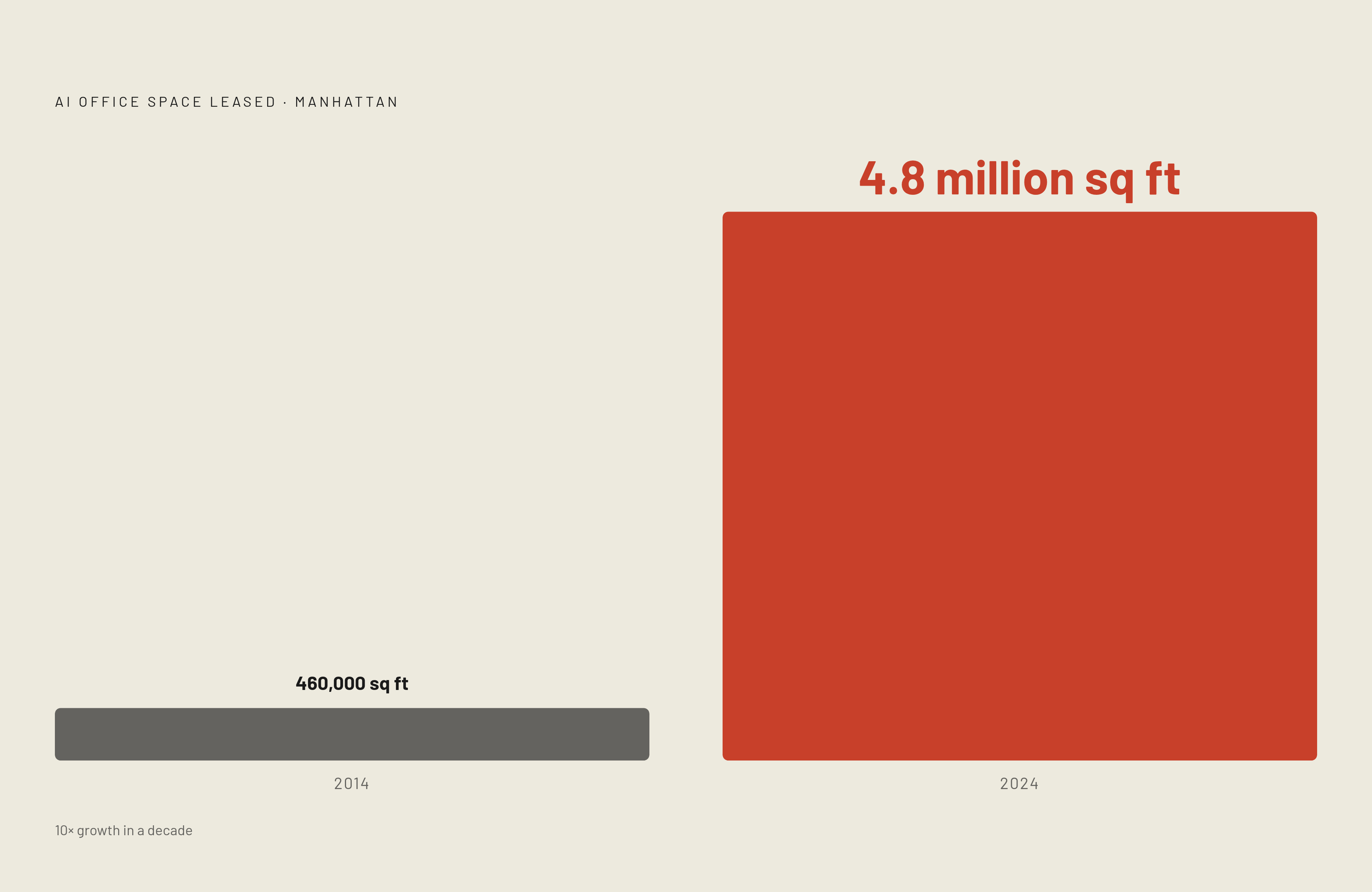
Here's the data point that reframes the whole conversation: AI companies leasing space in Manhattan went from roughly 460,000 square feet in 2014 to over 4.8 million square feet in 2024. That's not companies reluctantly paying for real estate. That's physical presence being treated as a competitive move, by the most well-capitalized companies in the fastest-growing sector.
Proximity to investors, peer founders, and talent pipelines is not incidental to where a cluster forms. It's the reason the cluster exists. And once a cluster exists, being inside it compounds over time — like a snowball rolling downhill, gathering mass from every referral, hallway conversation, and coffee meeting it picks up along the way. You get the introductions. You run into the right people. Your candidates already know how to get there.
The neighborhood also quietly filters your applicant pool. Commute patterns, neighborhood culture, and the vibe of the surrounding blocks all shape who actually shows up to interviews. A founder who picks a space based on how good the photos look and then wonders why they can't hire engineers has usually answered their own question.
Cost, lease structure, and flexibility also vary sharply by submarket. A decision made on instinct can lock you into terms that don't fit your runway. More on that later.
Flatiron and NoMad: the densest startup corridor in the city
Draw a line from 14th Street to 30th Street along Fifth Avenue and Broadway. That's the historic core of Silicon Alley. Still the single densest concentration of startups in New York, and the cluster effect is accelerating, not settling.
The anchor tenants tell you who's here. Ramp took 132,000 square feet. Datadog is here. Adyen took 90,000 square feet. AI firms Actively AI and AI One are on West 21st and West 23rd Streets. Through Q3 2025, AI startups had leased 486,000 square feet in Manhattan, with the majority concentrated in this corridor.
The Flatiron NoMad Partnership reported leasing reached 3.8 million square feet, up 15% over the prior year. Most new leases fell in the tens of thousands of square feet range. That is exactly the scale that fits a Series A or B company building out a real team.
The rent spread is wide enough to work with:
Cost-conscious founders can access this neighborhood without committing to a trophy building. Landlords are increasingly willing to flex on lease term for high-growth tenants, which matters when you genuinely cannot predict your headcount in 24 months.
The gravity here is real and a little hard to explain until you've worked inside it — like trying to describe why a room full of the right people feels different from a room full of the wrong ones: you know it when you walk in. Being in Flatiron or NoMad means your neighbors are other founders. Your investor is probably a ten-minute walk away. The candidates you're trying to hire have already been to this neighborhood a dozen times.
Chelsea and Union Square: the connective tissue between clusters
Chelsea sits immediately west of the Flatiron corridor. It started as a manufacturing district, and that industrial loft character is still there in the bones of the buildings. Open floors, high ceilings, flexible layouts. That physical environment projects a specific kind of culture, which is partly why major tech anchors landed there. Google, Apple, Verizon, and Samsung all have established presence in Chelsea.
For startups, space options range from small (roughly 400 square feet) to mid-size (up to 10,000 square feet), with coworking through WeWork, The Yard, and Industrious for teams not ready to sign a direct lease.
Union Square functions as the transit crossroads of the entire corridor. The 14th Street station serves nine subway lines and logged nearly 23 million annual riders in 2024, ranking it the city's fourth busiest station. For hiring, transit access matters more than most founders budget for in their thinking. You can pull talent from almost anywhere in the five boroughs without asking anyone to make a punishing commute.
The market data reinforces that Union Square is genuinely in demand. Submarket availability sits at 10.9% versus Manhattan's overall 17.2%. Worker visits in October 2024 hit 444,000, representing 123% of January 2020 levels. That's the strongest return-to-office recovery of any Midtown BID. This is a live, working neighborhood, not a neighborhood in transition.
For founders who want Flatiron proximity without Flatiron asking rents, Union Square and Chelsea offer real optionality within the same talent catchment. You're still in the corridor. You're just paying a bit less to be in it.
Hudson Square: the submarket with the fastest-rising rents and a Brooklyn-to-Manhattan migration story
Hudson Square is south of SoHo, along the Hudson River. It was a printing district. Now it's absorbing overflow demand from both the Flatiron corridor and Brooklyn, at a pace worth paying attention to.
Leasing volume more than doubled year-over-year between 2024 and 2025, per JLL data. That's the fastest growth rate of any submarket covered here. Average asking rents rose more than 17% over three years, from $77.12 per square foot at the start of 2023 to $90.50 per square foot in early 2026. Still below peak Flatiron Class A, but closing fast.
The clearest signal of where this neighborhood is heading: Anthropic confirmed it would lease the entire building at 330 Hudson Street, taking close to 500,000 square feet as it scales toward a workforce of 1,000. One tenant of that size and profile reshapes a submarket's identity. The surrounding blocks follow.
The broader migration pattern shows up in individual company decisions. Brooklinen relocated from DUMBO to Hudson Square in 2024, signing a 10-year, 32,000 square foot lease at 225 Varick Street. That move is not unusual. A funding event happens, the team grows, investors start asking where you're based, and suddenly the DUMBO address that felt right at 15 people feels like the wrong answer at 60. Brooklyn works well at a certain stage. Then it doesn't, and the path often leads here.
Hudson Square is past the "undiscovered" phase but not yet at Flatiron prices. Founders who've been watching from the sidelines are going to find a different market in another 18 months.
SoHo: the neighborhood where brand identity and office choice are the same decision
SoHo draws a specific kind of company. Consumer brands, media companies, creative agencies, and tech startups for whom the physical address is itself a brand asset. The neighborhood signals taste. It signals a kind of ambition that's distinct from the technical ambition you'd associate with Flatiron.
The rent reflects the premium. Asking rents averaged $89 per square foot in early 2026, at or above Flatiron Class A in some buildings.
The marquee signal came from OpenAI, which took 90,000 square feet at the Puck Building. That was not a random real estate decision. It communicated something specific about what kind of company OpenAI wants to be seen as, and it immediately changed the neighborhood's profile among AI firms.
SoHo is genuinely compelling for consumer startups, fintech, and brand-forward B2B companies. The density of creative talent, proximity to Tribeca, and cachet with certain categories of investor all reinforce each other. It is less compelling for infrastructure or deep-tech startups whose hiring doesn't depend on creative neighborhood energy. Senior ML engineers are making their decision based on team and equity. The cast-iron facade is not moving the needle.
If the space reinforces who you're trying to hire and how you want to be perceived by customers and partners, the premium is worth it. If you just like the neighborhood, it isn't.
DUMBO and Williamsburg: Brooklyn's startup neighborhoods and who still belongs there
Brooklyn gets treated as the budget alternative to Manhattan. That framing undersells it. DUMBO hosts over 500 tech, creative, and professional firms. Anchor tenants include Bjarke Ingels Group, Twelve, Soko Glam, and Quip. That's a genuine cluster, not a consolation prize.
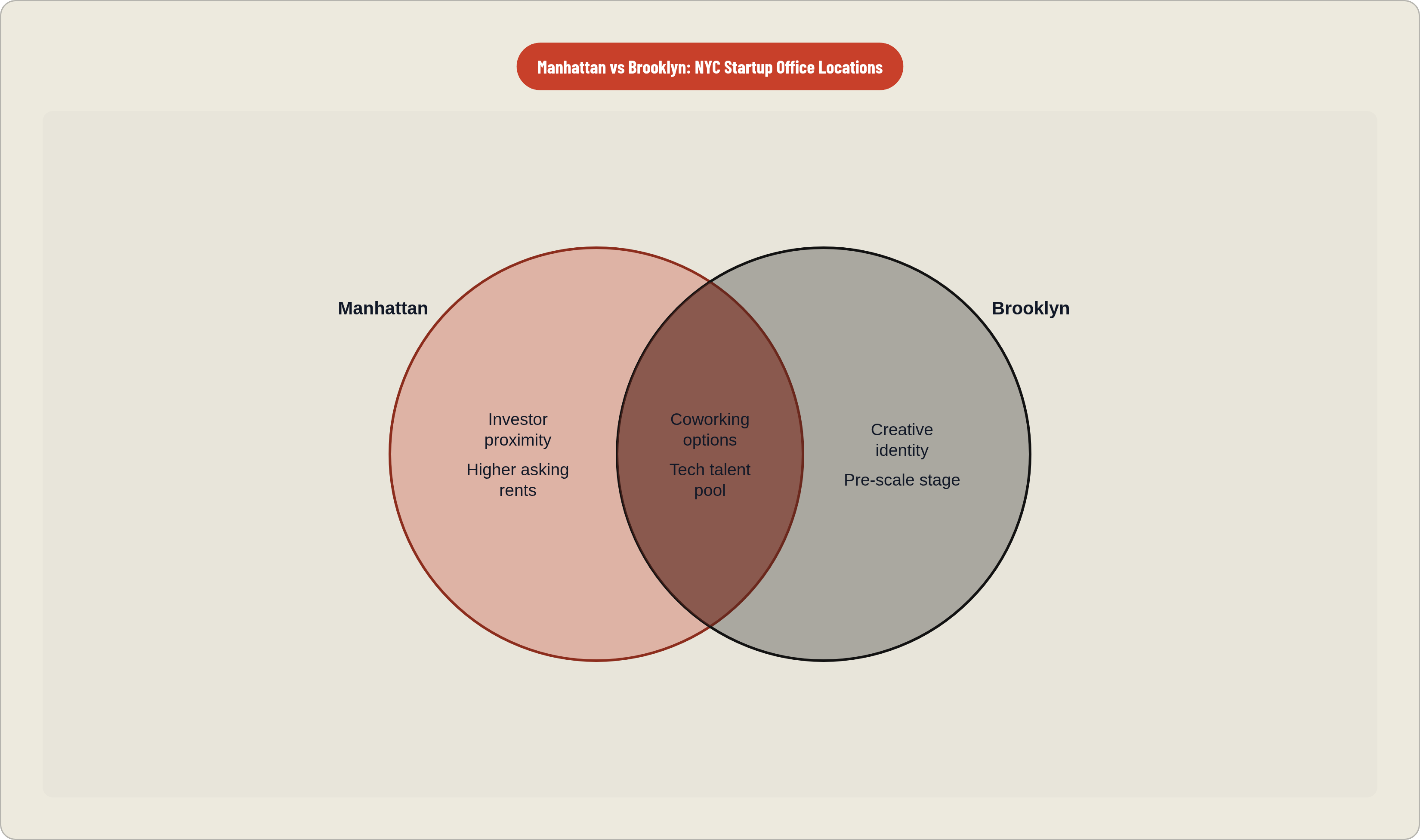
DUMBO has a specific character. Cobblestone streets, waterfront, a strong creative identity. It attracts consumer companies, design-forward teams, and early-stage startups that want a neighborhood identity without Manhattan asking rents. Many small AI startups are choosing Brooklyn specifically because they're pre-scale. They can't justify Midtown South rents yet. DUMBO absorbs a meaningful share of that cohort.
Williamsburg offers a different flavor. More residential-adjacent. Stronger creative and consumer culture. Options like the Mindspace location at 25 Kent Avenue, a waterfront building with a rooftop and real amenities, are built for teams that want polished infrastructure without a direct lease commitment.
The Brooklyn-to-Manhattan migration pattern is real and well-documented. AI company Altana signed a lease for 62,000 square feet in Midtown, tripling its previous Williamsburg footprint. The inflection point is usually a funding event that demands proximity to investors and a larger talent pool. Brooklyn works until it doesn't, and the signal that it's stopped working is usually obvious in hindsight — like realizing you've outgrown a city you used to love: nothing went wrong, you just got bigger than the space allowed.
Brooklyn is the right answer for a specific stage and a specific type of company. The question is whether you're still at that stage. And the answer lives in your cap table, not your headcount.
What the real estate mechanics actually look like for startups in 2024
The pandemic-era leverage that tenants had is mostly gone. Manhattan office vacancy hit record highs at its worst but has been falling, sitting at its lowest point since early 2022 per Cushman and Wakefield's Q4 2025 report. Sublease inventory shrank sharply as demand surged. The window where you walk in and negotiate aggressively from a position of strength has closed.
A few mechanics that founders consistently underestimate:
Sublease vs. direct lease. Sublease rents typically run well below direct lease asking rents for comparable space. The main benefit is avoiding expensive buildouts on space that's already configured. NYC fit-out costs exceeded $200 per square foot in 2024, among the highest in the country. Tenant improvement allowances generally don't cover that gap, which means founders are often writing a check that never made it into their post-raise budget. Build it in.
Security deposits. Landlords typically require three to twelve months of rent as a security deposit for companies without established profit records. If you haven't modeled that into your post-raise cash position, it will become a problem at the worst possible moment.
Coworking as a bridge. Manhattan memberships average several hundred dollars per month per person, with Brooklyn running slightly lower. Coworking works for pre-lease teams. It breaks down for companies that need culture-building space and predictable headcount capacity. It's a bridge, not a home.
Use a specialist broker. A tenant broker who works specifically with startups routinely secures better TI allowances, free-rent periods, and exit clauses than a founder negotiating alone. The costliest early-stage real estate mistakes are consistent: over-committing on space, ignoring buildout costs, skipping flexibility clauses. A good broker has seen all three and knows how to push back. The fee is worth it.
How to use this map when you're actually making the decision
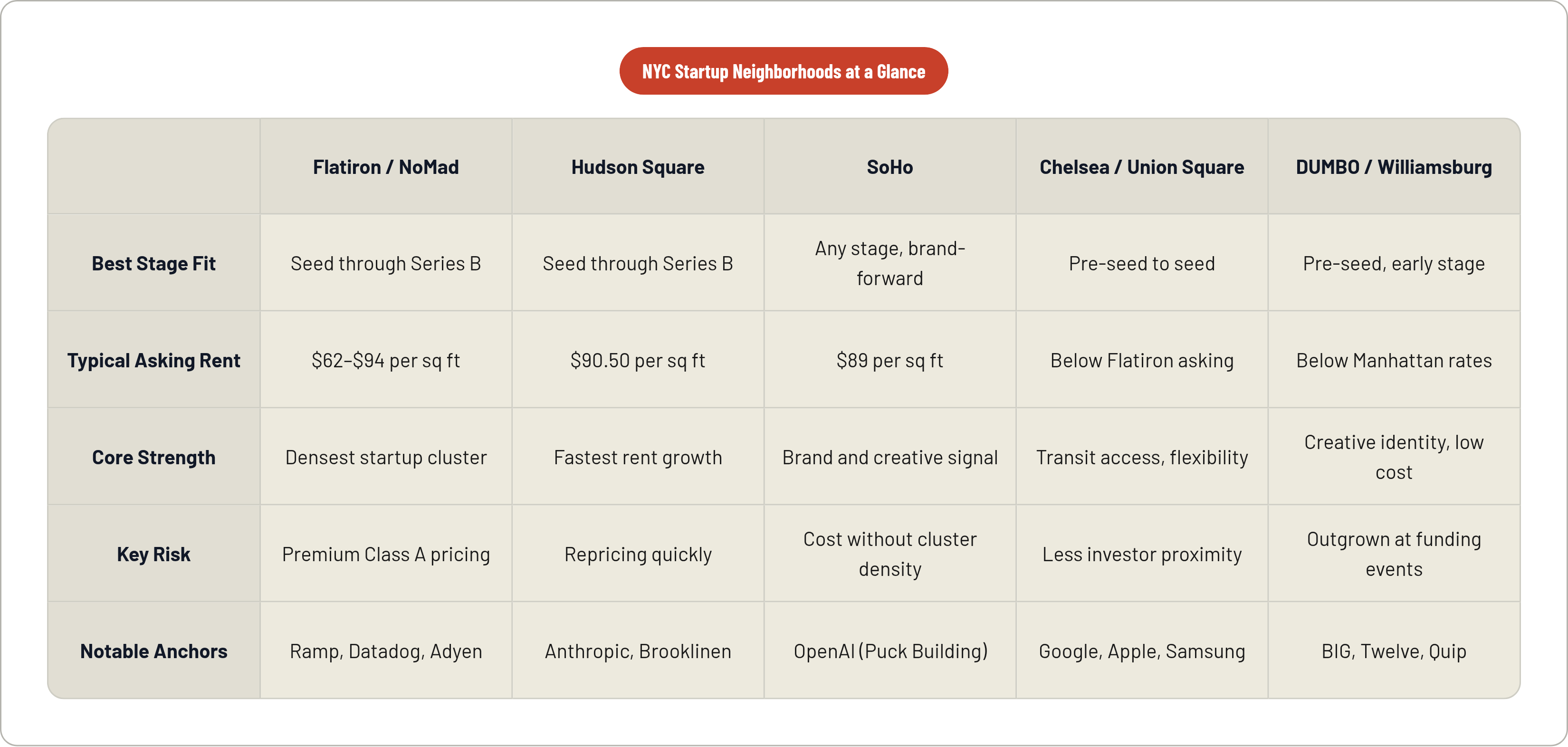
The right neighborhood comes down to four things:
- Cost relative to runway
- Talent density for your specific hiring profile
- Proximity to the investors and peers you need access to
- The culture signal your office sends to candidates and customers
A rough guide by stage:
- Pre-seed or early seed: Coworking in Union Square, Chelsea, or DUMBO. Preserve cash. Stay mobile. Stay in the corridor.
- Post-seed, building a team: Flatiron or NoMad Class B, or Hudson Square. Pay for proximity to the cluster. Negotiate hard on TI and flexibility clauses.
- Series A or B, scaling: Consider the full Midtown South band. This is when being physically inside the cluster starts paying dividends you can actually measure, in candidates who already wanted to work near here and investors who see you on their walk to lunch.
- Consumer, brand-forward, or design-centric: SoHo is worth the premium if the address reinforces your hiring and your brand. If it doesn't, it's just rent.
- Staying in Brooklyn: Legitimate if your talent pool is there and your investors aren't expecting a Midtown address. Set a reassessment trigger tied to your next funding round so the question comes up before it becomes urgent.
This map is not static. Hudson Square repriced 17% in three years. Anthropic's 500,000 square foot commitment at 330 Hudson will shift that submarket's gravity further. Treat this as a snapshot, not a fixed picture.
Where your peers are building is worth knowing. Not to follow them blindly, but because clusters are self-reinforcing in ways that accumulate quietly and then matter enormously, and communities like NYC Founders Club, a private dinner club for active NYC startup founders that hosts small weekly chef's-table gatherings across the city, exist precisely because knowing who's in the cluster, and getting a warm introduction to them, is itself a form of real estate. The talent concentrates. The introductions happen. The informal information that compounds over time all pools in the same few blocks. New York's startup geography is moving faster right now than it has in years, and keeping track of it is not wasted attention.