Restaurants and Venues NYC Founders Use for Informal Investor Meetings
Where you meet investors in NYC signals who you are and what you're building.

Most ecosystems have a campus. A corporate park. One zip code where everyone ends up by default. New York doesn't work that way. The city is the infrastructure, which means navigating it well is an actual skill — and in New York, if you don't know where you're going, you're already lost.
The center of gravity for NYC's tech scene runs through a corridor: Flatiron, NoMad, and SoHo. This isn't random. The dot-com era planted roots in Flatiron and Union Square in the nineties, when the neighborhood earned the nickname "Silicon Alley." The firms that survived stayed. Union Square Ventures, AlleyCorp. Newer players, including Thrive Capital and various New York outposts of larger coastal firms, landed in SoHo. The density is real and it concentrates fast.
What that means practically: suggesting a spot near where an investor already eats lunch says "I know where you are." It removes friction. And it signals something harder to fake, which is that you understand how this city actually works.
SoHo in particular has shifted post-pandemic into a primary hub for tech. The office stock runs smaller, more intimate. Nothing about it feels corporate. A meeting in SoHo lands differently than a meeting in Midtown, and founders who've spent time here know that difference without needing it explained.
Brooklyn is its own thing entirely. Williamsburg, Greenpoint, and DUMBO have become home to a real cluster of consumer, lifestyle, and creative tech founders. Choosing a Brooklyn venue isn't a compromise or a logistical accident. It's a statement about your market, your team, and who you're building for. If you're making something for a culturally specific, taste-driven audience and you bring an investor to Greenpoint to show them that world, you're demonstrating something a slide deck can't.
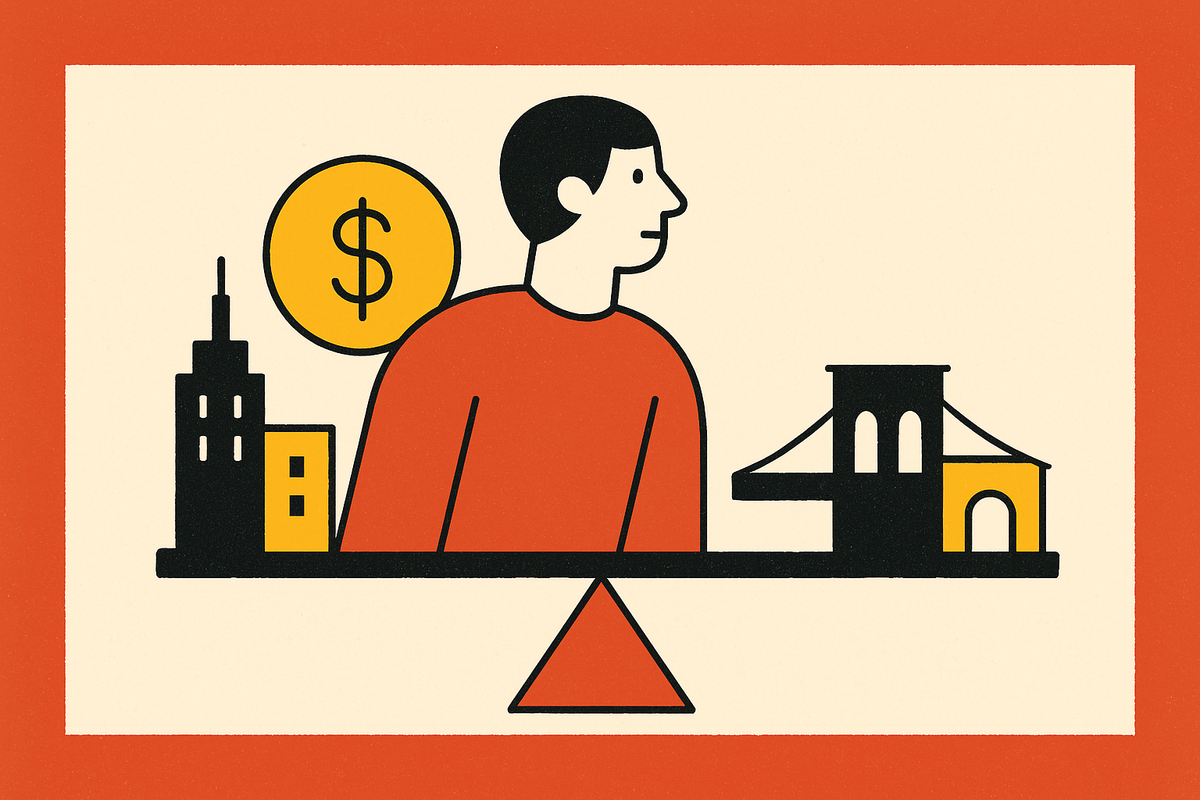
Geography is not neutral. A fintech founder meeting a Wall Street-adjacent investor near FiDi is a coherent move. An AI builder meeting in SoHo makes sense. The same fintech founder suggesting a Williamsburg cocktail bar is a mismatch — like showing up to a black-tie dinner in a hoodie. And mismatches read as off, even when nobody says it out loud.
The Logic Behind the Dinner Format — and Why It Dominates
The informal dinner is often where the real evaluation happens. Not the formal pitch. Not the partner meeting. The dinner.
A thirty-minute deck review tells an investor what you built and what you're asking for. Two or three hours across a dinner table tells them who you are. Those are different data sets, and investors know it.
A few things happen over dinner that don't happen in a pitch:
- Shared food changes the posture of both sides. It's harder to stay purely evaluative when you're passing bread.
- A curated room, a small group where everyone was personally invited, means everyone present has been vouched for. Trust moves faster.
- The conversation can go anywhere. Tangents are allowed. That's when you actually learn things.
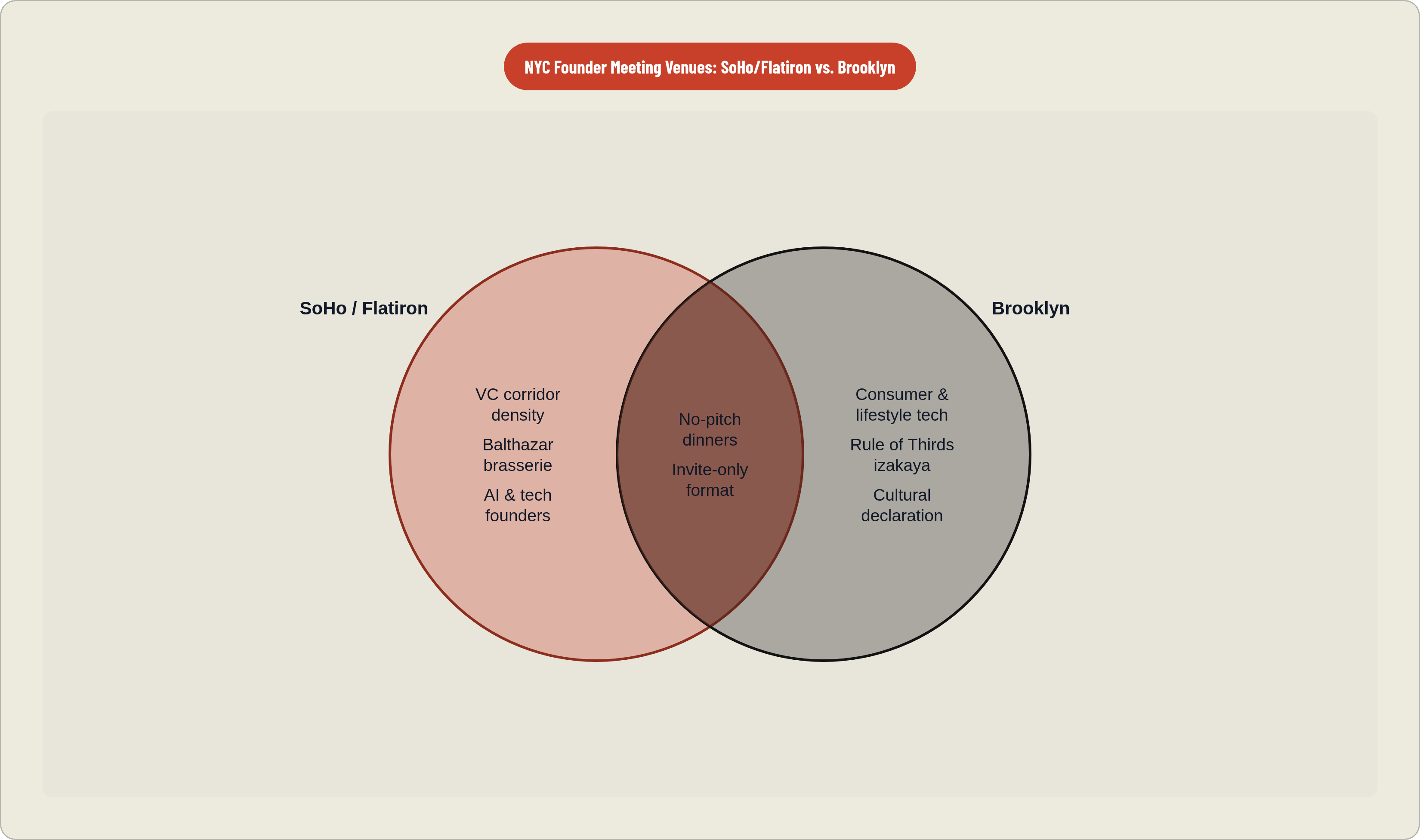
During NY Tech Week 2025, event after event used language like "real talk, no pitches" or "candid conversation, no panels." That phrasing isn't accidental. Explicitly removing the pitch as the organizing frame paradoxically makes a transaction more likely to follow, not less, because it removes the defensive crouch that a formal pitch activates in both sides.
Omakase dinners are the premium expression of this logic. Fixed menu, no choices, everyone eating the same thing. There's no negotiating, which means there's one less thing separating people at the table. The format enforces a shared experience in a way that a la carte never quite does.
The breakfast variant is worth noting too. Invite-only morning gatherings, "just real talk over bagels," compress the same dynamic into a shorter window. They signal operational peers connecting, not a founder chasing a check.
And what actually gets decided over these meals? Follow-on introductions. Co-investor conversations. Informal references. The downstream value of a relationship, not just the immediate transaction.
Specific Venues NYC Founders Actually Use and What Each One Signals
Balthazar (SoHo, Spring Street)
Keith McNally's French brasserie has been open since 1997 and is about as legible a power room as New York has. It's loud, energetic, and not intimate by design. But the private booths and the ambient noise create real conversational cover. It sits in the heart of the SoHo VC corridor, which makes it geographically logical for anyone already working nearby.
Who it works for: a consumer or media-adjacent founder meeting a generalist investor. Who it doesn't work for: a highly specialized AI founder who wants to signal deep technical focus. Balthazar in that context might read as trying to be something you're not.
Fraunces Tavern (Lower Manhattan, FiDi)
The oldest bar and restaurant in New York City. The historical weight is not subtle, and that's the point.
During NY Tech Week 2025, Jonathan Bush used Fraunces Tavern for a "real talk, no pitches" cocktail format. Candid company-building conversation in a room that's been standing since the 1700s. What a tavern does is flatten hierarchy in a way that's hard to replicate in a sleek modern restaurant. Nobody is at the head of the table. For a founder who wants to sidestep the power asymmetry of a pitch, this is a smart move. For fintech founders whose investors have Wall Street connections, the FiDi location is an obvious pull.
Rule of Thirds (Greenpoint, Brooklyn)
An NYC izakaya with private events capacity for large groups, which is genuinely rare for Brooklyn. The Greenpoint location is the whole point. Choosing it is a geographic declaration.
The signal: consumer, creative tech, or culturally driven founder who builds in Brooklyn and wants you to know it. Coming to Greenpoint asks the investor to enter the founder's world, literally and symbolically. For an early-stage founder whose community and customer base are concentrated there, this move reads as authentic rather than performed.
Rooftop Venues
A recurring format during NY Tech Week and beyond. Penthouse rooftops, skyline-as-backdrop, cocktails for B2B founders and operators. The vibe is aspirational and the city itself becomes part of the atmosphere.
The real limitation: ambient noise and movement kill conversation depth. Rooftops are better for warm introductions and broad relationship-building than for anything requiring sustained, focused exchange. Know what you're using it for.
VC Office Socials
Relaxed socials inside VC firm offices, coffee and light bites, no formal agenda. When a founder co-hosts in a VC space, it signals an existing relationship with that firm. When they're there as a guest, it means they're already in the room.
Worth noting the dynamic shift: the investor's office is the investor's territory. That changes things compared to a neutral restaurant. The home-field advantage inverts. Sometimes that's useful. Sometimes it isn't.
Game-Based Venues (Electric Shuffle, Shuffleboard Bars)
EisnerAmper and Reitler used game-based venues during Tech Week. The format deliberately reduces status anxiety. When everyone is playing shuffleboard, hierarchy is harder to enforce. It works well for mixing senior and junior people in the same room without the pecking order becoming the whole story.
Union Square Pub and Bar Roundtables
Founder drinks roundtables near Union Square. No presentations, no pitches, no approval process. Open and accessible.
The upside is easy entry into the ecosystem. The limitation is that the room is wide, not curated, so relationship depth per interaction is shallower. Better for showing up than for moving a specific relationship forward.
The Alternative Formats Gaining Ground Alongside Restaurants
The dinner still dominates. But a cluster of alternatives have developed real traction. They all share the same underlying logic: physical co-presence, some element of shared experience, and the explicit removal of the pitch as the organizing frame.
Morning runs. Firms like Collab Fund have hosted group runs followed by coffee and breakfast. Everyone is sweaty. Nobody has a title on their chest. The candor that follows is a different flavor than what emerges over wine, and not a worse one.
Pickleball and padel. Hebbia AI hosted invite-only padel during Tech Week. The choice of sport-and-drinks over panels signals cultural identity as clearly as a venue does. There's also a useful performance element: a VC who sees how you compete under pressure has seen something a pitch deck can't show.
Poker nights. Tech investors and founders, various stakes, cocktails and appetizers. The format is explicitly about reading people, and both sides understand this. That shared meta-awareness — the fact that everyone knows what's happening — is oddly trust-producing. You could say poker nights are the one time in fundraising where showing your hand actually helps.
Barry's Bootcamp. A recurring Tech Week format. Shared physical effort as relationship-building, post-workout coffee as the real meeting. The endorphins do what alcohol used to. It appeals to founders who want to signal discipline and don't need the lubrication of a traditional dinner.
Contrast therapy. Sauna and ice bath, sometimes paired with a leadership discussion. Small but growing for senior founders. Shared physical discomfort is a fast route to real conversation. Hard to stay guarded when you're sitting in an ice bath together.
The Unwritten Rules Founders Follow When Choosing a Venue
There's no written playbook. But watch enough of these meetings happen and the logic becomes clear.
Match the neighborhood to the investor's geography, not just your own. A Williamsburg-based founder who suggests Balthazar for a SoHo investor is demonstrating range. The same founder suggesting a Greenpoint spot to that investor is asking them to come to their world. Both are valid moves. They are not the same move.
The room should fit the stage of the relationship.
- First coffee or drinks: low commitment, easy exit, somewhere near the investor's office
- First real dinner: enough ambient energy to carry a lull in conversation, but quiet enough to actually hear each other
- A small curated dinner: a private room or an omakase counter signals the relationship has moved from exploratory to intentional
Know who else eats there. A venue where the investor knows the maître d' shifts the power dynamic toward them. A venue where the founder is the known quantity shifts it the other way. Neither is wrong. Just know which one you're choosing.
The "no pitches" framing is a tool, not just a norm. Choosing a format that implicitly removes the pitch often makes an investor more receptive than a formal meeting would, because it removes the defensive posture a pitch activates. Use it deliberately.
Exclusivity of the room reflects exclusivity of the relationship. An invite-only dinner of six communicates something different to an investor than an open networking event of a hundred, even if the conversation quality is identical. Communities built around exactly that format, such as NYC Founders Club, a private chef's-table dinner community for active NYC startup founders, treat the scarcity of the seat as the point rather than a side effect. The scarcity of the seat is itself a signal about how seriously you take the relationship.
What to avoid. The venue that announces itself too loudly. A splashy Midtown steakhouse reads as trying too hard. The venue that's too obscure forces the investor to solve a logistics problem before the conversation has started. Both are friction you created.
Why NYC Specifically Produces This Kind of Venue Culture
In most tech ecosystems, the infrastructure is literal. A campus. An office park. A highway corridor where everything is walkable if you have a car. New York has none of that. So founders here learn to use the city itself: the restaurants, the neighborhoods, the rooms.
That also means proximity to media, finance, fashion, and hospitality at the highest level makes "the room" carry cultural weight in a way it simply doesn't somewhere built around conference centers. A founder in New York has genuinely better raw material to work with. And investors here expect them to know how to use it.
The density of the NYC ecosystem means informal meals and gatherings happen constantly, and that reputation travels fast. A bad venue choice, or one that signals social unawareness, circulates. So does a choice that shows genuine fluency. In a small, high-frequency community, these signals compound over time in ways that matter.
And underneath all of it is something most serious NYC founders actually believe: the relationships built across a physical table produce outcomes that remote interaction doesn't. Trust calibrated in person, over dinner, across months of informal meals — that's the slow drip that fills the reservoir. That's what makes a warm introduction actually warm. Not the email. Not the Slack message. The dinner that happened six months ago.