How NYC Founders Use Co-Investor Relationships to Close Rounds
NYC founders close rounds by stacking trusted co-investors, not chasing solo checks from strangers.

New York doesn't fund startups the way Silicon Valley does. Rounds here get built by groups of investors who already trust each other, rather than by a single fund writing a check and calling it done. Miss that difference and you'll spend months chasing a "yes" that was never going to come from a stranger.
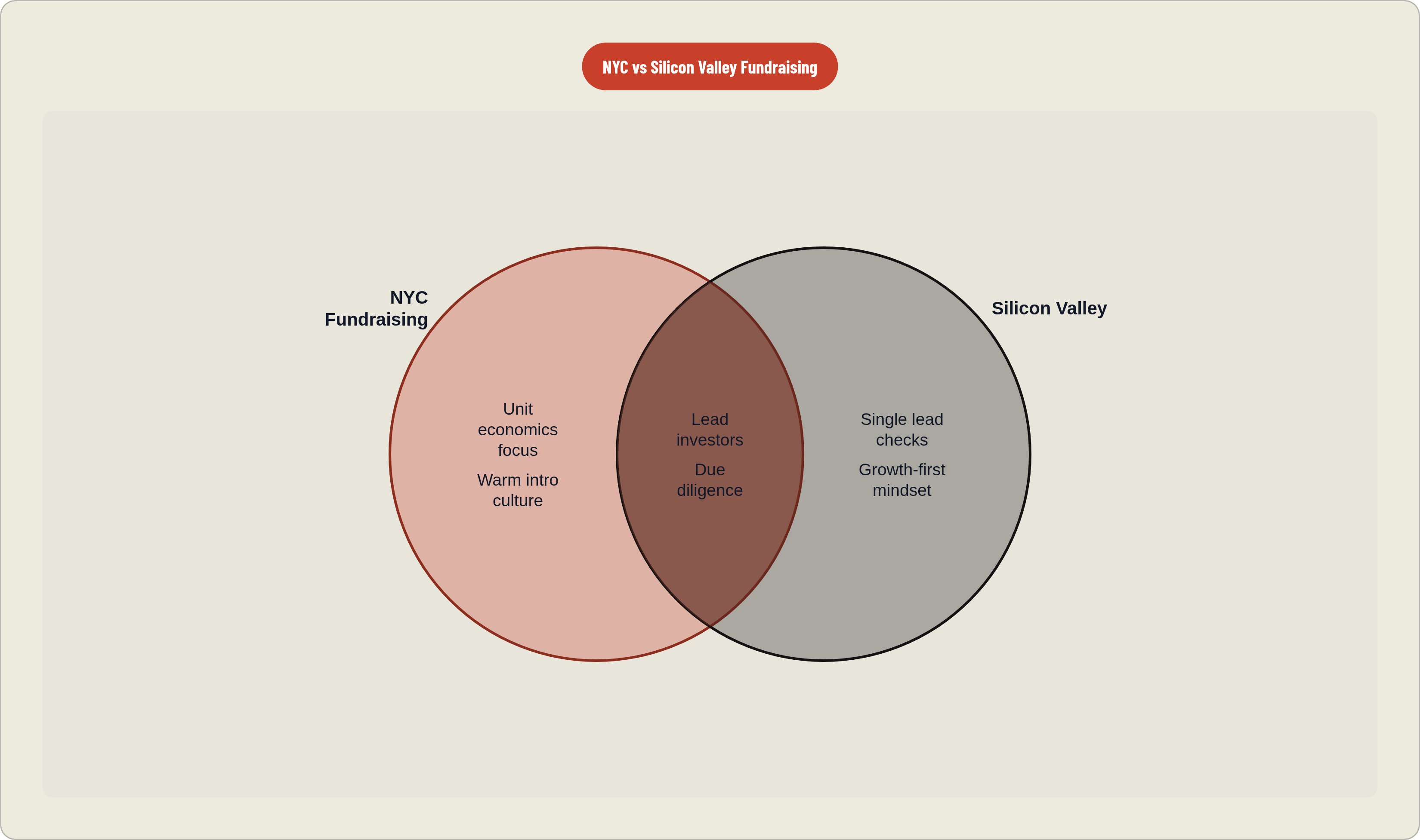
Start with the basics. NYC seed rounds routinely close with two or three checks instead of one, and Series A rounds pile on more names, not fewer. Part of that is math: a lot of active funds here write smaller checks than their West Coast counterparts, so you need more of them to fill the round. Part of it is culture. This city's whole financial DNA means investors ask about unit economics and capital efficiency earlier, and more insistently, than a market that's comfortable waiting for growth to explain itself later. Put both together and the lesson writes itself: you're building a slate, and each investor is there to prove a different point about the business. Miss that, and the whole game plays out differently than you expected.
What co-investor relationships actually are and why they move faster than cold capital
Two logos on a cap table don't make a relationship. A real co-investor relationship is trust with money attached, between people who've vouched for the same company before and have their names tied to how it turns out.
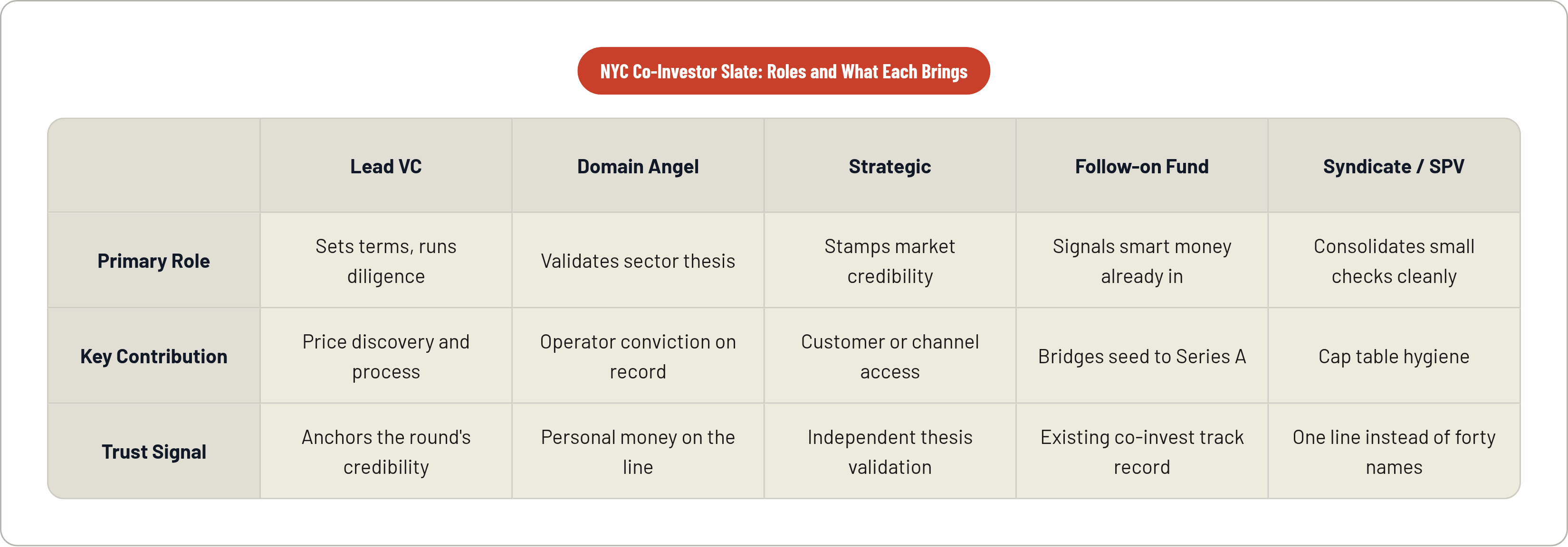
You'll run into the same handful of characters every time. The lead sets terms and runs diligence. Follow-on funds write smaller checks because they trust the lead's read on things. Operator angels show up with domain credibility riding shotgun on their capital. Syndicates bundle a pile of small checks into one clean line on the cap table so nobody has to manage forty relationships. Strategics, meanwhile, lend their name as a stamp that the business thesis holds water.
Warm beats cold for one boring reason: investors who've worked together before skip the getting-to-know-you phase entirely. They've already calibrated each other's judgment on past deals. Nobody needs to relitigate whether the other person's opinion is worth listening to.
The warm intro is what holds the whole thing together. An intro from a current investor carries more weight than one from a friendly contact who has nothing riding on the outcome, because the investor's own money and name are attached to whatever happens next. And the strongest signal in the whole ecosystem fits in one sentence: an existing investor saying "I'm putting more in, you should join." That single line turns the conversation from evaluation into confirmation, because most follow-on investors are really just deciding whether to trust someone who already made the call.
How the warm introduction engine actually works in New York
Cold outreach into NYC funds is close to a dead end, and I mean that literally. Most VCs here can fill every meeting on their calendar with warm referrals alone. A cold email doesn't compete with a handful of other cold emails; it competes with zero.
There's a rough pecking order to how much weight an intro carries. At the top, an existing investor putting in more money themselves, which basically pre-sells the seat before you've even opened your mouth. Next, a portfolio founder from the same fund, because the shared history with that fund gives the referral real context. Below that, an angel or advisor who can speak directly to the company's potential. At the bottom but still worth having, a professional contact with nothing invested.
Monthly investor updates are the most underused tool in the whole kit, and it's not close. Add a short "current asks" line, name the specific funds or investor types you're chasing, and every backer you have becomes a standing introduction machine without you ever having to ask twice. Most founders skip this, then wonder why the phone goes quiet between raises.
New York's endless supply of dinners, demo nights, and founder meetups matters more than people give it credit for. Introductions happen there before a raise is even public, which is exactly when they carry the most weight. Nobody's negotiating. Nobody's performing. It's just two people talking about a company one of them actually believes in. Timing matters just as much: ask for introductions well before you need to close and the process reads as momentum. Wait until you're three weeks from running out of runway, and it reads as distress, no matter how good the business actually is.
There's a nice little loop hiding underneath all of this, too. Angels who backed the seed often come back for the Series A, and by doing that they turn into introduction machines pointed at institutional networks where they now carry real weight. The early check buys more than equity. It buys a permanent advocate who keeps showing up.
Round design as a deliberate act, not a sequence of pitches
Founders keep making the same mistake: pitch institutional VCs first, then angels once the VCs go cold, then family offices once the angels stall too. Each group smells the hesitation of the one before it. Nobody wants to be the only fish in an empty pool.
Run parallel tracks instead. Different investor types move on different clocks anyway, so working them all at once builds optionality. Sequencing just leaks momentum, one rejection at a time.
Deliberate slate design means you assign roles before the first meeting, not after the round has already taken shape by accident:
- One lead to set price and run diligence
- One domain expert whose name backs up the sector thesis
- One strategic whose network opens a specific customer or channel
- One follow-on fund whose participation signals to the next round that smart money already said yes
Cap table hygiene matters more than most founders realize until it's too late. Series A investors read your cap table like a report card on how well you understood what you were doing at the earlier stage. Too many individual names creates governance headaches and awkward questions about who controls pro-rata and information rights down the line. The standard fix is folding angels and small checks into an SPV: cleaner entry, same network value, none of the mess later.
Empathy's Series C is worth pointing to here, as a template. Institutional VCs, global funds, and several insurance-industry strategics all sat in the same round, each one validating a different piece of the business for whoever looks at that cap table next.
The investors who anchor NYC co-investor slates and what they each contribute
Some names show up again and again on NYC term sheets. Each one does a specific job beyond simply cashing a check.
BoxGroup is the classic first-check seed investor: fast decisions, early conviction, and a fintech and marketplace track record that actually means something to whoever writes the next check. Primary Venture Partners plays a similar role but leans hyper-local; the fund knows the city's founder networks from the inside, so its introductions come with real context, not just a name and a LinkedIn link.
AlleyCorp is its own animal. It builds companies internally with recruited operators, so co-investor trust already exists on day one instead of getting stitched together mid-raise under time pressure.
At Series A and B, Differential Ventures, led by Nick Adams, gets named over and over for active follow-on introductions and genuinely hands-on board work. It's the kind of fund that keeps working the flywheel long after the check clears, instead of disappearing into the cap table.
Syndicate leads matter too. They let founders bring in a pile of smaller investors through one SPV line instead of forty separate entries. Angel groups add another layer. New York Angels is one of the most active groups in the country, doing diligence collectively and often following on into later rounds, which bridges seed money into institutional territory. HBS Alumni Angels of Greater New York taps a deep bench of operator-executives and shows up again at follow-on more often than not, which makes the group useful well past the first check.
Then there are the strategics, corporates and industry funds that show up as validators, not return chasers. Their real value is simple: future investors read their presence as an independent stamp on the market thesis, which saves everyone downstream a pile of diligence work.
Operator angels and why their introductions carry a different kind of weight
Operator angels bring more than another line item of capital. They change how institutional investors read the entire round, full stop.
Here's the logic. A former founder or operator writing a personal check has already run their own diligence with their own money and their own name on the line, and that kind of conviction reads differently than a fund checking boxes on a process. New York's thick layer of exits means there's no shortage of these people, either. Assaf Rappaport of Wiz and Olivier Pomel of Datadog sit in the enterprise and infrastructure tier; their presence in a round speaks to technical chops and go-to-market credibility, not just a nice logo for the deck. Joanne Wilson (Gotham Gal) has backed a huge number of companies over many years and is known specifically for sticking around across rounds, so her introductions come with continuity baked in, not a one-time favor she'll forget by next quarter.
The practical upshot: an operator angel's introduction to a follow-on fund carries someone's personal judgment, and institutional investors weight that heavily at the early stage, when the metrics are still too thin to tell the whole story on their own.
You don't get these introductions through cold email. You get them through dinners, peer groups, casual events where nobody's pitching anything to anybody. Showing up to that stuff consistently is its own fundraising strategy, whether it feels like one at the time or not.
How lead-follow trust shapes what founders can negotiate
When a lead and a follow-on fund have co-invested before, diligence gets shorter, plain and simple. Old deals become shared reference points, and those substitute for weeks of calls nobody actually wants on their calendar.
That compression is leverage, and founders who get this manage it on purpose. A known, trusted slate makes the round credible before it even closes, so the question in the room stops being "will this happen?" and becomes "can I still get in?" A follow-on investor publicly committing before the round fills up creates real FOMO among everyone else still on the fence.
Terms move with trust too. Leads who've co-invested successfully with a follow-on fund before are less likely to push terms that fund would find ugly. The relationship keeps both sides honest, because nobody wants to burn a partner they'll need again next round.
It cuts the other way just as fast. A cap table with investors known for being difficult or unreliable at follow-on gets flagged by Series A investors as a red flag, and it gets read as a whole, not name by name. One bad actor drags the rest of the list down with it.
There's a geographic wrinkle worth mentioning. NYC-anchored seed investors who've co-invested before with West Coast growth funds build a bridge that helps local companies pull institutional Series A and B money from funds that don't usually source out of New York. Rogo's round is a decent example of the mechanism: BoxGroup anchored the seed, and the final cap table included larger outside funds such as Khosla Ventures, Thrive Capital, and Tiger Global alongside it.
What founders who close rounds here do differently in practice
The founders who close efficiently start the relationship long before they start the raise. Investors who've watched a founder's thinking sharpen over six or twelve months walk into the actual pitch already sold on judgment and character. The meeting becomes a formality more than a test.
Monthly updates to angels and advisors between raises do more work here than almost anything else on this list, and most founders skip them entirely. They keep the network warm without turning every single touchpoint into an ask.
Before launching a process, the sharpest founders map the co-investor architecture first: who fills which role, in what order, before a single meeting gets booked. They treat existing investors as active introduction engines rather than passive references, naming specific funds and asking directly, folded into a regular update instead of a separate, awkward request. They run parallel tracks across investor types from day one, because pitching sequentially just broadcasts uncertainty and lets each group watch the last one flinch.
Cap table composition gets treated as a signal, not paperwork to clean up later. Small investors get consolidated into SPVs, pro-rata gets preserved for the follow-on investors who earned it, and names carrying baggage get dealt with before they turn into liabilities at the next round.
None of this happens by accident. It happens because founders invest in the community infrastructure that makes operator angel introductions possible in the first place: the dinners, the peer groups, the events with no agenda attached. In a market this dense, the room you're standing in matters almost as much as the deck in your hand.