What a Mastermind Group Actually Does for Founders
Peers who remember what you promised and ask if you did it.

A mastermind group is a small, recurring circle of founders who meet on a set schedule to pressure-test each other's decisions and hold each other to what they said they'd do. That's the whole mechanism. No mystique required, despite what the self-help shelf at your local bookstore might suggest.
What a mastermind group is and its origins
Napoleon Hill gets credit for naming this thing, first in 1925's The Law of Success, then again in 1937's Think and Grow Rich. Nearly a century later, the format still runs on the same basic machinery he described: a group of people, meeting regularly, thinking through problems together.
Strip away the branding and you get something almost boring in its simplicity. Six to twelve people. A recurring meeting. A habit of checking in on commitments made last time. Six to twelve people, a recurring meeting, and a habit of checking in on commitments made last time are the technology. That's the technology.
What actually matters here is the peer part. Not a teacher lecturing from the front of the room. Not a mentor who's twenty years further down the road, dispensing wisdom from the mountaintop. A room of people at roughly your altitude, who remember what you said you'd do and will ask about it.
This is separate from things it gets lumped in with. Coaching is one expert guiding one client, a vertical relationship. Mentoring is similar: someone further along, giving you the benefit of hindsight they earned and you haven't. A conference or a one-off call ends when the calendar invite ends, and nobody follows up on what you decided to do afterward. Generic networking has no fixed cadence, no witnessed commitments, no loop that closes. A mastermind has all four of those things a networking event doesn't: fixed people, fixed schedule, spoken commitments, and someone checking in on them.
The founder problem a mastermind is built to solve
Founders make the hardest calls alone, and nobody puts that on the pitch deck. Pricing changes. Who to hire, who to let go. Margin pressure that means something has to stop. There's no formal board for most early-stage companies, no peer who fully understands the context, and often no safe place to just say "I don't know" out loud.
The people standing closest to any given problem all have skin in the outcome. A co-founder buried in product work sees the decision through that lens and no other. Investors want momentum and will read almost any update through that filter. A team wants clarity, understandably, which means they're not always the best audience for a founder's uncertainty. Everybody's take reflects a different, partial vantage point. Nobody's take is complete.
This isn't a shortage of advice, either. If anything, founders drown in it. Podcasts, social media threads, that one friend from business school who always has an opinion. The problem is that all of this advice comes from people with partial views and their own stakes in the game.
A mastermind fills a specific gap in that picture: recurring peers who actually understand the constraints a founder is operating under, and who have no reason to flatter the founder sitting in the hot seat. That combination, context plus disinterest, is rarer than it should be.
Accountability in a recurring group versus advice you get once
Advice without follow-up is basically entertainment. A founder hears something smart, nods along, feels briefly enlightened, and goes back to doing what they were doing the week before. Nothing wrong with that as an experience. It just doesn't change anything.
Accountability changes things because it closes the loop. A member says out loud, in front of the group, what they're going to do. The group hears it, remembers it. The next session opens with the same question every time: what did the member actually do since the group last met? That single recurring question does more behavioral work than most business books combined.
Most founder bottlenecks aren't knowledge gaps anyway. Founders usually know what needs to happen. The problem is delay, avoidance, or attention scattered across nine fires at once. Structure beats inspiration here, every time.
The "hot seat" format is where this gets teeth. One member brings a live problem to the group; everyone digs in, asks questions, pushes back. Then it rotates, and someone else takes the seat next time. Everyone gives as much as they take. That reciprocity is what keeps the room from feeling like a favor and makes it feel like an obligation, in the good sense of that word.
Honest feedback depends on the room being safe and the cohort being right
A group can't help with a problem it never actually sees. Sounds obvious, but it's the single most common failure mode: a room full of founders performing success at each other, protecting their image instead of naming what's actually broken. Everyone leaves feeling good and nothing gets solved.
There's a subtler trap, too. A founder walks in already leaning toward a decision, and uses the group to get reassurance instead of a challenge, steering the conversation until it agrees with them. That founder gets nothing the format was built to deliver. Might as well have stayed home and asked a mirror.
Three ways this breaks down tend to recur. Mismatched cohorts, where a bootstrapped founder, a VC-backed founder, and an agency consultant sit in the same room with such different constraints that the advice never lands where it needs to. Rooms with no real safety, where image management wins out over honesty. And reassurance-seeking, where the group becomes a mirror instead of a challenge.
Confidentiality isn't a nice-to-have bolted onto the format. Confidentiality makes honesty possible. One founder, quoted in research on the subject, described a circle where members could share personal insecurity right alongside business uncertainty, precisely because what got said in the room stayed in the room. Take that away and you get a group of people being carefully, politely useless to each other.
What peer support does for resilience over time
The loneliness of running a company isn't just uncomfortable, it's a durability problem. Founders who carry every hard call by themselves burn out faster than the ones who don't. That's not a soft claim; it appears in how long people last in the seat.
Founder research from five years ago found that 92% of founders named resilience the single most important trait for success. More recent research, from 2024, looked at what actually builds that resilience and found the highest-performing founders take deliberate steps to protect it, with peer-to-peer support and one-to-one coaching both landing at the top of the list. Resilience, in other words, is a maintenance habit, not a personality trait some founders are born with. It's a maintenance habit.
One founder captured this well in research on the topic, describing a circle that let them share "anything," and get reinforcement on personal difficulty and insecurity right alongside actual business steps. The emotional and the strategic are the same conversation in a room like that. They're the same conversation.
Imposter syndrome doesn't care how experienced someone is, either. First-time founders and CEOs with decades of scar tissue behind them both experience it. Sitting in a room of people who recognize that feeling, who've been on both sides of success and failure, changes a founder's relationship to their own self-doubt. Doesn't erase it. Just makes it smaller and easier to carry.
Warm Introductions From a Tight Peer Group
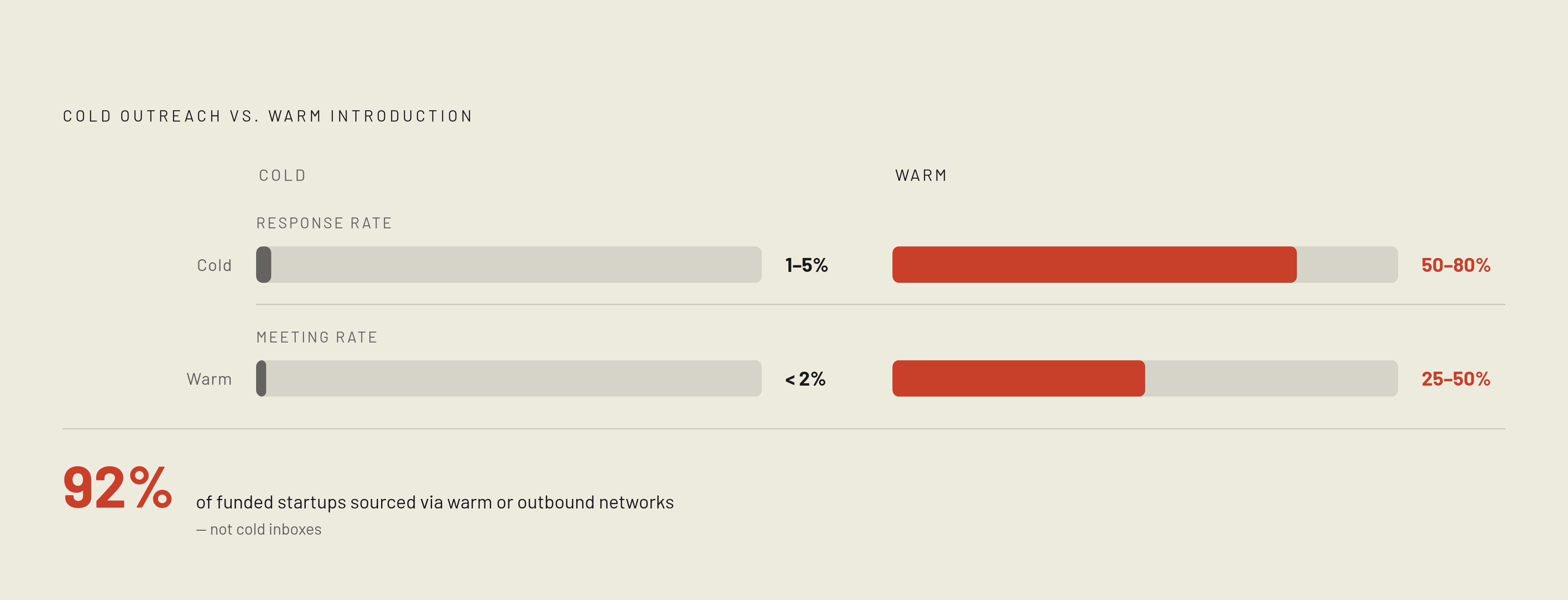
Warm introductions convert at 8 to 15%. Cold outreach converts at 3 to 5%. Break it down further and cold outreach gets a response rate of just 1 to 5%, with very few turning into an actual meeting. Warm intros land a response rate of 50 to 80%, with 25 to 50% turning into a meeting.
The pipeline math backs this up at scale. Roughly 40% of initial pitch decks arrive through warm channels. By the time a deal reaches an investment committee, 80% of the warm introductions in the room are still advancing. Add it up and 92% of funded startups came through warm or outbound networks, not a cold inbox.
Why the gap? A warm intro from someone who genuinely knows both sides carries trust a cold message simply cannot fake. The investor or the hiring manager on the other end isn't reading a pitch from a stranger. They're getting a vouch from someone already inside their circle of trust, which is a completely different transaction than a LinkedIn message that starts with "Hope this finds you well."
Four established formats and what each one buys you
None of these formats is objectively "the best." Each one buys a founder something different: a level of structure, a bar for entry, a specific culture. The right question isn't which one wins, it's which one matches the constraints a given founder is actually working under.
Vistage is the largest CEO peer advisory and executive coaching network around, with roughly 45,000 members across more than 40 countries. It's also the most formal of the bunch: groups run by professional facilitators, called Chairs, many of them former CEOs themselves. Meetings run on an agenda, members are expected to show up prepared, and the format includes monthly one-on-one executive coaching on top of the group sessions. As of January 2026, the initiation fee runs around $2,500, plus monthly fees of $1,380 for CEO-level members. Vistage suits a founder who wants discipline and measurable structure, with an experienced outside facilitator steering the room rather than pure peer-to-peer chemistry.
YPO, the Young Presidents' Organization, dates back to 1950 and now counts more than 36,000 members across 142 countries and 450 chapters. It runs on a forum model with strict confidentiality, and unsolicited advice is off-limits. Members have to actually ask for input before the room gives it. Entry requires being a CEO, president, or managing partner who hit qualifying scale before turning 45, subject to chapter approval and an interview. Costs, as of mid-2026, run an initiation fee of $4,790 plus annual fees of $4,790. The age cap does something interesting to the conversations inside: they skew toward growth and transition, rather than the post-exit reflection you might find in a room with no age ceiling. Global reach at this price point is tough to match.
Two things stand out across both formats. Entry requirements do real work, filtering for founders operating at comparable scale so the advice in the room actually lands. And cost isn't incidental either; it's a filter of its own, screening for people serious enough to show up and pay attention.
How Building in New York Shapes Founder Peer Groups
New York's startup scene isn't background noise here, it's the actual substance of what a local peer group has access to. The city pulled in $31.1 billion in venture capital in 2025, up $6.2 billion from the year before, inside an ecosystem now valued at $621 billion and home to more than 7,000 startups.
Sector concentration is what makes a New York cohort genuinely different from a mastermind assembled over a video call from six time zones. Software and tech services made up 52.4% of NYC venture capital between 2020 and 2024. AI alone accounted for 35% of capital raised in the city in 2023. Fintech pulled in $6.71 billion in deal value in 2024, which is 30% of all domestic fintech investment landing in one city. Digital health raised $2.4 billion in the first half of 2025, up 10% year over year, and life sciences and biotech made up 27% of NYC venture funding over that same stretch.
The deal flow keeps moving, too. Brooklyn-based creative AI platform FLORA closed a $42 million Series A in January 2026. Earlier in 2025, a cluster of New York tech startups landed Series A rounds across a range of scales, among others.
What all that adds up to, for a founder sitting in a mastermind, is density. A peer in the room isn't a hypothetical case study pulled from a business school textbook. They're three subway stops away, running into the same investors, competing for the same senior engineers, watching the same sectors heat up in real time. That kind of proximity changes what "peer" means. The proximity turns the category into a person you might run into at the coffee shop on the corner.