Mastermind Groups for Women Founders in NYC
How peer accountability circles help women founders navigate New York's unequal funding landscape.

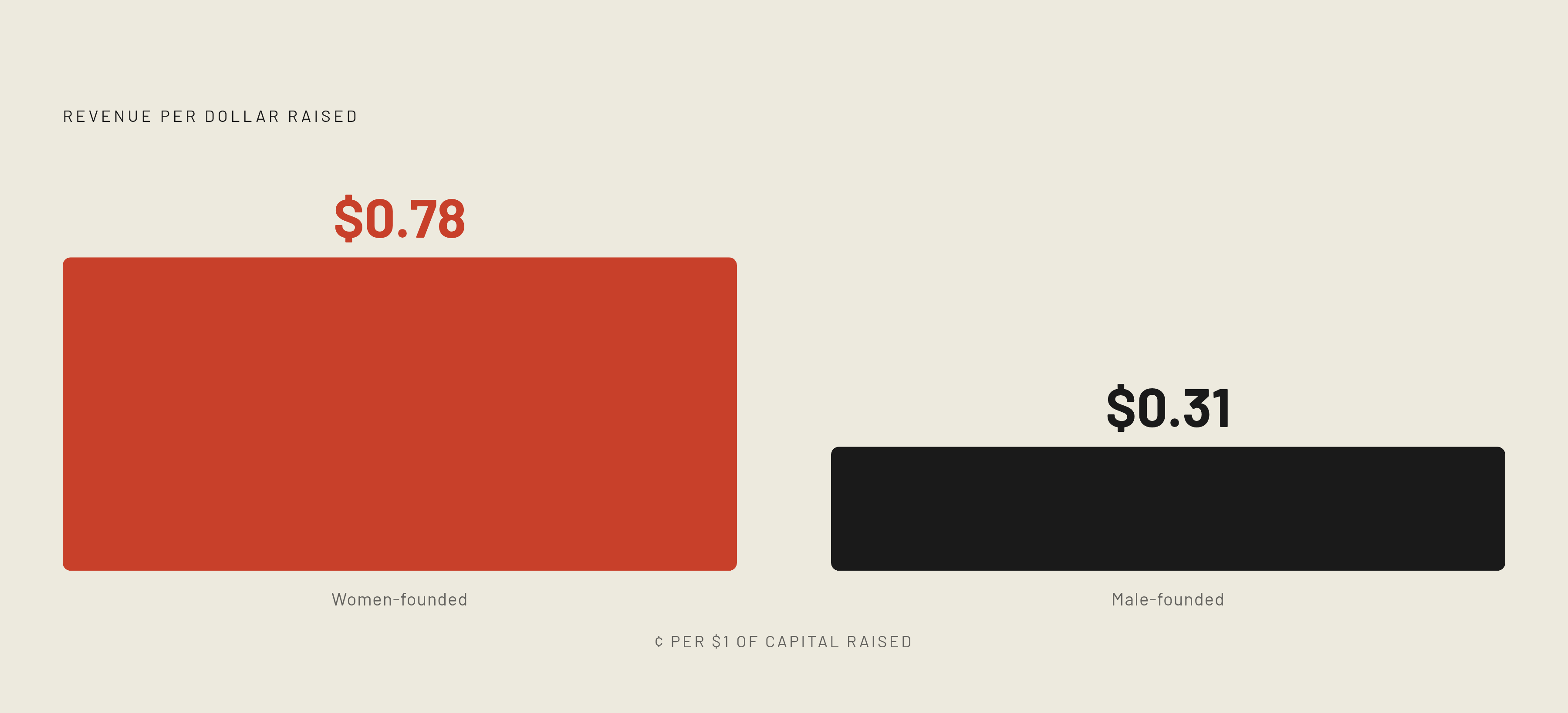
Women founders in New York raise roughly 1 to 2% of total venture capital nationwide. Meanwhile, women-founded companies generate 78 cents of revenue for every dollar raised, compared to 31 cents for male-founded companies. That gap has nothing to do with performance and everything to do with who gets a seat in which room. This piece is about one specific room: the mastermind group, and why it's become one of the sharpest tools a founder can use in a city that hands out plenty of opportunity and almost no patience.
Even the headline 2025 number, $73.6 billion raised across 3,219 deals for female-founded companies, more than a quarter of the national total, falls apart on a second look. Anthropic and Scale AI alone ate more than 40% of that pile. Stripping those two out makes the banner year get a lot quieter, a lot faster.
Why New York concentrates both the opportunity and the pressure for women building companies
New York is the second-largest tech and venture ecosystem on the planet, with more than 25,000 tech-enabled startups, 1,200 active VC firms, and a tech workforce that's cracked 360,000, up more than 30% over the last decade. That density cuts both ways. More capital in the room, more potential co-founders at the coffee shop, more investors within walking distance of each other. It also means more competition for every single one of those things, all the time, from everyone else who read the same headline you did.
The 2026 numbers look unstoppable on paper. NYC startups pulled in $8.88 billion across 233 deals in Q2 2026 alone, a 46% jump year over year and the strongest second quarter the city's venture scene has ever posted. Through August, the city had already blown past all of 2025's $19.01 billion total, with a third of the year still left on the clock.
A closer look changes the story. That 46% jump in capital came with only a 2% increase in deal count. Average deal size jumped 26%. The money is going to fewer, bigger deals, not spreading across the early-stage market where most women founders are actually building. A rising tide that only lifts the yachts isn't much of a tide if you're rowing.
Even so, New York is still the best imperfect place to be standing. The city ranked No. 2 nationally by deal count for female-founded companies in 2025, with 426 deals, and all-female-founded NYC companies raised $955 million across 143 deals in the 12 months ending June 2025, ahead of San Francisco on both counts. New York doesn't fix the funding gap; it just gives you better odds while you work around it. It just gives you better odds while you work around it.
What a mastermind group is, and what separates it from every adjacent thing
A mastermind group is a small, recurring circle of peers, usually six to twelve people, meeting on a fixed schedule to work through real decisions together. Not to network. Not to vent. To pressure-test choices, hold each other to commitments made out loud, and say the honest, occasionally unwelcome thing instead of the comfortable one.
The idea goes back to Napoleon Hill, who described it decades ago as a kind of collective brain trust. The mechanics haven't moved much since then. What's changed is who's in the room and what they're using it for.
Get precise about what a mastermind is not, because the word gets stretched to cover things it isn't. Coaching puts one expert at the front of the room, guiding everyone else; a mastermind has no front of the room, and everyone takes a turn in the hot seat. A conference or a one-off call ends the moment it ends, and nobody's checking back in three weeks to see what you committed to. Mentoring pairs someone further along with someone earlier in the climb, while a mastermind is a room of equals, roughly matched on the size and shape of their problems. A community or network is ambient: you opt in when it's convenient, and nothing happens if you vanish for a month. A mastermind has a cadence, and skipping it costs you something.
Four things make the format work. A matched cohort, people at a comparable stage wrestling with comparable problems. A fixed cadence, so the group meets whether anyone feels like it or not. The hot seat, where one member brings a live problem and the room actually digs in. And witnessed commitments: what you said you'd do gets written down, and somebody asks about it next time. Pulling out any one of those four quietly turns the whole thing into a nice lunch.
Why the peer room solves problems no other resource in a founder's orbit can solve
Founders run into a specific kind of isolation that leaves no trace on an org chart. The team wants clarity, so the founder can't think out loud in front of them. Investors want momentum, so admitting uncertainty in front of them is off the table too. Friends and family usually don't have the context to weigh in. What's left is a short list of people who can hear the real version of the problem and respond with something more useful than a nod.
A peer room fills exactly that gap, and sometimes the value is just someone telling you not to do the thing. Sometimes the value is simply a peer who's made a costly mistake telling you not to repeat it, before the paperwork is signed. Nobody throws a parade for advice that stops a disaster before it starts. It just quietly doesn't happen, which is the entire point of having someone in the room who's already been burned.
The warm introduction is the other underrated mechanic. A Hampton member posted about a VP of Sales search and had three warm introductions by the end of the day, each one from a founder who'd actually worked with the candidate. Compare that to scrolling a job board or cold-messaging strangers on a professional networking platform. A referral from someone who's managed the person carries a different kind of weight.
Research on founder networks backs up the instinct: 54% of founders meet key partners at industry events, which tells you serendipity is doing a lot of unpaid labor in most careers. A mastermind doesn't get rid of the luck; it just puts that luck on a recurring schedule, with people who already trust each other, instead of leaving it up to whichever conference happens to be in town that quarter. It just puts that luck on a recurring schedule, with people who already trust each other, instead of leaving it up to whichever conference happens to be in town that quarter.
The three ways mastermind groups fail
Most bad masterminds fail for one of three reasons, and all three are visible before you ever sign up, if you know where to look.
Wrong cohort is the most common failure, and it's almost always fatal on its own. Stage misalignment, revenue misalignment, or both, and suddenly nobody in the room can understand anyone else's problem with any real precision. A founder bootstrapped at $100,000 ARR is solving a different puzzle than one who's post-seed and scaling a sales team, who's solving something different again from someone pushing past a much larger revenue milestone. Getting revenue alignment wrong stalls the conversation before it moves past small talk. Get the cohort wrong and the conversation never gets past the small talk you'd have standing around at a rooftop networking event.
No real safety kills the format from the inside, and it kills it quietly. Confidentiality is the whole precondition for honesty: if members aren't sure what gets said in the room stays in the room, they start editing themselves. A mastermind built on edited answers is just an expensive support group with worse snacks.
The reassurance trap is the hardest one to catch, because it feels like the group is working. Over time, groups drift into cheering effort instead of questioning assumptions. It feels good in the moment, and it accomplishes nothing, because problems that never get questioned never get solved. A good facilitator, or a set of norms the group names out loud and actually enforces, is the only real defense against a room that's turned into a fan club.
Existing options: the groups and programs serving women founders in and around NYC
A few organizations touch this need already, ranging from tight peer cohorts to broad networks to public-sector fellowships. None of them is quite the tightly matched, recurring peer room described above.
Chief is a private business network for senior women leaders, launched in New York in 2019 by co-founders Carolyn Childers and Lindsay Kaplan. It became a women-founded startup that crossed a $1 billion valuation in 2022. As of 2026, members connect online, at live events, and at four clubhouses across the country, and Chief also runs a hiring board where members privately post candidates and open roles to the network. It's built for senior executives, not early-stage founders. If your peer set is senior operators, that's a fit. If you're pre-Series A looking for people wrestling with your exact stage of problem, it's the wrong room.
HearstLab is a NYC-based corporate venture fund built on a direct thesis: gender diversity is a competitive edge in venture, and the fund exists partly to push back on the reality that women-led startups receive only a sliver of total venture funding. It invests in early-stage, women-led companies across enterprise technology, data analytics, health, and fintech. As of January 2026, it had made 56 total investments, with 2 added in the prior 12 months, a deliberate, unhurried pace rather than a spray-and-pray approach. HearstLab isn't structured as a mastermind, but its portfolio brings together a notable collection of women-led early-stage companies operating in New York.
NYCEDC's Founder Fellowship is a public-sector-backed program aimed at knocking down barriers to the venture-backed world, with explicit encouragement for BIPOC and female founders to apply. Since launching in 2022, it's supported nearly 400 NYC-based entrepreneurs across 243 startups, which have collectively raised more than $170 million. The 2026 cohort includes Chloe Capital, a movement-driven venture firm investing in seed-stage companies through a gender and diversity lens, with a focus on climate, health, and workforce tech. Structurally, it's a cohort fellowship, not an ongoing peer mastermind. But for a lot of participants, the bonds formed during the program outlast the program itself and end up doing that job anyway.
None of these three are interchangeable. Chief serves senior operators, HearstLab serves a portfolio, and the Founder Fellowship serves a cohort with an expiration date. Knowing the difference before you walk in is the whole game.
Sources
- waveup.com
- alleywatch.com
- alleywatch.com
- NYCEDC Announces Applications for 2026 Founder Fellowship Program, Addressing Inequities in Tech Ecosystem and Launch of Founder Alumni Program | NYCEDC
- Female Founder Statistics 2026: Funding, Growth & Key Trends
- NYCEDC Unveils Selection of 60 Early-Stage Startups to Participate in Fifth Cohort of the Founder Fellowship | NYCEDC
- Companies to Watch: Female Founders Helping Shape the Future of NYC Tech — Tech:NYC Blog
- en.wikipedia.org