SAFE vs Priced Round for Early NYC Startups
Deal size and round stage matter far more than founder preference in choosing between them.

A SAFE gets you money fast without setting a price. A priced round sets the price upfront and hands the investor real stock with real rights. That's the whole trade, and yet founders in New York keep treating it like a personality choice when stage, deal size, and your specific investor determine it for you, most of the time.
Where each instrument actually gets used — and why stage and deal size drive the choice more than founder preference
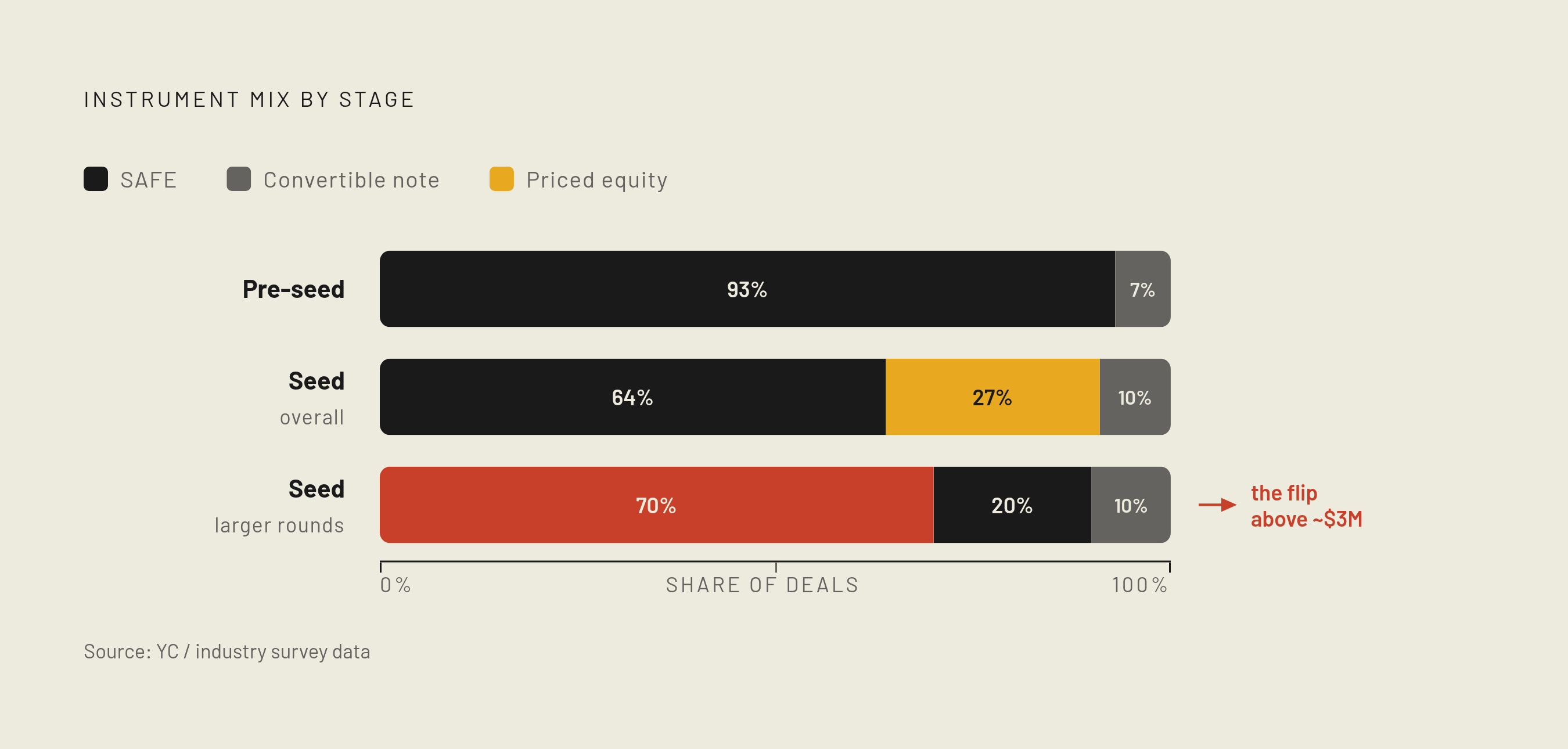
Pre-seed is basically a SAFE monopoly at this point, with nobody fighting over that ground anymore. On Carta, 93% of pre-seed deals in Q1 2026 used a SAFE, with convertible notes down to 7% and shrinking.
Seed is where it gets interesting. From Q4 2023 through Q3 2024, Carta's data showed 64% SAFEs, 27% priced equity, and 10% convertible notes. Still SAFE-heavy, but not a landslide.
Here's the part founders miss: the switch from SAFE to priced tracks dollars more than stage. Rounds above a few million dollars at seed flip hard toward priced equity (about 70%), while SAFEs drop to roughly 20%. The mid-single-digit million dollar band is the genuine toss-up zone, and it's exactly where founders spend the least time thinking it through, because they assume the earlier instrument just carries forward.
For orientation: the median post-money SAFE cap for rounds between $500K and $1M sat at $10M through 2024. Median pre-money Series A valuations hit $48M in early 2025. The 2024 Angel Funders Report put average seed checks from professional firms at $420K, with median pre-money around $12M. Bridge rounds, meanwhile, typically run on SAFEs, since repricing a company mid-uncertainty just to raise a stopgap adds friction most founders and investors prefer to avoid.
This pattern reflects what the market at that check size expects, and pushing against it costs time and goodwill you don't get back.
The dilution problem that SAFE stacking creates and why founders rarely see it coming
Here's the asymmetry nobody explains clearly enough: in a SAFE, every new dollar dilutes the founder alone — not existing SAFE holders, not anyone else at the table. In a priced round, new money dilutes everyone proportionally, founders and existing investors alike. That difference sounds small, but it isn't.
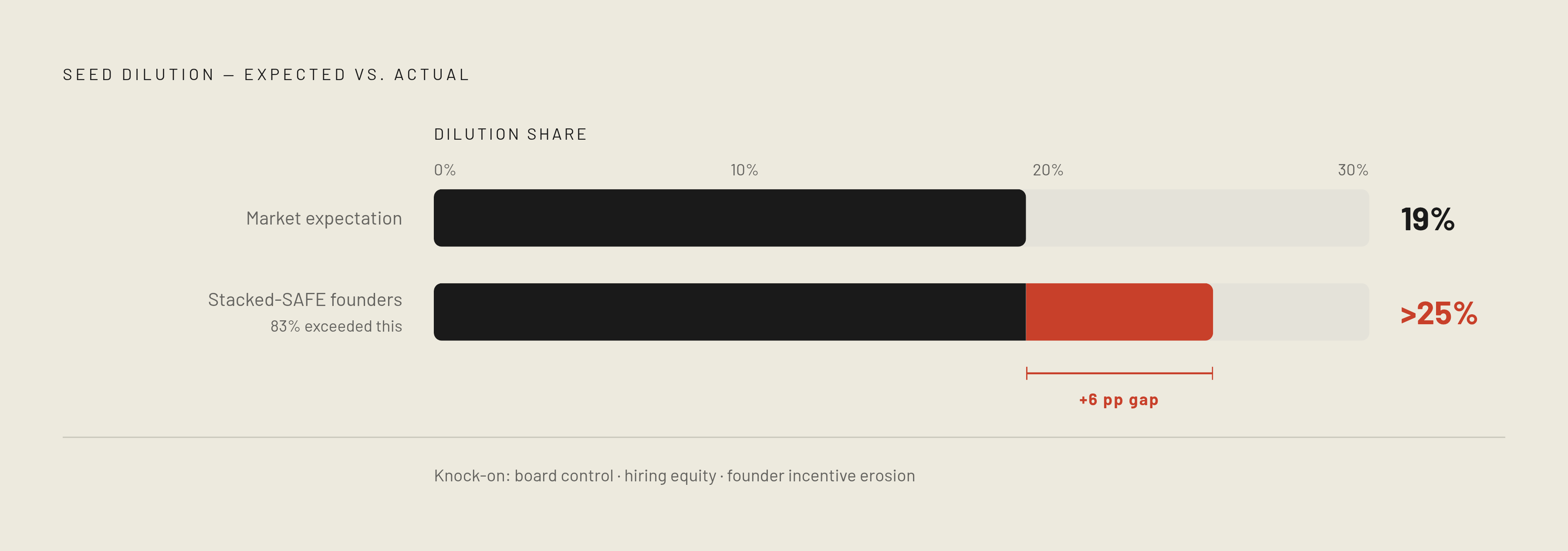
Stack two or three SAFEs at different caps before your Series Seed or Series A, and the math compounds quietly. You feel nothing in real time, because SAFEs don't convert until the priced round happens, and that's exactly when all of them land on you at once. A 2026 dilution analysis from Velawood and Horizon Capital found that 83% of founders who signed stacked post-money SAFEs without modeling the conversion first ended up with seed dilution above 25%, against a market expectation closer to 19%. Six points doesn't sound like much until it's six points of a company worth tens of millions.
The knock-on effects show up later and hit harder: board control gets shaky, there's less equity left for the first ten hires, and the founder's own incentive to keep grinding starts to erode. Investors notice, too. A founder who can't walk through how their existing SAFEs convert, and what the cap table looks like post-Series A, is telling a VC something about the quality of counsel they've had, or haven't had.
The lesson here is narrower than avoiding SAFEs altogether: run the conversion math against your existing stack and a realistic Series A price before signing, every single time.
Why so many founders are deferring their first priced round, and what that delay actually costs
Three things are pushing founders to keep stacking SAFEs instead of biting the bullet on a priced round. IPOs have been scarce, so the pressure to keep a spotless cap table for a future exit has eased off. The gap between funding rounds has stretched out since the slowdown that started in mid-2022, and plenty of founders would rather spend six weeks on product than six weeks in a term sheet negotiation.
There's an investor-side piece too. After mid-2022, investors started rewarding lean spend and early profitability over growth-at-any-cost, and startups responded by asking for less money, which nudges more rounds into SAFE territory purely by size, and it makes sense on paper.
Except deferral has a bill that comes due later. Every SAFE that converts at a different cap adds another layer to the cap table, and Series A leads increasingly ask for a cleanup before they'll close, which is a polite way of saying "your spreadsheet is a mess, fix it first." Meanwhile, the excuse that priced rounds are slow and expensive is getting weaker by the year. Platforms like Carta, SeedLegals, and AngelList Stack have cut the time and cost dramatically, and flat-fee packages from startup-focused firms now run $10,000 to $25,000 for a straightforward seed priced round, compared to $150,000 or more for anything cross-border or structurally complicated. What used to eat months now takes weeks.
The deferral instinct made sense in 2022 and 2023, but it's worth asking honestly whether it still holds in 2025 and 2026, or whether it's just habit at this point.
When a priced round at seed makes sense — and what founders give up and get in return
The single biggest thing a priced round buys is certainty. You know exactly how much of the company you sold, and you know it the day the round closes, not three quarters later when SAFEs convert and surprise everyone.
A few signals point toward pricing the round rather than stacking another SAFE: round size creeping toward or past $3M to $5M, where stacking risk gets dangerous; a lead who's an institutional VC and expects a board seat and governance rights as table stakes, not a favor; a founder who's already run two or three SAFEs and is starting to feel the cap table turning into a liability during diligence; and enough traction to argue a real valuation instead of hiding behind a cap.
The tradeoff comes down to speed against structure: a SAFE closes in two to three weeks, a priced round takes six to twelve given term sheet talks, diligence, and the board conversation, and in exchange it delivers a clean structure, an investor with actual accountability, and shareholders who have real skin in how the company is governed.
On governance itself: the standard first priced round board is three seats, two founder-designated and one investor-designated, and founders should still hold the room. On dilution, leads typically target 10% to 15% dilution at seed and 15% to 25% at Series A, numbers worth modeling against before any negotiation starts. And since median pre-money at Series A sits around $48M, a couple of percentage points of avoidable dilution at seed isn't rounding error — it's real money.
How building in New York specifically shapes which instrument gives a founder more leverage
New York is a first-tier market in its own right. NYC startups raised $31.1 billion in venture capital in 2025, up from $18.7 billion across 869 deals in 2024, a jump of $6.2 billion in a single year. In April 2025 alone, NYC startup funding reached $1.4 billion across 62 deals, and the city's Series A activity accounted for 23.9% of all U.S. Series A funding that month. Manhattan, at this point, is a major early-stage hub, with 543 companies raising a seed or Series A round in a single year.
That density changes who's writing checks and what they expect. Twenty VC funds under $200M launched in New York in 2024, which means local institutional money is active and increasingly comfortable pushing for institutional-grade structure as rounds scale up. Fintech is a huge piece of that; Fintech is a major pillar of New York's venture ecosystem, and fintech investors read cap tables the way an accountant reads a tax return. A stacked SAFE mess that an angel might wave through won't necessarily survive that kind of diligence. AI founders face something similar: over 2,000 AI startups and $27 billion in AI funding since 2019 means competition for the best rounds is fierce, and speed still matters early, but a clean structure matters more as the round grows.
New York's density does something else too: it turns founders into each other's best intelligence network. When 543 companies are raising in the same twelve months, word travels fast about which investors are demanding priced rounds, at what stage, and what caps are actually clearing right now. That kind of ground-truth is most useful when it comes from founders at a similar stage in a similar sector who just closed a round themselves, not from a term sheet database three months out of date.
The city's legal infrastructure keeps up, too, and startup-focused firms with flat-fee seed packages are well established here, which has quietly removed a lot of the old cost argument against pricing early. And international companies choosing New York as their U.S. base, names like ElevenLabs and DeepL among the recent entrants, keep raising the bar on what a "normal" clean early cap table looks like for everyone else in the pool.
The questions a founder should answer before choosing an instrument — and where peer judgment fits in
Skip the formula. This comes down to four questions, answered honestly.
Is there a real, defensible valuation, or is a cap the best proxy available right now? What's the round size: under $3M leans SAFE by default, $3M to $5M means model both instruments side by side, above $5M means expect to price it. Who's the investor: angels and micro-VCs tend to want SAFEs, institutional seed leads increasingly want priced rounds with governance attached. And what does the existing SAFE stack look like, how many, at what caps, and what happens to ownership if the next round prices at today's market rate?
Before signing anything, model the cap table all the way through Series A, not just through whatever round is in front of you right now. Governance matters even at pre-seed, even though it feels premature; SAFEs push that conversation down the road, and founders should decide on purpose whether that delay helps them or just postpones a harder talk.
This is where peer knowledge earns its keep. Founders who closed a round recently, in the same city and the same sector, know things no term sheet database will ever capture in real time: which investors are actually asking for what, which caps are clearing, which lawyers move fast and which ones stall. Small, trusted founder groups, where people actually know each other's real numbers, are where that kind of candid information changes hands. The value of the advice tracks directly with the trust in the room.
Neither instrument beats the other on principle. The right one is whichever a founder can explain start to finish, has modeled all the way to Series A, and has pressure-tested with people who've already been through the fire.