Enterprise Sales Cycles for NYC B2B Startups
Why enterprise sales cycles are stretching and how NYC founders can compress them.

Enterprise sales cycles are getting longer, and the data backs it up. A SaaStr survey of over 1,000 B2B SaaS sales pros found 58% reported longer cycles in 2024, stacked on top of a 24% jump the year before. For complex enterprise SaaS deals specifically, 2023 saw 36% cycle growth, and now you're looking at nearly a year, on average, to close.
NYC founders have real structural advantages that can push back against that trend. Buyer density, warm introductions, proximity to decision-makers, but none of it works if you don't use it on purpose.
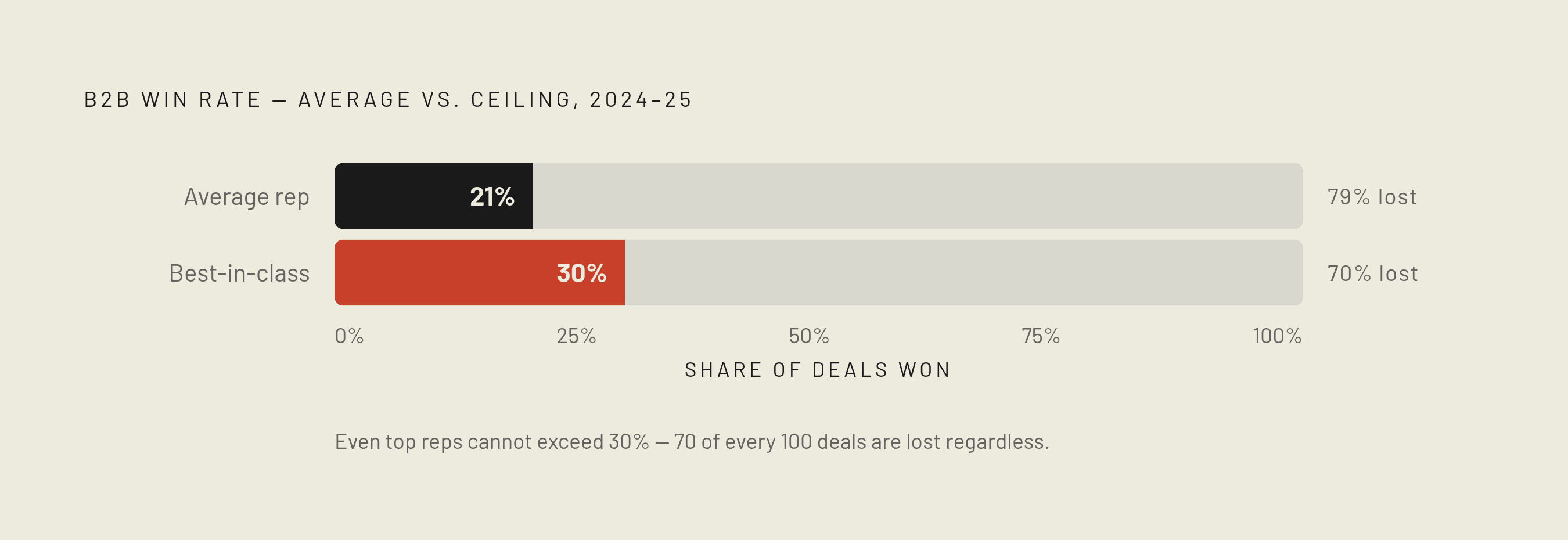
Win rates tell the same grim story as cycle length. Average B2B win rate sits at 20-21% in 2024-2025, and even the best reps in the business top out around 30%. So this isn't a market where you can coast on a good product and a nice deck. This is the baseline every NYC B2B founder is fighting against, and the rest of this piece is about the mechanics of beating it.
What makes an enterprise cycle long in the first place
Cycle length isn't some mystery. It tracks to a handful of variables you can actually name: deal size, number of active stakeholders, how mature the buyer's procurement process is, and whether a real internal champion exists and got activated early.
Gartner's 2024 research found buying committees have swelled from around 5 people a decade ago to somewhere between 8 and 12 today. More people means more consensus needed, and more chances for a deal to just quietly die without anyone telling you why. Procurement itself now ranks as a top-three influencer in 58% of enterprise purchases, according to Qualtrics XM Institute's 2024 research. And if your product touches any meaningful amount of customer data, security review alone can tack on 4 to 8 weeks.
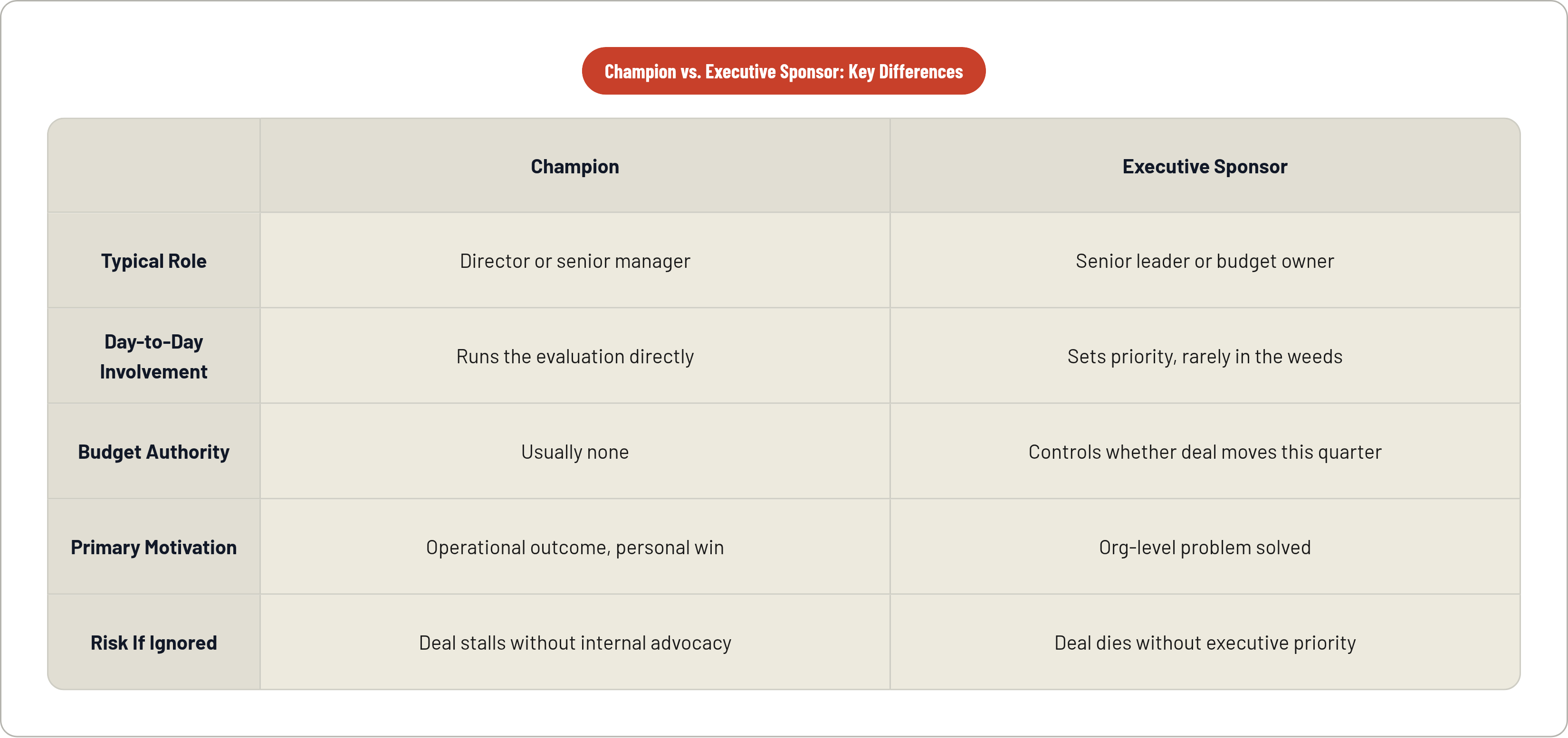
Here's a distinction that trips up almost everyone early on: the champion and the executive sponsor are not the same person. The champion is usually a director or senior manager, the one actually running the evaluation day to day, motivated, sure, but often not the person who controls budget. The executive sponsor is the senior leader whose org owns the problem you're solving, and that person decides whether your deal is a priority this quarter or a nice idea for next year. Founders win the champion constantly and lose the executive sponsor just as often, and then wonder why the deal went cold.
Single-threading is the single most common way early enterprise deals die. All your relationship equity sits with one contact. That contact changes roles, goes on leave, or loses political capital internally, and the deal is dead, even though nobody told you it was dead. Deals rarely lose to a flashier competitor; they lose to misalignment between people the founder never even met.
And without stage definitions tied to actual exit criteria, forecast slippage runs 25 to 40%, which means the pipeline number on your dashboard is probably lying to you.
The NYC structural advantages that are genuinely useful in enterprise B2B
New York's central fact is buyer density. Banks, media companies, law firms, hospitals, real estate operators, insurance carriers, all sitting within a few square miles of most founders in the city. The West Coast model builds a product and waits for a market to show up, while New York builds for an industry that's already downstairs.
That proximity matters at more than just the first meeting. It's easier to get in-person time with mid-level champions when you're in the same city, and it's more realistic to meet an executive sponsor when you share a conference, a neighborhood, or a mutual contact who can make a real introduction (not a LinkedIn "let me connect you two" that goes nowhere). Security and legal conversations that usually drag out over email chains can get compressed into one sit-down meeting.
Fintech founders get an extra dose of this. Close to 4,000 NYC startups, roughly 16% of the total, focus on financial services, which means the buyer cluster for payments, compliance, and embedded finance products is unusually thick on the ground. Layer AI on top: over 1,000 AI-related companies in New York have raised $27 billion since 2019, and the most active buyers of AI workflow tools tend to be the same enterprise verticals already sitting in the city.
None of this activates on its own, though. Geography gets you proximity. It doesn't get you the meeting.
How warm introductions compress the timeline in ways cold outreach cannot
Cold email is not a good enterprise sales tool anymore, if it ever was. B2B cold email reply rates are widely understood to be low, and enterprise decision-makers receive a high volume of sales outreach, so the real functional rate is lower still. Cold outreach is useful for market mapping and message testing, but it is not a reliable way to close a seven-figure deal.
Warm introductions work on a completely different mechanism. Referral leads close at meaningfully higher rates and in far less time than cold leads, because trust gets borrowed from whoever made the introduction. The executive shows up pre-qualified instead of pre-skeptical, which changes the entire tone of the first call.
In enterprise deals specifically, warm intros solve a bigger problem than just getting a meeting: they solve the multi-stakeholder problem. A peer who already knows the economic buyer can put a founder directly into the right room, skipping the champion layer entirely, or giving the champion cover to make internal introductions they'd otherwise be too nervous to make. Deals with three or more active contacts close at dramatically higher rates and stall far less often in the late stages.
NYC's density of genuine founder-to-founder relationships (people who've built in the same vertical, raised from the same investors, sold to the same buyers) is what makes this tactic actually executable, not just theoretical. And the quality of the introduction matters as much as the channel. A warm intro from someone who truly knows both sides is a structurally different thing than a cold DM wearing a warm intro's clothing.
Multi-threading as the specific tactic for NYC founders to internalize
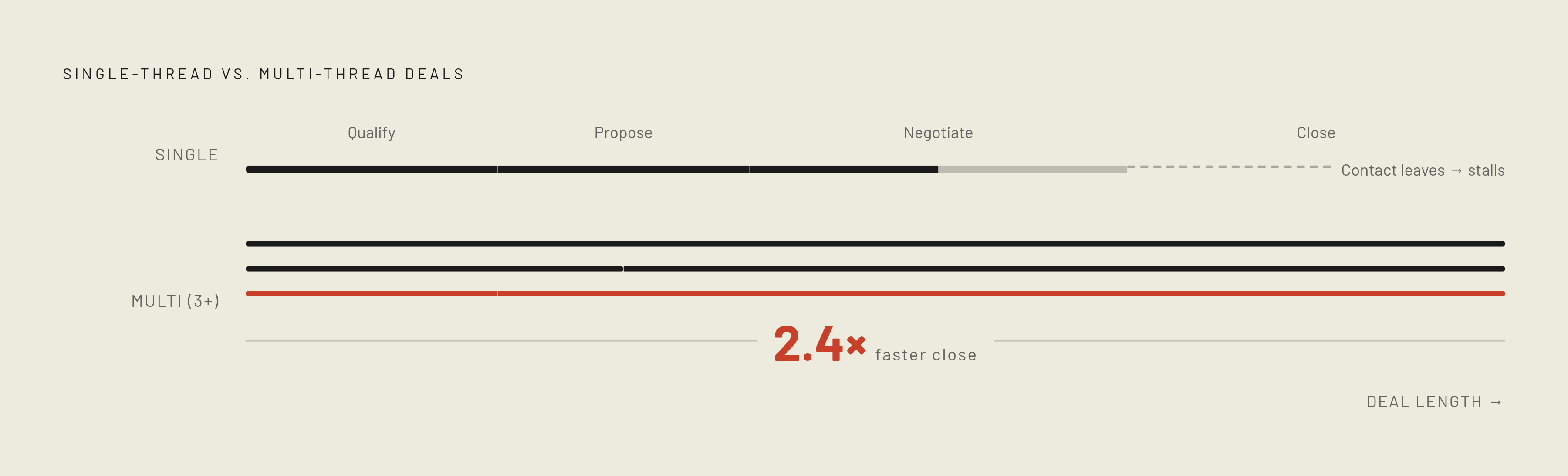
Multi-threading means building active relationships with three or more stakeholders inside a target account, at the same time, rather than one at a time. Engaging three or more contacts can close deals 2.4 times faster, and multi-threaded deals show meaningfully higher win rates across the board. It also protects you: if one contact leaves or loses internal support, the deal doesn't automatically die with them.
In practice, that means mapping the buying committee before the formal evaluation even starts, not scrambling to do it after your champion surfaces a name you've never heard of. Who's the economic buyer? Who runs procurement? Who owns the security review? And which of those people can you reach through an existing relationship, a co-investor, a peer founder, a former colleague, before you ever send a cold outbound message?
This is where NYC's peer network pays off twice. The same web of relationships that gets you a warm intro to the champion can often produce a separate, independent introduction to the economic buyer or the technical evaluator. Vertical communities in fintech, media, and legal tech mean founders frequently know a second-degree connection inside a target account they haven't even bothered to map yet.
Account-based focus reinforces all of this. Enterprise account executives typically carry a far smaller account load than their SMB counterparts, and that lower number is exactly what makes the depth of relationship-building multi-threading requires actually feasible. Gartner's research on account-based approaches backs this up: targeting accounts that fit your ideal customer profile tightly, instead of casting a wide net, is broadly recognized as a more effective approach at the enterprise level.
The champion problem: finding one, testing one, and not over-relying on one
Founders confuse enthusiasm with championship constantly, and it's an expensive mistake. A real champion has three things: personal motivation tied to the outcome, actual political weight to move the deal internally, and willingness to stake some of their own reputation on your product. Someone who's friendly, responds fast, and seems genuinely interested but has no budget authority and avoids internal conflict isn't a champion. They're a fan, and fans don't close deals.
Test the champion before the formal evaluation locks in, because it's one of the highest-leverage moves in the whole process. Ask them to set up an intro to the economic buyer. If they can't, or won't, the deal is nowhere near as far along as your pipeline says it is. Ask them to share your one-pager internally: their willingness (or reluctance) to do that tells you everything about whether they're actually advocating for you behind closed doors.
The structural risk here is single-threading through the champion alone. If they leave, get reorganized onto a different problem, or lose standing internally, the deal usually dies no matter how good your product is. Multi-threading up toward the executive sponsor is the hedge, and the warm introduction network is, again, the mechanism that lets you do it without torching the champion relationship in the process.
NYC founder networks offer a specific, underused version of this: someone who's crossed paths with the economic buyer or executive sponsor before, through a prior deal, a board seat, or an investment, and can get you in front of them before the evaluation window closes.
Where NYC peer networks create a durable sales advantage beyond the first deal
One warm introduction gets you one meeting. A real, trusted peer network gets you ongoing deal flow, mutual referrals, and shared intelligence about the accounts you're chasing. Founders who've already sold into the same enterprise verticals know which buyers move fast, which procurement teams are functionally broken, and which executive sponsors actually have the authority to sign versus the ones who just like meetings. That kind of information, shared across a table rather than posted in some public forum, shortens cycles in ways no CRM or sales tool ever will.
There's a compounding effect too. Enterprise buyers talk to each other constantly. A successful deployment at one financial services firm generates word of mouth into peer firms, especially in New York, where these buyers sit on the same boards, attend the same industry events, and run in overlapping social circles. The best reference customer for your next enterprise deal is often sitting five blocks away from the last one.
Co-investor relationships add another layer. NYC's investor community frequently has direct portfolio ties to the exact enterprise buyers a founder is targeting, and a warm introduction from an investor who genuinely knows both sides carries real weight.
The practical takeaway: which relationships a founder maintains matters as much as which product they build, when it comes to how fast the next deal closes. Founders who invest real time in peer community, trust built over years rather than traded transactionally, consistently find the second enterprise deal easier than the first, and the fifth easier still. That's the argument for small, curated, in-person founder communities specifically for B2B: the people sitting across the table are often the most valuable nodes in the whole network that eventually closes your deal.
What founders can do immediately to start compressing their cycle
Map the buying committee before you pitch, not after. Identify the economic buyer, the procurement lead, the technical evaluator, and the end-user champion for every target account before outreach starts, and figure out which of those contacts you can reach through a warm introduction before you ever send a cold message.
Test your champion early, and be explicit about it. Ask them to do one thing that costs them internal political capital: introduce you to the budget holder, share a document with their leadership, co-present to their exec team. Their response tells you, immediately, whether you've got a champion or a fan.
Build multi-threading into the account plan from day one. Three or more live stakeholder relationships per account isn't a nice-to-have at the enterprise level; it's the minimum viable sales motion. Use peer introductions to reach the layers your champion either can't or won't connect you to.
Get ahead of procurement and security bottlenecks before they ambush you late in the process. Ask about security questionnaires and procurement requirements during the discovery call, not after the term sheet's on the table. Have your standard security documentation, vendor onboarding materials, and legal redlines ready in advance; that alone can cut real weeks off a 4-to-8-week review window.
And invest in the peer relationships that make future deals faster, not just the current one. The founder most likely to hand you a warm intro to a financial services buyer next quarter is someone you know well enough that they'd actually pick up the phone, not someone whose business card you collected at a conference eighteen months ago. The NYC advantage is real, but it runs on density of trust, not density of zip codes. The relationship has to exist before you need it.