Product-Led Growth for NYC SaaS Startups with Enterprise Ambitions
Strategic freemium requires designing exactly enough value to hook users, not unlimited generosity.

Product-led growth means the product itself sells, converts, and expands the account, not a rep on the phone or a banner ad on LinkedIn. It caught on because B2B buyers now do almost all their shopping before they ever want to talk to a salesperson, and a product that sells itself fits that behavior instead of fighting it. Here's the catch nobody puts on the landing page: most SaaS companies now call themselves product-led, but plenty of them track almost nothing about whether a user ever actually reaches the product's core value. Slack, Figma, Dropbox, and Calendly all won early because the product was shareable by design, value was visible to the next user before that person ever created an account. This piece is about the part after that: how a PLG company built with enterprise ambitions actually gets there, without torching the product culture that got it in the room.
The freemium math founders underestimate before they're committed to the model
Free users cost money. That surprises people who assume "free" means "no cost to us," but content, paid distribution, and partnerships all carry a real price per signup, and the conversion from free to paid tends to run low enough that the math gets uncomfortable fast.
Founders generally pick between two flavors. Freemium gets you volume: lots of signups, a smaller share of them ever paying. Free trial flips that, fewer people walk in the door, but a meaningfully higher share convert once the clock is ticking. Neither is the "correct" answer in some universal sense. It depends on your ACV, how complicated the product is, and how fast a new user can get to the moment where the product actually does something for them.
That last part is where most of the funnel quietly dies. A large chunk of free users in a typical PLG funnel never hit the activation milestone at all, they sign up, click around for a few minutes, and vanish. No email complaint, no cancellation, just silence.
The industry's answer to this has been to stop giving everything away for free and start giving away exactly enough. Call it strategic freemium: a free tier engineered to build a real habit and create real upgrade pressure, not one designed to be generous for generosity's sake. Slack, Notion, HubSpot, and Calendly have all tightened their free tiers in recent years, and that's not stinginess, it's a signal that unlimited generosity doesn't survive contact with a company's actual cost structure at scale. The right question for a founder isn't "how much can we give away." It's "what's the smallest experience that gets someone hooked and gives them a reason to pay."
What product-qualified leads are and why most PLG companies don't use them well
A product-qualified lead is a user or account whose behavior inside the product says "we're ready to buy," not someone who downloaded a whitepaper or sat through a webinar half-muted in another tab. PQL signal looks like: repeated use of the core feature, teammates getting invited into a free account, someone bumping into a usage limit or feature gate over and over, or a burst of activity across multiple sessions packed into a short window.
Here's the strange part. Despite decent evidence that reaching a user at their moment of peak intent beats a generic MQL handoff by a wide margin, only a minority of PLG companies actually run a formal PQL program. Why the gap? Because it requires instrumentation most early-stage products just don't have yet, it requires product and sales to actually agree on what "high intent" means, and getting two departments to agree on a definition is its own small miracle.
Skip this step and you get one of two outcomes. Either sales ignores the product data entirely and goes back to cold prospecting like it's 2011, or they drown in a flood of undifferentiated free signups and burn hours chasing accounts that were never going to convert. A working PQL motion looks almost boring by comparison: the product emits a signal, sales gets a prioritized queue, and outreach happens on the user's timeline, not on the sales team's Tuesday call block.
How PLG companies actually make the move to enterprise sales without breaking what works
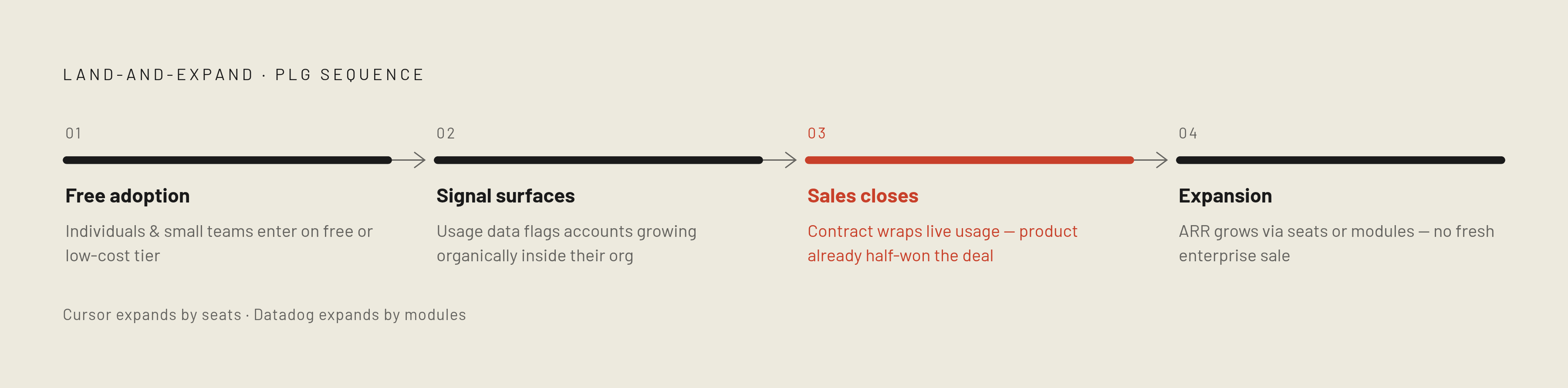
A self-serve motion doesn't graduate into an enterprise sales machine on its own. The two require different instrumentation, different incentive structures, and frankly different conversations, and treating them as the same motion with a bigger invoice is how companies stall out. Most PLG companies start layering in a sales-assist motion well before they hit serious scale, not after, because waiting until urgency forces the issue just guarantees chaos.
The logic that works is land and expand. Individual users or small teams pick up the product on a free or cheap tier. Usage data starts showing which accounts are growing organically inside their own walls. Sales steps in to formalize what's already happening, wrapping a contract around usage that already exists rather than pitching a hypothetical. The enterprise conversation should start with proof already on the table, not a leap of faith.
Enterprises want things self-serve was never built to provide: SOC 2 and other compliance documentation, SSO, audit logs, contracts that a procurement department can actually process, admin controls and role-based access at scale, and a dedicated onboarding contact with a name and an inbox. Build the sales team before any of that exists and reps end up with nothing to sell except a spreadsheet of free signups, so they revert to cold outbound, and cold outbound is exactly the thing PLG was supposed to make obsolete.
The other classic failure: building enterprise features before the bottom-up motion has produced actual champions inside the accounts you're targeting. You end up selling top-down into a company that has no internal advocate, no one to open the door, no one to vouch for you in the Slack channel where the real decision gets made. And if reps get paid on new logos only, they have zero incentive to nurture the product-led expansion accounts, which is exactly backwards, since those accounts are the whole point of the model.
The discipline worth naming is product-led sales: sales sits downstream of product signal, closing deals the product already half-won instead of hunting from a cold start. Protecting the product culture through all this, the fast iteration, the tight feedback loops, the low friction, isn't automatic. Enterprise requirements have a way of quietly taking over the roadmap if nobody's actively guarding against it.
Datadog and Cursor as two different proofs of the same underlying playbook
Datadog, founded in New York, is the clearest large-scale proof that land-and-expand works at enterprise size. It started with developers adopting one monitoring product on a cheap tier, then expanded methodically into a full observability platform, where each new module added ARR without requiring a fresh enterprise sale each time. The company grew to a significant number of customers each generating over a million dollars in ARR, a number that shows how deep the model can go inside a single account once it takes root. The NYC origin mattered here too: early access to enterprise clients in finance, media, and healthcare gave Datadog real-world testing at scale that a smaller market simply couldn't offer.
Cursor (built by Anysphere) is the newer proof, and it shows PLG can generate serious ARR velocity before a sales org exists at all. Developers adopted the AI code editor individually, then brought it into their companies on their own. Anysphere didn't hire an enterprise sales rep until the product had already produced very substantial ARR, meaning the model proved itself before the sales layer got bolted on. For early-stage founders without an enterprise sales team, that's not a gap to explain away in a pitch deck. It's a feature of the phase you're in, assuming the product is doing its job.
The two companies share the same patience: let usage build inside organizations first, formalize the relationship second. Where they differ is the shape of expansion. Datadog grows by module, more products sold into the same customer. Cursor grows by seat, more users inside the same organization. Both are legitimate expansion architectures. Which one fits your company depends on where your product naturally wants to spread.
Why building a PLG company in New York gives enterprise ambitions a structural head start
New York's industry mix means enterprise buyers are reachable long before a company has a sales team to reach them with. A fintech SaaS startup can pilot with banks in Midtown while the product is still half-built. A healthtech company can get into hospital network workflows across the metro area. Adtech and martech tools can test pricing and features with agencies in Chelsea before committing to a market segment at all.
What that produces is a real enterprise feedback loop starting at seed and Series A, years before most startups elsewhere ever see one. Founders find out how compliance, procurement, and security requirements actually land in a real deal, before those requirements become the reason a later deal dies.
There's a talent piece too. The alumni networks from companies like Datadog, MongoDB, and Bloomberg's engineering org have people who've actually shipped SSO, role-based access control, audit logging, and SOC 2 workflows for enterprise SaaS, and that experience is sitting in the local hiring pool, not locked behind a NDA in another city. NYC founders also disproportionately come out of finance, consulting, and media, backgrounds that build a working fluency in procurement dynamics and the internal politics that actually decide whether a deal closes or dies in legal review.
New York is also an entry point for companies from outside the U.S. European companies including Anterior, Contentsquare, and ElevenLabs have opened New York offices specifically to get access to U.S. enterprise relationships, which means NYC-based PLG founders are competing in a market that global players are actively trying to break into, not one they're fleeing. Even the office address carries weight: Flatiron, NoMad, and Chelsea read as legible signals to an enterprise legal or procurement team sizing up whether your company is the kind of company they're allowed to sign with.
What the enterprise onboarding experience has to do that self-serve never needed to
Self-serve onboarding has one job: get a single person to value, fast. Enterprise onboarding has to do that for multiple people at once, across departments and approval layers that don't talk to each other and don't share a definition of "value" to begin with.
That means separate activation paths for the technical evaluator, the business buyer, and the actual end user, and it means framing the same product completely differently for a legal team than for an engineering team, because they're not trying to solve the same problem even though they bought the same license. Research on enterprise onboarding consistently shows that personalizing the experience by persona and department produces a meaningful lift in trial-to-paid conversion. Specificity here isn't a nice-to-have, it's the mechanism.
Underneath all of that sits the compliance layer, and enterprise buyers won't move past evaluation without it. SOC 2, SSO, data residency, audit trails, these need to exist before the deal gets serious, not after the LOI is signed and someone in security asks a question nobody prepared for. Role-based access, provisioning, and admin dashboards aren't features buyers get excited about. They're the boring stuff procurement checks off before anyone's allowed to sign.
And someone has to actually own the account. A help center link isn't a relationship. Enterprise deals want a named person who answers when something breaks, and that person matters to the buyer almost as much as the product does. Bolt all of this on reactively, in response to one specific deal's demands, and you get fragile implementations that create technical debt and slow down every deal that comes after. The founders who get this right build the compliance and admin layer before the first enterprise conversation starts, not scrambling during it.
How to instrument a PLG product so it generates the signals enterprise sales actually needs
A lot of PLG companies adopt the model and just never build the measurement underneath it. Without tracking whether users actually hit activation, the whole PQL motion is guesswork dressed up as strategy.
Start with the activation event itself: the one action that most reliably predicts a user sticks around, defined precisely, not a fuzzy proxy like "logged in" but a specific moment where the product delivered real value. Layer expansion signals on top of that inside free accounts: team invites sent, integrations connected, features hit against a paywall more than once. Then roll individual signals up to the account level, because sales needs to see which organizations are expanding as a whole, not just which single user happened to click around today.
None of this works if product, growth, and sales don't share a definition of what counts as a PQL. Disagreement here means sales quietly ignores the data or product ends up optimizing for the wrong behavior entirely. The tooling has to support event tracking at the product layer, aggregation at the account layer, and delivery that puts a prioritized account in front of the right rep at the right moment, not a CSV someone remembers to export on Fridays.
One trap worth naming directly: building a lead-scoring model on top of marketing data and calling it a PQL program. Behavioral data from inside the product is a different animal from firmographic or intent data pulled from ad platforms, and mashing them together produces a list sales stops trusting within a month. Close the loop by feeding results back to product, which PQL triggers actually preceded closed deals, and which ones were noise, so the model gets sharper instead of staying frozen at version one.
Pricing architecture decisions that have to be made before the enterprise conversation arrives
Here's the tension nobody likes admitting out loud: a free tier built to be genuinely useful can cannibalize the enterprise deal you actually want. If a team can run its core workflow entirely on a free or cheap plan, the procurement conversation never even starts, because nobody upstairs ever hears there's a problem to solve.
Enterprise pricing architecture has to build in natural expansion surfaces, seats, usage volume, feature modules, so organic growth inside an account raises ARR without a new sales cycle every time. And the paid tier has to hold back enough real value that a growing team hits a wall on the free plan and feels it, rather than coasting indefinitely on a plan built for someone else's use case. Get this sequencing wrong, and by the time the enterprise conversation arrives, there's nothing left to sell them that they don't already have for free.