Work Life Balance for Entrepreneurs Leaving NYC
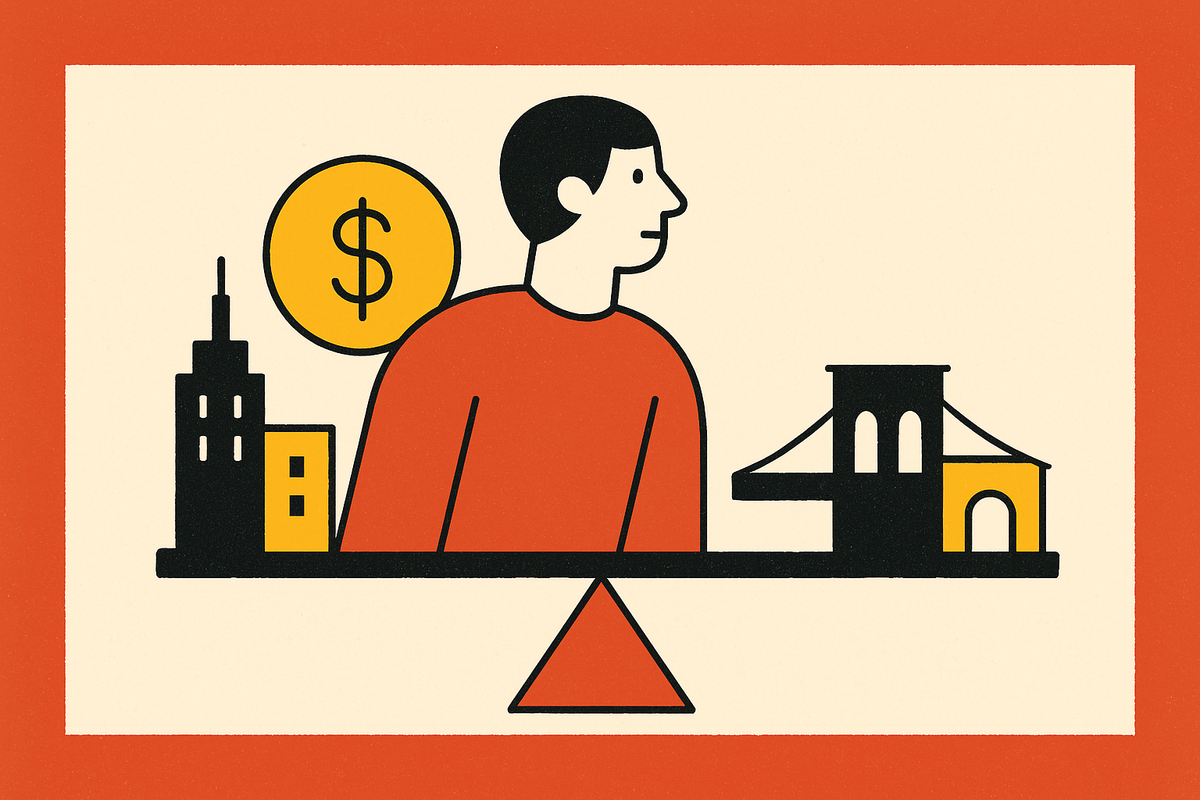
Founders are leaving New York when the math on rent no longer justifies staying.

New York is losing founders right now because rent, taxes, and a harder political climate have collided with a genuine, defensible belief that building a company no longer requires a Manhattan zip code. This is not a story about people getting soft or chasing vibes. The math is straightforward and the people running it are sober. Pre-revenue and early-stage founders in particular are looking at their burn rate, looking at their lease, and finding it hard to justify the New York premium when the product can ship from anywhere.
The city's own numbers complicate the narrative a little. Securities employment in New York City is at an all-time high, and the finance and insurance sector grew in 2025. The departures that get announced on social media have not yet shown up meaningfully in the jobs data, says the Center for New York City Affairs at the New School. So the exodus is real at the individual level without yet being a citywide trend. Both things are true at once, which is usually how real economic shifts start.
What's changed isn't just the cost column. Remote work and AI tools have quietly dismantled the old argument that physical presence is non-negotiable for building a company. Five years ago, "you have to be in the room" was gospel. Now it's a preference, and preferences are negotiable when rent is not. Miami, Austin, and Charlotte are the usual landing spots, each selling some combination of lower taxes, more square footage per dollar, and a pace of life that doesn't require a founder to apologize for leaving the office before 9pm.
None of this makes leaving a mistake. It makes it a decision with real inputs, and those inputs deserve to be taken seriously before anyone calls a moving truck.
What the work-life balance gains from leaving are worth
Give the departure its due. The lifestyle gains are not imaginary, and they are not small. Lower housing costs and a lighter tax burden free up actual capital, and more physical space frees up something harder to price: cognitive bandwidth. A founder who isn't doing math on a cramped studio apartment has more brain left over for the business.
New York's always-on culture carries a real cost, and that cost is a legitimate health risk, not a personal failing. Round-the-clock connectivity expectations, long hours normalized by an investor culture that treats sleep as optional, and the slow erosion of identity that happens when a person becomes indistinguishable from their company, these are structural pressures the city amplifies by design. Burnout here is an occupational hazard with a very specific zip code, not a character flaw.
Leaving removes a lot of the ambient noise that makes that burnout possible. Fewer events compete for a founder's calendar. Fewer investor dinners quietly turn into unpaid obligations. The physical environment itself stops nagging. New York is a city that broadcasts "you should be working" from every illuminated office window at 11pm, and when that signal disappears, so does some of the guilt that came with ignoring it.
There's a founder-specific version of the financial math too. A founder who has spent two years drawing a minimal salary just to keep the lights on can, after a move, suddenly afford a mortgage, hire with more patience instead of desperation, and stop personally subsidizing the company's growth with their own financial stress. It's a company upgrade, not just a lifestyle upgrade. A founder who isn't white-knuckling their own finances makes better decisions, and better decisions compound.
What the work-life balance calculation quietly leaves out
The spreadsheet most founders run before they leave only counts what they stop paying, and it rarely counts what they stop receiving. And the things that stop arriving are hard to put a number on, because nobody ever sent an invoice for them in the first place.
Start with warm introductions. In early-stage venture, investors still lean on social proof instead of financial proof, mostly because a startup at that stage simply doesn't have the data history to model. A warm introduction from someone who genuinely knows both the founder and the investor is often the only real path to a first check for a first-time founder. No amount of polished cold outreach replaces a mutual friend saying "you should meet this person."
Then there's serendipitous proximity, which sounds like a fancy term for luck but is really just repetition dressed up. The deals, hires, and co-investors that show up from being physically present at demo nights, curated dinners, and pitch nights don't translate over Zoom or Slack. They require the kind of trust that only builds across repeated, unscheduled run-ins, the type where someone remembers your face before they remember your pitch deck.
Peer accountability belongs on this list too. Being around other serious founders, people who can spot when a decision is really a rationalization wearing a decision's clothes, and who will say so over dinner, is a form of discipline that no Slack community fully replicates. It's harder to lie to yourself in person.
And there's the institutional layer. Programs like the NYCEDC Founder Fellowship, which has accelerated 393 New York City-based founders across 243 tech startups selected from more than 2,300 applications, with fellows going on to raise over $170 million in follow-on capital, require at least one founder to reside within New York City at the time of application. The program's official language doesn't state that participation ends if a founder later relocates, but the eligibility bar itself tells you something: this kind of infrastructure is built around presence, not just intent.
None of this collapses the day someone signs a lease in Austin. It appears later, in a fundraise that takes longer than expected because key introductions never happened, or a hire that never materializes because nobody made the introduction. These are uncounted costs, not catastrophic ones, and a founder who doesn't plan for them will have a hard time explaining, six months in, why things feel harder than the spreadsheet promised.
How deep New York's founder infrastructure runs
"The ecosystem" is a vague phrase that hides something very specific: a dense, distributed network of recurring events and micro-communities that assembles on purpose. It's not an accident that these things keep happening in the same rooms with the same regulars. That intentional design is both the system's strength and the reason it requires a body in the room to access it.
A lot of the deal flow and referral activity that actually matters doesn't happen on a stage or in a pitch deck. It happens in private Slack groups and WhatsApp threads, and getting into those is a function of who knows someone in person, not what that someone has built. Distance degrades that kind of access fast, because nobody adds a stranger to a trusted group chat based on a LinkedIn profile.
Silicon Alley's 30th anniversary in January 2026 produced a quote that captures how mature this whole thing has become. LinkShare co-founder Stephen Messer put it this way: "Nobody talks about Silicon Alley anymore; it's just tech. New York's tech scene is so large now that there's no center." Read that twice. An ecosystem that no longer needs a brand name is an ecosystem that's stopped advertising itself, which makes it invisible from the outside and very easy to underestimate right up until someone leaves it and feels the difference.
Why the loss hits hardest at the earliest stages
The cost of leaving isn't flat across every company stage, and pretending otherwise does early-stage founders a disservice. Physical presence matters most at seed and Series A, when a founder's network is effectively the company's only asset. As a company matures and builds its own reputation and data history, that dependence fades.
For a first-time founder with no track record, a warm introduction from someone embedded in the New York network is often the only realistic path to a first check. Cold outreach doesn't close that gap, even with AI doing the drafting, because investors price early-stage companies heavily on the founder's social proof over their metrics. There aren't enough metrics yet to price.
A founder who leaves New York before building that reputation is walking away before collecting the one asset the city is genuinely best at producing: trust, accumulated in person, over time.
Later-stage founders face a different equation. Series B and beyond, with a board, a customer base, and a company name people actually recognize, absorb a relocation far more easily. They've already converted proximity into relationships that survive a few thousand miles of distance. The lesson here is to know which asset you're still building before you decide you don't need the place that builds it.
The strongest case for leaving anyway
Leaving makes real sense for a specific kind of founder, and naming that profile precisely does more good than a blanket argument for staying put.
Founders building in industries that were never concentrated in New York to begin with, certain flavors of deep tech, agriculture, energy, logistics, may find that proximity to customers, supply chains, or regulators affects fundraising speed, hiring, and regulatory approval more directly than proximity to Manhattan's VC corridor.
Founders who've already built their network also clear the bar. Someone who's raised a first or second round, assembled a board, and built relationships that don't require weekly in-person maintenance can relocate without giving up the value they spent years compounding in New York. They're not leaving the table. They already own a seat at several.
The burnout case deserves to be taken at face value too. A founder who stays in New York and breaks down two years in has made a worse trade than one who left and built something sustainable somewhere quieter. The city's pace is a feature for some people and a liability for others, and that's a wiring issue, not a character judgment.
The "location doesn't matter anymore" argument holds some water as well. AI tools, async communication, and a more remote-friendly investor culture have genuinely lowered the friction of building outside a major hub. But lowered friction isn't the same as zero friction. These tools shrink the premium on being physically present. They don't erase it. The founders this piece is really written for are the ones leaving before they've built the thing New York is best at helping them build.
What to do before you leave
The founders who leave New York without looking back later are the ones who treated their time here like an investment to harvest, not a cost to escape. They didn't wait for the move to force the issue. They built intentional substitutes for what the city gives them, before they needed those substitutes.
Before packing a single box, convert proximity into relationships sturdy enough to survive distance. Warm introductions, investor relationships, the kind of peer accountability that keeps a founder honest, all of it holds up far better when it was built face-to-face over time instead of maintained through the occasional LinkedIn comment.
While still in the city, prioritize the smallest, highest-signal rooms available. A curated dinner with a handful of other founders who actually know what's at stake will do more for a company than a sprawling mixer with an open bar and a name tag. Big events produce contacts. Small, repeated ones produce relationships, and relationships are the only thing that travels.
An introduction leads somewhere only when the person making it genuinely knows both sides. A founder's network matters less for its size than for that kind of depth, and depth gets built slowly, in person, across a lot of ordinary dinners that don't feel significant until they are.
After leaving, figure out in advance what will replace the ambient peer pressure of being embedded in a real founder community. Without a deliberate substitute, the quiet and the extra square footage that make leaving appealing can curdle into isolation within a year. Nobody plans for that part, and it catches people off guard.
The founders who navigate this well stop treating in-person community as a perk of living in New York. They treat it as infrastructure, something that takes ongoing investment and intentional design no matter where the company is headquartered. The city was never really the asset. The table was, the small room where people who know each other well enough to tell the truth sit down together on purpose. That table is harder to find once you've left, and a lot harder to rebuild from scratch than most people expect before they try.