LLC vs Delaware C-Corp Before Your First NYC Round
Delaware C-Corp from day one saves founders millions in taxes and conversion costs when raising.

Google "LLC vs C-Corp for startups" and the internet hands back the same shrug every time: "it depends." That answer is technically true and practically useless if there's a term sheet with a deadline on it. For most NYC founders heading toward a first institutional raise, there's no real debate to have: the entire machinery of venture financing was built around the Delaware C-Corp, and the only real question is whether to form one now or pay to become one later, under pressure, on someone else's timeline. The expensive path is drift: running as an LLC "for now" while quietly planning a raise, then discovering that converting costs real time and real money at the exact moment there's a shortage of both. So what follows breaks down why the C-Corp became the default, what the 2025 tax changes add to the math, where New York's own rules complicate things, and what it costs you to wait too long.
Venture financing documents and fund structures lock in the C-Corp requirement
Start with the paperwork, because the paperwork decides more than any founder preference does. The Y Combinator SAFE converts into preferred stock of a corporation. The NVCA model documents that govern most priced rounds assume a Delaware corporation from the first page to the last. These are the starting templates for the large majority of institutional deals, and preferred stock itself, with its liquidation preferences, anti-dilution math, board seats, and conversion rights, only works cleanly inside a corporate structure. An LLC can't issue preferred stock the same standardized way.
The fund side makes this even less negotiable. Most venture funds are set up as limited partnerships, and their limited partners are pension funds, endowments, and foundations, which are normally tax-exempt. If pass-through income from an LLC is routed through a fund to one of those LPs, the IRS treats it as Unrelated Business Taxable Income, taxable even for an organization that otherwise pays nothing. Foreign LPs run into a similar wall: income connected to a U.S. business through a partnership interest creates U.S. filing obligations and possible withholding. A C-Corp blocks both problems at the entity level, because the corporation absorbs the business income itself before it can reach the LP. On top of that, every LLC generates K-1s for each investor in the fund, and K-1s mean individual filing headaches for people who invested specifically to avoid them. Many fund agreements just ban the fund from holding LLC interests.
None of this is a matter of VC taste. It's a matter of what the fund's own governing documents allow it to hold. Add the diligence angle: lawyers on both sides already know the Delaware C-Corp playbook cold, so reviewing one takes less time and costs less money than untangling a custom structure. Even equity compensation points the same direction. LLCs can't grant Incentive Stock Options, so they fall back on profit interests, and those carry messier tax treatment and don't sell as well to a new engineering hire comparing offers.
The 2025 QSBS expansion's effect on founders who delay incorporation
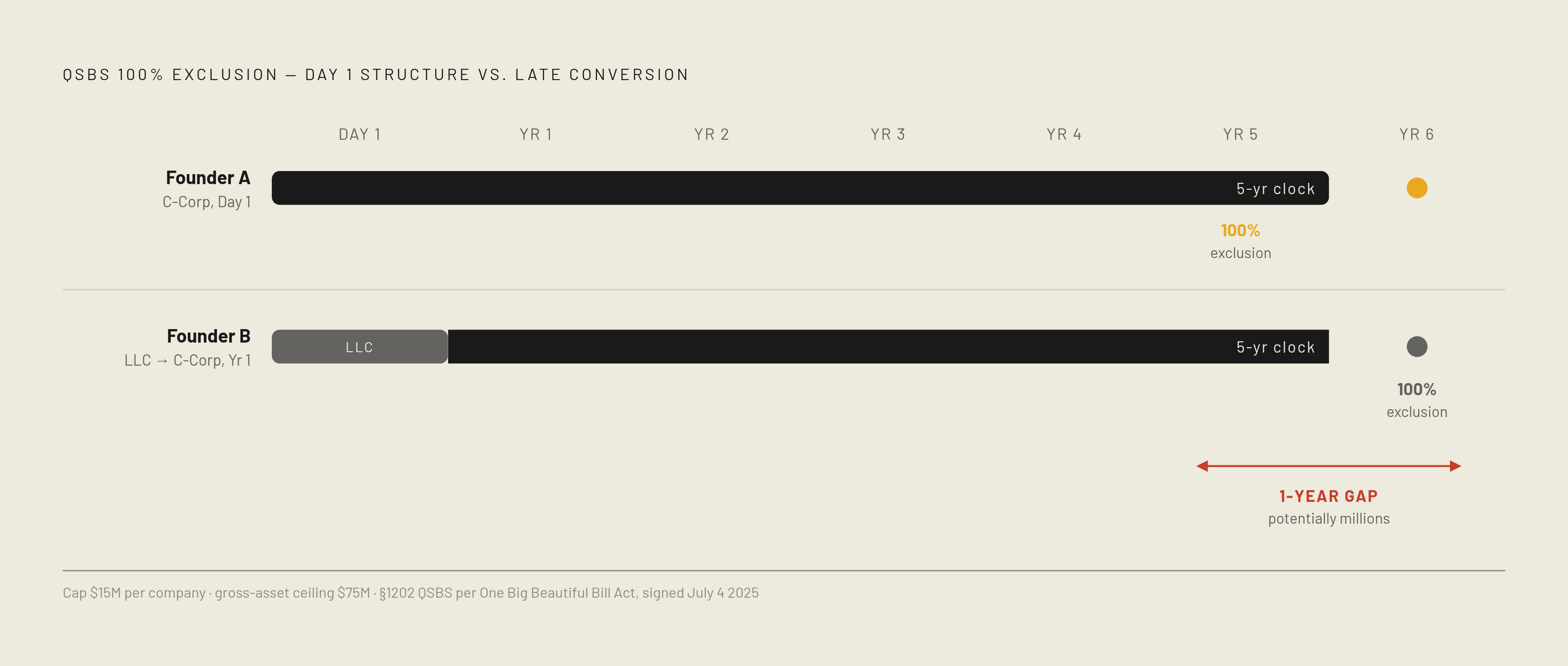
The tax code just made the timing question sharper. The One Big Beautiful Bill Act, signed July 4, 2025, expanded Section 1202 QSBS for stock issued after that date: a 50% gain exclusion after a three-year hold, 75% after four years, 100% after five years, with the per-company cap raised to $15 million and the gross-asset ceiling raised to $75 million, indexed for inflation starting in 2027. Only stock in a C-corporation can ever qualify. LLC interests are never eligible, no matter how long you hold them, because the holding-period clock doesn't start ticking until the entity is actually a corporation.
Picture two founders starting on the same day. If you incorporate as a Delaware C-Corp right away, you start a five-year countdown toward a 100% federal gain exclusion when you exit. Say the other runs as an LLC for a year before converting, so that same five-year clock only starts once the conversion happens, a full year later. The dollar difference at exit, on a successful company, can run into the millions. A founder who converts later can't backdate the clock to when the business actually started.
New York conforms to the federal QSBS rules, so if you live and sell here, you keep that exclusion at the state level too. That benefit tracks the founder's residency, not where the company was incorporated in Delaware, a distinction to keep straight when thinking through the paperwork. Compare that to California, Pennsylvania, Alabama, and Mississippi, none of which conform. So a founder in one of those states can watch a large federal exclusion still generate a serious state tax bill. NYC founders don't have that problem, which makes the decision to incorporate early carry weight on both the federal and state side at once.
The New York LLC publication trap that catches out-of-state playbooks
The twist catches founders who've done this before, just not in New York. Form a New York LLC instead of a Delaware C-Corp, and the state hands over a requirement that dates back generations and doesn't exist in any other major startup city. Under Section 206 of the New York State LLC Law, every NY LLC has to publish a notice of its formation in two newspapers, one daily and one weekly, both tied to the county where the LLC keeps its main office, and it has 120 days to get it done.
New York corporations don't have to do any of this. The rule applies to LLCs only. In Manhattan, where the county happens to be one of the more expensive places in the country to buy newspaper space, the publication bill has crossed into the thousands of dollars for plenty of founders, sometimes landing close to or beyond the cost of forming a Delaware C-Corp. Missing the 120-day window brings a penalty arguably worse than dissolution: suspension of the LLC's right to use New York courts, which becomes a real problem the first time there's a contract to enforce or a dispute to settle.
Founders who've formed C-Corps before, or who formed LLCs in other states, often get blindsided by this, because almost nowhere else requires it. Running the numbers reveals the irony: a New York LLC ends up costing more to form than a Delaware C-Corp, takes longer to become fully compliant, and still can't accept institutional money without converting anyway. So whatever savings the LLC seemed to offer tend to vanish by the time the newspaper bill arrives.
The cost of converting from LLC to C-Corp, and when it nearly kills a deal
One SaaS founder operated as a sole proprietor, then converted to a Delaware C-Corp under pressure from an incoming VC, ending up spending $15,000 in conversion costs trying to save money upfront, because the bill comes back bigger once a deal is already moving.
Delaware allows a straightforward statutory conversion from LLC to corporation, and lawyers handle these regularly, but routine doesn't mean it's free. Every handshake agreement and informal promise made as LLC membership interests has to be translated into actual stock and option grants, and that translation becomes legal cleanup work billed at full rates. Investors watching this unfold have varying levels of patience. Some will wait out a conversion. Others will simply move on to a founder whose cap table is already in order. And the QSBS clock, as covered above, resets to zero at conversion no matter how long the LLC had been operating, so none of that earlier time comes back.
The real lesson sits in the framing, not just the invoice. Treating C-Corp formation as an avoidable upfront cost is a false economy: the gap between forming the corporation on day one and converting under deal pressure isn't a few hundred dollars in filing fees, but a multiple of that in legal fees, plus tax exposure, plus the risk that the delay itself costs the deal. In a financing where weeks decide outcomes, a multi-week conversion process competing for the same lawyers who are supposed to be closing the round is its own kind of expensive.
When an LLC is the right answer
None of this makes the LLC a bad entity. It's the right one for a real, well-defined category of businesses, and the actual mistake isn't picking an LLC, it's picking one while planning a venture raise, which is the one scenario where the structure reliably causes problems. An LLC makes sense for a founder aiming at profitability and owner distributions rather than outside equity: an agency, a consultancy, a real estate vehicle, a holding company, anything with no plans to take institutional capital, grant ISOs, or chase an IPO. Pass-through taxation, the ability to pull money out without dividend mechanics, and flexibility in splitting economics among owners can be real advantages, if your business actually fits that mold.
There's also a tax wrinkle that favors the LLC for a specific kind of founder. A C-corporation traps its losses at the entity level, so they never flow through to shareholders, and they can't offset a founder's personal income from elsewhere. An LLC's losses pass through to its members and can offset other personal income, subject to basis, at-risk, and passive-activity rules. For a founder with significant income from another source during a pre-revenue stretch, that's a real and legitimate reason to lean LLC, at least for a while.
The practical test comes down to timeline. If you're targeting institutional VC within roughly 12 to 18 months, you should just form the Delaware C-Corp now and skip the detour. A founder who's pre-revenue, bootstrapping, with no raise on the immediate horizon but one plausible later, can reasonably run a Delaware LLC with a planned conversion down the line, as long as the New York publication requirement gets handled if the main office sits in New York. If a founder raises only from angels, friends and family, or small funds without tax-exempt or foreign LPs, they can usually run SAFEs and convertible notes through an LLC just fine, though conversion will still arise once institutional money enters the picture.
When the situation is genuinely unclear, the asymmetry points one direction. A C-Corp keeps more doors open, and if it closes a few, you can reopen them cheaply later. The reverse, going from LLC back to the flexibility of pass-through status, is far messier. On the cost side, Delaware's annual maintenance shouldn't scare anyone off: a corporation's franchise tax runs a minimum of $175 or $400 depending on the calculation method, plus a $50 annual report fee, against a flat $300 annual tax for an LLC. That gap is small enough that it shouldn't drive the decision either way for a company planning to raise. Delaware's default method for calculating franchise tax can spit out a bill that looks like tens of thousands of dollars, which panics almost everyone the first time they see it. If you recalculate under the assumed par value method, most early-stage companies come back down to, or near, that $400 floor.
NYC founders who work through this sequencing early, rather than discovering it mid-diligence with a term sheet on the table, tend to make calmer, more deliberate choices than founders scrambling to react. That kind of lesson travels fast across a dinner table full of people who've already lived it, and it's the premise behind NYC Founders Club, a private community of active NYC founders from seed through Series B built on the idea that the hard-won, money-saving insights spread naturally when the right founders are in the room together. Once a founder understands that the C-Corp default is a matter of mechanics, not personal preference, the real question is no longer whether to resist the default but when to get ahead of it, before a VC's counsel points it out during diligence.
What NYC's seed funding momentum means for how fast this decision arrives
NYC's seed market won't wait for you to finish thinking about entity structure. In the first half of 2026, more than 240 NYC startups raised a combined total above one billion dollars in seed funding, with the average seed round reaching $6.64 million, up from the first half of 2025. At that pace, the stretch between "planning to raise eventually" and "a term sheet is sitting in the inbox" is shorter than most founders assume, which turns the entity decision from a someday item into a now item.
That's why the QSBS clock matters: the five-year countdown toward a full exclusion starts the day you incorporate as a C-Corp, so every month you spend running as an LLC is a month the clock hasn't started, and that cost compounds the longer you ignore it. New York's conformity to federal QSBS rules gives resident founders a real advantage over counterparts in states like California or Pennsylvania, where the same federal exclusion can still trigger a hefty state tax bill. In a market moving at NYC's current speed, the founders who incorporate deliberately, before the raise rather than in reaction to it, are the ones who end up keeping the gains they're working to build.