Simple Agreement for Future Equity Explained for First-Time Founders
SAFEs feel fast and simple, but their real consequences hide in clauses that hit founders hardest.

A SAFE is fast to sign and easy to misunderstand. This piece is about that gap, between how fast the document moves and how slowly its consequences become visible, and it's where a lot of first-time founders lose equity they didn't know they were giving away.
Why first-time founders sign SAFEs they don't fully understand
Picture the scene: a warm intro from an angel, a term sheet that fits on six pages, and a founder who has three weeks of runway and a product launch to worry about. Nobody in that room wants to spend an afternoon debating valuation caps. The SAFE was built for exactly this moment, and it delivers on the promise.
Y Combinator introduced the SAFE in late 2013 as a faster, cheaper alternative to convertible notes. The pitch was fewer complications, and the format spread across pre-seed and seed-stage fundraising because that pitch held up. A SAFE really is simpler to draft, simpler to close, and simpler to read than a note stacked with interest rates and maturity dates.
But simpler to sign is a different claim from simpler in consequence. But simpler to sign is not the same as simpler in consequence: valuation caps, discount rates, MFN clauses, and the pre-money vs. post-money distinction all embed dilution math that becomes visible only when a priced round triggers conversion. Nothing about the six-page document warns you that the real negotiation happened in a clause you skimmed. The founders who get burned aren't careless. They just signed before running the numbers forward, and the numbers didn't introduce themselves.
What a SAFE is
A SAFE is a contractual right to future equity. It is not a loan, and it is not current ownership, and that distinction should anchor every decision a founder makes about it.
The investor hands over money and receives a promise: the right to equity later, not a stock certificate now. No shares change hands at signing, and the investor has no ownership rights until something specific happens to trigger conversion. That trigger is usually a priced equity round, though an IPO, a sale, or an acquisition can also do it, and none of those events are guaranteed to happen at all. A company that never raises a priced round or gets acquired can leave a SAFE investor holding a promise that never converts into anything.
The absence of debt is what makes SAFEs feel low-stress compared to convertible notes. No interest clock is running, no maturity date is approaching, and there's no repayment obligation hanging over the business, so founders spend their energy building the company instead of managing a countdown. Y Combinator's current templates reflect this simplicity: three variants exist, a valuation cap with no discount, a discount with no valuation cap, and an MFN version with neither, and each one sets up a different deal between founder and investor.
The structural simplicity holds up. The complexity, and the risk, lives inside the terms themselves, which is exactly where the next section goes.
The three terms that determine how much of your company you give away
Valuation caps, discount rates, and MFN clauses each pull ownership away from founders in different ways, and modeling their interaction before signing is the only way to know what you're agreeing to.
Start with the cap. It sets the maximum valuation at which the SAFE converts into equity. If that cap sits well below the price of the eventual Series A, the SAFE investor converts as though the company were worth far less than new investors are paying, which hands them proportionally more shares for the same money. This is the most consequential variable in most SAFEs: a low cap relative to eventual Series A valuation is highly dilutive to founders.
The discount rate looks smaller on paper, so founders underestimate it, and a modest discount applied against a high Series A valuation in a company that's grown fast can produce dilution they never expected, because the discount scales with the size of the priced round rather than staying fixed.
The two terms rarely act independently. When a SAFE carries both a cap and a discount, it converts on whichever mechanism gives the investor more shares, and that is almost always the cap. This is the detail most founders miss: they negotiate hard over the discount percentage while the cap quietly does all the work. Y Combinator removed the combination SAFE from its standard documents in 2021, saying it hadn't encountered situations where the combo structure was the preferred choice, yet plenty of founders still sign combo SAFEs today without understanding why YC walked away from the format.
Then there's the MFN clause, which behaves less like a term and more like a tripwire. A Most Favored Nation provision lets an early SAFE investor automatically claim the benefit of better terms given to a later investor, so a generous deal cut with a late-stage angel can reach backward and improve an earlier investor's position. Founders who issue multiple SAFEs with MFN provisions can find that a late, aggressive deal reprices earlier agreements across the board.
The 2018 switch to the post-money SAFE
The switch from pre-money to post-money SAFEs made the math clearer for investors and shifted the dilution burden onto founders instead, and a surprising number of first-time founders have no idea the switch ever happened.
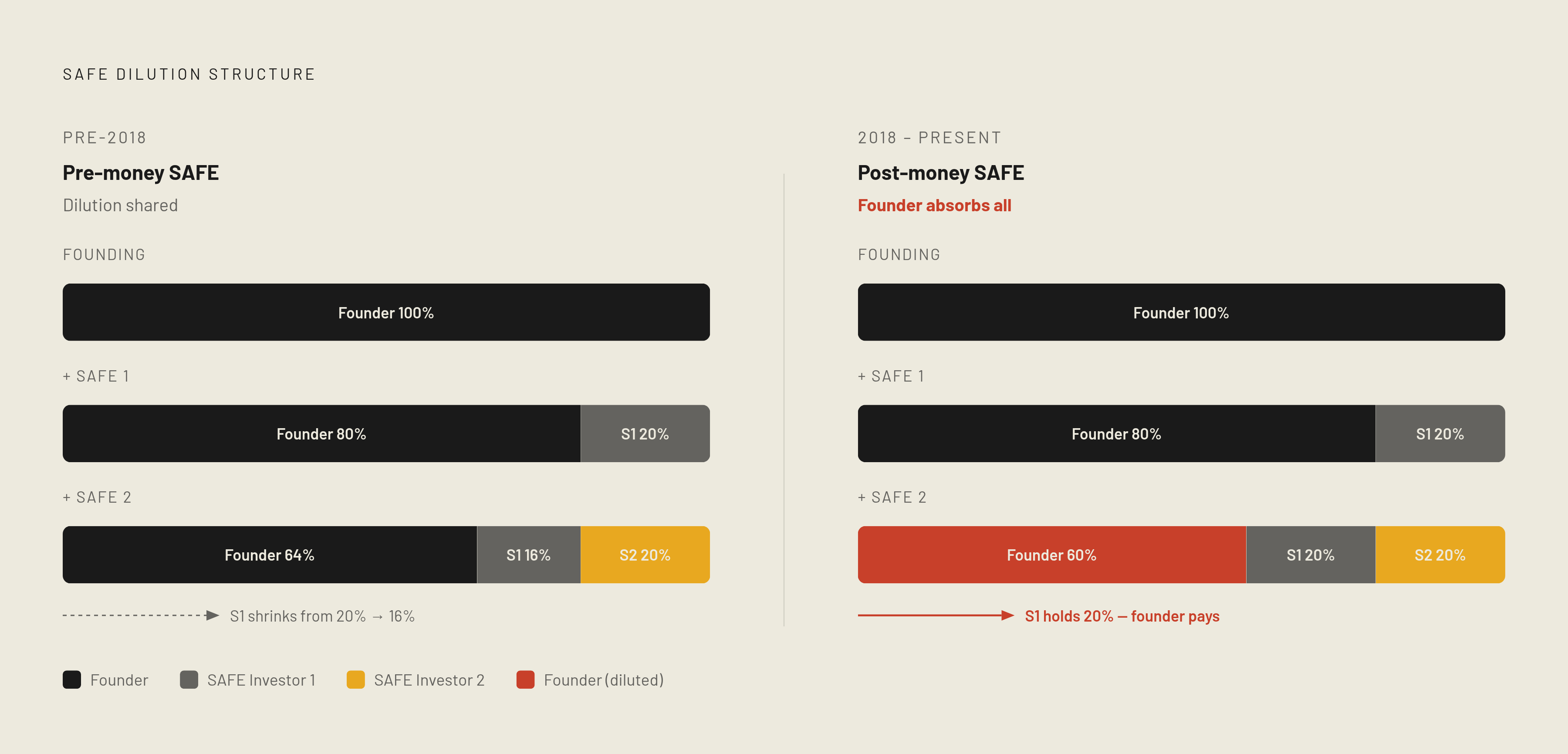
In 2018, Y Combinator replaced its original pre-money SAFE with a post-money version, changing when an investor's ownership percentage gets locked in. Under the old pre-money structure, that percentage was calculated at conversion, so every new SAFE issued afterward diluted all the existing SAFE holders together. The pain, at least, was shared. Under the post-money structure, the investor's ownership percentage is set at the moment of signing, based on the valuation after their investment, and that means every SAFE issued after it dilutes the founders alone rather than spreading the impact across earlier investors.
Post-money SAFEs are now the standard, accounting for a large majority of SAFEs signed today. That matters because a founder who finds an old blog post explaining "how SAFEs dilute everyone proportionally" is reading a description of a mechanism that no longer applies to their deal. The clarity is genuinely useful. Founders can now calculate what percentage a SAFE investor will own the moment the SAFE is signed, instead of waiting for conversion to find out. But that same clarity makes it obvious, once you look, that the founder is the one absorbing every bit of dilution from every SAFE stacked on top of the first.
That last point is the whole story of the next section: a structure where each new SAFE hits only the founder makes stacking multiple SAFEs a much riskier habit than it used to be.
Stacking multiple SAFE rounds fragments your cap table
Layering several SAFEs with different caps and discount rates ahead of a priced round builds up dilution arithmetic that stays hidden until the worst possible moment: when a new institutional investor is running due diligence on the cap table.
Each SAFE in the stack locks in its own ownership percentage for its own investor, and under the post-money structure, every new SAFE added to that stack dilutes the founders only, leaving prior SAFE holders untouched. A single SAFE with a low cap looks perfectly manageable sitting on its own. Add a second SAFE at a different cap with a 20% discount, then a third one six months after that, and the combined conversion math at Series A can leave the founder holding a stake that looks nothing like what they pictured when they signed the first document.
None of this shows up while it's happening, which is what makes it dangerous. Concerns have emerged related to unexpected dilution issues for entrepreneurs, especially where multiple SAFE investment rounds are done prior to a priced equity round. Accumulating several SAFE rounds before equity financing can fragment ownership in ways that deter Series A investors, and a messy cap table with multiple conversion events in progress is a due diligence red flag.
This risk isn't shrinking. Average seed round sizes in the NYC market have grown substantially in H1 2026. That means the dollar amounts riding on each SAFE, and the dilution stakes when they convert, are higher than they were two or three years ago. Stacking SAFEs isn't a mistake in itself. Plenty of strong companies raise several rounds of SAFEs before their first priced round, and there's nothing wrong with the tool. The mistake is signing each new one without running the combined conversion math first.
Where the "founder-friendly" label stops being accurate
SAFEs earn the founder-friendly label under specific conditions, and that label stops fitting the moment founders mistake a simple document for a simple deal.
The label holds up well in a specific case: a small round, a short timeline to the next priced round (12–18 months), and only one or two SAFEs total in the stack. In that situation, the structural advantages over a convertible note are exactly as advertised. No interest accruing, no maturity date forcing a renegotiation, no repayment obligation competing for the founder's attention while they're trying to build a product.
Where the label breaks down is when founders let that structural simplicity stand in for actually understanding the economics. WilmerHale's analysis, titled "Giving Away the Farm with SAFEs: Understanding the Alternatives and Avoiding Unnecessary Dilution," makes this point directly: letting an investor collect the more favorable of a cap or a discount can work against the founder, and that exact structure has shown up in plenty of signed agreements. SAFEs aren't risk-free for the investor either. A company that never reaches a priced round leaves the investor holding a contract that never converts into anything.
The honest version of this conversation, the one a founder would have with a peer who's already been through a seed round, doesn't treat SAFEs as either a trap or a gift. It treats them as a tool that works well under specific conditions, and the terms of each agreement either put those conditions in place or fail to. Knowing which situation applies separates diagnosis from action, and action is where the next section goes.
Negotiating and modeling a SAFE before you sign it
A founder who runs the conversion math on every SAFE scenario before signing keeps control of the outcome, while a founder who waits until Series A due diligence to look closely ends up discovering the terms instead of negotiating them.
Modeling before signing means projecting the cap table forward to an expected Series A valuation and applying each SAFE's cap and discount to that number, so the founder can see what percentage each SAFE holder receives at conversion and what stake remains for the founder once every SAFE has converted and new investor money has come in. For any SAFE that carries both a cap and a discount, that modeling has to run both scenarios separately, cap and discount, and then assume the investor converts on whichever one benefits them more, since that's almost always the cap. Skipping this step is how a founder ends up finding out their real ownership percentage from a Series A lawyer instead of from their own spreadsheet.
None of this requires exotic tools. Cap table software exists to make the projections easier to build, but the software isn't the point: the math has to get done before the signature goes on the page, not after a new investor's diligence team does it for you and hands you the result as a surprise. A SAFE rewards founders who treat it the way it deserves to be treated: a short document with long consequences, worth exactly as much scrutiny as its length tries to talk you out of giving it.