NDA Use Cases and Limits for Early-Stage Startups
NDAs protect what matters, but asking investors to sign first kills your funding chances.
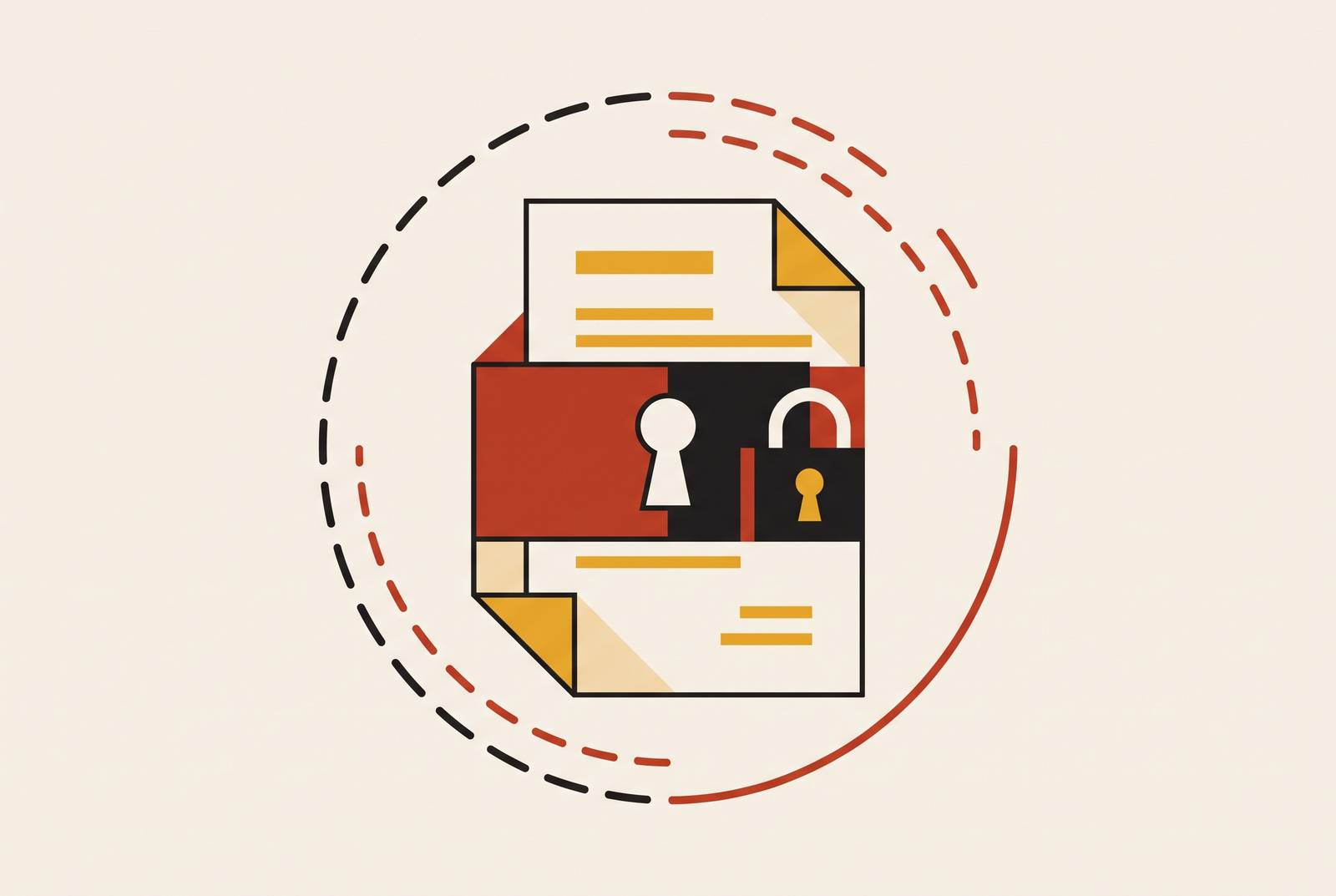
An NDA is a contract. One party promises to keep specific information confidential, and if they break that promise, the other party has legal grounds to act on it. That's the whole mechanism. It doesn't stop anyone from reading your deck, remembering your roadmap, or letting your idea rattle around their brain and quietly influence whatever they build next.
Founders who get this right protect the stuff that actually has commercial value: proprietary algorithms, AI training data, source code, financial projections, customer lists, pricing strategy, product roadmaps. Founders who get this wrong try to protect a vibe. A basic concept isn't covered. Neither is anything already public, anything that's common knowledge in the industry, or anything the founder has discussed publicly at events. Once it's out, it's out. No signature undoes that.
Enforcement is where the fantasy meets the invoice. Litigating a breach in U.S. courts can run into the tens of thousands of dollars before discovery even starts, and the founder still has to prove that specific confidential information was misused and that the misuse caused measurable damage. That's a high bar, and a slow, expensive climb to it. An NDA doesn't prevent anyone from reading, remembering, or being influenced by what was shared with them.
Two structural versions exist, and they're built for different rooms. A one-way NDA is what you'd use hiring a contractor or bringing on a vendor: you're the one exposing information, and they're the one promising to sit on it. A mutual, two-way version, where both sides exchange sensitive information, is common in later-stage deals, strategic partnerships, joint ventures, and M&A conversations.
None of this makes an NDA a strategy on its own. Founders who actually know what they're doing treat it as one layer in a bigger stack, sharp when deployed at the right moment, and actively harmful when waved around at the wrong one. Which raises an obvious question: what's the wrong moment? Turns out it's one nearly every founder tries at least once.
Asking investors to sign before a pitch
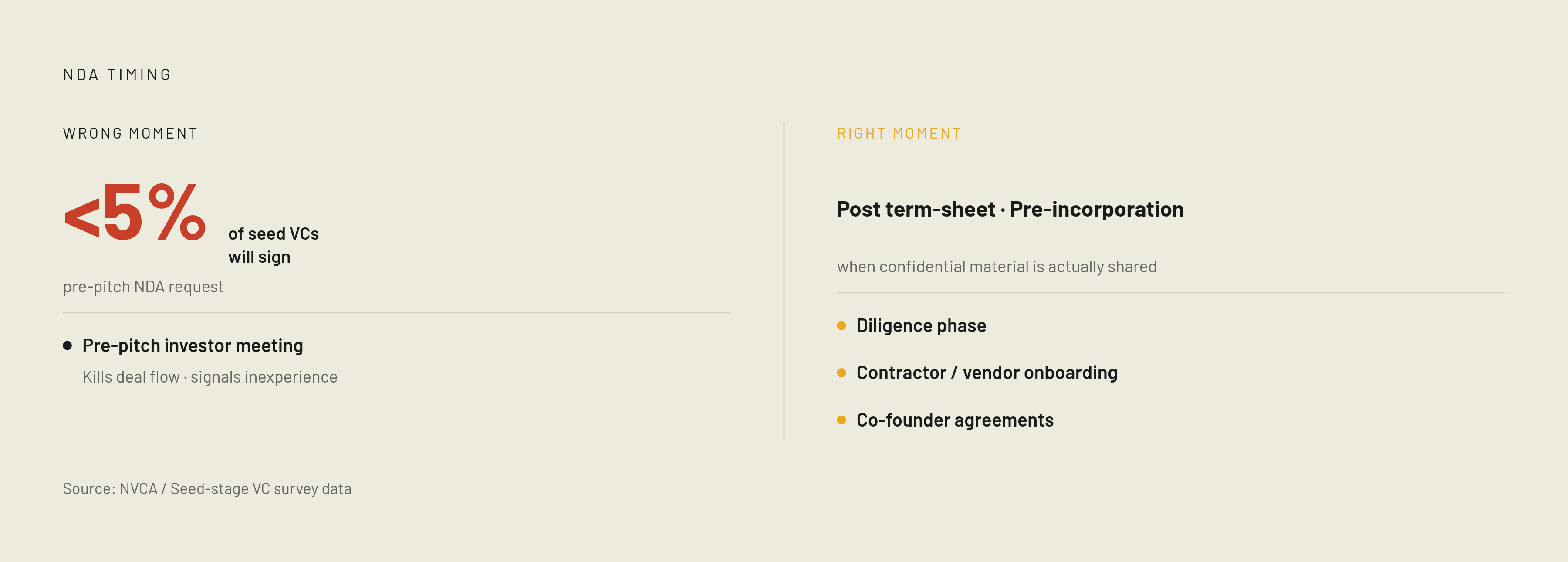
Fewer than five percent of seed-stage VCs will sign an NDA before they'll even open your deck. Pushing the issue broadcasts that you've never done this before, and the meeting quietly evaporates, which feels backwards. Handing your financials to a stranger who might be talking to three other companies doing the same thing sounds like a bad idea, and the instinct to protect yourself isn't wrong. In 2026, a startup's secret sauce is effectively its only currency, whether a proprietary AI model, a unique fintech algorithm, or a disruptive biotech process, and that's why the instinct to guard it feels so urgent. It's just aimed at the wrong tool.
The refusal isn't personal, it's structural, and it's worth understanding rather than taking as an insult. A mid-size fund might see thousands of pitches a year across overlapping verticals. Many startups are working on similar problems, and an NDA could prevent an investor from working with legitimate future portfolio companies with overlapping solutions, a problem that's especially acute for deep-tech and focused-thesis investors. Sign NDAs with every founder building in the same space, and the fund faces constant accusation risk once it invests in one. Multiplying that by hundreds of deals would need a lawyer cross-referencing agreements before every term sheet, grinding the whole pipeline to a halt. Investors want to open a deck, forward it to a partner, and get to a meeting fast. A pre-pitch NDA jams that funnel at the first step.
There's also a quieter enforcement mechanism at work: reputation. A fund that gets known for leaking decks or ripping off founder ideas stops seeing good deal flow. Word travels. That social cost does more to keep investors honest than a signature ever could.
Warm introductions from co-investors, portfolio founders, and mutual advisors are the primary currency for getting meetings in a relationship-driven ecosystem, so anything that chills early openness carries a real opportunity cost that compounds over time. Anything that makes you look difficult in those early conversations doesn't just cost you one meeting. That opportunity cost compounds over time. The clock on fundraising has also gotten longer generally, per Carta's analysis, so torching a relationship over an NDA at the pitch stage can mean waiting well over two years for a comparable shot.
The fix is staged disclosure paired with technical controls: dynamic watermarks, page-level analytics showing who viewed what and for how long, screenshot protection, links tied to a specific identity. You stay protected without asking a single investor to sign a single thing before they've even decided they like you. Save the actual NDA for later, when an investor is past a term sheet and needs to see real internals: source architecture, unpublished research, patentable processes. Save NDAs for post-term-sheet diligence and deep-tech IP reviews, where an investor needs to see actual internals to evaluate the deal, per Peony.
NDAs for contractors, vendors, and key hires
Hiring and vendor relationships are where NDAs stop being theater and start being genuinely useful. This is the section where the paperwork actually matches the risk.
Start with anyone touching your systems. Independent contractors and freelancers who get access to code, data, or strategic documents should sign one. Same for technical candidates deep enough in the hiring process to review the codebase or run a paid trial project. Strategic partners and vendors who see your roadmap, your financials, your customer data, or anything tied to a platform integration belong on the list too. So do AI and ML service providers, since a third party fine-tuning a model on your data is, functionally, a party with access to your data. Co-founders should sign something before the company is formally incorporated, or while equity splits are still being hashed out, since that's exactly the period when things get said informally and remembered selectively later.
A contractor who signs an NDA has agreed to keep quiet. They haven't agreed that the code they wrote belongs to you. Those are two separate agreements, and skipping the second one means the contractor can walk away legally owning work you paid for, even though they never breathed a word about it to anyone. Pair the NDA with an IP Assignment agreement, every time, no exceptions. IP Assignment agreements paired with contractor NDAs matter because owning the code matters as much as keeping it quiet, per DocSend.
Two more practical notes. For vendor and partner NDAs, specify which jurisdiction's laws govern the agreement: cross-border work is now standard, and this matters for enforceability. And expect a term length of two to five years, adjusted based on how sensitive the information actually is. A vendor NDA covering pricing data doesn't need the same shelf life as one covering a patentable process.
What AI tools mean for NDA language in 2026
Contractor NDAs now need a clause covering explicit AI tool usage and data sharing that didn't exist in most templates a few years back. This is a direct response to how contractors actually work now.
A contractor pastes your proprietary code into an AI coding assistant to get help debugging or refactoring, and that code travels to a third-party server. No malice involved, no intent to leak anything. The contractor is just doing their job the way everyone does their job in 2026. But your codebase has now left the building, and depending on how the original NDA was worded, nothing about that technically counts as a violation.
Founders have caught on. A small but fast-growing minority of founders have updated their NDAs to include restrictions preventing contractors from using startup data to train their own custom models. A functional AI clause needs to cover a few things: restrictions on running company data through third-party AI tools, clear ownership of any model trained on that data, accountability for data leakage through AI systems generally, and a redefinition of what "public" information even means now that AI tools can reconstruct patterns from scraps of public data that used to be harmless on their own.
Standard templates from two or three years ago simply don't have this language, because the risk didn't exist in its current form when those templates were written. A founder relying on one of those old documents isn't protected the way they think they are. The gap between "I have an NDA" and "I have an NDA that covers how my contractors actually work today" is exactly the gap that gets exploited.
What a well-drafted NDA must include to be enforceable
Vague definitions are the single most common way NDAs fail. An agreement that doesn't clearly spell out what counts as confidential information is close to unenforceable, no matter how serious it looks on the page. Courts need something specific to point to, and "business secrets" isn't specific.
A handful of elements separate a real document from a false sense of security. Legal names of both parties need to be exact, since a typo can create ambiguity about who's actually bound by the thing. Confidential information needs to be defined by category, not vibe: source code, customer lists, financial projections, algorithms, product roadmaps, named specifically. The agreement should state the purpose the information is being shared for, which limits what the receiving party is allowed to do with it. It needs to spell out the receiving party's obligations directly: no sharing with others, no using it for personal gain, access restricted to people who actually need it.
Exclusions matter just as much as inclusions. Exclusions from confidentiality include information already in the public domain, information the receiving party already knew independently, and information they got from a third party with no confidentiality obligations attached. Term length runs two to five years depending on how sensitive the material is. Governing law and jurisdiction need a clear answer, especially with cross-border contractor work now standard. Remedies should cover both injunctive relief and monetary damages, and there should be a clause requiring written consent from both parties before anything in the agreement can be changed.
The most common objection is that a template should be good enough. Sometimes it is. But plenty of generic templates carry a "residual knowledge" loophole, language that lets the receiving party retain and use anything they remember without deliberately trying to, which can leave real proprietary information unprotected after a perfectly casual technical conversation. On anything high-value, get a legal professional to review before signing. A template is a starting point. Have a legal professional review it before signing on high-value deals, since templates are a starting point, not a substitute for counsel when the stakes are material.
The limits NDAs share with every legal instrument: what they cannot replace
Not everything needs protecting, and not everything that needs protecting can get it from an NDA alone. Founders who internalize that distinction use the tool precisely. Founders who don't end up with a drawer full of signed paper and a false sense that they're covered.
An NDA can't replace judgment about who you're talking to and when. Signing one doesn't make a conversation with the wrong person safe, it just makes that conversation legally expensive to have gone wrong after the fact. It can't replace technical controls either: staged disclosure, watermarking, identity-bound links, page-level analytics all protect information before anything leaks, rather than giving you a lawsuit to file afterward.
Founders sitting on a genuinely novel algorithm, a patentable chemical process, or regulated health data are handling assets where sharing with an investor or contractor exposes something that can't be un-exposed. An NDA gives that relationship a legal obligation that no amount of goodwill or good vibes creates on its own. Deep-tech and regulated verticals are where "just share it and see what happens" turns into a real liability.
For everyone else, the bigger cost of overusing NDAs is the awkward ask itself, since what NDAs actually protect is proprietary algorithms and AI training data, source code, business plans and financial projections, customer lists, pricing strategies, and product roadmaps. It's the slow erosion of the trust that makes warm introductions happen, makes peer feedback honest, and makes the whole ecosystem worth being part of. Founders who treat every early conversation as a legal risk instead of a relationship worth building end up behind the ones who earn trust first and deploy the legal instrument precisely when it's actually needed, and in founder rooms, that second posture is the one people remember and the one that keeps the door open next time.
Sources
- The Startup Guide to NDAs: What's an NDA, why and when you need one (+ free NDA template) | DocSend
- Startup NDAs: When You Need One and When to Skip in 2026 — Peony
- Non-Disclosure Agreements (NDAs): The Ultimate Guide For Startups - Capbase
- Is That NDA Even Enforceable? Protecting Startup Ideas
- When (and When Not) to Use an NDA When Pitching Investors
- Non-Disclosure Agreements (NDAs): Everything You Need to Know | Ironclad
- The founder's guide to non-disclosure agreements | Mercury
- AI and M&A NDAs: Managing Artificial Intelligence Risks in Confidentiality Agreements - KJK | Kohrman Jackson Krantz