NYC Startup Deal Activity by Stage in the Last Twelve Months
AI concentration and a Series B gap complicate NYC's venture boom.

NYC's venture numbers for the first half of 2026 look like a victory lap. Capital raised grew dramatically, but deal volume barely moved. The money got concentrated into fewer, bigger rounds rather than spreading out to more founders. A founder skimming the headline and concluding the market is wide open is reading the wrong signal. The real story lives underneath the topline number, stage by stage, and it tells a more complicated story than "NYC is booming.
AI as the structural engine behind the surge
AI is the operating logic deciding which companies, at every single stage, get access to institutional-scale capital in NYC's portfolio mix right now.
NYC's advantage here is structural. The city's density in finance, healthcare, and enterprise gives AI companies an unusually short distance between building something and selling it to someone with a budget. That matters to investors, because investors need deployable markets, not just an impressive demo in a pitch deck.
June 2026 made this concrete. Flourish came out of stealth with a major raise backed by Jeff Bezos, Lux Capital, GV, and Catalio Capital, building brain-inspired AI out of a ten-story lab in SoHo. In the same month, General Intuition announced a large Series A led by Khosla Ventures to train action models on gameplay data. Two frontier research labs, both picking New York over anywhere else.
NYC isn't trying to out-build San Francisco on foundational model scale, and nobody serious thinks it will. What New York builds is the application layer, the infrastructure tooling, and, increasingly, the research surrounding that layer. That distinction matters to a founder planning a raise, because the AI premium investors are paying doesn't apply uniformly. It appears differently depending on whether a company is raising seed, Series A, or a growth round, and mistaking one for the other is how founders misjudge their own leverage.
Where late-stage capital goes
Late-stage deals are soaking up a disproportionate share of NYC's venture capital, and the reason is not mysterious. Investors writing nine- and ten-figure checks at this stage are paying for companies that have already proven revenue durability. AI adjacency alone doesn't get a company in the door.
June's total was the strongest single month on record for the city, and it wasn't built on one freak outlier skewing the average. It was built on depth: multiple large rounds across multiple companies, none of them so big they distorted the whole picture by themselves.
The pattern underneath those rounds is consistent: late-stage investors underwrite net revenue retention, proven revenue scale, and a market position a competitor can't easily take away, rather than chasing AI hype the way seed investors sometimes do. For founders approaching Series C and beyond, that's good news if the business is built for it: the market is genuinely strong. But the bar for entry is revenue durability, not how fast the top line is growing.
Seed and Series A: a healthier market than the headline suggests, with one important caveat
Further down the stack, the picture brightens. Seed and Series A in NYC are expanding in both volume and round size, and that combination is what makes a market functionally healthy, not just loud. But "healthy" needs a definition before any founder gets comfortable.
Series A activity was particularly strong. NYC captured a disproportionate share of all Series A capital and deal count nationally, which reflects something real: the city has become a dominant force in forming companies at the early-scale stage, not just funding them once they arrive from elsewhere.
Proxima's $86.3 million seed round in January 2026 signals something beyond its size, because of what it signals rather than just its size. AI-native teams with credible founders can still command outsized checks before they've even reached Series A. That's not the norm for every seed round in the city, but it shows a high ceiling exists.
Nationally, NYC captures roughly a fifth of early-stage dollars, a share that's actually stronger than its piece of the late-stage pie once the outsized effect of a handful of megadeals gets normalized out of the national totals. That's the encouraging half of the story. The caveat sits one stage further down the pipeline, and it's the reason seed and Series A founders shouldn't read this section as a green light to relax.
Series B: the stage where the current market structure breaks down
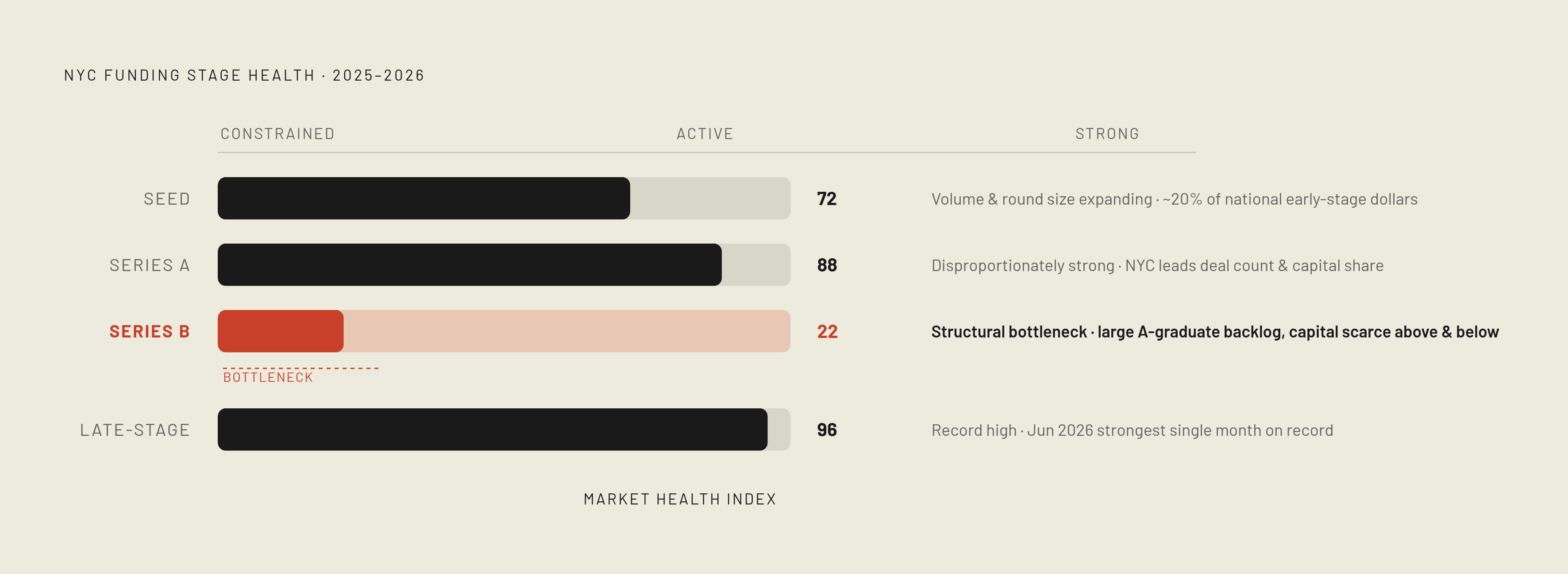
Series B is where the bifurcation becomes a real problem for real companies, not just an abstract data pattern. Capital is abundant above this stage and below it, but the bridge connecting a proven concept to a scaled business is under real pressure, and that pressure will decide which NYC companies make it through the next two years.
Series B deal count and median round size look quiet, especially set against the sheer volume of Series A companies that raised in 2024 and 2025 and will need a Series B soon. That mismatch is the predictable result of an earlier boom working its way through the pipeline on a delay.
Companies that raised at high valuations during the peak of Series A activity in 2024 face the steepest climb. They have to grow into those valuations while facing a Series B market with fewer active lead investors and tighter diligence than existed when they raised their last round.
The logic investors apply also shifts the moment a company clears Series A. Growth rate stops deciding the outcome of the conversation. A company with strong net revenue retention and improving unit economics will beat a faster-growing competitor that's bleeding customers out the back door. Most founders are still optimizing for the metric that mattered at their last raise, not the one that matters at their next one.
Flat rounds, bridge financing, and consolidation become more likely deal terms for Series A companies that haven't built net revenue retention discipline before they walk into a Series B conversation. Treating that milestone as a deadline, not a target to hit eventually, is the difference between controlling the timeline and having it control you.
How the most active investors are deploying capital
Watching where the most active investors are actually writing checks tells a cleaner story than any aggregate number can. Early-stage volume is getting served. Late-stage conviction is getting served. The middle stage has fewer active hands navigating it, and that scarcity is itself information.
Y Combinator's decision to host in-person interviews in New York specifically for fintech and crypto founders is a structural signal, not a one-off event calendar item. It points to NYC's growing weight in those verticals specifically, and it suggests more programs built around the city's strengths rather than treating it as a satellite of some other, larger tech hub.
The investor mix changes shape as companies move up the stack. At seed and Series A, NYC-native funds and accelerators do most of the work. At late stage, platform funds with national mandates take over. That shift matters practically: the relationship infrastructure that gets a seed founder a meeting is not the same infrastructure that moves a Series B term sheet forward.
The investor who led a company's seed round may not have the network, the check size, or the mandate to lead its Series B. Building the relationships that will matter at the next stage has to start well before that round is actually being raised.
Why NYC's monthly swings are not ecosystem signals
The single most useful correction for anyone reading monthly NYC funding reports: a swing in capital share from one month to the next reflects megadeal timing, not a change in the underlying health of the ecosystem at any particular stage.
NYC captured 24.4% of all U.S. venture dollars in June 2026, up from a low single-digit share in May. A jump that large in thirty days is the statistical footprint of a cluster of large rounds happening to close in the same month, not a sign of sudden momentum. The reverse is equally misleading: months when NYC's national share compresses usually reflect megadeals concentrated in defense technology, clean energy, or AI infrastructure at companies headquartered elsewhere, not any retreat in NYC's own activity.
For seed and Series A founders, the monthly number carries almost no information. The conditions that actually matter (investor appetite, sector focus, typical round sizes) move on a quarterly or annual rhythm, not a monthly one. The honest read of the market right now: seed and Series A are functional and improving, Series B is structurally strained, and late-stage is historically strong for companies with proven revenue. None of those three facts flips because one month's national share ticked up or down.
What this market structure means for NYC founders
The bifurcated market described above rewards founders who know which rules apply to their current stage and who start building toward the next stage's criteria before they're sitting across the table trying to raise it.
Seed founders are working a receptive market. Round sizes are rising, and NYC is capturing a disproportionate share of early-stage capital nationally. The cohort of companies raising seed money right now will compete for the same Series A leads as a similarly large cohort that raised in 2025. Differentiation has to happen in the first year of actually building the product, not in the Series A pitch meeting.
Series A founders are benefiting from a real and disproportionate NYC advantage at this stage. But the path to Series B runs through durability metrics, net revenue retention and unit economics, not top-line velocity. Growth rate is the story that wins Series A. Durability is the story that wins Series B. Making that transition has to happen before the raise starts, not mid-process when a term sheet is already on the table.
Series B founders are facing the most demanding stage in the market right now. Treating product and revenue milestones as deadlines, not loose targets, and walking into the Series B conversation with net revenue retention already demonstrated, is what separates a competitive process from a grinding one.
Late-stage founders are operating in a market that's genuinely strong for companies with proven revenue models in AI, fintech, and health. Institutional investors are writing large checks with real conviction, and NYC's density in enterprise and finance means the customers who validate those revenue models are often sitting a subway ride away.
Across every stage, the advantage NYC actually offers is proximity: to customers, to investors, and to other founders who have already navigated the exact transition a given company is facing. Founders who use that proximity deliberately, through relationships that last longer than a single Slack thread, see the market more clearly than founders relying on quarterly reports alone. A founder who hears from a peer, in person, that Series B diligence has quietly shifted toward net revenue retention has six months of runway to act on that information. A founder who reads it in a funding report after the fact is already behind.