Equity Dilution in Startup Funding Rounds
Founder ownership shrinks faster than most realize, dropping to 23% by Series B.

What each stage costs in ownership, round by round
Dilution is a series of haircuts. It's a series of them, and each one changes how the next one gets calculated. Most founders walk into a raise thinking about a single number: "I'm giving up 20% this round." That framing treats every raise like its own closed transaction. The real math is cumulative: the terms from one round bleed into the next round's option pool, the next round's conversion price, the next round's board seat allocation. By the time Series B closes, a founder can stare at the cap table and genuinely wonder where the company went.
The mechanics themselves are simple, even if the outcome doesn't feel that way. Say founders hold 8,000,000 shares out of 10,000,000 total, that's 80%. Issue 2,500,000 new Series A shares, and those same 8,000,000 shares now represent 64% of the company. Nobody sold anything. Nobody transferred a share. The denominator just got bigger. Dilution happens because more shares now exist than existed yesterday, not because of anything you did wrong.
None of this makes dilution bad. Every round buys something: capital, credibility, a board member who's done this before. The real question isn't whether to dilute, it's whether what got bought was worth the percentage points it cost. And because percentage points also translate into votes, board seats, and control over the next financing decision, this runs deeper than economics. It's a governance question too, and here's the arc from pre-seed to Series B, laid out round by round, so the compounding becomes visible in the cap table before the term sheet lands on the table instead of after.
Pre-seed rounds in the first half of 2025 carried a median valuation around $3.95 million, drawn from a sample of more than 3,000 startup valuations. It's the cheapest round percentage-wise, but founders negotiate it with the least leverage, since there's usually no product and no revenue to point to yet.
Seed rounds in 2025 landed in the mid-single-digit millions, with median dilution around 19%. Founding teams typically hold onto about 56% of the company after the round closes. Still a majority, still enough to make every meaningful call. It's also the last round where that's guaranteed.
Series A is where the math turns. Carta's 2025 data puts the median dilution at 17.9%, down from 20.9% the year before. Founder ownership drops to roughly 36% at this point, meaning outside investors now collectively own about half the company. Half. That's the round where "founder-controlled" starts requiring an asterisk next to it.
Series B eases the per-round hit slightly, dilution runs around 13-14%, but the cumulative damage is already done. Founder ownership falls to roughly 23% median, with external investors holding close to 61.6% of the company. And close to 10% of startups sell more than 30% of the company in a single round. That's a structural problem: it leaves no room to dilute further without founders dropping into minority-owner territory well before the company's earned that outcome. Valuation, leverage, sector, and how well someone negotiates all move the number meaningfully. Valuation, leverage, sector, and how well someone negotiates all move the number meaningfully.
How the cumulative ownership loss accelerates across rounds
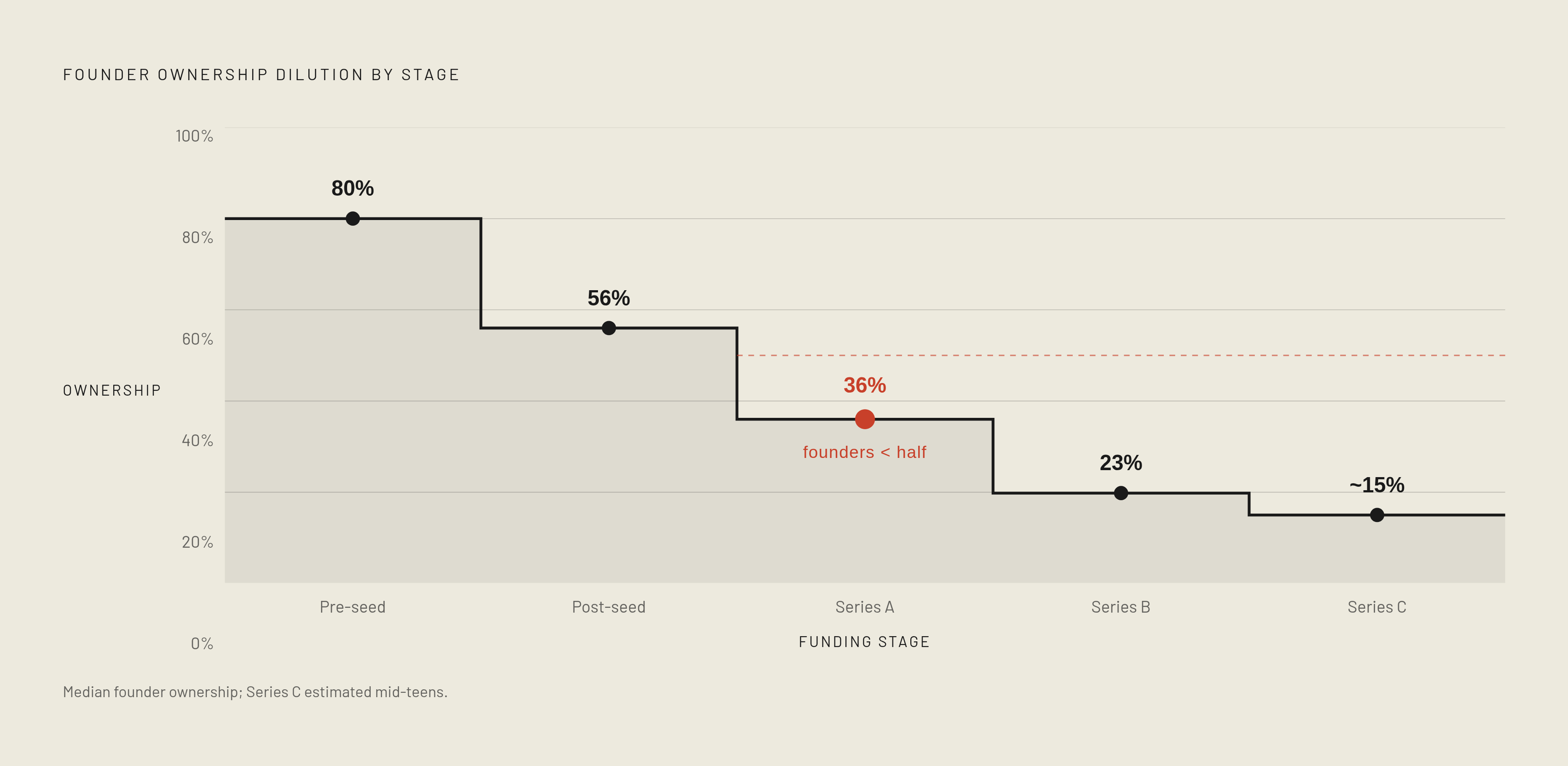
Lining the rounds up shows a trajectory that reads like a slow leak that turns into a fast one. Pre-seed: founders hold the large majority of the company. Following the seed round, founders hold about 56%. After Series A: about 36%, so more than half the company already belongs to somebody else. After Series B: roughly 23% median, with outside investors controlling about 61.6%.
By Series C, median founder ownership drops below the size of the employee option pool. Founders end up owning less of the company, in percentage terms, than the pool set aside for the people they hired. That crossover happens in the mid-teens as a share of fully diluted stock, and it's not a warning sign so much as a permanent feature of how later-stage cap tables get built.
Employees aren't a rounding error in this story either. Startups typically allocate close to 11.8% of equity to employees at the seed stage, and that pool grows substantially by the time later rounds close. The dilution splits a shrinking pie three ways: investors, employees, and whatever's left for the people who started the thing. It's founders splitting a shrinking pie three ways: investors, employees, and whatever's left for the people who started the thing.
Governance dilutes in lockstep with economics, and this part gets less attention than it should. A seed-stage board is usually three people, two founders and one investor, so founders control the room. By Series A, boards commonly expand to include founder, investor, and independent seats, with the independent seat acting as the swing vote that can move contested decisions out of founder hands even when founders hold multiple seats.
Then there's the liquidation waterfall, the part of the cap table nobody thinks about until an exit forces the question. By Series C, three separate preferred stock classes can be stacked on top of each other, each with its own payout priority. In a modest exit, one that doesn't clear all those preference stacks, common shareholders (founders, in plain terms) can walk away with nothing, even after years of building the thing. The compounding happens whether anyone's tracking it or not. The only real choice founders have is whether they're making that trade deliberately, round by round, or finding out what they signed up for at the exit, when it's too late to renegotiate any of it.
Where SAFEs and convertible notes hide the dilution until it's too late to negotiate
SeedForge's analysis of Carta data shows SAFEs now show up in roughly 90% of US pre-seed rounds. For most founders, a SAFE is the first funding instrument they'll ever sign, and it's built around a comforting idea: skip the valuation argument now, figure out the percentage later once a priced round sets the price.
That relief is also the trap. Postponing the ownership math doesn't shrink the dilution, it just delays when it appears on the cap table. Multiple SAFEs then convert all at once, right when the Series A term sheet is already sitting on the table with no room left to renegotiate anything.
Picture three SAFEs raised over 12 to 18 months, each at a different valuation cap. All three sit quietly, undiluted on paper, until the priced round closes, and then they convert simultaneously. The lower the cap on any given SAFE, the more shares that investor gets, and the more dilution founders absorb on conversion. Stacking three or four of these together can push the combined conversion dilution to run 15-25%, on top of whatever the Series A round itself costs. Founders who thought they were raising "just a little bit" across a handful of SAFEs sometimes find out at Series A that the stack cost more than one clean priced round would have.
Convertible notes carry their own quiet compounding: accrued interest. A $200,000 note at 6% sitting for two years converts as $224,720, not $200,000, and that extra $24,720 becomes shares at a price that favors the investor. Multiplying that across three or four notes with different rates and different start dates produces an effect that adds up in ways that are easy to underestimate until the conversion table actually gets built.
The fix here is structural. The structure of each SAFE determines when the ownership math becomes visible, and founders should understand how each instrument calculates conversion before signing, pushing for whichever structure makes dilution clearest at signing rather than at the priced round. More importantly, model every SAFE and note conversion into the Series A cap table before signing anything, not after the lead investor is already sitting across the table with a term sheet in hand.
The option pool shuffle: how a "neutral" term sheet item transfers dilution onto founders
Somewhere in every term sheet sits a line about the option pool, and it reads like an administrative detail. It reads that way, but it isn't an administrative detail: it determines who bears the cost of the option pool. Investors typically require the pool to be created or expanded before the round closes. As a result, it gets counted in the pre-money capitalization, before the new investor's money is even in the door.
The effect: founders absorb 100% of the dilution from that pool expansion, while the incoming investor ends up paying less per share for the same ownership stake. A term sheet with a lower stated pre-money valuation but a smaller mandatory pool can produce a better outcome for founders than a flashier, higher pre-money number paired with a bigger pool requirement. The headline number lies if nobody checks what's baked into it.
Standard Series A term sheets typically require a meaningful option pool as a share of the post-money fully diluted share count. Industry data suggests the median pool available for employee grants at Series A typically falls in the low double digits as a share of fully diluted shares. That's before pool refreshes even enter the picture: fast-scaling companies top up the pool at nearly every major round, layering additional dilution on top of whatever the round's headline percentage already says.
Founders aren't powerless here. A detailed 12 to 18 month hiring plan, with real headcount numbers instead of a vague growth story, gives founders concrete grounds to argue for a smaller pool. Investors build in a large buffer because they're guessing at future headcount. Replacing the guess with a model shrinks the buffer. Every item in a term sheet that looks like paperwork, pool timing, pool size, where it sits in the cap table, is actually a decision about who bears the cost of future hiring. Ask who that clause protects before signing it, not after.
Anti-dilution provisions protect investors, not founders, and what actually protects founders
Founders hear "anti-dilution provision" and assume it protects their stake. It doesn't, and that misunderstanding costs people real ownership. Anti-dilution provisions exist to protect preferred shareholders, meaning investors, against down rounds. They apply to investor shares. Founder common stock isn't covered by them.
Two formulas dominate how this plays out. Full ratchet resets the investor's conversion price to match the lowest price of any later round, which can meaningfully increase how many shares that investor ends up with. It's rare in practice because it scares off future investors who don't want to prop up an earlier investor's position. Broad-based weighted average is the market standard as of 2026: earlier investors get extra shares to offset a lower price in a down round, softening the blow for them, while the added shares dilute everyone else, founders included.
So when a down round hits, preferred shareholders receive additional shares as compensation for the lower price, and founders eat that dilution a second time, on top of whatever the round's headline percentage already cost them. Down rounds themselves are getting rarer (Carta data puts them at under 14% of all new financings), but the bar for avoiding one keeps climbing. Flat or down outcomes stay on the table for any company that can't show growth that compounds.
Real founder protection looks nothing like what the term sheet assumes it covers. Pre-emption rights let founders, or early investors, invest in future rounds to hold their percentage steady. Vesting structures that keep shares intact through the early rounds determine how much of the company founders still control by the time later rounds hit. Setting a valuation that's defensible rather than a vanity number avoids manufacturing a down round nobody wants later. And weighted-average anti-dilution protection can, in some cases, get negotiated for founder shares directly. Uncommon at seed and Series A, but not off the table for someone willing to ask.
Context shapes all of this too. The founder-friendly peak of 2021 saw a lot of these protective provisions waived entirely, because capital was cheap and investors were competing for deals. The 2026 landscape has swung back toward more balanced terms, and founders raising today aren't negotiating in the same environment as founders who raised at the top of that cycle.
How sector, geography, and company type shift these numbers in practice
Medians are a starting point, not a verdict, and the gap between sectors is wide enough to matter. Capital-intensive industries, biotech, hardware, tend to see higher dilution per round, simply because R&D and manufacturing costs demand bigger raises relative to whatever milestone the company's trying to hit. Software-driven companies, SaaS, fintech, need less capital to reach the same milestones, and founder ownership medians skew higher as a result, since those companies make up a large share of the sample those medians get built from.
AI companies are their own case, and a lopsided one. Carta and CRV data show Series A valuations for AI startups have run significantly higher than for non-AI companies, which structurally reduces dilution for AI founders who can show real traction, since a higher valuation means fewer shares need to change hands for the same dollar amount raised. Infrastructure and compute costs eat capital fast, though, which can push AI founders back into the market sooner than planned, undercutting some of that valuation advantage before it has time to compound.
Geography moves the number just as much. US pre-seed dilution runs around 19.69%, the most founder-favorable rate globally. Europe sits higher, around 21% median at pre-seed. Emerging markets tend to run higher still where investors typically demand a larger stake for the same capital. One major metro hub has had a particularly strong run lately: a substantial jump in deal volume and capital raised year-over-year and the strongest second quarter that city's venture market has recorded. First-half 2026 totals have tracked meaningfully ahead of the same period in 2025. A founder raising in that city right now is negotiating in a meaningfully different market than one raising there two years ago.
Team structure moves the math as well. Solo founders made up more than a third of US business incorporations in 2024, but they're a distinct minority among VC-backed companies, and fundraising math is harder without a co-founder in the room to split the pitch, the diligence calls, and the negotiating table. None of these benchmarks are ceilings. Founders with real traction in a hot sector, or raising in an active market, have genuine room to negotiate below the median dilution numbers. The medians describe what happens on average, not what has to happen to any one company.
The dilution management practices that experienced founders use
Prevention beats repair, and nowhere is that truer than an inverted cap table, one where founders hold so little that the company becomes structurally hard to invest in. Investors reviewing a cap table in that condition tend to call the company essentially uninvestable, unless a new lead is willing to restructure the entire equity table from scratch. That's a rescue operation, and it's far easier to avoid than to fix after the fact.
Round discipline determines how much dilution a founder absorbs and how much control they retain over future financing decisions. Raise enough to fund sufficient runway toward the next real milestone, not more, since extra capital at any given stage compounds dilution without buying proportional progress. Treat seed dilution as a discipline benchmark, keeping it in line with market medians, and model the cumulative dilution across all prior rounds before agreeing to the next one, not just the headline percentage sitting in front of you. Start Series A conversations with 9-12 months of runway left, so the negotiation happens from strength instead of urgency. Carta's 2024 data puts the median time from seed to Series A at around 774 days, far longer than the 18-month timeline a lot of founders still carry around in their heads.
Instrument discipline runs alongside it. Understand how each SAFE structure calculates dilution and negotiate for whichever makes your ownership math transparent at signing until the round actually closes, and model every SAFE conversion into the cap table before signing a priced round's term sheet, not after.
Option pool discipline closes the loop. Push for the pool expansion to come from the post-money capitalization rather than the pre-money, and bring a real 12 to 18 month hiring plan to justify a smaller pool than what typically gets requested. Check the number against current benchmarks too, since a pool sized off an outdated assumption tends to run too large by default, and too large always favors the other side of the table.
None of this eliminates dilution. Dilution is the price of other people's money, and there's no version of fundraising that skips paying it. But the founders who come out the other side of Series B still holding a meaningful stake and a meaningful vote are the ones who treated every round as connected to the next one. Not the ones who signed what was in front of them and hoped the math would sort itself out later.