Which Documents NYC Series A Investors Request First
Investors request documents in stages, starting with a pitch deck and cap table snapshot.

NYC Series A investors ask for documents in stages, starting with a pitch deck, a cap table snapshot, and high-level financial metrics before they move into formal diligence. Founders who prepare in that order, while fixing deeper record gaps before fundraising begins, can keep their deals moving. The task is to have the right evidence ready when conviction turns into verification.
Why Series A investors don't hand you a document list on day one
Investors need a reason to investigate before they need every record the company has ever produced. The first requests help them decide whether the business is worth a deeper look, while formal diligence tests whether its claims hold up. Those are different jobs, with different paperwork. Asking for everything immediately would bog down the process before an investor had formed enough conviction to pursue the deal.
The eventual review is intensive, extending to a Stock Purchase Agreement of substantial length. But its scope does not make every document equally urgent at the outset. Founders who treat fundraising as a simultaneous document dump can spend preparation time on the wrong things. The useful distinction is between when records must be ready and when investors request them. Having the full set assembled before signing a term sheet can shorten legal diligence without turning the first meeting into a filing-cabinet inspection.
The pre-term-sheet ask: what investors request before they commit to anything
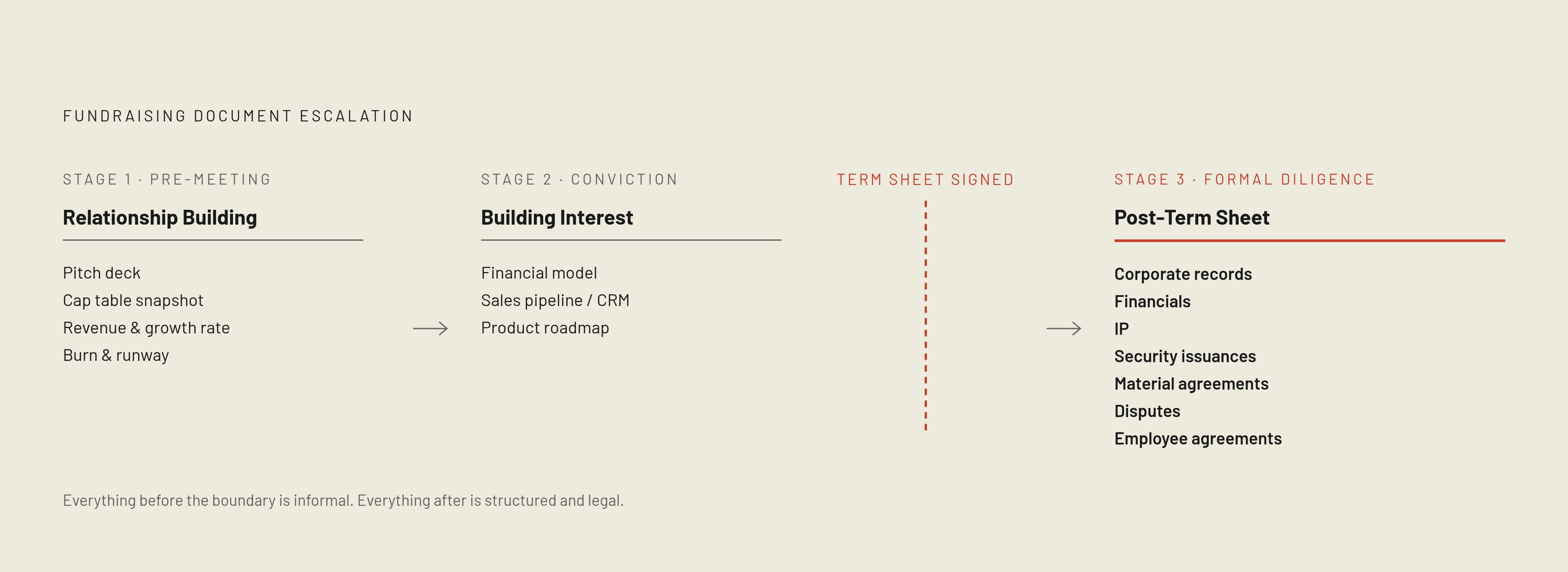
The first requests are usually informal, arriving during the relationship-building phase. Almost universally, investors ask for the pitch deck, a cap table snapshot, and high-level financial metrics, including revenue, growth rate, burn, and runway. This is the first tier of preparation. These materials let an investor assess the business, its ownership, and its financial position before committing to a more extensive review.
An investor may also request the financial model, a view of the sales pipeline or CRM, and the product roadmap. The purpose is still to build conviction. At this stage, investors are learning whether the company can explain its plans through records. Speed, completeness, and consistency shape the investor’s view of operational maturity.
The way those materials are organized sends its own message. Richard Dulude, Co-Founder and Partner at Underscore VC, puts it plainly. “I assume you run your company like you run your deal room”.
What the formal diligence list covers, and why it arrives in seven categories
Once a term sheet is signed, the requests become a structured review of distinct risks. Y Combinator’s Series A diligence checklist, compiled by Jason Kwon, formerly General Counsel of YC Continuity after involvement in hundreds of financings, provides a reference for that review. The document universe spans seven areas, including employee agreements. Each addresses a different potential weakness in the deal. Strength in one area does not cancel a problem elsewhere.
Corporate records and charter documents make up the company’s formal record. They include directors’ and stockholders’ meeting minutes, written consents, the Certificate of Incorporation, Certificates of Designation, and Bylaws. A corporate organizational chart is relevant where parents or subsidiaries exist. The business plan and financial records include GAAP financial statements for the past two to three years, recent monthly management accounts, and bank statements. They also include a financial model with three to five years of projections and assumptions, a fully diluted cap table, and burn rate and runway analysis.
Intellectual property records show what the company owns. They include trademarks, patents, copyrights, and domain names, with filing or registration documents, plus IP assignments from founders, prior employers, or contractors. Security issuances and cap table records show more detail about who owns what. Investors request stockholder issuance dates and original prices, option grant dates and exercise prices, and agreements governing options, warrants, and conversion rights. Vesting schedules, acceleration provisions, and evidence of federal and state exemption compliance, including Rule 701, belong here too.
Material agreements cover customer terms, contracts above a material threshold, leases, debt instruments, mortgages, encumbrances, insurance, and partnership, joint venture, and consulting agreements. They also include agreements requiring third-party consent to the financing. For disputes and potential litigation, the list includes pending or threatened actions, regulatory investigations, correspondence about alleged IP infringement, and labor disputes or union actions. Employee agreements complete the map of records. The checklist is broader than at seed, reaching product, sales and marketing, unit economics, and formal legal documents, and typically arrives as a PDF.
Where the process actually gets stuck: the three document gaps that kill Series A deals
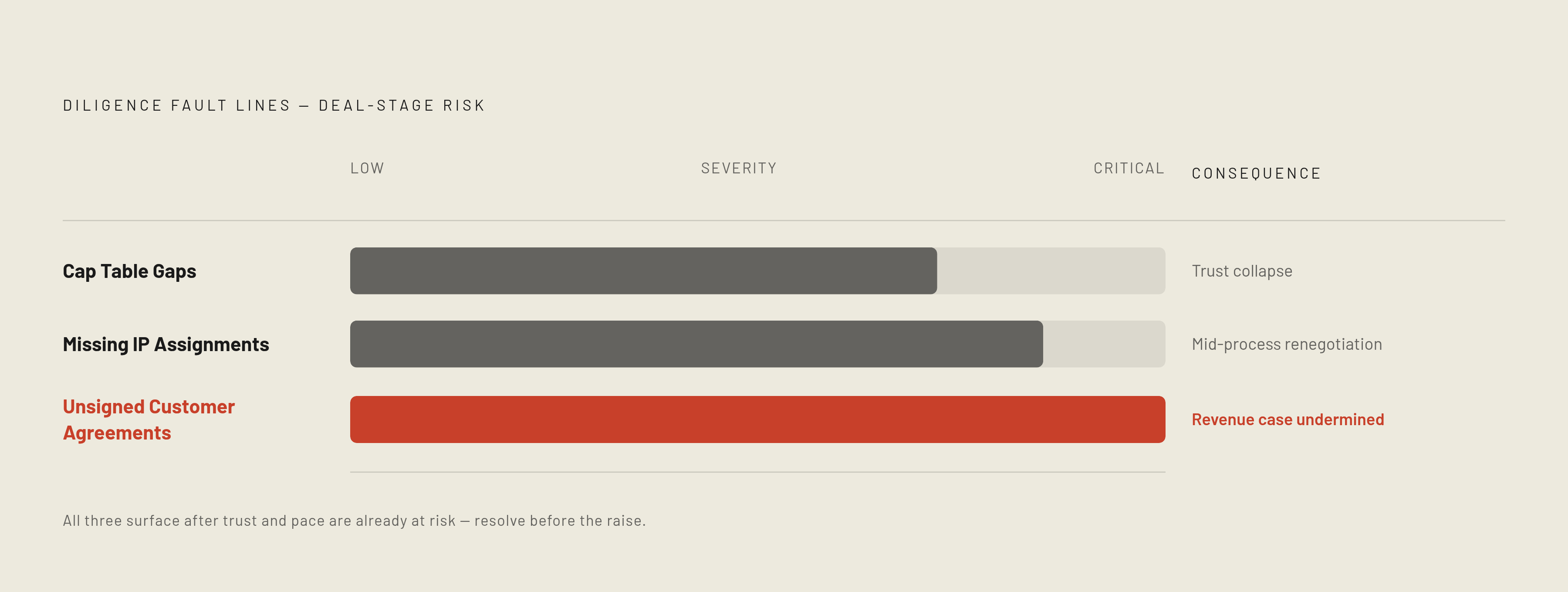
The dangerous gaps sit in ownership, intellectual property, and customer agreements, where a missing or inconsistent record can undermine something central to the investment. Those gaps can hurt even a business that investors want to back. Once they come to light during diligence, the founder must fix them while the investor’s trust and the deal’s pace are already at risk.
The cap table is the first fault line. The ownership picture has to account for equity, SAFEs, convertible notes, options, and warrants. The recommended preparation includes an audit against Delaware filings. This is where neatness and accuracy part company. A clean-looking spreadsheet is not a substitute for resolving the records behind it.
Missing IP assignments leave another question about who owns what. Code must belong to the company. If a co-founder wrote code before incorporation and never formally assigned the IP, the issue can require renegotiation or a legal remedy mid-process. Customer agreements leave the third gap when revenue depends on promises made in conversation that have yet to be formalized in signed contracts. A strong relationship cannot serve as the document investors need to verify the revenue.
Financial projections with formulas that do not tie out are a subtler warning, suggesting that the model was built for the pitch. Clearview Growth Advisory says that founders who prepare three to six months ahead close faster, get better terms, and avoid surprises that can kill a deal. Fixes can require weeks of legal or accounting work. Finding them before the raise preserves a stronger negotiating position.
How the financial documents get scrutinized, and what investors are actually testing
Financial diligence checks whether the company’s records agree with one another. Investors are not simply asking whether the revenue number looks attractive or whether the forecast rises sharply enough. They want the documents to tell a coherent story. That is why financials generate so much scrutiny, and why a polished model alone cannot settle the questions.
Investors cross-check income statement revenue against bank statements, and even a minor discrepancy can trigger follow-up questions. For SaaS companies, revenue recognition adds another layer. Monthly and annual contracts, professional services, and deferred revenue affect how and when revenue is booked. The reported ARR’s comparability to benchmark expectations depends in part on this treatment. The label on the number is not enough.
The same consistency test applies to projections. Strong growth with no additional headcount or marketing spend raises questions about whether the model was built backward from a desired result. Optimism is not the main issue here. Investors are testing whether the assumptions support one another.
Hidden liabilities introduce a more serious concern because they undermine disclosure as well as the financial picture. Undisclosed debts, pending tax obligations, and unrecorded commitments can kill deals. These are not simply adjustments to a spreadsheet. They change what the investor understands about the company’s obligations and whether the information supplied is complete.
What NYC Series A investors specifically want to see, and how the bar differs from other markets
NYC’s Series A expectations put a stronger emphasis on revenue already in hand and enterprise and B2B metrics. Local firms ask about the sales process, customer acquisition cost, and gross margins because user growth alone does not make the case for the business. The emphasis is on documented commercial traction. Those questions guide which financial and customer records investors look at early.
That emphasis does not mean NYC necessarily demands a higher revenue figure than San Francisco. The local revenue expectation is meaningfully lower in absolute terms, while the expectation of revenue already in hand remains firm. These are different dimensions of the bar. One concerns how much revenue the company has, while the other concerns the evidence behind its commercial progress. Neither makes one market universally easier.
Signed customer contracts are particularly important in that context. NYC Series A investors want signed customer agreements, with that requirement more strictly enforced than among earlier-stage West Coast investors. The stage distinction is important to the comparison. For a founder raising in NYC, the customer-document gap is therefore not merely a legal housekeeping issue. It sits directly beneath the revenue case the investor is evaluating.
How the introduction you get — before any document is requested — shapes what comes after
Before an investor asks for the pitch deck, the introduction often decides whether a conversation starts. Cold outreach is structurally disadvantaged compared with introductions from portfolio founders, angels in the investor’s network, or funds that passed but still respect the company. The sender changes how the message lands. An introduction from someone the investor trusts can reduce skepticism before the founder presents a single metric.
That introduction signals something about founder judgment and network quality. A peer who has sat across the table from the same investor can speak to the founder’s integrity as well as the company’s performance. This is a concrete benefit of peer relationships. The introduction can establish the trust needed to get financial or legal verification started.
NYC’s density makes such relationships more achievable than in dispersed markets. The same investors, founders, and operators recur across deals, dinners, and events, allowing familiarity to develop over time. Proximity alone is not the useful part. Relationships built at a real table can produce an introduction with substance. The first piece of fundraising evidence may therefore be someone else’s credible judgment of the founder.
The preparation timeline that lets founders control the pace of their own deal
The lesson for founders is to resolve the slow problems before the investor starts the clock. Three to six months before fundraising, the recommended work is to audit the cap table against Delaware filings and collect signed IP assignments from every founder, early employee, and contractor. Verbal customer agreements should become signed contracts. This is also the time to clean up GAAP financials and make sure the model’s formulas tie out.
One to three months before fundraising, preparation shifts to the data room. Its folder structure should follow the seven category areas, with the contents assembled before the first investor meeting. The first meeting still calls for a smaller package. The pitch deck, cap table snapshot, and high-level financial metrics should be ready to share immediately, while the deeper records wait for the corresponding requests. Complete preparation does not require indiscriminate distribution.
After the term sheet, founders who have done that work can spend diligence answering questions. Kruze Consulting recommends using the checklist as a monthly or quarterly operating tool, so the records reflect the business before fundraising begins. A resolved cap table, signed IP assignments, and a clean data room demonstrate the operational maturity Series A investors are trying to evaluate. The paperwork is part of the proof.